
On this page
Start here
Quick answer
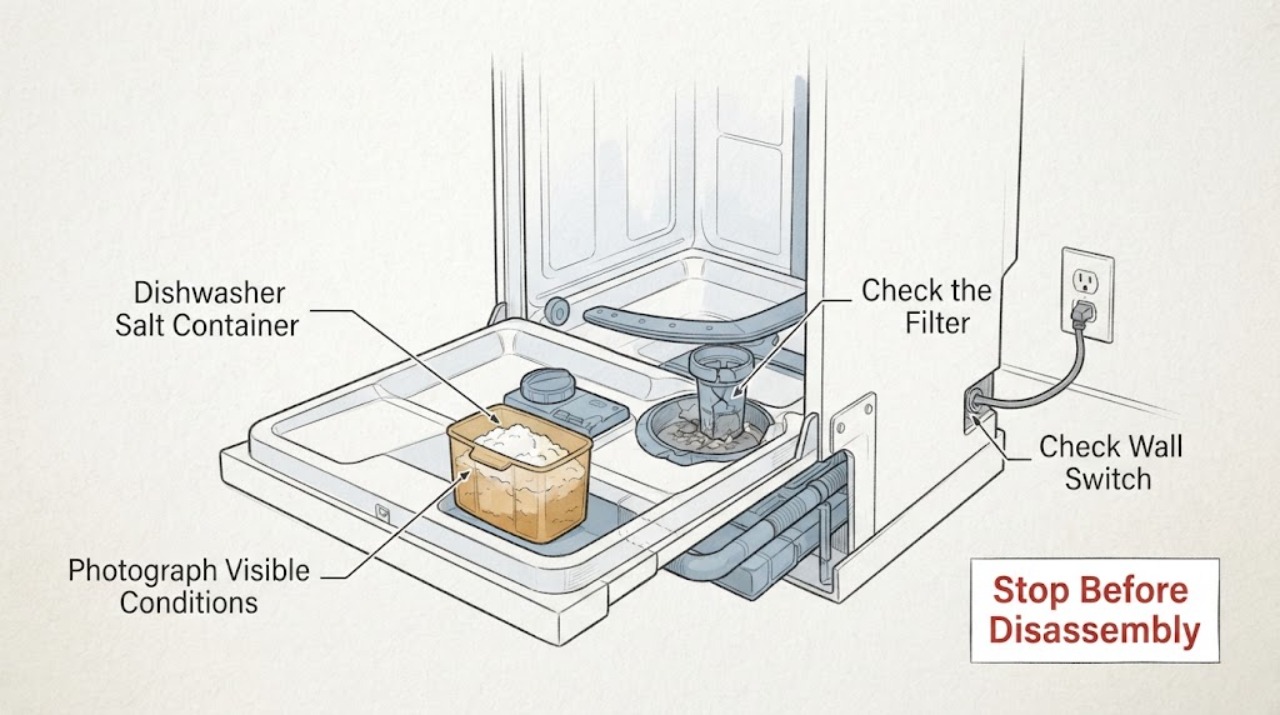
If dishwashing powder went into a Neff dishwasher's salt container, stop before starting another programme and do not assume the filter is broken. Neff's official instructions state that detergent may damage the water-softening system and that the salt dispenser is for special dishwasher salt only. Keep the container closed, do not add vinegar, cleaner, extra salt, or other chemicals to dilute the powder, and identify the appliance's E-Nr so the exact manual or Neff service team can specify the recovery step. If a cycle has already run, report that fact, how much powder was added, and any salt warning, residue, leak, or unusual result; do not keep running cycles to test it.
Work through in order
Diagnostic checks
Use only checks that match the exact appliance or system and its official guide.
-
Check 1
Stop the dishwasher before another programme starts. If it is currently running and there is no immediate electrical or water danger, use only the normal user control to stop or pause it; otherwise switch it off from a safe position. Do not open a hot or pressurised appliance just to inspect the salt container.
Expected result: No programme has run since the powder was added, or the powder has already been exposed to water during one or more programmes.
Next step: Leave the appliance unused while you identify the exact E-Nr and obtain model-specific Neff guidance. If a programme already ran, record the number of cycles and report it rather than trying repeated rinses.
Stop if: Do not add salt, vinegar, descaler, cleaner, water, or another chemical to the salt container as a home dilution attempt.
Why this matters
Why: A dry, unused misfill is a different recovery situation from detergent that has dissolved into the salt path. Neff warns that detergent may damage the water-softening system, so continued cycles can increase uncertainty and exposure.
-
Check 2
Read and photograph the complete Neff E-Nr from the rating plate, and record the region, the product placed in the salt container, an approximate amount, whether it was powder or a tablet, and whether the appliance has been run since.
Expected result: The complete E-Nr and incident details are available, or the model information cannot be read.
Next step: Use the exact E-Nr to open the Neff manual or contact Neff support. If the rating plate cannot be read, arrange assistance rather than applying instructions from a different model.
Stop if: Do not remove panels or pull an integrated dishwasher out of its cabinet solely to search for the rating plate.
Why this matters
Why: Neff's support system uses model identity and directs owners to the manual specific to the appliance. Without the E-Nr, a safe recovery sequence, dispenser design, and permitted user-level steps cannot be selected reliably.
-
Check 3
With the appliance off and cool, inspect only the accessible salt-container cap, filler opening, surrounding tub, and visible filter area for powder residue, a cracked or cross-threaded cap, standing water, leaks, or obvious damage. Do not dismantle the salt system or filter housing.
Expected result: The cap is intact and the area is dry, or there is visible residue mixed with water, a damaged cap, a leak, or a part that will not seat.
Next step: Photograph the condition and provide it with the E-Nr to Neff support or a qualified technician. Keep the appliance unused if the cap is damaged, the salt path is wet with detergent, or a leak is present.
Stop if: Do not scrape deep into the opening, vacuum or blow powder into the machine, use a tool to break up material, or remove internal panels.
Why this matters
Why: A clean external appearance does not show whether detergent reached the water-softening medium. Water, damage, or a cap that cannot seal raises the need for exact-model service and should not be corrected by forcing parts.
-
Check 4
If the dishwasher was used after the mistake, document any low-salt warning, unusual water spots, cloudy or residue-covered dishes, corrosion-like marks, poor wash result, leak, or change in softening performance. Do not run extra programmes solely to see whether the symptoms repeat.
Expected result: There are no new symptoms, or residue, water marks, a persistent salt warning, leaks, or other abnormal results appear after the incident.
Next step: Report the symptoms, E-Nr, product amount, and number of programmes run to Neff support or qualified service. Follow only the exact recovery and cleaning steps supplied for that appliance.
Stop if: Stop use for a leak, burning smell, smoke, electrical hazard, or any condition that could expose people to hot water or detergent residue.
Why this matters
Why: No immediate symptom does not prove that the water softener is undamaged. Abnormal results after exposure make the chemical misfill more relevant and give service a concrete failure history.
-
Check 5
Request exact-model Neff support or qualified appliance service when detergent has been wetted or cycled through the salt container, the cap or dispenser is damaged, or the model-specific manual does not provide a safe owner-level recovery step.
Expected result: The incident is fully documented and the exact manual provides a bounded user step, or the recovery instructions are unavailable or the appliance has a visible fault.
Next step: Keep the dishwasher off as directed, provide the E-Nr and incident record, and follow the exact instructions from Neff or the qualified technician.
Stop if: Do not open the sealed cabinet, bypass safety devices, or replace the filter, salt container, water-softener resin, valve, or control part without exact model documentation.
Why this matters
Why: Neff publishes model-specific documentation and repair routes, while the opened general material warns of water-softener damage without naming a universal cleanup method. The absence of a universal method is a reason to escalate, not to choose a filter or softener part by guesswork.
Use your observations
Decision map
Find the observation that best matches what you see, then follow the next safe action.
-
PATH 01Next step
What you see
Dishwashing powder was added but the appliance has not been run, the salt cap is intact, and there is no leak or electrical hazard.
Do this next
Leave the dishwasher unused, record the E-Nr and product details, and obtain the exact Neff manual or support instruction before adding anything or starting a programme.
Why this path and its safety boundary
Why it matters: The contamination has not been documented as having circulated through the water-softening path, but the Neff warning still makes an improvised flush or additional chemical unsafe to assume.
-
PATH 02Next step
What you see
A programme ran after the powder was added, or the powder is visibly wet or mixed with water in the salt opening.
Do this next
Stop further programmes and contact Neff support or qualified service with the E-Nr, amount of powder, and number of cycles. Do not try repeated rinse cycles as a test.
Why this path and its safety boundary
Why it matters: The wrong product may have contacted the water-softening system; the opened Neff material warns of possible damage but does not establish the extent or a universal recovery cycle.
-
PATH 03Next step
What you see
The salt cap will not close, the container appears cracked, powder is leaking into the tub, or the dishwasher has a leak or persistent abnormal residue.
Do this next
Keep the dishwasher off and arrange exact-model Neff or qualified appliance service. Do not select a replacement filter or salt-container part from appearance alone.
Why this path and its safety boundary
Why it matters: There is a visible dispenser or water-path problem in addition to the chemical misfill, and forcing the cap or continuing operation could worsen it.
-
PATH 04Next step
What you see
Smoke, burning smell, electrical damage, unusual heat, a large leak, or another immediate hazard is present.
Do this next
Switch the appliance off from a safe position, keep people away from the hazard, and arrange qualified help. Do not reproduce the failure or reach into the appliance.
Why this path and its safety boundary
Why it matters: The immediate electrical, fire, or water hazard overrides the chemical-misfill investigation.
Helpful context
Understand the symptom
This is a salt-dispenser chemical mistake, not automatically a broken filter
The salt container feeds the dishwasher's water-softening system. In the opened Neff manual, detergent is identified as a substance that may damage that system, and the dispenser is reserved for special dishwasher salt. That warning does not prove that the filter has failed, nor does it identify a replaceable filter or softener part. Treat the immediate issue as a wrong-product contamination of the salt path and stop before adding more material.
Stop and preserve the information needed for the exact recovery decision
Do not start another wash, add salt on top of the powder, pour vinegar or a dishwasher cleaner into the container, or try to flush the dispenser with an improvised mixture. The official Neff material opened for this research tells owners what belongs in the salt dispenser but does not publish one recovery sequence for every Neff platform. Keep the appliance in its current safe state and note whether the powder was dry or wet, whether any cycle ran afterward, and whether the salt cap or surrounding area is visibly damaged.
Find the E-Nr before asking for instructions
Neff's support assistant identifies appliances by an E-Nr and tells owners that the user manual specific to the appliance is the best source for model-specific help. Read the rating plate and record the complete E-Nr, FD number if shown, region, and the date of the mistake. A Neff manual for another model can demonstrate the purpose of the salt dispenser, but it cannot authorize a flush, drain, or disassembly procedure for the reader's unit.
Know when service is the safe next step
Use Neff's exact-model support or repair route if the powder has already been exposed to water, a programme has run, the salt warning remains abnormal, the cap will not close, the dispenser appears cracked, the dishwasher leaks, or the dishes show persistent residue after the incident. Do not open the sealed cabinet or water-softener housing to reach the contaminated path. If the appliance has smoke, a burning smell, an electrical hazard, or a major leak, switch it off from a safe position and arrange qualified help immediately.
When checks do not resolve it
Need a professional?
Contact Neff support or a qualified appliance technician when dishwashing powder has been wetted or cycled through the salt dispenser, when the salt cap or container is damaged, when a leak or persistent residue appears, or when the exact model manual does not give a safe recovery step. Provide the complete E-Nr, product and approximate amount, whether a programme ran, and the observed condition. Do not open the water-softener housing or choose a filter or salt-container replacement by guesswork.
Common questions
FAQ
Will putting dishwashing powder in a Neff salt container break the filter?
It does not prove that the filter is broken. The opened Neff manual identifies the salt dispenser as part of the water-softening system and warns that detergent may damage that system. Record the E-Nr and incident details, keep the dishwasher off, and obtain the exact model recovery instruction before selecting a filter or another part.
Should I add salt or run a rinse cycle after the mistake?
Do not improvise by adding salt, vinegar, cleaner, water, or extra rinse cycles. Neff's public model-specific support material does not establish one recovery procedure for every appliance. Use the complete E-Nr to obtain the correct manual or service direction, and report whether the dishwasher has already been run.
What information will Neff service need?
Provide the complete E-Nr, FD number if available, region, the product and approximate amount placed in the salt container, whether it was dry or wet, how many programmes ran afterward, and any salt warning, residue, water marks, cap damage, or leak. Neff's support assistant uses model-specific documentation and provides contact and repair routes.
Read the exact guide
Official sources
- NEFF Online Appliance Assistant - Dishwasher SupportNeff · Opened the official Neff appliance assistant page. The displayed example is a specific E-Nr, so its support navigation is used only to establish Neff's model-specific workflow and service routes, not to claim that its listed problems or instructions apply to every Neff dishwasher.
- Information for Use S297EB801ENeff · Opened the official Neff PDF. It is a model-specific manual used here for the documented function and warning: detergent may damage the water-softening system and only special dishwasher salt belongs in that dispenser. It does not establish a universal recovery procedure for all Neff models.
Community feedback
Share a repair observation
Share a plain-text repair observation. Accepted observations are published automatically; this page may take a moment to update.