
On this page
Start here
Quick answer
If a Neff dishwasher leaks, stop the cycle, protect the floor, and note whether water appears at the door, dispenser, hose area, or underneath. Check only accessible door closure, gasket cleanliness, detergent loading, and visible hose connections; do not remove panels or loosen pressurised fittings. Neff's official assistant separates dispenser leaks from other faults and directs model-specific repair to the manual or service.
Before you begin
Safety first
- Do not remove panels, loosen pressurised connections, reach into the base, or work around live electrical parts.
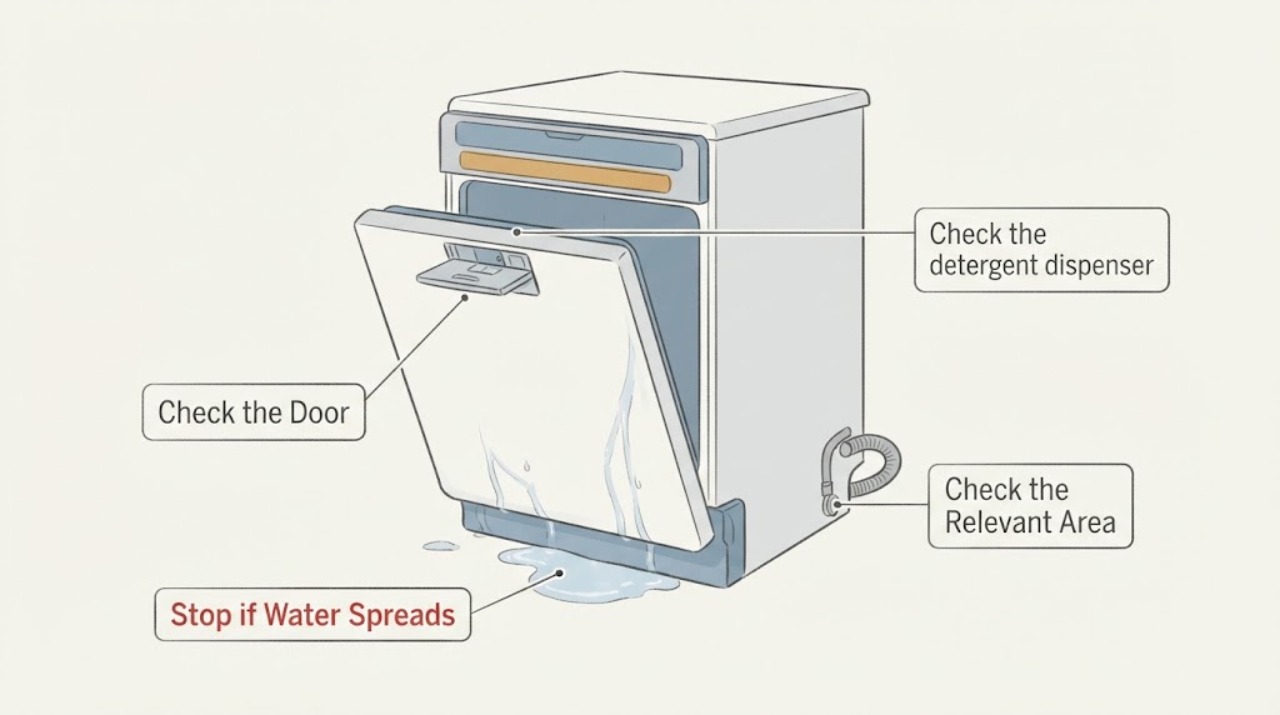
Work through in order
Diagnostic checks
Use only checks that match the exact appliance or system and its official guide.
-
Check 1
Stop/cancel the cycle, keep the door closed, and inspect the floor and toe-kick area for the first wet point without reaching under the machine.
Expected result: Water is concentrated at the door edge, dispenser area, hose/sink area, or appears from underneath.
Next step: Dry the area and do not run another cycle until the visible cause is identified or service is arranged.
Why this matters
Why: The location distinguishes a door/dispenser loading issue from a supply, drain, base, or internal fault.
-
Check 2
Inspect the gasket and door perimeter for food residue, folds, tears, or a rack/utensil preventing a complete latch.
Expected result: The gasket or closure is visibly obstructed/damaged, or the door closes evenly.
Next step: Remove one loose obstruction and clean accessible residue. Do not glue, cut, or force the gasket.
Why this matters
Why: A poor seal can let wash water escape at the front; an even closure makes a door-edge cause less likely.
-
Check 3
Check the detergent dispenser and loading instructions in the exact manual; remove excess spilled detergent from accessible surfaces without mixing cleaning chemicals.
Expected result: Detergent is caked/spilled or the dispenser and load look normal.
Next step: Use only the manual-specified detergent amount and retest only when the area is dry and no internal leak is suspected.
Why this matters
Why: Neff lists dispenser leakage separately; incorrect loading or residue can redirect water at the door, while an unchanged leak needs a broader inspection.
-
Check 4
With the supply valve closed and the unit cool, look at accessible inlet/drain hose connections under the sink for a loose-looking or visibly damaged connection; do not loosen fittings.
Expected result: A connection is visibly wet/damaged, or all accessible connections are dry.
Next step: Leave the water supply closed and request service for any damaged connection or under-unit leak.
Why this matters
Why: A wet connection can be external to the tub; a dry exterior with water underneath keeps an internal hose, pump, or base leak in scope.
Use your observations
Decision map
Find the observation that best matches what you see, then follow the next safe action.
-
PATH 01Next step
What you see
Water appears only at the dispenser/door edge and stops after an obvious load or residue correction
Do this next
Monitor one supervised cycle only if the manual permits; stop if any water returns.
Why this path and its safety boundary
Why it matters: A front sealing or dispenser-path issue is supported.
-
PATH 02Next step
What you see
Water appears under the unit or from a hose connection
Do this next
Keep the supply closed and arrange service; do not pull the appliance or open panels alone.
Why this path and its safety boundary
Why it matters: An external connection or internal base leak is more likely than detergent splash.
-
PATH 03Next step
What you see
The leak persists after the gasket, loading, and dispenser checks
Do this next
Provide photos, E-Nr, programme, and leak location to Neff service.
Why this path and its safety boundary
Why it matters: The cause is not safely identified by user-accessible checks.
Helpful context
Understand the symptom
Stop water before diagnosing
A leak can damage cabinets before the dishwasher's electronic symptom is clear. Cancel the cycle according to the manual, close the water supply if safe, and document where the first wet point appears.
When checks do not resolve it
Need a professional?
Close the water supply when safe and keep the appliance off until the leak is assessed.
Safety scope: Do not remove panels, loosen pressurised connections, reach into the base, or work around live electrical parts.
Have this ready
- Provide the E-Nr, leak location, cycle stage, water amount, gasket/dispenser checks, and photos of accessible wet points.
Common questions
FAQ
Can I run a Neff dishwasher once more to find a leak?
Only a supervised model-approved test after an obvious external correction is reasonable. If water appears underneath, the leak recurs, or the source is unclear, keep the supply closed and request service.
What information should I give Neff about a leak?
Give the E-Nr, programme, when the water first appears, the wettest location, door/gasket result, detergent observation, and any visible hose damage.
Read the exact guide
Official sources
- Service Assistant for your kitchen appliancesNEFF · NEFF dishwasher leak/dispenser troubleshooting and related water, door, and programme categories
- NEFF Dishwasher Repair ServiceNEFF · NEFF dishwasher authorised repair, model identification, and service boundary
Community feedback
Share a repair observation
Share a plain-text repair observation. Accepted observations are published automatically; this page may take a moment to update.