
On this page
Start here
Quick answer
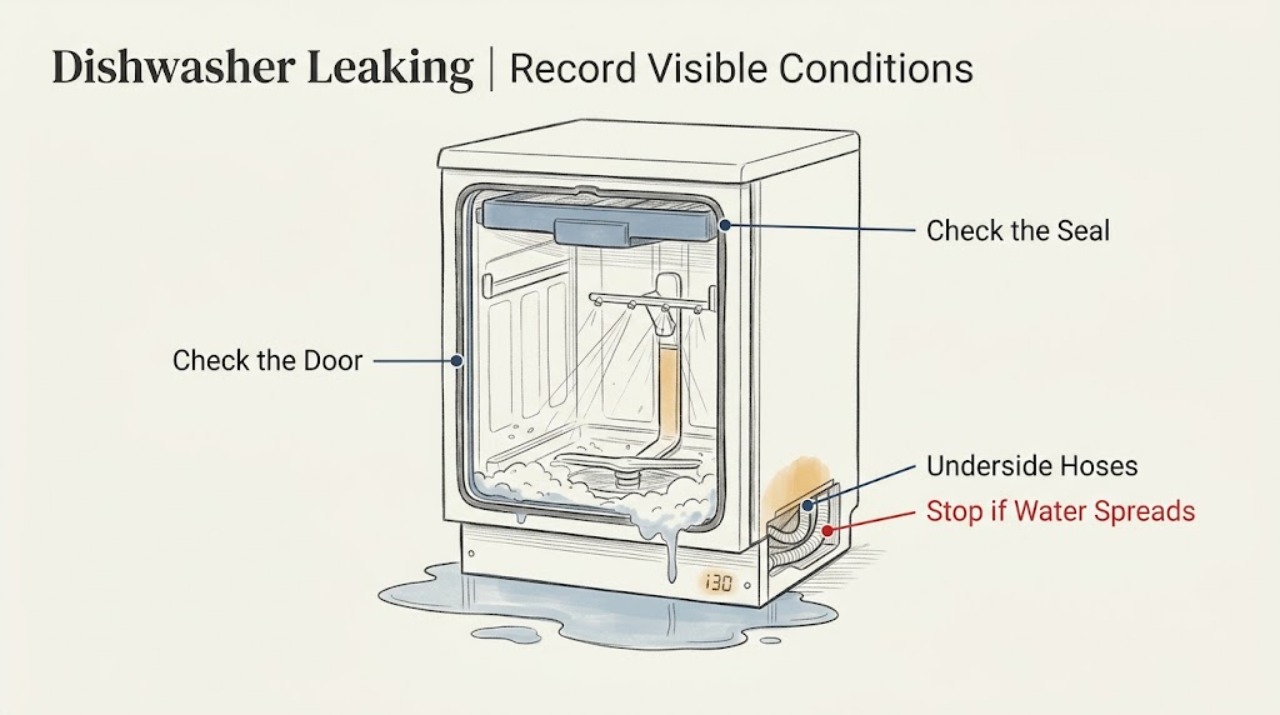
Turn off the dishwasher and close the water tap as soon as you see a leak. Note whether the water comes from the door, a rear connection, underneath the appliance, or only appears as foam. AEG's accessible checks are to confirm the dishwasher is level, verify a built-in unit has its furniture door panel fitted correctly, inspect accessible hoses and seals for kinks or disconnections, ensure spray arms can rotate without a large item deflecting water, and clean an intact door gasket. If foam is escaping, stop the cycle and use only dishwasher detergent. An i30 code, a leak that returns, a damaged seal or hose, or water collecting in the base needs an authorised technician; do not keep testing a leaking dishwasher or open its cabinet.
Work through in order
Diagnostic checks
Use only checks that match the exact appliance or system and its official guide.
-
Check 1
Stop the cycle, close the dishwasher's water tap, and inspect the visible water pattern before wiping it up. Record whether the leak starts during filling, washing, or draining; whether it comes from the lower door edge, a rear hose connection, beneath the appliance, or as foam; and whether i30, three beeps, or three flashes appear.
Expected result: Water is at the lower front door; a pipe or connection is wet at the rear; water is beneath the cabinet; foam is escaping; or i30 and a continuously running pump are present.
Next step: Keep the tap closed while using the matching installation, pipe, spray/gasket, foam, or i30 check below. Do not restart the dishwasher merely to reproduce the leak.
Why this matters
Why: The location changes the next check. A front leak makes the gasket, spray pattern, load, levelling, or foam more relevant. A rear wet connection points to a visible hose or seal. Water beneath the cabinet or i30 raises concern for an internal base leak, while foam is a detergent-related path that can force water out of the door.
-
Check 2
Check the installation at the outside surfaces: confirm the dishwasher is level, and if it is integrated, confirm the furniture door panel is fitted and securely attached as the model installation instructions require. If you need to pull it forward, protect the floor and avoid stretching any connection.
Expected result: The appliance rocks or is visibly out of level; the integrated furniture panel is missing, loose, or misaligned; or the installation looks sound.
Next step: Correct only an obvious, manual-approved installation issue and leave the water tap closed until the door and connections are stable. If the panel is missing, loose, or the appliance cannot be levelled safely, stop and arrange service or an installer visit.
Why this matters
Why: AEG links incorrect levelling or an incorrectly fitted integrated furniture panel with door operation and leaks. A sound installation makes a pipe, spray pattern, foam, or gasket check more useful, but does not rule out an internal leak.
-
Check 3
With the water tap still closed, inspect each accessible pipe and connection behind or beneath the dishwasher for a kink, twist, visible disconnection, wet seal, crack, or erosion. Do not loosen a connection or open a panel just to look further inside.
Expected result: A hose is kinked or visibly disconnected; a seal or pipe is cracked or wet; all accessible connections are dry; or the leak returns from inside the cabinet.
Next step: Keep the water supply off and arrange an authorised repair for a damaged or leaking pipe, or when no external source is visible. Do not run a cycle to pressure-test a wet connection.
Why this matters
Why: A clear external routing or connection defect can explain water under the dishwasher. A damaged seal or pipe should not be treated as a tightening challenge. Dry external connections with water still appearing beneath the cabinet make an internal leak or base-water condition more likely.
-
Check 4
For a leak from the door during a normal wash, remove any unusually large item that could block a spray arm or deflect its jet, then check that the spray arms and filters are clean and can move freely. Inspect the entire door gasket for food residue, limescale, tears, deformation, looseness, or wear; clean an intact gasket with a soft cloth only.
Expected result: A large item blocked the spray arm; a spray arm or filter was dirty; the gasket is dirty but intact; the gasket is damaged or no longer seals; or the leak continues with a clear load and clean gasket.
Next step: After the water tap has remained closed long enough for the base to dry, use one model-approved test only if no damage or internal leak is suspected. If the gasket is damaged or the leak returns, stop and book service.
Why this matters
Why: A deflected spray can concentrate water on one door area and overwhelm the seal. Cleaning an intact gasket may restore the seal surface. A cracked, deformed, loose, or persistently leaking gasket requires replacement or service, and continued leaking after these checks is not a reason to increase detergent or spray pressure.
-
Check 5
If bubbles or foam came through the door, stop the dishwasher and remove as much foam as is safely accessible with a cup or towel. Check that only dishwasher detergent was used and that rinse aid has not spilled into the tub; follow the model manual for a detergent-free rinse after the foam has subsided.
Expected result: The leak began after hand-washing liquid or excess detergent was used; rinse aid spilled; foam disappears after rinse cycles; or water still leaks without foam.
Next step: Do not add more detergent or use hand-washing liquid. Keep the tap closed and stop the appliance if foam escapes again; arrange service if the leak persists after foam is gone.
Why this matters
Why: AEG identifies wrong detergent, excess detergent, and rinse-aid spillage as foam causes; foam can push water out through the door. If foam disappears and the door remains dry, a detergent issue is more likely than a failed seal. A water-only leak needs the mechanical and internal-leak branches instead.
-
Check 6
If i30 appears, the pump runs continuously, or water is collecting beneath the appliance, leave the dishwasher switched off with the water tap closed. After the model's safe drying period, reconnect and test only if the external checks found no damage; stop immediately if i30 or leaking returns.
Expected result: i30 clears and a single monitored programme completes without leakage; i30 returns; the pump continues to run; or water remains in the base or reappears underneath.
Next step: Close the water tap, disconnect power if safe, and arrange an authorised service visit. Do not tilt the dishwasher, bypass the anti-flood device, or remove panels to drain the base.
Why this matters
Why: AEG says i30 may reflect an internal leak and water in the base; a temporary disappearance does not prove the source has been repaired. A returning code, constant pump, or recurrent water under the appliance is a service condition.
Use your observations
Decision map
Find the observation that best matches what you see, then follow the next safe action.
-
PATH 01Next step
What you see
The leak is at the lower door edge, started with foam or after a detergent change, and the gasket is intact.
Do this next
Stop the cycle, remove accessible foam, use only dishwasher detergent, and follow the model manual's detergent-free rinse procedure. If water leaks without foam or returns after foam disappears, move to the gasket and internal-leak checks.
Why this path and its safety boundary
Why it matters: The combined pattern makes over-foaming or a temporary spray pattern more likely than a torn door seal. AEG says hand-washing liquid, excess detergent, or spilled rinse aid can produce foam that leaks through the door.
-
PATH 02Next step
What you see
The leak is from one door area, a large item blocked or deflected a spray arm, or the gasket is dirty but undamaged.
Do this next
Clear the load, confirm spray-arm movement, clean the filters and gasket with non-abrasive methods, and leave the water tap closed while the base dries. Test once only if the seal is intact; service a leak that returns.
Why this path and its safety boundary
Why it matters: The pattern makes concentrated spray or a contaminated sealing surface more likely. It does not establish that the pump or gasket has failed.
-
PATH 03Next step
What you see
A rear pipe or seal is visibly wet, kinked, cracked, or disconnected, or an integrated dishwasher's furniture panel is missing or misfitted.
Do this next
Keep the water tap closed, avoid pulling on the connection, and arrange an authorised repair or qualified installation correction. Do not run the dishwasher to verify a wet connection.
Why this path and its safety boundary
Why it matters: The pattern makes an installation or external connection problem more likely than a hidden control fault. A damaged pipe or seal can continue leaking even if the door and spray arms are normal.
-
PATH 04Next step
What you see
Water appears under the cabinet, i30 is displayed, the pump runs continuously, or the leak returns after the accessible hose, load, foam, gasket, and levelling checks.
Do this next
Keep the water supply closed and the appliance off; disconnect power if safe and arrange service. Provide the i30 code or pump sound, leak timing, location, and the checks already completed.
Why this path and its safety boundary
Why it matters: The pattern is more consistent with water in the base or an internal leak than with a user-correctable obstruction. AEG recommends authorised service for this condition because the source is not exposed by the safe checks.
Helpful context
Understand the symptom
Start with the leak location, not a replacement part
A small wet line at the door, water under the appliance, foam escaping from the front, and an i30 warning do not identify the same failed component. AEG's leak guidance covers both freestanding and built-in dishwashers, but the installation checks differ: an integrated machine also needs its furniture door panel fitted correctly. Keep the water supply closed while you identify the pattern.
Use only accessible checks
You can inspect the door area, loading, spray arms, filters, and visible pipe connections without opening the dishwasher cabinet. If the machine must be pulled forward, do so only when it can be moved without straining the water or electrical connections. A leak that continues after the external checks, or water in the base, is a service diagnosis rather than a reason to remove panels.
Only after diagnosis
Potential parts
- dishwasher door gasket
Consider this category only when the gasket is visibly cracked, deformed, loose, or no longer seals after residue is cleaned and the spray-arm/load check is clear.
Confirm the complete AEG model number or PNC and the manufacturer's fit information; do not assume one gasket fits all integrated or freestanding models. - dishwasher inlet or drain hose and seal
Consider this category only when an accessible hose or seal is visibly split, eroded, kinked beyond safe correction, or leaking at the connection; a hidden base leak needs diagnosis first.
Match the exact model or PNC and connection type through AEG or an authorised service provider before ordering or fitting.
When checks do not resolve it
Need a professional?
The appliance shows i30, the pump runs continuously, or water is collecting in or under the base., A pipe, seal, door gasket, or integrated furniture panel is damaged, loose, or still leaking., The leak returns after one safe model-approved test or the source cannot be seen without opening the cabinet.
Have this ready
- The dishwasher model number or PNC and serial number from the rating plate.
- The leak location, cycle stage, whether foam was present, and any i30 beeps, flashes, or display text.
- Whether the dishwasher is integrated or freestanding and which accessible checks changed or did not change the symptom.
Common questions
FAQ
What should I do first when my AEG dishwasher leaks?
Stop the cycle and close the water tap. Identify whether water comes from the door, a rear connection, beneath the appliance, or as foam, and note any i30 warning. Keep the appliance off while checking only accessible hoses, loading, spray arms, filters, levelling, and the door gasket.
Does i30 always mean the AEG dishwasher needs a new pump?
No. AEG says i30 may indicate an internal leak with water collecting in the base, and it recommends authorised service when the code returns. Foam, a deflected spray, levelling, or a gasket issue can also be involved, so do not order a pump from i30 alone or bypass the anti-flood protection.
Can a large dish cause an AEG dishwasher to leak from the door?
It can contribute. AEG explains that a large item can block a spray arm or deflect its jet into one area of the door seal, leading to flooding or leaking there. Remove the obstruction, check spray-arm movement, and inspect the gasket; stop and request service if the leak returns.
Can hand dish soap make an AEG dishwasher leak?
Yes. AEG says hand-washing liquid can create excessive foam, which may escape through the door and push water out. Stop the cycle, remove accessible foam, and use only detergent intended for automatic dishwashers. A water leak that continues without foam needs the mechanical and internal-leak checks.
Should I keep using an AEG dishwasher if the leak stopped?
Not automatically. If i30, water under the cabinet, a damaged seal or pipe, or a recurring leak was involved, keep the tap closed and arrange service. Only consider one model-approved test after an external, safe correction when there is no visible damage or internal-leak warning; stop immediately if water or the code returns.
Read the exact guide
Official sources
- Dishwasher Leaking – Causes and SolutionsAEG · AEG dishwasher leaks at the door, under the appliance, or during use; model manual controls installation details
- Dishwasher Over-Foaming – Causes and SolutionsAEG · AEG dishwashers with foam or bubbles escaping from the door during or after a programme
- Dishwasher repair serviceAEG · AEG dishwasher leaks, recurring faults, drainage, pump, spray-arm, and door-seal issues
- Dishwasher displays error code i30AEG · AEG dishwashers showing i30, three beeps/flashes, a continuously running drain pump, or constant leaking
Community feedback
Share a repair observation
Share a plain-text repair observation. Accepted observations are published automatically; this page may take a moment to update.