
On this page
Start here
Quick answer
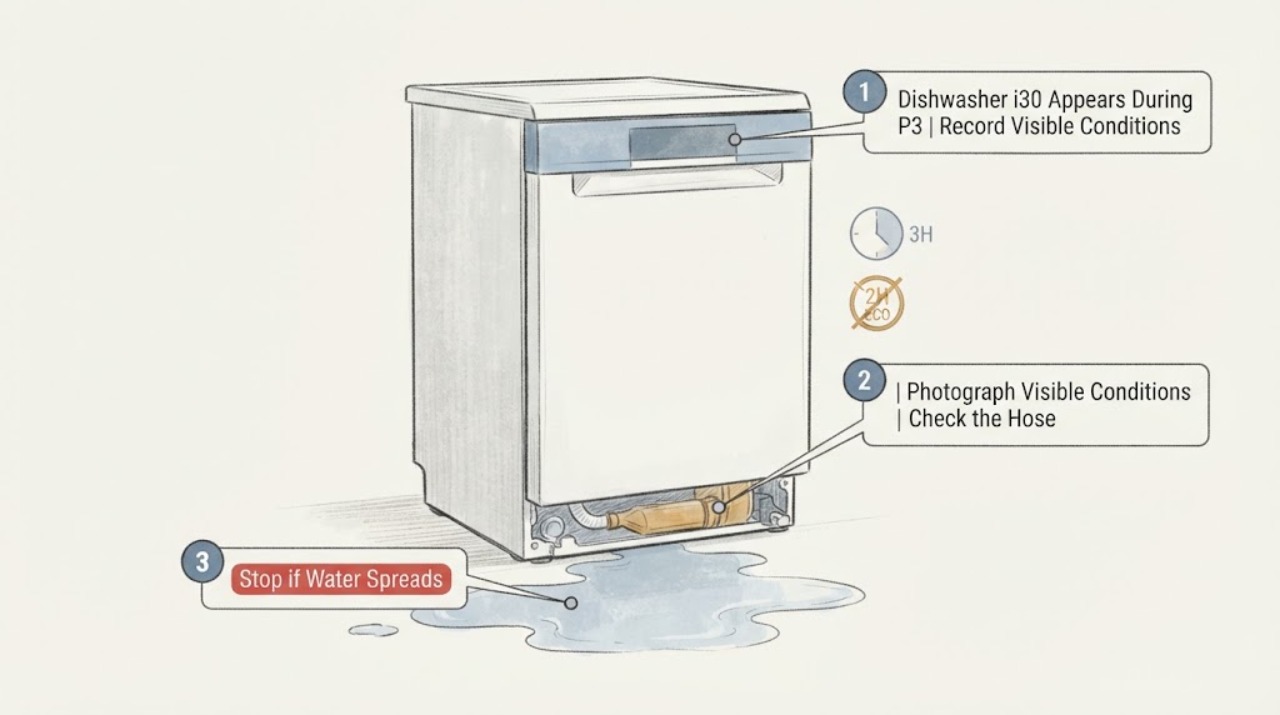
Treat AEG i30 as a leak or anti-flood warning even when it appears only during the P3 programme and not during Eco. Close the water tap, stop the dishwasher, and do not tilt, repeatedly reset, or run another cycle to reproduce the event. AEG says i30 can mean water has collected in the base and may be accompanied by three beeps or flashes or a pump that runs continuously. From a dry, safe position, record exactly when P3 reaches i30, look for water or foam around the door and visible plumbing, and check only the accessible load, spray-arm clearance, filters, sump, and door gasket as the exact manual permits. The P3-versus-Eco difference is a timing clue, not proof that P3 is faulty or that a pump, seal, or control is bad. If i30 returns, any leak remains, or the cause is not obvious, keep the tap closed and arrange authorised AEG service.
Work through in order
Diagnostic checks
Use only checks that match the exact appliance or system and its official guide.
-
Check 1
Record the complete i30 display, any three-beep or three-flash pattern, whether a low pump hum continues, the exact P3 point at which it appears, and whether Eco completed without the warning; then stop the machine and close the water tap.
Expected result: i30, three beeps or flashes, continuous pump noise, visible water, or a leak is present, or only the programme history is known without a visible hazard.
Next step: Keep the tap closed and do not run another cycle to reproduce the code. If there is uncontrolled water, smoke, burning odor, or electrical danger, keep away and call qualified emergency or appliance help.
Why this matters
Why: AEG treats i30 and its associated pump or beep pattern as possible anti-flood activation from water in the base. The P3/Eco difference is a useful timing record but does not clear the appliance or identify a part.
-
Check 2
Photograph the rating plate and retrieve the exact AEG manual using the model and PNC; for a dishwasher, look at the inside corner of the door without pulling the unit out.
Expected result: The full model and PNC are readable, or the appliance has no readable plate and the market or series is uncertain.
Next step: If identity is incomplete, keep the dishwasher off and provide a plate photo to AEG or an authorised technician. Do not borrow a P3 or Eco procedure from another AEG series or country.
Why this matters
Why: AEG says the data plate contains model, PNC, and serial information and that a dishwasher's plate is on the inside corner of the door. The manual and PNC are needed to distinguish programme names and owner-allowed checks in the relevant market.
-
Check 3
From a dry, safe position, inspect the floor, lower door edge, visible hose connections, and sink area for water, foam, a wet trail, or evidence that water returned after draining; do not pull out the dishwasher or loosen hidden connections.
Expected result: Water or foam is at the door or floor, the sink or drain connection shows backflow, visible hoses are kinked or damaged, or the exterior is dry.
Next step: Keep the tap closed. If a visible hose or sink connection is damaged or backflow is seen, use a plumber or authorised service; do not reach behind or beneath a built-in appliance as an experiment.
Why this matters
Why: AEG lists door leaks, pipe or hose problems, excessive foaming, and internal water in the base as different leak paths. A dry exterior does not rule out water in the base or a leak that appears only at a particular programme stage.
-
Check 4
With the water tap closed and power isolated only from a dry safe position, inspect the load and accessible spray-arm path; remove only a visibly oversized item or obstruction, and clean the filters, spray arms, sump, and door gasket only as the exact manual allows.
Expected result: A large item blocked or deflected a spray arm, the gasket or accessible filter area is dirty or damaged, foam is present, or no accessible cause is found.
Next step: Do not tilt the appliance, remove panels, or continue testing with the water supply open. If a dirty accessible area was corrected, leave the dishwasher off with the tap closed and follow only the exact manual's next step; recurring i30 goes to authorised service.
Why this matters
Why: AEG says a blocked spray arm or large item can direct water at one seal area and cause flooding, and lists clean filters, spray arms, sump, and gasket as first checks. Foam can also trigger i30, while no visible cause leaves an internal leak unresolved.
-
Check 5
Check the detergent history without adding products: note whether hand dish soap, excess rinse aid, or a wrong detergent may have created foam, and do not mix chemicals or run a foam-clearing cycle while i30 or a leak is active.
Expected result: There is foam at the door or tub, detergent or rinse aid was spilled, hand dish liquid may have been used, or there is no foam.
Next step: Keep the water tap closed and leave the appliance off. Provide the detergent and foam history to service; do not add vinegar, bleach, dish soap, or another chemical to counteract the foam.
Why this matters
Why: AEG says excessive foam can produce i30 and warns that hand dishwashing liquid must not be used in a dishwasher; rinse-aid spillage can also foam when the programme starts. Lack of foam makes that branch less likely but does not clear an internal leak.
-
Check 6
Compare the P3 and Eco records only as timing evidence: note whether i30 follows fill, spray, heating, draining, or the end of the cycle, and whether the pump continues after the display changes; do not select a programme repeatedly to test the pattern.
Expected result: The warning is tied to one stage of P3, appears after a drain, or returns immediately on any start; Eco has completed normally but P3 has not.
Next step: Keep a dated record and arrange authorised service for any recurrence or unresolved leak. Do not reset, bypass anti-flood protection, or make a component diagnosis from the programme name.
Why this matters
Why: A stage-linked pattern can help a technician inspect the relevant water path, seal, hose routing, or anti-flood response. A programme that completes once does not prove the base is dry or the leak is fixed, and AEG says i30 is likely to return if the leak source is not rectified.
Use your observations
Decision map
Find the observation that best matches what you see, then follow the next safe action.
-
PATH 01Next step
What you see
i30 is accompanied by visible water, a wet door edge, a continuous pump, or three beeps/flashes.
Do this next
Close the water tap, keep the appliance off, and arrange authorised service. Do not tilt the unit or open the cabinet.
Why this path and its safety boundary
Why it matters: This matches AEG's possible water-in-base and anti-flood branch; the dishwasher is not cleared simply because Eco previously completed.
-
PATH 02Next step
What you see
Foam is present, or hand dish soap, excess rinse aid, or a detergent spill preceded the P3 warning.
Do this next
Leave the tap closed and appliance off; do not add another chemical or run a clearing cycle while the protection warning or leak remains. Follow AEG's exact foam guidance only after the appliance is safe and the code is not recurring.
Why this path and its safety boundary
Why it matters: AEG identifies excessive foaming as a possible i30 trigger and warns that hand dishwashing liquid is not interchangeable with dishwasher detergent.
-
PATH 03Next step
What you see
A large item deflected a spray jet, the spray arm could not rotate, or the door gasket, filters, or sump show accessible contamination or damage.
Do this next
Correct only the visible load or manual-permitted cleaning with the tap closed. If i30 returns, stop and book authorised repair.
Why this path and its safety boundary
Why it matters: AEG says loading and spray-arm obstruction can concentrate water on one seal area; a dirty or damaged gasket can also leak. This is a possible contributor, not proof that the internal leak is resolved.
-
PATH 04Next step
What you see
The sink or drain hose shows backflow, a kink, a disconnection, or other visible routing problem after a P3 drain, while no internal area is accessible.
Do this next
Keep the dishwasher unused and have the visible plumbing corrected by a qualified plumber or authorised technician. Do not pull out a built-in unit or disconnect hidden hoses.
Why this path and its safety boundary
Why it matters: AEG says drain-hose installation, kinks, twists, damage, or the drain connection can cause water to flow back; that does not establish a pump failure.
-
PATH 05Next step
What you see
P3 repeatedly triggers i30 but Eco does not, and no foam, load, gasket, or visible plumbing cause is found.
Do this next
Close the water tap, stop testing, and arrange authorised service with the PNC, exact programme stage, photos, and the fact that Eco did not reproduce it. Do not infer a failed valve, pump, seal, or control from P3 alone.
Why this path and its safety boundary
Why it matters: The programme difference is a timing clue only. AEG's guidance leaves an internal leak or anti-flood condition unresolved when i30 returns after accessible checks.
Helpful context
Understand the symptom
i30 is a protection warning, not a P3 diagnosis
AEG's official i30 article applies to integrated and freestanding dishwashers and describes possible water in the base, an anti-flood response, continuous pump noise, and three beeps or flashes. A P3-only occurrence tells you when the condition becomes detectable; it does not identify a failed pump, gasket, valve, or programme. Preserve the P3/Eco difference for the technician while treating every i30 recurrence as a leak-safety branch.
Separate leak, foam, spray, and drainage clues
A visible leak or wet door edge points toward sealing or installation. Foam points toward detergent misuse or rinse-aid spillage. A blocked spray arm or large item can direct water at one part of the door seal, while backflow after draining points toward hose routing or the sink connection. These observations narrow the next safe handoff; none justifies tilting the dishwasher or opening its cabinet.
When checks do not resolve it
Need a professional?
Book authorised AEG service when i30 returns, any water remains, the pump runs continuously, the programme cannot complete, a hose or gasket is damaged, multiple warnings appear, or no safe external cause is found. Stop immediately for uncontrolled water, burning odor, smoke, sparks, or electrical trips.
Have this ready
- Provide the model, PNC, serial number, market, a photo of the display and rating plate, whether the warning occurs during P3 but not Eco, the exact stage, beeps or flashes, pump behavior, water or foam location, load, gasket, filter, spray-arm, hose, and detergent observations.
Common questions
FAQ
Why does i30 appear on P3 but not on Eco?
The difference tells the technician when the leak-protection condition becomes detectable, but it does not prove that P3 itself or a specific component is faulty. Record the stage, stop the machine, close the water tap, and do not run P3 repeatedly to reproduce it.
What does AEG i30 mean?
AEG says i30 may indicate water collecting in the appliance base and an anti-flood response. It can occur with three beeps or flashes, continuous drain-pump operation, or leaking. Close the water tap and arrange service if the warning returns.
Can I tip the dishwasher to clear i30?
Do not tip it in this situation. AEG's safe boundary is to close the water tap, keep the appliance off, perform only permitted accessible checks, and contact authorised service when i30 returns or a leak remains. Tilting or opening a built-in dishwasher can create water, plumbing, installation, and electrical hazards.
Read the exact guide
Official sources
- Dishwasher displays error code i30AEG · AEG UK support guidance for integrated and freestanding dishwashers; exact model manual and local market instructions take precedence.
- Where can I find appliance's PNC number?AEG · AEG domestic appliances; dishwasher plate location is specifically identified, while programme meaning remains model and market dependent.
- Water is flowing back into the dishwasherAEG · AEG UK guidance for integrated and freestanding dishwashers; visible plumbing only and no built-in pull-out experiment.
- Dishwasher Leaking – Causes and SolutionsAEG · AEG UK dishwasher leak guidance; it does not authorize cabinet disassembly or part selection.
- Too much foam in the dishwasher during or after finish of the cycleAEG · AEG UK guidance for integrated and freestanding dishwashers; use the exact manual for any model-specific cleaning step.
Community feedback
Share a repair observation
Share a plain-text repair observation. Accepted observations are published automatically; this page may take a moment to update.