
On this page
Start here
Quick answer
Stop using a leaking Beko dishwasher until you know where the water is coming from. First note whether the leak appears at the door, under the sink or behind the appliance, or only during filling, washing, or draining. Beko's troubleshooting guidance points to damaged or misaligned door hinges and seals, loose water or drain connections, foaming from unsuitable detergent or spilled rinse aid, and seals around the motor or pump as different paths. Inspect only dry, visible areas; keep water and electricity isolated when a connection must be handled. A cracked seal, damaged hinge, leaking hose, water under the appliance, or an unexplained recurring leak needs an authorized appliance technician or qualified plumber.
Before you begin
Safety first
- This article covers ordinary-access observation only. Do not pull or tip a built-in appliance, open its base, loosen pressurized fittings, touch wet electrical parts, add chemicals, or keep resetting a protective device.
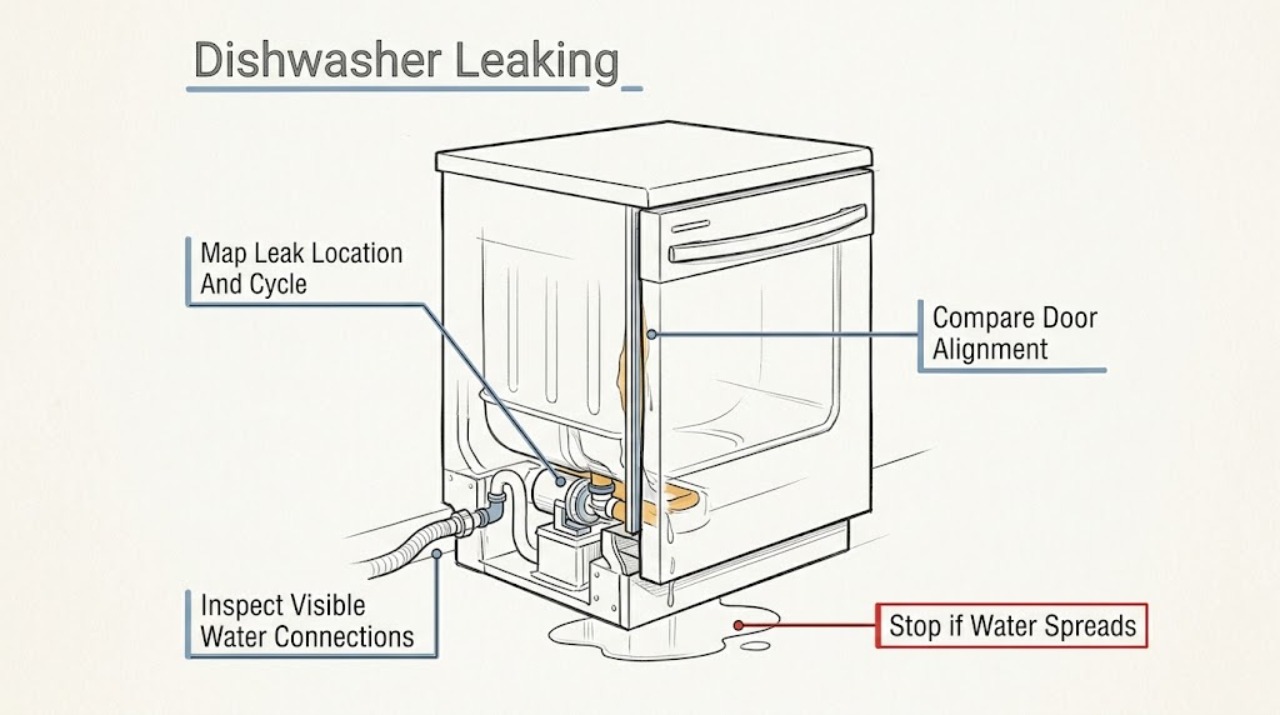
Work through in order
Diagnostic checks
Use only checks that match the exact appliance or system and its official guide.
-
Check 1
With the dishwasher stopped, cool, and the floor dry enough to stand safely, photograph and map the first wet point without pulling the appliance out. Note whether water is at the door edge, under the sink, behind the unit, or under the base, and when it first appears during filling, washing, draining, or after the cycle.
Expected result: Record the location, timing, amount and appearance of water, whether the leak returns while the machine is idle, and whether any foam, detergent residue, or error indication is present.
Next step: Keep the dishwasher out of use and use the location and timing to choose the next visible check. Do not run an additional cycle merely to reproduce a leak.
Stop if: Stop immediately for active flooding, water near an outlet or electrical component, a damaged cord, a hot or burning smell, or a floor that is slippery or unstable.
Why this matters
Why: A front-edge leak during washing keeps the door seal, hinges, alignment, or foam in view. Water at the sink cabinet or rear route points toward supply or drain connections. Water from beneath the appliance or a leak that recurs without an obvious external source needs internal diagnosis.
-
Check 2
From the front with the door open and power off, inspect the visible door seal, hinge area, inner door edge, and surrounding frame for cracks, flattening, displacement, looseness, or an obstruction that prevents an even close. Do not remove the seal or force the door.
Expected result: Classify the door area as intact and even, visibly cracked or loose, misaligned, obstructed by a dish or rack, or impossible to assess without disassembly.
Next step: Remove only a plainly visible loading obstruction. If the seal, hinge, frame, or door alignment is damaged or the leak persists with this area apparently clear, arrange authorized appliance service.
Stop if: Do not pry the seal, adjust hinge hardware, bend the door, or keep operating with a door that does not close evenly or leaves a changing gap.
Why this matters
Why: Beko identifies loose or misaligned hinges and damaged or cracked door seals as leak causes. An intact-looking door area does not rule out a base or connection leak, but a damaged seal or hinge makes continued operation unsafe until repaired.
-
Check 3
If the wet point is under the sink or at the rear route and access is dry and ordinary, turn off the dishwasher water supply before handling anything, then visually inspect the accessible supply hose, drain hose, valve, waste connection, and visible clamps for wetness, kinks, punctures, corrosion, or a loose connection. Do not pull the dishwasher out.
Expected result: Record whether the water supply or drain route is dry and secure, visibly wet at a connection, kinked or damaged, or hidden behind the appliance.
Next step: Leave the water supply off if a hose or connection is wet or damaged. Arrange a qualified plumber or appliance technician, and provide the photo and exact leak location; do not disconnect a concealed hose.
Stop if: Do not loosen fittings under pressure, use force or improvised sealant, move a built-in dishwasher, or touch a wet plug or electrical connection.
Why this matters
Why: Beko says loose pipe connections can cause water from the back or under the sink and identifies the water hose, drain pipe, and valves as connection points to check. A punctured, corroded, or hidden hose is not an ordinary tightening problem and needs qualified service.
-
Check 4
Without restarting the appliance, inspect the tub and door area for persistent foam or a slippery detergent film and review the last load for hand-wash detergent residue or spilled rinse aid. Wipe only plainly accessible spills with a dry towel; do not add chemicals or reach into standing water.
Expected result: Record whether foam was present, whether hand-wash detergent or rinse aid may have entered the tub, or whether the water is clear with no foam.
Next step: Keep the dishwasher off and follow the exact model manual's safe cleanup instructions. If the leak returns, water remains, or the source is not clearly foam, arrange service rather than testing with another detergent or cycle.
Stop if: Do not mix cleaners, add defoamer or another chemical, scoop hot or contaminated water by hand, or continue operation while foam or water is escaping.
Why this matters
Why: Beko states that hand-wash detergent can foam because it lacks dishwasher antifoam and that spilled rinse aid can also cause foam. Foam at the door can mimic a seal leak. Clear water with no foam makes a physical seal, connection, drain, or internal component path more likely.
-
Check 5
From a dry position, check whether the leak is accompanied by water under the machine, repeated filling or draining, an automatic water shutoff indication, a fault message, or a leak that returns after all visible door and connection areas are dry. Do not remove the toe kick or tip the appliance.
Expected result: Record whether the underside is wet, the leak appears only when the motor or pump runs, a protective feature has stopped the water, a fault message appears, or no external source can be found.
Next step: Keep the water supply off and arrange authorized appliance service. If the leak is at a building-side valve or drain connection, involve a qualified plumber; provide the model, timing, photos, and whether the water shut off automatically.
Stop if: Do not pull, tip, open, or electrically test the appliance. Stop for flooding, water near electrical parts, smoke, burning odor, or any unstable installation.
Why this matters
Why: Beko notes that many models have WaterSafe or WaterSafe+ features that can cut water flow during an overflow or leak, and identifies motor and pump seals as harder-to-reach leak areas. A wet underside or unexplained recurring leak therefore needs internal diagnosis, not a user-level part swap.
Use your observations
Decision map
Find the observation that best matches what you see, then follow the next safe action.
-
PATH 01Safety boundary
What you see
Water first appears along the front or lower door edge during washing, and the door seal or hinge area is cracked, displaced, misaligned, or obstructed.
Do this next
Remove only an obvious loading obstruction. Keep the dishwasher off and arrange authorized service for a damaged seal, hinge, frame, or door alignment; do not operate it to confirm the leak.
Why this path and its safety boundary
Why it matters: The door sealing path is more likely than a rear hose connection; foam remains a competing explanation if detergent residue is present.
Safety stop: Do not bend the door, pry out the seal, or adjust hinge hardware without model-specific service instructions.
-
PATH 02Safety boundary
What you see
Water is first seen under the sink or behind the dishwasher, and the accessible supply or drain route is wet, kinked, corroded, punctured, or loose.
Do this next
Turn off the dishwasher water supply, leave the appliance unused, and arrange a qualified plumber or appliance technician for the affected connection. Keep the photo and timing record.
Why this path and its safety boundary
Why it matters: A water or drain connection is more likely than a door leak, but a hidden hose or cabinet-side valve still cannot be safely diagnosed by pulling the appliance.
Safety stop: Do not loosen a pressurized connection, use improvised sealant, or touch wet electrical equipment.
-
PATH 03Safety boundary
What you see
Foam or a slippery detergent film is present, the door seal looks intact, and the leak followed hand-wash detergent residue or spilled rinse aid.
Do this next
Keep the unit off, clean only as the exact model manual permits, and use only dishwasher detergent in future. Arrange service if water escaped, the leak returns, or the cause is uncertain.
Why this path and its safety boundary
Why it matters: Foam is a plausible temporary contributor, but it does not prove the seal is healthy or rule out a second leak source.
Safety stop: Do not add chemicals to suppress foam, mix cleaners, or run repeated cycles while the appliance is leaking.
-
PATH 04Safety boundary
What you see
Water is under the appliance, appears when the motor or pump runs, returns after visible checks, or is accompanied by a protective water shutoff or fault indication.
Do this next
Keep the water supply off and arrange authorized appliance service. Use a qualified plumber as well when the building-side supply or drain connection is involved.
Why this path and its safety boundary
Why it matters: A hard-to-reach motor, pump, internal hose, base, or overflow condition is more likely than a user-serviceable door or cabinet connection.
Safety stop: Do not pull, tip, open, or reconnect the appliance to test it; keep clear of water near electrical components.
Helpful context
Understand the symptom
Find the leak's location and timing before touching anything
A wet front edge after a wash points toward the door area, while water under the sink or behind the dishwasher points toward a supply or drain connection. A leak that appears only while the pump runs can have a different cause from water present before a cycle starts. Dry the accessible floor, take a photo of the first wet point, and do not run another cycle just to reproduce an active leak.
Door seals and hinges are visible checks; pump seals are not
Beko's own troubleshooting guidance starts with the door hinges and seal, including looseness, misalignment, cracks, or other damage. It separately identifies seals around the motor and pump as hard-to-reach areas. That distinction matters: a visible seal observation can guide a service call, but it is not a reason to remove the door, tip the appliance, or open the base.
Foam can look like a hardware leak
Hand-wash detergent left on dishes and spilled rinse aid can create foam in the tub. Foam may escape around the door even when the seal is intact. Beko recommends detergent made for dishwashers and warns against hand-wash detergent; do not add another chemical or run repeated cycles to chase foam.
Only after diagnosis
Potential parts
- dishwasher door seal or gasket
Consider this category only if inspection finds a cracked, loose, or displaced seal and a technician confirms the door seal is the leak source.
Confirm the full Beko model number, seal profile, installation direction, and manufacturer fit information before ordering. - dishwasher inlet or drain hose
Consider this category only if a visible hose is punctured, corroded, kink-damaged, or confirmed by a technician to be the source after the water is isolated.
Confirm the exact model, hose length and connection type, and manufacturer fit information; do not substitute a hose based on appearance alone. - dishwasher pump or motor seal assembly
Consider this category only when qualified diagnosis locates the leak at a pump or motor seal after visible door and connection checks do not explain it.
Confirm the exact model and the complete service assembly specified by Beko; these parts are not identified by a leak symptom alone.
When checks do not resolve it
Need a professional?
Stop using the Beko dishwasher and arrange authorized appliance service when the door seal or hinge is damaged, the leak comes from under the appliance, the source is not visible, the leak returns after a foam or visible-connection check, or motor and pump seals may be involved. Turn off the dishwasher water supply for an active or connection leak. Use a qualified plumber for a leaking building-side valve, sink waste connection, or damaged water or drain hose. Seek qualified electrical help for water near wiring or outlets, repeated protective-device trips, smoke, sparking, heat, or a burning odor.
Safety scope: This article covers ordinary-access observation only. Do not pull or tip a built-in appliance, open its base, loosen pressurized fittings, touch wet electrical parts, add chemicals, or keep resetting a protective device.
Common questions
FAQ
Where should I look first when my Beko dishwasher is leaking?
Map the first wet point and when it appears. Check the visible door seal and hinge area for damage, then inspect only the dry, accessible supply and drain connections under the sink. Water under the appliance or a source that is not visible needs service rather than a cycle test.
Can a Beko dishwasher door seal cause a leak?
Yes. Beko lists loose or misaligned hinges and cracked or damaged door seals as possible leak causes. Inspect them with the door open and power off, but do not pry out the seal, bend the door, or keep operating the dishwasher when the door does not close evenly.
Could foam be mistaken for a Beko dishwasher leak?
Yes. Beko says hand-wash detergent residue and spilled rinse aid can create foam. Foam can escape around an intact door, so record whether the water is foamy and what detergent was used. Do not add chemicals or run repeated cycles while the appliance is leaking.
Should I tighten a leaking Beko dishwasher hose?
Do not tighten a wet connection under pressure or use improvised sealant. Turn off the dishwasher water supply, inspect only an ordinary-access connection from a dry position, and arrange qualified plumbing or appliance service for a wet, damaged, hidden, or recurring connection.
When is a Beko dishwasher leak an appliance-service issue?
Arrange service when the leak comes from under the appliance, returns after visible checks, involves a damaged door seal or hinge, has no clear external source, or may involve the motor or pump seals. Keep the water supply off for an active leak and keep water away from electrical equipment.
Read the exact guide
Official sources
- How to fix a dishwasher that's leaking?Beko · Beko's official troubleshooting guidance for dishwashers; exact model instructions and local water/electrical requirements control a particular appliance.
- How to fix a dishwasher that's foaming upBeko · Beko's official dishwasher troubleshooting guidance; exact model care instructions control cleanup after a foam event.
- How to install your Beko dishwasherBeko · Beko's official dishwasher installation guidance; model-specific installation instructions and applicable local requirements control.
Community feedback
Share a repair observation
Share a plain-text repair observation. Accepted observations are published automatically; this page may take a moment to update.