
On this page
Start here
Quick answer
If a Siemens iQ500 dishwasher is still leaking while it runs and shows E15, stop the programme, close the accessible water tap, and switch the appliance off. Siemens defines E15 or F15 on its dishwasher support page as an activated water-protection system and advises against trying to resolve it at home. Do not tilt the dishwasher to clear the code, keep restarting it, open the base, or treat it as proof of a blocked drain pipe. First record the complete E-Nr. and market from the rating plate—the iQ500 name alone is a product family, not a unique machine. From a dry position, distinguish water at the sink trap or air-gap connection, water at a visible inlet or drain connection, water emerging from the door or tub, and water under the appliance. A sink or household drain that backs up while the dishwasher remains dry is a plumber or building-drain route; E15, water in the dishwasher base, an appliance-side leak, or an unexplained leak during operation is a Siemens appliance-service route. Keep the tap closed and the machine unused until the source is professionally assessed.
Before you begin
Safety first
- For a confirmed Siemens dishwasher E15/F15 or ongoing appliance-side leak, close the accessible water tap, switch off the dishwasher, and leave it unused. Do not tilt it to clear the code, remove panels or the base, disconnect hoses, force the pump cover, enter service mode, or repeatedly energize the appliance.
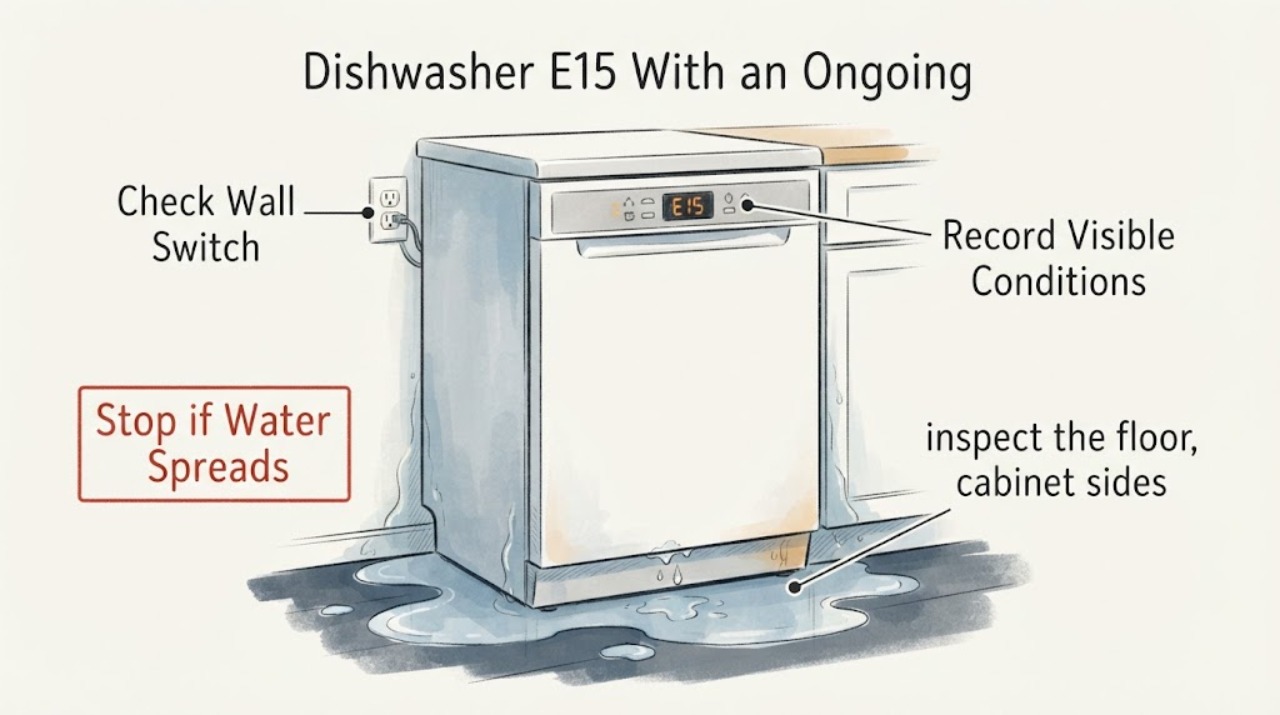
Work through in order
Diagnostic checks
Use only checks that match the exact appliance or system and its official guide.
-
Check 1
Stop the programme as soon as water is still leaking. From a dry, safe position, close the dishwasher's accessible water tap and switch the appliance off using its normal control. If water is near electrical connections, the area is flooded, or there is smoke or a burning smell, stay clear and obtain urgent help; do not reach through water to isolate power.
Expected result: Water continues to flow, the tap cannot be reached safely, the leak stops after the tap is closed, or the display remains on E15/F15 or another code.
Next step: Keep the tap closed and the dishwasher unused. Photograph the display and arrange Siemens appliance service for E15 or any appliance-side leak; use emergency or building help for active flooding or electrical danger.
Stop if: Do not restart the programme, repeatedly reset the code, tilt the machine, or open the base.
Why this matters
Why: Siemens treats E15/F15 as an activated water-protection system and directs the owner to close the tap and switch off. Whether water stops at the tap is useful timing evidence, but it does not identify the leaking part.
-
Check 2
Read the complete E-Nr. from the label or engraving on the top or side rim of the dishwasher door, and record the FD or other production information, country, display characters, and whether the code is E15, F15, E:3000, E31-00, or another format. Do not move the appliance to find a hidden label.
Expected result: The full E-Nr. is legible and matches a Siemens dishwasher manual, or only “iQ500”/a partial model is available.
Next step: Give the complete identity and exact code to Siemens service. If the identity is incomplete, stay with the water shutoff and external safety guidance rather than borrowing instructions from another iQ500 model.
Stop if: Do not enter service mode or use another model's button sequence to identify the fault.
Why this matters
Why: Siemens says model-specific codes and recommended actions may not apply to every dishwasher. A family name or partial E-Nr. cannot safely select a reset, drain procedure, or replacement component.
-
Check 3
From a dry position, inspect the floor, cabinet sides, sink base, and any visible inlet, drain, trap, or air-gap connection without pulling out the dishwasher. Use a dry towel only on the surrounding floor to see where new moisture first appears; do not touch wet electrical parts.
Expected result: The sink or trap backs up while the dishwasher cabinet stays dry, water is at a visible hose or plumbing connection, water emerges from the door or tub, or water appears beneath the appliance.
Next step: Photograph the first wet location and timing. Call a plumber when the dishwasher is dry and the household drain is the clear source; call Siemens appliance service for E15, water under the machine, or an appliance-side source.
Stop if: Do not loosen fittings, disconnect hoses, remove the toe panel, slide the machine out, or run it to reproduce the leak.
Why this matters
Why: A sink-side or household-drain-only pattern makes a plumber or building-drain issue more likely. Water from the dishwasher door/tub or beneath the machine makes an appliance-side leak or water-protection event more likely. A visible connection still does not prove which seal or hose has failed.
-
Check 4
With the dishwasher switched off and the door closed if it is safe to do so, note whether the water is only a small amount inside the tub, standing across the tub floor, on the kitchen floor, or still entering after the tap is closed. Do not scoop through hot water or reach into the filter, pump, or floor tray.
Expected result: The tub contains residual water but no external leak, standing water spreads outside the tub, water remains in the floor tray, or water continues despite the tap being closed.
Next step: Keep the tap closed and arrange appliance service for E15, floor-tray water, external leakage, or unexplained accumulation. Tell a plumber about the case only when the wet source is clearly the sink or household drain and the dishwasher itself is dry.
Stop if: Do not tilt the dishwasher, clear the code by moving it, dismantle the pump area, or run a drain programme while the leak source is unresolved.
Why this matters
Why: Residual tub water can follow an interrupted programme, but E15 and water in the floor tray are water-protection evidence in Siemens' code guidance. Continued or external water is not safely explained by a drain blockage alone.
-
Check 5
Compare the exact code with the matching Siemens manual or official code list without assuming that an iQ500 label makes every code universal. If the display is E15/F15, follow the water-protection stop; if it is E24/E25 or another code, record it separately rather than combining codes into one diagnosis.
Expected result: The code is confirmed as E15/F15, a different code is displayed, the display alternates or is incomplete, or the model manual is unavailable.
Next step: Send a photo of the full display and E-Nr. to Siemens service. Keep the tap closed for ongoing water; do not attempt a reset or user repair when the code is E15 or the water is abnormal.
Stop if: Do not clear or combine codes, enter service diagnostics, or order a pump, valve, or water-protection part from the code alone.
Why this matters
Why: Siemens' code list distinguishes water in the floor tray from drain, inlet, heating, and other faults, and warns that actions may differ by model. A partial or unverified code cannot establish a blocked pipe or a failed pump.
-
Check 6
Prepare the service handoff with the E-Nr., FD or serial information, country, exact code, cycle and stage when water appeared, whether the door was opened, first wet location, water-tap result, photographs, and any recent installation or plumbing work. Do not remove panels or try to make the dishwasher run again before the visit.
Expected result: A technician or installer can inspect the appliance water-protection system, concealed water path, door and tub seals, inlet, drain routing, and the household plumbing separately, or proposes only a generic drain cleaning or a guessed part.
Next step: Request a written diagnosis stating the first wet location, what was tested with the appliance isolated, whether the fault is appliance-side or plumbing-side, and what evidence supports any part recommendation.
Stop if: Do not authorize a pump, valve, seal, or water-protection replacement solely because E15 or standing water was observed.
Why this matters
Why: A complete event record lets the provider separate a household drain/backflow issue from an appliance-side leak and use the correct E-Nr. documentation. A generic blocked-pipe explanation does not account for Siemens' E15 water-protection meaning.
Use your observations
Decision map
Find the observation that best matches what you see, then follow the next safe action.
-
PATH 01Safety boundary
What you see
The display is confirmed as E15 or F15 on a Siemens dishwasher, water is in the floor tray or the appliance is leaking, and the source is not clearly the sink plumbing.
Do this next
Leave the tap closed and the dishwasher unused. Contact Siemens appliance service with the complete E-Nr., code photo, water location, and timing.
Why this path and its safety boundary
Why it matters: Siemens defines E15/F15 as activated water protection and advises closing the tap, switching off, and arranging professional repair. This is an appliance-service branch, not a blocked-pipe or home-reset branch.
Safety stop: Do not tilt the dishwasher, clear the code by moving it, open the base, or run another cycle.
-
PATH 02Next step
What you see
The dishwasher cabinet and floor remain dry, but the sink, trap, air gap, or household drain backs up when the appliance drains or when the sink is used.
Do this next
Keep the dishwasher off and have a plumber or building-drain professional inspect the sink-side connection. If E15 or appliance-side water appears later, switch to Siemens appliance service.
Why this path and its safety boundary
Why it matters: The observed wet source is more consistent with a plumbing or building-drain restriction/backflow than with E15 water in the dishwasher floor tray. The dishwasher should still not be run while the backup can overflow.
-
PATH 03Next step
What you see
Water first appears at the dishwasher door or tub, beneath the machine, or at an appliance-side connection during operation, and the household sink remains normal.
Do this next
Close the tap, switch off, do not pull out the machine, and contact Siemens appliance service with photos and the full E-Nr.
Why this path and its safety boundary
Why it matters: An appliance-side water path or protection event is more likely than a household drain blockage. The location and timing narrow the service inspection but do not identify a door seal, hose, pump, or valve.
-
PATH 04Next step
What you see
The display is not actually E15/F15, the characters are incomplete, or only iQ500 is known and the full E-Nr. and market cannot be matched to a manual.
Do this next
Keep the tap closed for any ongoing leak, photograph the display and rating plate, and ask Siemens service to identify the correct platform before any reset or repair step.
Why this path and its safety boundary
Why it matters: Siemens warns that error codes and recommended actions may not correspond to every dishwasher. The code cannot safely be mapped to water protection, a pump, or a blocked pipe without exact identity and display format.
-
PATH 05Safety boundary
What you see
The leak continues after the tap is closed, water is spreading toward electrical connections, or there is smoke, burning odor, or another unsafe condition.
Do this next
Stay clear and obtain urgent emergency, electrical, or qualified appliance help as appropriate. Tell the provider whether the water continued after the tap was closed and keep the dishwasher unused.
Why this path and its safety boundary
Why it matters: This is an immediate flooding or electrical-safety boundary. Closing the tap does not make it safe to reach into wet areas or energize the dishwasher to find the source.
Safety stop: Do not touch wet wiring, repeatedly reset power, open panels, tilt the unit, or continue operation.
Helpful context
Understand the symptom
E15 is a water-protection stop, not a generic drain code
On Siemens' official E15 support page, E15 or F15 means that the dishwasher's water-protection system has activated. Siemens advises closing the water tap and switching the appliance off rather than attempting a home repair. A different display such as E24 or E25 belongs to the drain-fault family in Siemens' error list. That distinction matters here: an ongoing leak must not be treated as a blocked pipe simply because water is also present in the tub.
iQ500 is not a complete identity
iQ500 identifies a Siemens product family, not a single dishwasher platform. Siemens says the exact E-Nr. should be read from the rating plate or engraving and used to find the matching manual. Record the full E-Nr., FD or production number if shown, serial information, country, and the exact display format. Do not borrow a button sequence, code detail, or part decision from another iQ500 model.
Choose a plumber or appliance service by the first wet location
An appliance-side E15 or water in the floor tray belongs with Siemens appliance service because the protection system or a concealed machine water path needs diagnosis. If only the sink, trap, air gap, or household drain backs up while the dishwasher and its cabinet remain dry, a plumber or building-drain professional is the better route. A visible hose connection can be documented from a dry position, but do not loosen it, pull the machine out, or tilt the dishwasher to search for the source.
When checks do not resolve it
Need a professional?
Use Siemens appliance service for E15, floor-tray water, leaks from the door/tub/under-unit area, or an unexplained leak during operation. Use a plumber for a sink, trap, air-gap, or household-drain backup when the dishwasher itself remains dry. Involve electrical or emergency help for water near energized parts, smoke, burning odor, or fire.
Safety scope: For a confirmed Siemens dishwasher E15/F15 or ongoing appliance-side leak, close the accessible water tap, switch off the dishwasher, and leave it unused. Do not tilt it to clear the code, remove panels or the base, disconnect hoses, force the pump cover, enter service mode, or repeatedly energize the appliance.
Have this ready
- Provide the complete Siemens E-Nr., FD or production and serial information, market/country, exact display format, cycle and stage, first wet location, water amount and whether it continued after the tap was closed, photos, installation or plumbing history, and whether the sink remained normal.
Common questions
FAQ
Does Siemens E15 mean the dishwasher drain pipe is blocked?
No. Siemens defines E15/F15 as an activated water-protection system and separately lists E24/E25 for drainage problems. Close the water tap, switch off, and arrange service rather than treating E15 as a routine blocked-pipe code.
Can I tilt the Siemens iQ500 dishwasher to clear E15?
Do not. Siemens advises against resolving E15 at home. Tilting can move water without finding the leak, create a spill or handling hazard, and erase useful evidence. Keep the tap closed and use appliance service.
Should I call a plumber or Siemens service?
Call a plumber when the sink, trap, air gap, or household drain is the clear wet source and the dishwasher cabinet remains dry. Call Siemens appliance service for E15, water in the floor tray, water from the dishwasher or beneath it, or an unexplained leak during operation.
Is iQ500 enough to find the correct E15 instructions?
No. iQ500 is a family name. Siemens directs owners to the complete E-Nr. on the dishwasher door rim or rating plate and warns that codes and actions can vary by model. Record the full E-Nr. and country before using any model-specific documentation.
Read the exact guide
Official sources
- Troubleshooting Your Siemens Appliance: E-Nr Model NumberSiemens Home Appliances / BSH Home Appliances · Official Siemens UK support page opened to confirm that appliance help and manuals are selected using the full E-Nr. and rating-plate information.
- Dishwasher error codes | SiemensSiemens Home Appliances / BSH Electrodomésticos · Official Siemens Spain dishwasher error-code page opened for the E15 floor-tray description, separate E24/E25 drain descriptions, and warning that codes/actions may differ by appliance; not used to select a part.
- Where to find the model number for your applianceSiemens Home Appliances / BSH Home Appliances · Official Siemens UK identity page opened to locate the complete dishwasher E-Nr. on the top or side rim of the door.
- Siemens service, user manuals, spare parts, accessories for SN858X03TE/51Siemens Home Appliances / BSH Home Appliances Group · Official Siemens Ireland iQ500 support page opened only to demonstrate that iQ500 support is organized by a complete E-Nr. and that E15 is a selectable issue on a specific model; it is not evidence that every iQ500 dishwasher shares that model's manual.
- E15 error on my dishwasherSiemens Home Appliances / BSH Home Appliances Group · Official Siemens UAE dishwasher support page opened for E15; used for the code meaning, tap shutoff, switch-off, and professional-service boundary. Regional wording should be checked against the owner's local manual.
Community feedback
Share a repair observation
Share a plain-text repair observation. Accepted observations are published automatically; this page may take a moment to update.