
On this page
Start here
Quick answer
On the Westinghouse WSF6608 manual for serial numbers greater than 82100000, F5 means a water-supply fault. Start by recording the complete display and confirming the model/serial and Australian-market manual, then check that the tap and household supply are on. With the dishwasher stopped, the water tap closed, and power isolated only from a safe dry location, inspect the visible inlet hose and the tap-end inlet filter as the manual allows. Do not cut, open, twist, or electrically test the Aquastop hose: the manual warns that it contains 240 V components. If F5 returns after those external checks, or there is a leak, standing water, continuous filling/pumping, or unsafe access, leave the dishwasher off and arrange authorised service rather than replacing a valve, Aquastop, flow meter, or control board by guesswork.
Before you begin
Safety first
- The WSF6608 manual's user boundary is the tap, household supply, visible hose routing, and tap-end inlet filter with the tap closed. Its Aquastop hose contains 240 V components: do not cut, open, splice, electrically test, or substitute it. Do not work on a wet or energised dishwasher.
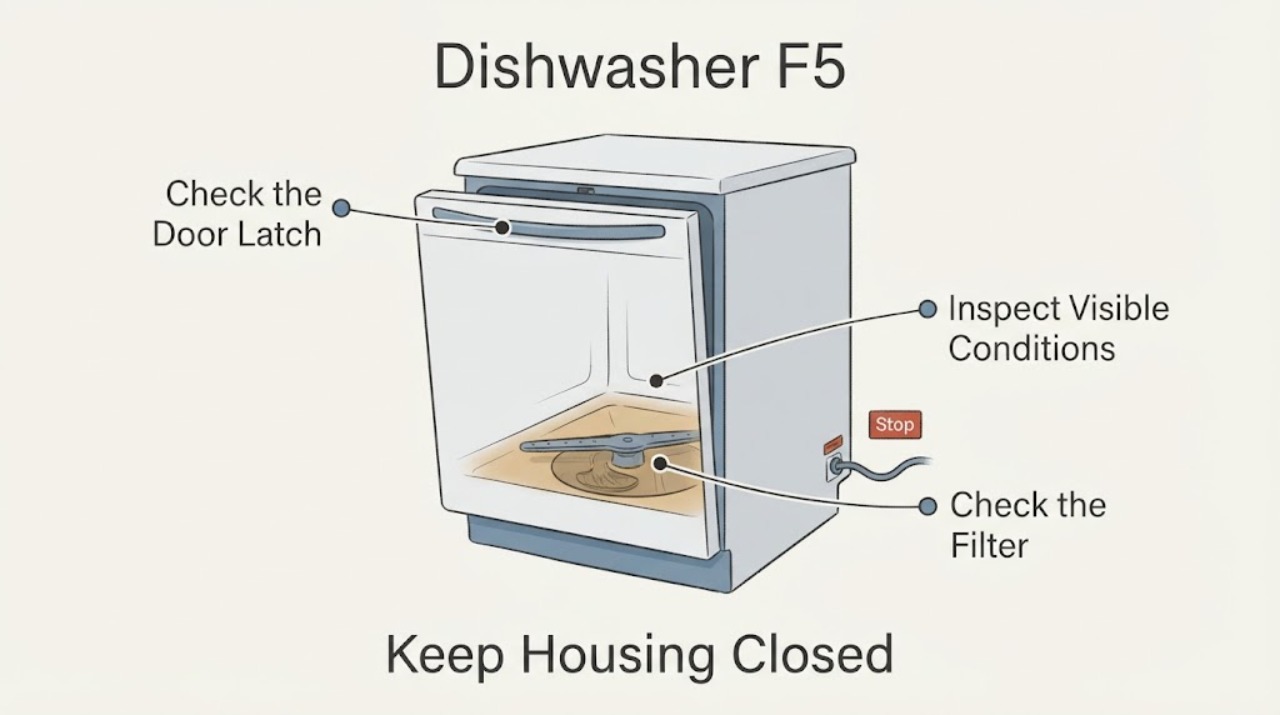
Work through in order
Diagnostic checks
Use only checks that match the exact appliance or system and its official guide.
-
Check 1
Stop the cycle and photograph the complete display, including the exact F5 format and any flashing indicators. Read the rating plate and record WSF6608, the serial number, the country/market, the selected programme, whether the machine first pumps out or tries to fill, whether the door latches, and whether water remains in the tub.
Expected result: The label matches WSF6608 with a serial number in the opened manual's scope, or the label has a suffix, different serial range, or different market; F5 is stable, another code is present, or the display is only a flashing-light pattern.
Next step: Use the manual matching the complete rating-plate identity. Continue only with safe external checks if there is no leak or wet electrical area; otherwise close the water tap and arrange service.
Stop if: Do not continue if water reaches the floor or electrical area, the supply cord or plug is damaged, there is smoke or burning odor, or the door cannot be controlled safely.
Why this matters
Why: The opened manual is specifically applicable to WSF6608 serial numbers greater than 82100000. A different identity or display format can use a different code table, while an initial drain, door condition, or standing water may point to a separate branch rather than water pressure alone.
-
Check 2
With the dishwasher stopped, check that the dishwasher water tap is fully open and that the home's water supply is on. If it is safe and dry, observe whether another nearby tap has normal flow; do not use a pressure gauge, disconnect a live appliance, or alter plumbing to make a measurement. The WSF6608 manual specifies an inlet pressure range of 0.03 MPa (0.3 bar) to 1 MPa (10 bar), so a persistent household pressure problem belongs with a plumber or qualified service provider.
Expected result: The tap is closed, other fixtures also have little or no flow, the tap is normal but the dishwasher still reports F5, or there is a leak at the visible connection.
Next step: Restore a closed tap or household supply only if the area is safe, then make one normal supervised cycle check. For a leak, close the dishwasher tap, keep the area dry, isolate power from a dry location if safe, and arrange service.
Stop if: Do not raise pressure above the documented range, bypass an inlet safety device, or continue operating with a leaking connection.
Why this matters
Why: No flow at the tap or throughout the home is an external supply condition; normal household flow with recurring F5 leaves an appliance-side or connection issue unresolved. A leak is a safety condition, not evidence that the inlet valve is defective.
-
Check 3
If the area is dry and the appliance is stopped, close the water tap and isolate power only through the normal accessible plug or switch. Inspect the visible inlet hose for a kink, twist, crush point, or obvious damage. If the tap-end filter can be reached without moving the dishwasher or opening the Aquastop housing, follow the manual's owner check: with the tap closed, disconnect the hose, rinse the filter at the tap connection, refit the hose, and check for leaks before restoring supply.
Expected result: The hose is kinked or crushed, the tap-end filter is visibly contaminated, the hose connection cannot be reached safely, or the connection is dry and clear.
Next step: Correct only a plainly visible routing problem or clean and refit the tap-end filter as documented. If access requires pulling an integrated or heavy machine, opening the safety-valve housing, or handling a damaged hose, stop and request qualified service.
Stop if: Never cut, splice, open, electrically test, or substitute the Aquastop hose; do not disconnect it while the tap is pressurized or power remains connected.
Why this matters
Why: A visible routing or filter restriction can explain F5 without proving an inlet valve, flow meter, or control fault. The WSF6608 manual warns that the Aquastop hose contains 240 V components and must not be cut, folded, twisted, kinked, or crushed.
-
Check 4
Before another run, check the visible door closure and the accessible drain route without moving the machine or reaching into a wet sump. Look for a door that cannot latch, a drain hose that is kinked, a blocked under-sink spigot or unremoved drain membrane after an installation, or standing water that has not cleared. Do not treat the sound of a drain pump or an empty tub as proof that the inlet path is good or bad.
Expected result: The door does not latch, standing water remains, the machine pumps continuously, the visible drain route is restricted, or the door and visible drain route appear normal.
Next step: Correct only a safe visible door or drain-hose/spigot condition described by the manual. If water remains after the visible check, the pump will not stop, or the drain path is inaccessible, leave the dishwasher off and arrange service.
Stop if: Do not remove the sump, dismantle the pump, tilt the dishwasher, reach into standing water, or run a cycle with a leak or uncontrolled filling/pumping.
Why this matters
Why: The WSF6608 manual treats door closure, drain restrictions, and water remaining in the machine as separate start/troubleshooting conditions. A pump or drain symptom can prevent the programme from reaching a normal fill decision, so it does not identify the F5 component.
-
Check 5
After a safe tap, hose, filter, door, and visible drain check, run at most one normal supervised programme and note whether F5 clears, water enters, the unit only drains, or the code returns immediately. Keep the exact code, cycle stage, water level, and any leak or abnormal sound for the service request.
Expected result: F5 clears and the programme fills normally, F5 returns, the programme never reaches fill, or a leak/continuous fill or pump symptom appears.
Next step: Use the recorded model, serial, code, and observations to contact a Westinghouse authorised service centre. Leave the dishwasher off for a returning code, leak, standing water, continuous filling/pumping, or any electrical concern.
Stop if: Do not repeat resets or test cycles, probe valve voltage, enter service mode, bypass the door or Aquastop safety, or replace a valve, flow meter, hose, or control board based only on F5.
Why this matters
Why: A cleared code after an external condition supports that condition as the next check, but it does not prove an internal component is healthy. A returning F5 or a safety symptom leaves model-specific diagnosis unresolved.
Use your observations
Decision map
Find the observation that best matches what you see, then follow the next safe action.
-
PATH 01Next step
What you see
The dishwasher tap is closed or another nearby tap also has no/low flow, and there is no appliance leak.
Do this next
Restore the household supply or open the dishwasher tap only if safe, then make one supervised normal-cycle check. If F5 remains with normal household flow, stop and request service.
Why this path and its safety boundary
Why it matters: The pattern is more consistent with an external water-supply interruption than with a proven dishwasher part failure.
-
PATH 02Next step
What you see
Household flow is normal, but the visible WSF6608 inlet hose is kinked/crushed or its tap-end filter is visibly contaminated and can be serviced with the tap closed and power safely isolated.
Do this next
Correct the visible hose routing or clean/refit the tap-end filter exactly as the manual allows, check for leaks, and perform at most one supervised cycle. Use service if F5 returns.
Why this path and its safety boundary
Why it matters: A restriction in the documented external inlet path can prevent the water supply fault from clearing; it does not prove the Aquastop valve or control circuit is defective.
-
PATH 03Next step
What you see
The door cannot latch, standing water remains, the dishwasher only drains/pumps, or the visible drain route is restricted when F5 is reported.
Do this next
Address only the manual's visible door or drain checks. Do not dismantle the sump or pump; leave the unit off and arrange service if water remains or the symptom persists.
Why this path and its safety boundary
Why it matters: A door or drain/start-state issue may be preventing a normal fill sequence; F5 alone cannot distinguish that state from an inlet problem.
-
PATH 04Next step
What you see
The tap, household supply, visible hose, tap-end filter, door, and drain path are clear, yet F5 returns or the dishwasher never fills.
Do this next
Leave the dishwasher off and provide the technician with the complete model/serial, the exact F5 display, cycle stage, water-flow observations, and filter/hose result. Do not perform voltage or continuity tests.
Why this path and its safety boundary
Why it matters: The external checks have not identified the cause. An internal inlet, safety, sensing, or control issue remains possible, but the code does not justify naming or replacing a part.
-
PATH 05Next step
What you see
The rating plate has a different suffix/serial range or market than the opened WSF6608 manual, or the display is not exactly F5.
Do this next
Obtain the matching regional manual from the complete rating-plate identity and contact Westinghouse support if the code remains unmatched. Keep the dishwasher off for a leak or unsafe water/electrical condition.
Why this path and its safety boundary
Why it matters: The code table and owner checks may belong to another Westinghouse platform; transferring them could misidentify the water system or safety hose.
Helpful context
Understand the symptom
F5 is narrower than a generic 'dishwasher will not fill' complaint on this model: the opened WSF6608 manual labels it a water-supply fault and gives owner-level checks for the tap, main supply, tap-end inlet filter, and inlet-hose routing. The manual is explicitly for WSF6608 dishwashers with serial numbers greater than 82100000, so confirm the rating-plate details before carrying its code table to another serial range, suffix, or market.
A water-supply code does not identify which internal part failed. The safe boundary ends at visible supply conditions and the manual's filter check. In particular, the WSF6608 manual warns that its Aquastop inlet hose has 240 V components; do not cut or open it, check voltage at a valve, or substitute a hose because it looks similar.
When checks do not resolve it
Need a professional?
Use authorised service for a returning or unmatched F5, inaccessible or damaged hose, leak, standing water, continuous filling/pumping, or any electrical symptom.
Safety scope: The WSF6608 manual's user boundary is the tap, household supply, visible hose routing, and tap-end inlet filter with the tap closed. Its Aquastop hose contains 240 V components: do not cut, open, splice, electrically test, or substitute it. Do not work on a wet or energised dishwasher.
Have this ready
- Provide the model and serial from the rating plate, market, a photograph of the exact display, programme stage, whether the unit drains or fills, tap/household-flow result, visible hose/filter result, and any leak or water-level observation.
Common questions
FAQ
What does F5 mean on a Westinghouse WSF6608 dishwasher?
For the opened WSF6608 manual covering serial numbers greater than 82100000, F5 is listed as a water supply fault. The manual directs the owner to check the tap/main supply, the tap-end inlet filter with the tap closed, and a kinked inlet hose; it does not identify a particular internal part.
Can I replace the inlet valve or Aquastop hose because F5 appears?
Not from F5 alone. First use the exact manual's safe external checks. The WSF6608 manual warns that the Aquastop inlet hose contains 240 V components and must not be cut or opened. A returning code needs qualified diagnosis and model/serial compatibility confirmation.
What water pressure does the WSF6608 manual specify?
The opened manual states a tap-supply range of 0.03 MPa (0.3 bar) minimum to 1 MPa (10 bar) maximum. Do not create a live or pressurised test yourself; if household flow is abnormal or pressure is suspected outside that range, use a qualified plumber or service provider.
Read the exact guide
Official sources
- Westinghouse WSF6608 User ManualWestinghouse Australia / Electrolux Home Products Pty. Ltd. · Opened the official Westinghouse Australia PDF. It identifies the WSF6608 dishwasher and Australian installation context, gives water-supply specifications and Aquastop warnings, and defines F5 in the failure-code table.
Community feedback
Share a repair observation
Share a plain-text repair observation. Accepted observations are published automatically; this page may take a moment to update.