
On this page
Start here
Quick answer
If a Westinghouse dishwasher is not heating, first check that the selected program includes a hot wash and drying phase, the inlet valve is open, and the machine completes its fill and drain steps. Westinghouse documentation identifies E3 as not reaching the required temperature, commonly associated with a heating-element malfunction, and E4 as overflow or a leak. Do not open the appliance or test live heater wiring. If E3 returns, dishes remain cold after one correct program, or water is present in the base, stop use and arrange service.
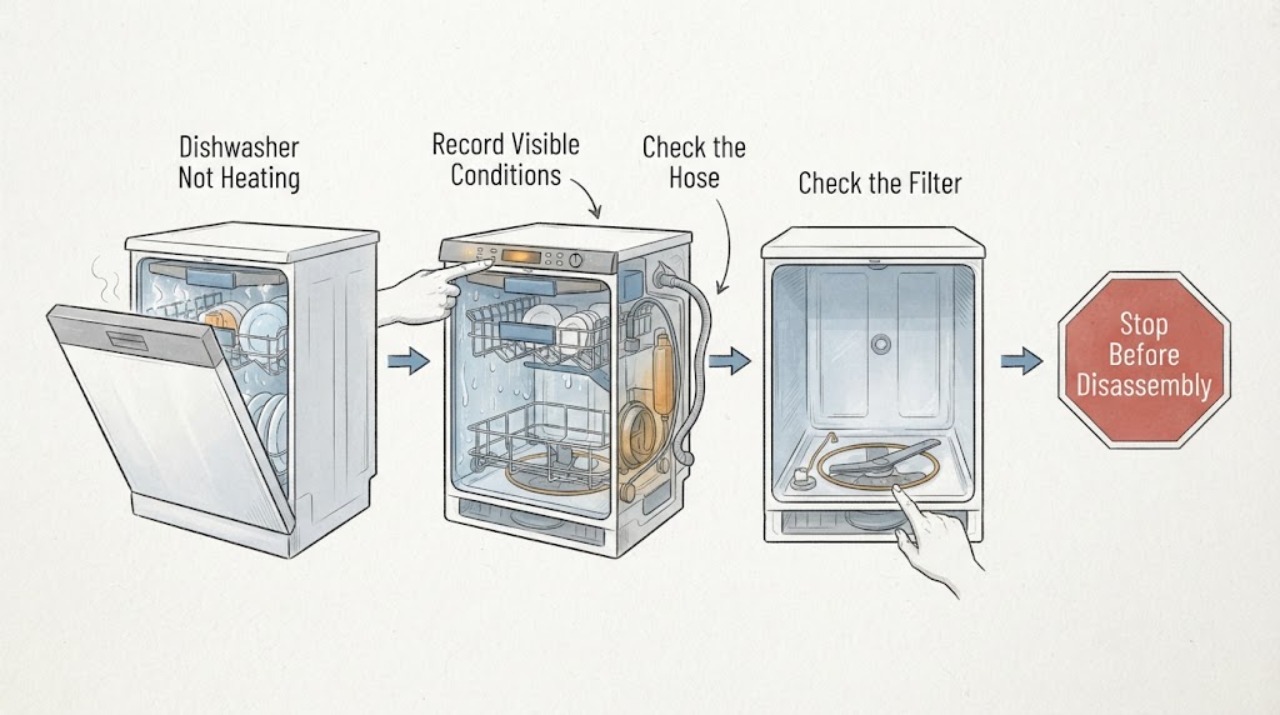
Work through in order
Diagnostic checks
Use only checks that match the exact appliance or system and its official guide.
-
Check 1
Choose the manual-described full wash program with a heating or drying phase and record the selected program and final water or dish temperature.
Expected result: The program is short/cool, or a full program is selected and dishes remain cold.
Next step: Run one comparable full program only if there is no leak or safety warning.
Why this matters
Why: Program choice can explain weak drying, while a cold full program points toward inlet, heater, sensor, or control diagnosis.
-
Check 2
Verify the accessible water valve is open, inlet hose is not kinked, and the dishwasher reaches a normal fill and spray sequence.
Expected result: Water entry is restricted or normal.
Next step: Correct an obvious valve or hose condition, then retest once.
Why this matters
Why: Poor fill can prevent the machine from reaching the conditions needed for heating and can trigger related errors.
-
Check 3
Inspect and clean the user-accessible filter and spray arms according to the manual, then reinstall them correctly.
Expected result: Filter or jets are blocked, or circulation is clear.
Next step: Run a full program and compare spray, drain, and final heat.
Why this matters
Why: Poor circulation can leave dishes cold or wet and can make a heating complaint look like a heater failure.
-
Check 4
Check the display for E3, E4, or another code and preserve the exact code rather than clearing it repeatedly.
Expected result: E3, E4, or no code appears.
Next step: Stop for E4 or water in the base and shut off the main water supply as documented; service recurring E3.
Why this matters
Why: E3 identifies failure to reach required temperature; E4 identifies overflow or a leak and changes the safety response.
-
Check 5
Check whether the door gasket leaks, the tub drains fully, and water remains in the base after the cycle.
Expected result: Water remains, a leak is visible, or the tub and base are dry.
Next step: Do not restart an overflowed unit; arrange service after securing water.
Why this matters
Why: A leak or base water can inhibit operation and creates a separate safety issue from heating.
-
Check 6
Apply the stop boundary after one documented test: check for E3 recurrence, cold water, burning odor, breaker trip, or an element/control symptom.
Expected result: Heat returns normally or the fault persists.
Next step: Stop using the dishwasher and arrange qualified Westinghouse service with code and program details.
Why this matters
Why: A persistent no-heat complaint needs heater, sensor, wiring, and control tests that cannot be confirmed externally.
Use your observations
Decision map
Find the observation that best matches what you see, then follow the next safe action.
-
PATH 01Next step
What you see
The dishes are wet after a short program but the full program heats normally.
Do this next
Use the documented longer/hotter program or manual drying guidance.
Why this path and its safety boundary
Why it matters: The symptom is program-specific drying behavior rather than a failed heater.
-
PATH 02Next step
What you see
E3 appears or a full program never reaches required temperature.
Do this next
Stop repeated tests and arrange qualified service.
Why this path and its safety boundary
Why it matters: A heater, temperature sensor, wiring, or control fault is likely.
-
PATH 03Next step
What you see
E4 appears or water is in the base.
Do this next
Turn off the main water supply and obtain service before restarting.
Why this path and its safety boundary
Why it matters: Overflow or leakage takes priority over heating diagnosis.
-
PATH 04Next step
What you see
No code appears, but full-program water remains cold after normal fill and circulation.
Do this next
Do not open live panels; arrange service.
Why this path and its safety boundary
Why it matters: An internal heater or control fault is more likely than program selection.
Helpful context
Understand the symptom
A short or energy-saving program may use less heat, and drying performance can differ from wash temperature. Compare the same full program once, recording whether the tub fills, sprays, drains, and shows a code.
Use the exact Westinghouse manual for program temperature, filter access, and error-code handling. Heater and sensor tests belong to a qualified technician.
Only after diagnosis
Potential parts
- heating element
Only if E3 and technician diagnosis confirm a failed element.
Match the exact Westinghouse model and element specification.
When checks do not resolve it
Need a professional?
A technician may test the element, temperature sensor, wiring, circulation, inlet valve, and control board, and inspect for an E4 leak. Provide model, program, code, water temperature, and base-water observations.
Common questions
FAQ
What does E3 mean on a Westinghouse dishwasher?
The manual identifies E3 as not reaching the required temperature and lists a heating-element malfunction as a possible cause. Preserve the code and arrange service if it returns.
Can a short program make dishes look like the dishwasher is not heating?
Yes. Westinghouse documentation says short programs use a lower washing temperature and can reduce cleaning and drying performance. Compare one full program.
What should I do for E4?
E4 indicates overflow or a leaking dishwasher in the manual. Turn off the main water supply and do not restart until the base and leak are professionally checked.
Can I test the heating element myself?
Do not test live wiring or remove panels. A technician should test the element, sensor, wiring, and control after the code and program checks.
Read the exact guide
Official sources
- WHS_UM Dishwasher_WSF6606XC WSF6606KXCWestinghouse · Use for Westinghouse WSF6606-series guidance; exact model controls vary.
Community feedback
Share a repair observation
Share a plain-text repair observation. Accepted observations are published automatically; this page may take a moment to update.