
On this page
Start here
Quick answer
A Beko dishwasher that finishes with cold water, undissolved detergent, dirty dishes, and poor drying may have a heating-element or thermostat fault, but those symptoms can also come from a short or unsuitable programme, poor loading, blocked spray arms or filters, inadequate filling, or a drainage problem. First use the exact model's programme guidance and check the user-accessible water path and filters. If a suitable cycle still completes without warming and the whole load is cold or wet, stop at visible checks and arrange an authorised Beko service visit; do not open the appliance or test live heating circuits.
Before you begin
Safety first
- This article supports cool, user-accessible checks of programme selection, loading, spray arms, filters, visible hoses, water inlet, and door closure. It does not authorize live electrical testing, service-panel removal, pump or valve work, heater or thermostat replacement, or bypassing safety controls.
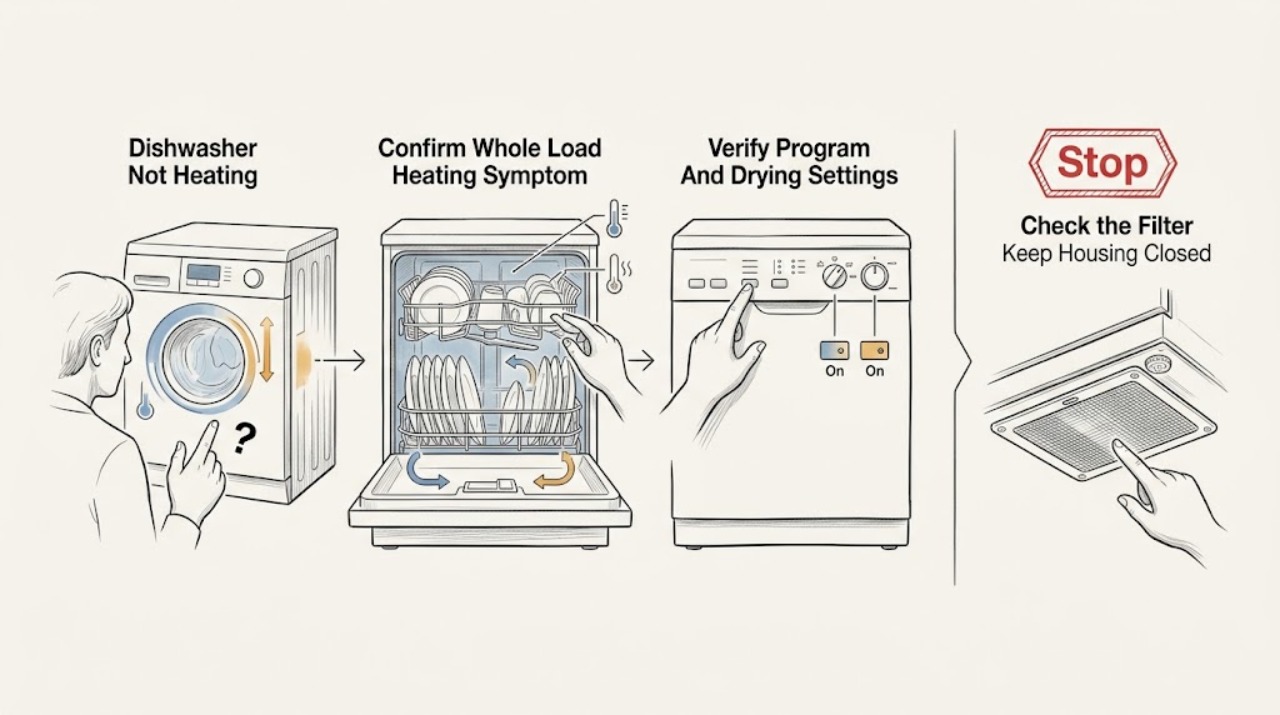
Work through in order
Diagnostic checks
Use only checks that match the exact appliance or system and its official guide.
-
Check 1
After a completed programme has ended, allow the dishes and interior to cool enough to handle safely, then check more than one item from different racks. Note the condition of the detergent dispenser, the cleanliness of the load, and whether moisture is concentrated only on plastic or Teflon.
Expected result: The whole load is cold and wet with detergent still present, only plastic or Teflon remains wet while glass or porcelain is dry, the load is dirty but warm, or the programme was a short/low-temperature cycle.
Next step: Repeat the observation only with a programme and load type allowed by the exact Beko manual. If a suitable cycle still leaves the whole load cold, continue to the visible checks and prepare for service.
Stop if: Do not open the door during a running cycle to feel the water, reach into hot vapour, or use a hand-temperature impression as an electrical diagnosis.
Why this matters
Why: A whole cold load plus undissolved detergent and poor cleaning is stronger evidence of absent heating than wet plastic alone. Dirty but warm dishes point toward circulation, detergent, loading, or programme selection; a short cycle or material-specific moisture does not establish a heater failure.
-
Check 2
Read the exact Beko model manual and compare the selected programme, temperature option, drying option, and detergent format with the load. Choose a model-supported programme intended for the soil level rather than repeatedly using the shortest cycle; do not change installer or service settings.
Expected result: A longer or higher-temperature programme is available and improves cleaning or warmth, the cycle has low-temperature or limited drying behaviour, the tablet setting does not match the detergent, or every suitable programme remains cold.
Next step: Keep the programme and detergent setting that the manual supports, then compare the complete load on the next cycle. If all suitable programmes remain cold, do not compensate by selecting progressively hotter settings indefinitely; move to user-accessible water and circulation checks.
Stop if: Do not enter service menus, bypass programme protections, add unapproved chemicals, or run a cycle with a damaged door, leak, or electrical fault.
Why this matters
Why: Improvement on a suitable programme makes a programme or detergent-setting mismatch more likely than a failed heater. Beko notes that short programmes can have lower rinsing temperatures and that tablets may need a model-supported tablet function; unchanged cold results across suitable programmes move the diagnosis toward a technical fault.
-
Check 3
With the dishwasher off and cool, remove the racks only as the manual permits. Check that the lower and upper spray arms turn freely, their visible holes are not clogged, the filter is seated and free of food debris, and dishes are not blocking the arms or detergent-dispenser lid.
Expected result: A spray arm is obstructed or clogged, the filter is dirty or incorrectly seated, dishes block an arm or dispenser, or the arms and filter are clear and correctly positioned.
Next step: Clean the accessible filter and spray-arm holes as shown in the exact manual, reload without blocking moving parts, and run one suitable programme. If the filter cannot be removed normally, is damaged, or the cold symptom persists, stop and arrange service.
Stop if: Do not force a spray arm, remove sealed panels, scrape parts with sharp tools, or continue operation if a loose component can enter the pump or if the tub or door is damaged.
Why this matters
Why: Restricted spray or filtration can prevent detergent from dissolving and reduce washing and rinsing performance, creating a false impression of no heat. If water circulation and loading are normal but the whole load still finishes cold, a heating element or thermostat becomes more plausible.
-
Check 4
From outside the appliance, inspect the water inlet and drain hoses for an obvious kink, crushing, leak, or blockage, confirm the water inlet tap is open, and verify that the door closes and latches without obstruction. Check for standing water only from the normal user-accessible filter area and follow the manual's cancellation or drain procedure if required.
Expected result: The machine fills and drains normally with no standing water, a hose is kinked or leaking, the inlet tap is closed, the door does not latch, or water remains after the programme.
Next step: Correct only an obvious external hose position or fully closed inlet tap if the manual permits, then run one suitable cycle. Arrange service for a leaking or punctured hose, failed latch, persistent standing water, or a fault that returns.
Stop if: Do not pull the built-in dishwasher out, disconnect plumbing under the cabinet, work on electrical connections, or operate with a water leak or exposed wiring.
Why this matters
Why: A fill, door, or drainage fault can prevent the programme from reaching or completing its heating stage; it does not prove that the heating element is defective. Beko states that a dishwasher unable to drain may not take in water and that a door detected as open will prevent operation.
-
Check 5
If the suitable programme still completes with the whole load cold after the user-accessible checks, record the Beko model number, programme and options, detergent type, whether the dispenser opened, fill and drain behaviour, any indicator or error, and the before-and-after condition of the dishes. Do not remove the door, base, or service panels.
Expected result: The cold result is repeatable on suitable programmes, the result improves after cleaning or programme correction, a fault or leak appears, or the appliance does not complete the cycle.
Next step: Book an authorised Beko service assessment and provide the recorded model, programme, symptoms, and checks. Keep the dishwasher out of service for leaks, electrical damage, repeated trips, burning odour, or unsafe heat behaviour.
Stop if: Do not use a multimeter on live parts, bypass a thermostat or safety device, replace a heater by generic instructions, or repeatedly reset a fault to force another hot cycle.
Why this matters
Why: A repeatable whole-load cold result after normal water movement and programme checks is consistent with a heating element, thermostat, temperature sensor, wiring, or control fault, but the observation cannot identify which component. Improvement after cleaning or settings points away from a proven heater failure.
Use your observations
Decision map
Find the observation that best matches what you see, then follow the next safe action.
-
PATH 01Safety boundary
What you see
Only plastic or Teflon remains wet, or the appliance was run on a short or low-temperature programme while glass or porcelain is dry and the load is otherwise normal.
Do this next
Use a suitable model-supported programme and the correct detergent or tablet setting, then reassess the complete load after it cools.
Why this path and its safety boundary
Why it matters: The evidence is weaker for a heater failure. Beko explains that these materials retain or bead water differently and that shorter programmes can have lower rinsing temperatures and reduced drying performance.
Safety stop: Do not replace a heating part based on wet plastic alone.
-
PATH 02Safety boundary
What you see
The load is dirty, detergent remains in the dispenser, spray arms do not turn freely, holes or filters are clogged, or the dishwasher has a fill or drain symptom.
Do this next
Clean and reseat accessible filters and spray arms, correct loading, inspect only visible hoses and the inlet tap, and run one suitable programme. Escalate a leak, failed latch, persistent standing water, or recurring fault.
Why this path and its safety boundary
Why it matters: Poor water delivery, circulation, loading, or drainage can prevent effective washing and make the machine appear not to heat; heating cannot be isolated until the water path is normal.
Safety stop: Do not dismantle the pump, base, inlet valve, drain connection, or electrical wiring.
-
PATH 03Safety boundary
What you see
A suitable programme completes repeatedly with the whole load cold and wet, detergent remains, and accessible spray arms, filters, filling, draining, and door closure are normal.
Do this next
Arrange an authorised Beko service assessment and supply the model number, programme history, and observations. Beko's support guidance specifically directs suspected heating-element or thermostat problems to an authorised service agent.
Why this path and its safety boundary
Why it matters: An internal heating element, thermostat, temperature sensor, wiring, or control fault becomes more likely, but the observed pattern cannot name the failed part.
Safety stop: Do not open service panels, test live circuits, bypass a safety component, or order a part before model-specific diagnosis.
-
PATH 04Safety boundary
What you see
The dishwasher leaks, trips a protective device, smells of burning, shows damaged wiring or a cracked enclosure, produces abnormal heat, or stops with a recurring fault indication.
Do this next
Stop using the dishwasher, disconnect power only if the plug and area are dry and reachable without contact with water, and arrange qualified appliance or electrical service. If safe disconnection is not possible, isolate power at the appropriate household protective device and seek help.
Why this path and its safety boundary
Why it matters: This is a safety or water-containment condition, not a routine heating check. Continuing cycles could expose people or property to electrical, burn, or water damage.
Safety stop: Do not touch wet electrical parts, continue resetting the machine, or attempt a heater, thermostat, wiring, or leak repair.
Helpful context
Understand the symptom
Confirm that the symptom is really a heating failure
Wet plastic or Teflon items alone do not prove that a Beko dishwasher stayed cold: Beko explains that those surfaces retain or bead water differently, and that short programmes may have lower rinsing temperatures and weaker drying. A stronger indication is a normal, model-supported programme that completes with the whole load cold, detergent still present, poor cleaning, and no normal warming or steam. Let the load cool before inspecting it and be careful of hot vapour when opening a running machine.
Water movement and programme choice come before parts
Heating occurs within a sequence of filling, circulating, washing, rinsing, and draining. A blocked spray arm, dirty filter, incorrect loading, restricted hose, or incomplete drain can leave the detergent and dishes looking as though the heater failed. Beko's user guidance supports checking those accessible conditions and selecting a programme suited to the load before treating the issue as a technical heating fault.
The exact model controls technical service
Beko manuals are selected by model number and their instructions are model-specific. The heating element, thermostat, sensors, wiring, and control parts are not safe targets for a generic continuity test or replacement. Keep the appliance disconnected if inspection exposes wiring, water, or a damaged enclosure, and use an authorised service agent for suspected internal heating faults.
Safety boundary
Stop conditions
- Do not open a running dishwasher to feel the water or reach into hot vapour; allow the load to cool before inspection.
- Do not test live voltage, bypass a thermostat or safety device, open the base or door electronics, or replace a heating component using generic instructions.
- Stop using the appliance for a leak, burning odour, repeated electrical trip, damaged cord or wiring, cracked door or tub, abnormal overheating, or a recurring fault indication.
- Do not pull an integrated dishwasher out or disconnect hidden water or electrical connections as a user troubleshooting step.
- Arrange authorised Beko service when a suitable cycle remains cold after accessible water-path and programme checks, or whenever the fault requires internal component diagnosis.
Only after diagnosis
Potential parts
- Beko dishwasher heating element or heater assembly
Consider this category only after authorised diagnosis confirms that the exact model's heater or heater assembly is not heating and that programme, water circulation, and temperature-control causes have been assessed.
Confirm the full Beko model and the manufacturer's compatible part information; do not choose a heater by appearance or perform the replacement as a generic user repair. - Beko dishwasher thermostat or temperature sensor
Consider this category only when authorised testing identifies a temperature-sensing or thermostat fault that explains the persistent cold-cycle result.
Confirm the exact Beko model, control family, connector, and manufacturer's fit information; do not bypass or substitute a safety sensor. - Beko dishwasher circulation or drain component
Consider this category only when authorised diagnosis finds that water is not circulating or draining correctly and that condition is preventing normal washing or heating progression.
Confirm the exact model and the manufacturer's compatible component information; do not disconnect hidden plumbing or pump wiring as a user check.
When checks do not resolve it
Need a professional?
Arrange an authorised Beko service visit when a suitable programme repeatedly completes with the whole load cold after the filter, spray-arm, loading, fill, drain, door, and programme checks; when the heating element, thermostat, sensor, wiring, or control is suspected; or when a leak, burning odour, electrical trip, damaged enclosure, or recurring fault appears. Do not perform internal or live electrical testing.
Safety scope: This article supports cool, user-accessible checks of programme selection, loading, spray arms, filters, visible hoses, water inlet, and door closure. It does not authorize live electrical testing, service-panel removal, pump or valve work, heater or thermostat replacement, or bypassing safety controls.
Common questions
FAQ
How can I tell whether my Beko dishwasher is really not heating?
Look at the whole cooled load, not one plastic item. A suitable programme that repeatedly finishes with the whole load cold and wet, detergent still present, and poor cleaning is stronger evidence of a heating fault. Wet plastic or Teflon alone, or a short programme, can have other explanations.
Can a clogged filter or spray arm make a Beko dishwasher seem not to heat?
Yes. Beko explains that clogged spray-arm holes, a dirty filter, or blocked movement can reduce water delivery and prevent detergent from dissolving, leaving dishes dirty even when the heater is not proven to be faulty. Clean accessible parts according to the exact model manual before seeking a heating part.
Should I run the hottest Beko dishwasher programme to test the heater?
Use only a programme and option supported by the exact model manual. A longer or higher-temperature programme can help distinguish a short-cycle limitation from a persistent cold result, but do not use service settings or repeatedly select hotter options to compensate for a fault.
Can I test or replace the Beko dishwasher heating element myself?
Do not perform live electrical testing or generic heater replacement. Beko's support guidance says persistent problems may involve the heating element or thermostat and advises contacting an authorised service agent. The exact model manual and qualified diagnosis determine the compatible repair.
Read the exact guide
Official sources
- How to fix a dishwasher that’s not cleaningBeko · Official Beko support guidance for dishwasher troubleshooting; exact controls and programmes vary by model, so the installed model manual governs.
- How to I fix a dishwasher that won't dry properlyBeko · Official Beko support guidance; drying results differ by model, programme, load material, and options, so wet dishes alone do not prove no heating.
- Beko Manuals and User GuidesBeko UK · Official Beko manual portal; the user must select the exact dishwasher model before applying programme or service instructions.
- Beko Support & Repair HubBeko UK · Official Beko support and repair hub; service availability and warranty terms depend on market and appliance.
- Beko Dishwasher User’s Manual DIS16R10 DIS15020 DIS15Q20Beko · Official manual for the listed Beko models only; it illustrates model-specific instructions and must not be treated as a universal manual for every Beko dishwasher.
- How to fix a dishwasher that won’t take in waterBeko · Official Beko dishwasher support guidance for user-accessible water-path checks; exact hose routing and access vary by model.
Community feedback
Share a repair observation
Share a plain-text repair observation. Accepted observations are published automatically; this page may take a moment to update.