
On this page
Start here
Quick answer
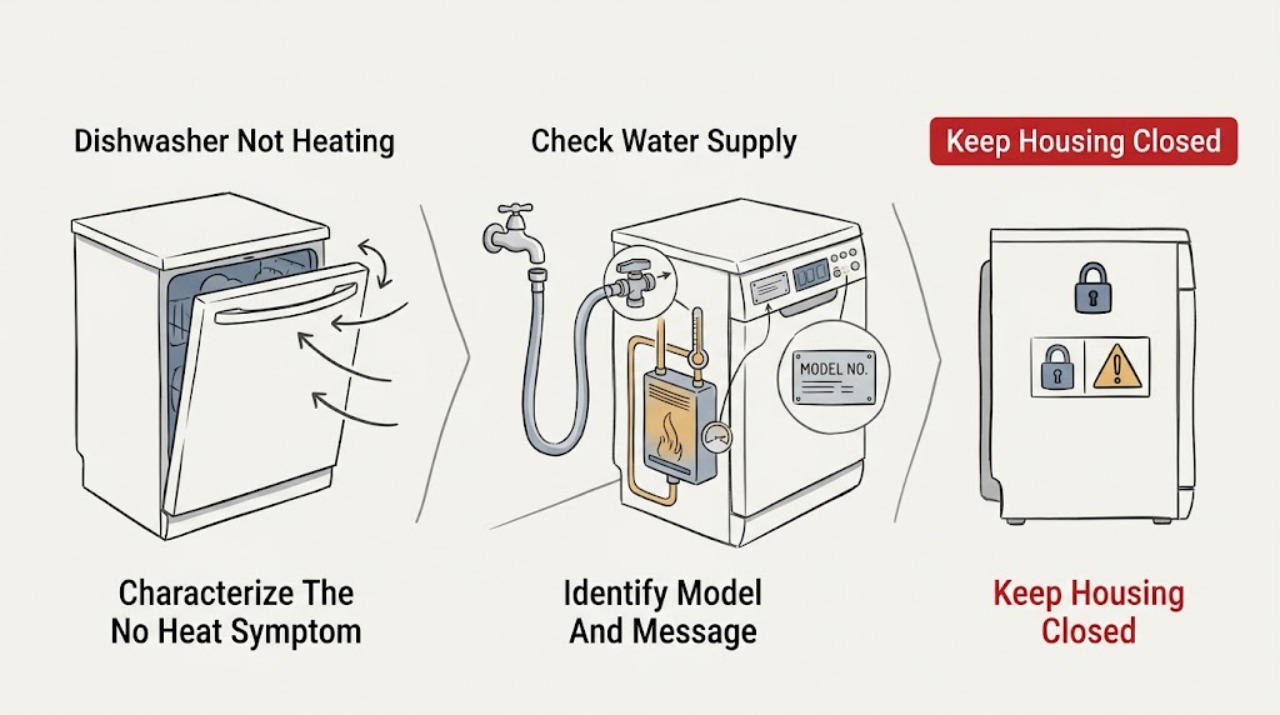
If a Bosch dishwasher is not heating, first confirm what is actually cold: a cycle can run longer when incoming water is not warm enough, and wet dishes alone do not prove that the wash water never heated because drying behavior varies by model and cycle. Use the exact model manual to identify the selected cycle and expected drying result, check that the water supply is on and the inlet hose is not kinked, and record any display message exactly. If the dishwasher is failing to heat water at all, repeatedly leaves a cold or poorly cleaned load, displays a heater-related condition, leaks, trips a breaker, or needs access to the heater, heat pump, sensor, control, or wiring, stop using it, close the water supply, switch off power when safe, and arrange qualified Bosch service. Do not open panels, measure live voltage, or install a heating part based on a generic Bosch model.
Before you begin
Safety first
- This article covers symptom characterization, exact-model lookup, accessible water-supply observation, and recording a display message. A qualified technician must handle heater, heat-pump, sensor, control, wiring, enclosure-panel, interlock, live electrical, and hidden plumbing work.
Work through in order
Diagnostic checks
Use only checks that match the exact appliance or system and its official guide.
-
Check 1
After a completed cycle has cooled, record whether the load was cleaned, whether the tub or wash water ever became warm according to the model's normal user-visible behavior, whether dishes are merely wet, and whether the cycle was unusually long. Compare the selected cycle and drying option with the exact Bosch manual; do not touch the water or heater to test temperature.
Expected result: The wash was effective but dishes are wet; the cycle was long; the interior and load stayed cold; cleaning was poor with no warmth; or the display showed a message.
Next step: For wet-only or long-cycle symptoms, continue with the model-specific cycle, drying, and water-supply checks. For a repeated cold load, a heater-related message, or an unsafe symptom, stop using the appliance and arrange qualified service.
Stop if: Do not open the door during a hot cycle to feel the water, touch a heating area, or run repeated cycles to provoke a fault.
Why this matters
Why: Wet dishes alone do not establish a failed heater. A repeated cold, poorly cleaned load or a model-specific display condition is stronger evidence that heating, water flow, sensing, or control needs attention.
-
Check 2
With the dishwasher off, check only accessible conditions: the household water supply valve is open, the inlet hose is not visibly kinked or damaged, and there is no visible leak or water in an unsafe location. Do not pull out a built-in dishwasher or disconnect plumbing to inspect hidden connections.
Expected result: The supply is off, the hose is kinked or damaged, the dishwasher is not filling, there is a visible leak, or the accessible supply looks normal.
Next step: Restore only a clearly closed accessible supply valve if there is no leak and the model instructions permit it. For a damaged hose, persistent no-fill symptom, leak, or hidden connection, stop and arrange service or qualified plumbing help.
Stop if: Do not disconnect hoses, loosen fittings, pull out a built-in unit, or continue operation with a leak or damaged inlet line.
Why this matters
Why: Insufficient or interrupted water flow can prevent a normal wash and make heating symptoms misleading. A leak or damaged hose is a safety issue, not a heating adjustment.
-
Check 3
Locate the complete Bosch model or E-Nr. on the appliance or its documentation and write down any displayed code or message exactly. Search Bosch support using that model and match the message to the model manual or Bosch dishwasher error-code page; do not use a code list from a different Bosch appliance family.
Expected result: No message is displayed; a code is present and matches the exact model; a code is present but the model is unknown; or the code returns after the documented reset.
Next step: Follow only the exact model's documented user reset or cleaning step. If the message is heater-related, returns after reset, is not covered by the manual, or the model cannot be identified, provide the model and exact display to qualified Bosch service.
Stop if: Do not invent a code meaning, substitute a similar-looking code, or remove panels to clear a message.
Why this matters
Why: Bosch uses model- and series-dependent codes for water flow, leakage protection, heater electronics, heat-pump heating, and other systems. A code can narrow service scope only when its model applicability is confirmed.
-
Check 4
If the dishwasher never heats water, the problem repeats after user-level checks, a heater or heat-pump condition returns, the unit leaks, smells burnt, exposes wiring, or trips a breaker, stop the cycle. Close the water supply and switch off the appliance at its normal isolator or breaker only when it is safe to do so, then arrange qualified service.
Expected result: The appliance has a persistent no-heat result, a returning heater-related message, leakage, burning smell, breaker trip, or no unsafe symptom after the documented user checks.
Next step: Leave internal diagnosis, electrical tests, heater or heat-pump access, sensor checks, and part selection to qualified Bosch service. Give the technician the complete model, cycle, symptom timeline, and exact message.
Stop if: Do not run another cycle with a leak or electrical symptom, work on live wiring, defeat a thermal or door safety device, or operate with enclosure panels removed.
Why this matters
Why: Persistent no heat can involve an integrated heater, heat pump, temperature sensor, control, wiring, or a safety circuit. These are not reliable DIY part-identification problems and can involve water and mains hazards.
Use your observations
Decision map
Find the observation that best matches what you see, then follow the next safe action.
-
PATH 01Safety boundary
What you see
The dishwasher cleans normally and the main complaint is wet dishes or a damp tub, with no evidence that wash water stayed cold.
Do this next
Use the exact Bosch manual to confirm the cycle's drying behavior and user adjustments. Escalate if a later cycle is also cold or cleaning deteriorates.
Why this path and its safety boundary
Why it matters: Drying method, cycle, option, loading, or rinse-aid behavior may explain the result; this is not enough to diagnose a failed wash heater.
Safety stop: Do not add a heater part or open the appliance based only on wet dishes.
-
PATH 02Safety boundary
What you see
The cycle is unusually long, the incoming supply is not warm enough, the dishwasher is not filling normally, or the inlet hose is kinked.
Do this next
Check the accessible valve and hose without disconnecting plumbing, then follow the exact model manual. Arrange service for persistent no-fill, damaged hose, leak, or continued cold operation.
Why this path and its safety boundary
Why it matters: Bosch notes that the appliance may need more time to heat incoming water; a water-flow problem can also prevent a normal wash and make a heating diagnosis unreliable.
Safety stop: Do not pull out a built-in dishwasher or continue operation with leaking or damaged plumbing.
-
PATH 03Safety boundary
What you see
Repeated cycles leave the interior and load cold, cleaning is poor with no warmth, or the model manual confirms that the appliance is not heating water.
Do this next
Stop using the dishwasher, close the water supply, switch off power when safe, and arrange qualified Bosch service. Provide the model, cycle, timeline, and any exact display message.
Why this path and its safety boundary
Why it matters: The heating system, heat pump, temperature sensing, control, water flow, or another model-specific fault needs diagnosis.
Safety stop: Do not test live voltage, remove panels, bypass thermal or door protection, or replace a heater based on a generic diagram.
-
PATH 04Safety boundary
What you see
The display shows a heater, heat-pump, water-flow, or leakage-related code that matches the exact Bosch model, or the code returns after the manual's user reset.
Do this next
Follow only the documented user step for that exact model. For a returning heater-related message, any leakage condition, or an uncertain code, stop the appliance and arrange qualified service.
Why this path and its safety boundary
Why it matters: The message narrows the service path but does not authorize a universal part diagnosis; leakage protection and heater electronics require different handling.
Safety stop: Do not transfer a code meaning from another Bosch series, repeatedly reset an unsafe appliance, or open panels to clear the code.
Helpful context
Understand the symptom
Not heating is not the same as wet dishes
Begin with the observable symptom. If dishes are wet but the wash water was hot and the cycle otherwise cleaned normally, the concern may be the model's drying method, selected option, rinse aid setup, or loading rather than a failed wash heater. Bosch dishwasher families and cycles differ, so use the owner's manual for the exact model before treating residual water as a heating diagnosis. Stronger evidence of a heating problem is a repeatedly cold interior or cold wash, poor cleaning that accompanies no heat, an unusually long cycle with no warm-water result, or a model-specific heater-related display condition.
Incoming water and the selected cycle affect the result
Bosch manuals note that incoming water that is not warm enough can make a dishwasher run longer because the appliance has to heat it. Check only accessible, user-level conditions: the household water supply is available, the dishwasher inlet hose is not kinked or damaged, and the selected cycle and options are the ones described in the model manual. Do not assume a temperature setting, cycle time, or heating sequence from another Bosch series. A dishwasher that is not filling correctly cannot produce a reliable heating result, so resolve a water-inlet symptom or have it serviced first.
A displayed condition must stay model-specific
If the display shows a code or other message, copy the characters exactly, including a leading E, dash, or additional digits, and look them up in the manual or Bosch's dishwasher error-code page for the appliance. Bosch's support list includes different heater, heat-pump, water-flow, and leakage conditions, so one code's meaning cannot be transferred to another model. A heater-related condition that returns after the documented user reset, or a leakage condition, is a service decision rather than a reason to remove the dishwasher or replace a part yourself.
Internal heating work is a professional repair boundary
The heater may be integrated with a heat pump or controlled by model-specific sensors and electronics. Diagnosing continuity, insulation, temperature feedback, control outputs, or supply voltage requires opening the appliance and can expose live electrical and hot-water hazards. Bosch directs owners to service when the appliance fails to heat water at all. Stop using it, close the water supply, and switch off power when safe if there is a leak, burning smell, repeated breaker trip, exposed wiring, or a persistent no-heat condition. Do not operate with panels removed or bypass a safety device.
Safety boundary
Stop conditions
- Stop using the dishwasher for a persistent no-heat condition, a returning heater-related message, water leak, burning smell, exposed wiring, or repeated breaker trip.
- If the appliance is failing to heat water at all, close the water supply and switch off power when safe before arranging service.
- Do not remove enclosure panels, test live wiring, access the heater or heat pump, bypass thermal or door interlocks, or select parts from another Bosch model.
- Do not continue cycles to provoke a fault or open a hot cycle to touch water; use the exact model manual for all user-level checks.
When checks do not resolve it
Need a professional?
Safety scope: This article covers symptom characterization, exact-model lookup, accessible water-supply observation, and recording a display message. A qualified technician must handle heater, heat-pump, sensor, control, wiring, enclosure-panel, interlock, live electrical, and hidden plumbing work.
Common questions
FAQ
Why is my Bosch dishwasher not heating?
First distinguish wet dishes from a genuinely cold wash. Check the exact cycle and drying behavior, confirm the accessible water supply and inlet hose, and record any exact display message. A repeated cold or poorly cleaned load points to a water-flow, heater, heat-pump, sensor, or control issue that needs model-specific service.
Can a long Bosch dishwasher cycle mean the heater is broken?
Not necessarily. Bosch manuals say incoming water that is not warm enough can lengthen a cycle because the dishwasher must heat it. Check the model's water connection and cycle guidance; a long cycle with a repeatedly cold load or heater-related message needs service.
Do wet dishes prove that a Bosch dishwasher is not heating?
No. Wet dishes can reflect the model's drying method, cycle, option, loading, or rinse-aid behavior. Use the exact Bosch manual to confirm expected drying and look for stronger evidence such as a cold wash, poor cleaning with no warmth, or a matching heater-related display condition.
What should I do if my Bosch dishwasher shows a heating error?
Copy the full code exactly and match it to the exact model manual or Bosch dishwasher error-code page. Follow only the documented user step for that model. If the message returns, indicates heating or leakage, or the model is uncertain, stop using the dishwasher and arrange qualified service rather than replacing a generic heater.
Can I replace the Bosch dishwasher heating element myself?
Do not assume a universal heating element or open the dishwasher based on a generic guide. Bosch heating systems may be integrated with a heat pump and model-specific sensors or controls; panel removal, live electrical testing, and heater access should be handled by qualified service.
Read the exact guide
Official sources
- Bosch Dishwasher Not Heating | Troubleshooting & RepairBosch · Official Bosch dishwasher support page; use for the general no-heating symptom and safety escalation, with exact model documentation controlling details.
- Bosch Dishwasher Not Drawing WaterBosch · Official Bosch US dishwasher support guidance; used only for accessible water-supply and no-fill context, not for internal heating diagnosis.
- Bosch Dishwasher Error CodesBosch · Official Bosch US dishwasher error-code page; codes and remedies must be matched to the appliance's exact model and series.
- Bosch Dishwasher Use and Care Manual 9001349513_ABosch · Official Bosch manual for the cited model family; exact model documentation controls cycle behavior, connections, and component access.
- Bosch Use and Care Manual SHX4AEF5NBosch · Official Bosch manual for the cited model family; used for the documented relationship between incoming water temperature and cycle time, not as universal instructions for every Bosch dishwasher.
Community feedback
Share a repair observation
Share a plain-text repair observation. Accepted observations are published automatically; this page may take a moment to update.