
On this page
Start here
Quick answer
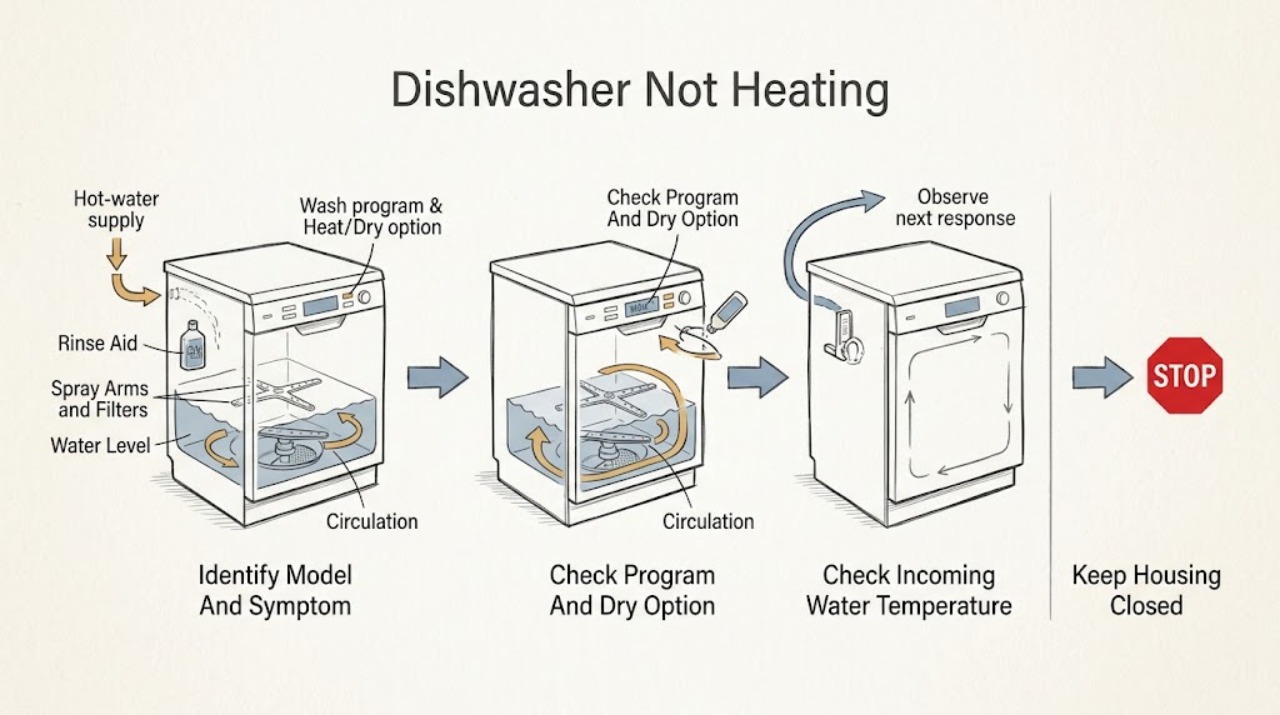
First separate a cold incoming supply or a no-heat program from water that remains cold throughout the wash. Electrolux says hot incoming water helps cleaning, Quick/Fast Wash can use Air Dry rather than heated drying, and Heat Dry is a selectable option on applicable models; plastics and concave items can still retain water. Check the selected program/options, rinse-aid status, water supply temperature at the sink, and whether spray arms and filters are blocked, using only the model manual for controls and cleaning. Do not touch the tub heater or hot water, remove panels, measure live voltage, or bypass a thermostat/door or control safety. Stop for smoke, burning odor, scorching, a hot or damaged cord, water near electrics, repeated breaker trips, or an overheat indication. If a normal heat-enabled program still leaves the wash water cold, the internal heating element, safety thermostat, NTC sensor, relay/control, wiring, water-level or circulation system needs qualified Electrolux service.
Before you begin
Safety first
- This article covers symptom classification, program and incoming-water checks, safe loading/rinse-aid review, and cool unpowered filter/spray-arm inspection. An authorized technician must handle the heater, thermostat, NTC sensor, relay/control, wiring, circulation/pump, water-level sensing, and any live or wet-base diagnostics.
Work through in order
Diagnostic checks
Use only checks that match the exact appliance or system and its official guide.
-
Check 1
Record the dishwasher model and serial information from its rating plate or the model-specific support page. Describe whether the symptom is cool wash water, poor cleaning, wet dishes after the final phase, no visible steam, a long cycle, an error/indicator, or a breaker trip. Do not open the door during a running hot phase just to feel the water.
Expected result: Only dishes are wet, the wash result is poor, the tub water is clearly cold after a completed heat-enabled cycle, a heat/error indication appears, or the unit has an electrical/odor symptom.
Next step: Use the exact manual to identify a heat-enabled cycle and any model-specific indication, then perform only the external checks below. For smoke, burning odor, hot cord, water at electrics, or repeated trips, keep the dishwasher disconnected and arrange service.
Stop if: Do not test temperature by touching wash water, operate with panels removed, or improvise a code reset from another model.
Why this matters
Why: Wet plastics or concave items and an Air Dry/Quick cycle do not prove that wash water failed to heat. Cold water throughout a model’s heat-enabled program, a repeated code, or an electrical symptom makes an internal heating or safety fault more likely.
-
Check 2
With the cycle stopped, check the selected program and options against the exact owner’s manual. Confirm that Quick Wash/Fast Wash, Rinse, Air Dry, or another low-heat option was not selected when heated washing or drying is expected, and check that a delay, pause, or interrupted cycle has not left the program in a different state.
Expected result: The cycle uses Air Dry or a quick program, Heat Dry is not selected, the cycle is Rinse-only, or a full heat-enabled program was selected and the dishes are still cold/wet.
Next step: For a settings explanation, run the exact manual’s intended program with the appropriate options and compare results without touching hot water. If the correct program still does not heat, continue to the incoming-water and circulation checks.
Stop if: Do not change service-mode parameters, force a heating option, or restart an overheated or electrically unsafe unit.
Why this matters
Why: Electrolux states that Quick/Fast Wash uses Air Dry on the applicable guidance, and that Air Dry may leave dishes less dry; this can explain wet dishes without a failed heater. A correctly selected heat-enabled cycle that stays cold shifts attention to supply, circulation, or internal heating.
-
Check 3
Check the hot-water supply at the kitchen sink without opening the dishwasher or touching its wash water. If the home system and installation manual permit it, run the sink until the supply is hot before starting a normal cycle. Confirm the dishwasher’s water supply is on and note whether another fixture is using hot water at the same time.
Expected result: The sink supply is cold or slow to heat, hot water is being used elsewhere, the dishwasher is connected to a cold/incorrect supply for the installation, or the incoming supply is hot but the dishwasher wash remains cold.
Next step: Correct only the household/installation condition allowed by the installation instructions; do not alter plumbing or electrical connections casually. If the supply is suitable but the dishwasher does not heat, continue with safe loading, filter, and spray-arm checks and then service escalation.
Stop if: Do not disconnect hoses, change wiring, open the water inlet or heater circuit, or use a thermometer inside a running cycle.
Why this matters
Why: Electrolux recommends at least 120°F incoming water for cleaning and says running the sink hot first helps the dishwasher reach the desired temperature sooner. A hot supply that still produces cold wash water makes a program, circulation, sensor, heater, or control issue more likely.
-
Check 4
After the appliance is cool and safe, inspect the load and rinse-aid dispenser as the model manual permits. Keep bowls and concave items angled so they can drain, avoid blocking the spray arms or detergent cup, and refill or adjust rinse aid only according to the model instructions. Do not treat a small amount of water on plastic as proof of a heating failure.
Expected result: Only plastics, wood, or concave items are wet, Air Dry was used, rinse aid is empty/low, the load blocks a spray arm or dispenser, or most items remain cold and poorly cleaned after a heat-enabled cycle.
Next step: Correct loading and rinse-aid conditions and use the exact program guidance. If the whole load remains cold or the cycle shows a heating fault, proceed to the external filter/spray-arm check and arrange service if it persists.
Stop if: Do not reach into hot water, add rinse aid to the wash tub, overfill the dispenser, or run with a damaged door seal or water leak.
Why this matters
Why: Electrolux notes that plastics, wooden, and concave items may not dry completely, and that rinse aid improves water sheeting. A blocked spray path can impair washing and heat distribution, but widespread cold water after the correct program is not explained by rinse aid alone.
-
Check 5
Turn the dishwasher off, let it cool, and disconnect power before removing only the user-accessible filter or spray arms described by the exact manual. Rinse food debris from the filter and check that spray-arm holes are visibly clear and the arms can rotate without a rack or utensil blocking them. Reinstall every part correctly before any normal operation.
Expected result: The filter is clogged, spray arms are blocked or cannot rotate, the sump contains standing water, or the filter and spray paths are clean with normal drainage.
Next step: Restore the clean, correctly seated filter and spray arms and follow the manual’s normal cycle guidance. If heating remains absent, do not keep repeating cycles; provide the model and symptom record to authorized service.
Stop if: Do not operate without the filter, reach into the sump, remove the heater or pump, clear a blockage with a sharp tool, or run a panel-open test.
Why this matters
Why: Food debris in filters or spray arms can reduce circulation and cleaning, so water may not contact the heater or dishes as intended. If circulation and drainage are normal but the wash remains cold, an element, thermostat, sensor, relay/control, wiring, or water-level fault is more likely.
-
Check 6
Record the model, program/options, incoming-water condition, whether the unit fills, circulates and drains, filter/spray-arm state, cycle duration, any fault code or light pattern, and any odor, smoke, leak, or breaker event. Keep the dishwasher off if heating is persistently absent or a hazard occurred, and contact an authorized Electrolux servicer.
Expected result: A normal heat-enabled cycle still leaves the wash water cold, the cycle skips or stalls at heating, a heating/temperature code returns, or the machine has an electrical, leak, or overheat symptom.
Next step: Stop use and arrange authorized Electrolux service with the symptom log and model information. Ask the technician to diagnose the circuit and water-level/circulation condition before selecting a part.
Stop if: Do not remove panels, probe the heater, measure resistance or live voltage, reset a safety thermostat, bypass a sensor/relay/door safety, or repair mains wiring yourself.
Why this matters
Why: Selected Electrolux technical documentation for dishwasher platforms identifies the heating element, NTC temperature sensor, safety thermostat, relay/control board, wiring, and water-level/circulation conditions as internal heating-system causes. Exact parts and diagnostics are model-specific and require service access.
Use your observations
Decision map
Find the observation that best matches what you see, then follow the next safe action.
-
PATH 01Safety boundary
What you see
The cycle was Quick/Fast Wash, Rinse, or Air Dry, or only plastic/wood/concave items retain water while other items are acceptably warm and clean.
Do this next
Use the exact manual’s heated program and load/rinse-aid guidance if heat and drying are required. Escalate if a heat-enabled cycle leaves the entire load cold or the symptom spreads beyond drying.
Why this path and its safety boundary
Why it matters: Program and load behavior is more likely than a failed wash-water heater; Electrolux documents Air Dry and item shape/material limits on applicable models.
Safety stop: Do not touch hot dishes or water to compare temperatures.
-
PATH 02Safety boundary
What you see
The kitchen sink supply is cold/slow to heat, another fixture is using hot water, or the installation does not provide the expected hot supply.
Do this next
Follow the installation manual and Electrolux’s supply guidance; reduce competing hot-water use and start only when the supply condition is suitable. Service the dishwasher if the supply is suitable but wash water remains cold.
Why this path and its safety boundary
Why it matters: Incoming-water temperature or household demand can explain slow cleaning/heating at the start of the cycle; it does not prove the dishwasher’s internal heater is defective.
Safety stop: Do not alter plumbing or electrical connections without qualified help.
-
PATH 03Safety boundary
What you see
The filter or spray arms are dirty/blocked, a rack or utensil prevents rotation, or water remains because drainage/circulation is abnormal.
Do this next
With power off and the tub cool, clean and reseat only the user-accessible filter/spray parts allowed by the manual. Arrange service if circulation, drainage, or heating remains abnormal.
Why this path and its safety boundary
Why it matters: Poor circulation can reduce cleaning and heat transfer; the internal heater may not be the first cause to assume.
Safety stop: Do not reach into hot water, run without the filter, or remove the pump/heater.
-
PATH 04Safety boundary
What you see
A heat-enabled program and suitable incoming water were used, filters/spray arms are clear, but the wash remains cold, the cycle stalls/skips heating, or a heating indication returns.
Do this next
Stop using the dishwasher and arrange authorized Electrolux service with the exact model and cycle details. Do not choose a generic heating element or sensor across models.
Why this path and its safety boundary
Why it matters: An internal heating, water-level/circulation, temperature-sensing, safety-thermostat, relay/control, or wiring fault is more likely than a drying-option explanation.
Safety stop: Do not open panels, resistance-test parts, or bypass the heater safety circuit.
-
PATH 05Safety boundary
What you see
Smoke, burning odor, scorching, a hot/damaged cord or plug, water near electrical parts, repeated breaker trips, or an overheat symptom occurs.
Do this next
Stop the cycle and disconnect power only from a dry safe position if the plug can be reached without touching a wet/damaged part. Keep clear and arrange qualified appliance/electrical inspection.
Why this path and its safety boundary
Why it matters: This is an immediate fire, shock, or burn hazard rather than a program or rinse-aid issue.
Safety stop: Do not restart, reset repeatedly, touch the heater or hot water, move a leaking machine, or open the door panel.
Helpful context
Understand the symptom
“Not heating” can mean three different things
A dishwasher can finish with cool dishes because the incoming supply began cold, the selected cycle uses air drying, the heat option is off, or the load itself retains water. That is different from a heat-enabled program whose wash water stays cold, whose cycle takes unusually long, or whose heating fault stops the cycle. Electrolux options and names vary by model, so record the model number and use the matching owner’s manual before interpreting a light, code, or temperature.
Treat the heater and wash water as burn and electrical hazards
Do not reach into a running dishwasher or touch the water, heating element, steam, racks, or dishes immediately after a heated cycle. Stop the cycle using the normal control and disconnect power only from a dry, safe position before user-level filter, spray-arm, or setting checks. Stop immediately for smoke, a burning smell, scorching, a hot or damaged cord/plug, water at electrical parts, repeated breaker trips, or an overheat alarm. Do not remove the door panel or base, probe the heater, measure live voltage, bypass the door latch, thermostat, sensor, or control, or reconnect a machine that has leaked into its electrical area.
Safety boundary
Stop conditions
- Stop immediately for smoke, burning odor, scorching, an unusually hot or damaged cord/plug, water near electrical parts, repeated breaker/GFCI trips, or an overheat indication.
- Do not reach into a running or recently heated tub; use the normal cancel/off control and disconnect power from a dry safe position before user-level filter, spray-arm, or setting checks.
- Do not remove panels, touch or probe the heating element, measure live voltage, reset a thermostat, bypass a door/sensor/relay safety, or repair mains wiring, pump, circulation, or water-level components.
- A cold wash after a correct heat-enabled program and suitable incoming water, or a returning heating/temperature fault, requires authorized Electrolux service.
When checks do not resolve it
Need a professional?
Safety scope: This article covers symptom classification, program and incoming-water checks, safe loading/rinse-aid review, and cool unpowered filter/spray-arm inspection. An authorized technician must handle the heater, thermostat, NTC sensor, relay/control, wiring, circulation/pump, water-level sensing, and any live or wet-base diagnostics.
Common questions
FAQ
Why are my Electrolux dishwasher dishes wet but the dishwasher may still be heating?
Check whether Quick/Fast Wash or Air Dry was selected and whether only plastic, wood, or concave items are wet. Electrolux says those conditions can limit drying, and rinse aid improves water sheeting. If a heat-enabled cycle leaves the entire load cold or poorly cleaned, investigate incoming water and arrange service if it persists.
Does an Electrolux dishwasher need hot water from the house?
Electrolux recommends a minimum 120°F incoming supply for cleaning performance and suggests running the sink until hot before starting. Follow the installation manual for your model. A suitable hot supply that still produces cold wash water points toward circulation, sensing, heater, or control service rather than a household-water adjustment.
Can Quick Wash make an Electrolux dishwasher seem like it is not heating?
Yes, for drying: Electrolux says Quick/Fast Wash uses Air Dry on the applicable guidance rather than a heated dry option, so dishes may not dry completely. That does not establish whether the wash water heated. Use the exact manual’s heat-enabled program when checking a no-heat complaint.
Can a dirty filter or blocked spray arm cause poor heating results?
A blocked filter, glass trap, or spray arm can reduce circulation and cleaning, so check and clean only the user-accessible parts described by the exact manual with power off and the tub cool. If a correct heat-enabled cycle still stays cold, an internal heater, sensor, thermostat, control, wiring, or water-level fault needs service.
When should I stop using an Electrolux dishwasher that is not heating?
Stop for smoke, burning odor, scorching, a hot or damaged cord/plug, water near electrical parts, repeated breaker trips, an overheat indication, or a leak into the base. Disconnect power only from a dry safe position and arrange qualified service. Do not touch the heater, open panels, live-test, or bypass a safety device.
Read the exact guide
Official sources
- Dishwashers - When is it best to use Quick Wash or Fast Wash Cycles?Electrolux · Official Electrolux dishwasher support article; exact cycle names and options vary by model.
- Dishwasher - Loading GuideElectrolux · Official Electrolux dishwasher support article; rack and spray-arm layouts vary by model.
- Dishwasher Rinse Aid GuideElectrolux · Official Electrolux dishwasher support article; dispenser layout and adjustment steps vary by model.
- Where can I find my model and serial number?Electrolux · Official Electrolux support article for all appliances; dishwasher label placement varies by model but is commonly visible with the door open.
- Dishwashers - How can I ensure the best cleaning results?Electrolux · Official Electrolux dishwasher support article; the recommendation is performance guidance, not permission to modify a dishwasher’s internal heating circuit.
- Dishwasher - Not DryingElectrolux · Official Electrolux dishwasher support article; named cycles and drying systems are available only on applicable models.
- Electrolux technical service documentation: heating element and temperature-control componentsElectrolux · Official Electrolux technical service manual for selected older platforms, not a universal owner manual; used only to identify internal component classes and reinforce professional-service boundaries.
- What should I do if my dishwasher is not starting?Electrolux · Official Electrolux dishwasher support article; it supports external control/supply triage, not internal heater repair.
- Dishwasher - Not CleaningElectrolux · Official Electrolux dishwasher support article; exact filter and spray-arm removal is model-specific.
Community feedback
Share a repair observation
Share a plain-text repair observation. Accepted observations are published automatically; this page may take a moment to update.