
On this page
Start here
Quick answer
First separate a cold wash from poor drying: a Quick Wash or Air Dry cycle, plastics and concave items, or an empty rinse-aid dispenser can leave dishes wet without proving the wash water stayed cold. Check the selected program and Heat Dry option, refill rinse aid if your model uses it, and confirm the household water starts hot; Frigidaire recommends a water-heater setting of at least 120°F and says hot water at the sink can improve results. A displayed heat-delay or heater-on status can simply mean the dishwasher is waiting for water to reach its target temperature. If a full model-approved cycle still leaves all dishes cold or wet, or a fault, burning smell, smoke, melting, or breaker trip appears, stop using the unit and arrange service. Do not perform live electrical tests or open the heater/control area.
Before you begin
Safety first
- Do not open the heater, pump, sensor, control, or wiring area; do not measure live voltage, bypass a safety device, or restart after smoke, melting, or an electrical smell. Isolate power only from a dry accessible point if safe and arrange qualified service.
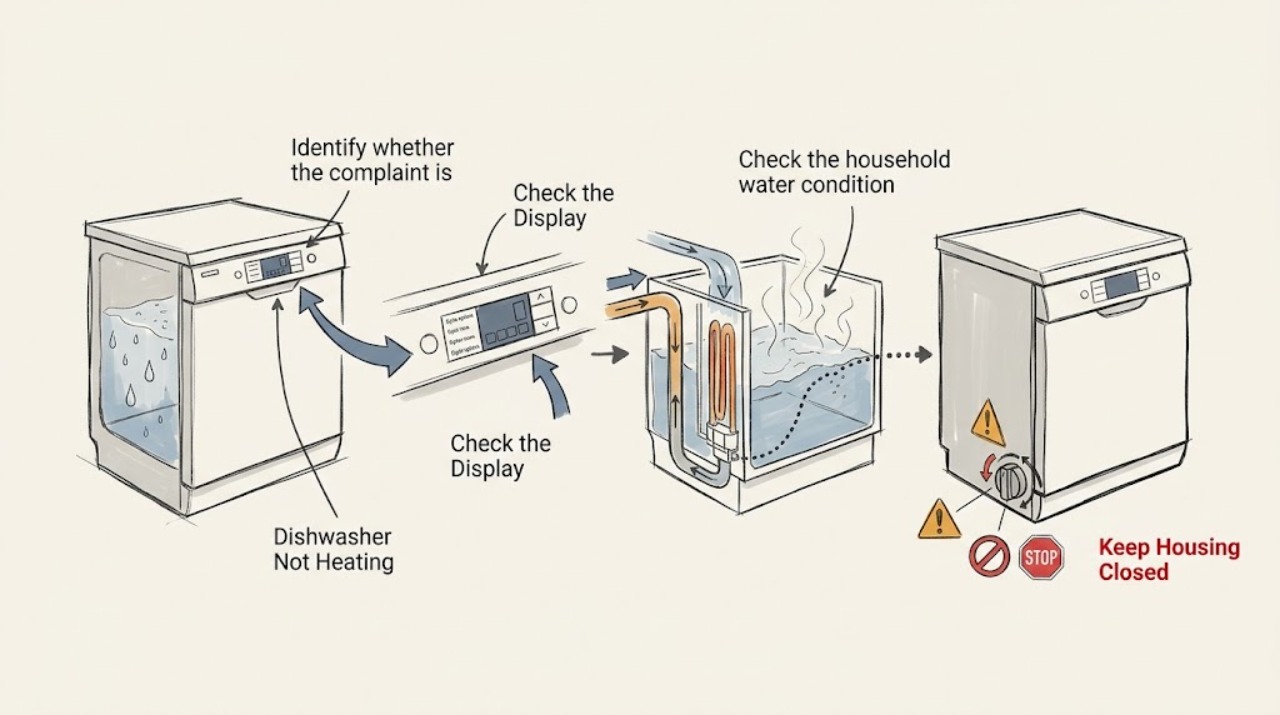
Work through in order
Diagnostic checks
Use only checks that match the exact appliance or system and its official guide.
-
Check 1
Identify whether the complaint is cold wash water, wet dishes, a long heat pause, or all three. Compare a normal full cycle with the model's Quick Wash, Air Dry, Heat Dry, or other selected options, and note whether plastics or concave items are the only items left wet.
Expected result: Only plastics or bowls are wet, a Quick Wash or Air Dry option was selected, the Heat Dry option is off, or every item remains cold and wet after a full cycle.
Next step: Run only the model-approved full cycle with the intended drying option once, if there is no safety sign. Do not open panels or test the heater. If the result remains cold or wet, continue with the water and status checks.
Why this matters
Why: Frigidaire says dish shape/material and cycle or drying-option selection can explain incomplete drying. An all-load failure on a full cycle is more meaningful than a few wet plastics, but it still does not identify the failed internal component.
-
Check 2
Read the display or status lights during the cycle and compare the exact wording or code with the model's owner's manual. Note a heat-delay/heater-on status, a normal pause, a completed cycle, or a recurring fault; do not assume a code from another Frigidaire series applies.
Expected result: The unit shows a documented heat-delay/heater-on status, remains paused while heating, completes normally, or repeats an unexplained heat-related code or flashing pattern.
Next step: Allow a documented heat delay to complete once. If the cycle never advances, the exact code returns, or the status is not covered by the manual, stop repeated resets and arrange Frigidaire service.
Why this matters
Why: Frigidaire describes Hd or HO as a heating delay while water reaches its target temperature. A recurring or unrecognized indication needs model-specific interpretation and may indicate a sensor, heater, control, or fill condition rather than a generic heater failure.
-
Check 3
Check the household water condition without opening the dishwasher: confirm the water supply is on, run the kitchen faucet until hot before starting if practical, and check the water-heater setting against Frigidaire's guidance and local safety requirements.
Expected result: The incoming water is cold, the household heater is set below the recommended 120°F, the water supply is restricted, or the external water condition is normal.
Next step: Correct only an obvious supply setting or wait until household water use is lower. Do not adjust unsafe plumbing or open the dishwasher. If the supply is normal but the wash remains cold, continue to the drying and service boundary.
Why this matters
Why: Frigidaire says colder incoming water extends heating delay and recommends at least 120°F for cleaning performance; restricted water can also affect operation. A normal external supply makes an internal heating or sensing issue more likely only after a full cycle confirms the symptom.
-
Check 4
Check the rinse-aid dispenser and drying setup from the user-accessible area. Refill rinse aid only if the exact model uses it and the indicator or manual calls for it; compare Heat Dry, Air Dry, and any model-specific forced-air option without changing unrelated settings.
Expected result: Rinse aid is empty, Heat Dry or the model's drying option is off, Air Dry was selected, or the drying settings and rinse aid are normal but all items remain wet.
Next step: Use the model-approved drying option and rinse aid once, then compare the result. If a full cycle still has no heat or drying response, do not replace a heater based on wet dishes alone; arrange qualified diagnosis.
Why this matters
Why: Rinse aid helps water sheet off dishes, Heat Dry uses heat, and Air Dry may leave dishes less dry; selected forced-air drying is model-dependent. These observations explain drying performance but do not prove that the wash-water heater is defective.
-
Check 5
Stop and record any escalation sign: burning smell, smoke, melted plastic, unusual heat, water near wiring, repeated breaker trip, a fault that returns, or a full model-approved cycle that remains cold after the external checks.
Expected result: Any safety sign is present, or the unit consistently fails to heat after the cycle, water, option, and rinse-aid checks.
Next step: Stop using the dishwasher, isolate power from a dry accessible point if safe, keep hands and tools away from internal components, and contact Frigidaire support or a qualified appliance technician. Do not bypass a safety device or perform live electrical tests.
Why this matters
Why: An internal heater, sensor, pump, control, wiring, or fill problem may be involved. The user-accessible checks cannot identify which part is at fault, and live testing or cover removal creates additional risk.
Use your observations
Decision map
Find the observation that best matches what you see, then follow the next safe action.
-
PATH 01Next step
What you see
Do this next
Angle concave items, use the model-approved Heat Dry and rinse aid settings, and monitor. Do not replace a heater based on this pattern alone.
-
PATH 02Next step
What you see
Do this next
Compare one model-approved full cycle with the intended drying option and rinse aid. If all items remain cold as well, proceed to water temperature and service checks.
-
PATH 03Next step
What you see
Do this next
Allow the documented delay to complete and improve the external hot-water condition if safe. If the status never clears or a model-specific fault repeats, arrange service.
-
PATH 04Next step
What you see
Do this next
Stop repeated cycles and arrange qualified Frigidaire service. Do not open the heater area, measure voltage, or substitute a model-specific part without diagnosis.
-
PATH 05Next step
What you see
Do this next
Stop the dishwasher immediately, isolate power from a safe accessible point if possible, and arrange qualified service. Do not restart it to reproduce the symptom or perform live tests.
Helpful context
Understand the symptom
Wet dishes are not the same as a cold wash
Check the result on several loads before naming a failed heater. Plastic, wood, bowls and other concave items may retain water, Quick Wash or 30 Minute programs may not dry completely, and Air Dry intentionally relies on air rather than heat. Compare the selected cycle, rinse aid, and the temperature of the water entering the machine with the exact owner's manual for the model.
Recognize a heating delay before stopping the cycle
On applicable Frigidaire models, Hd or HO indicates Heat Delay or Heater On mode while the unit heats water to its operating target; colder incoming water makes the delay longer. Do not treat that display as a universal fault code for every model. Record the exact display and use the manual for that model rather than applying another series' code table.
Separate incoming-water conditions from an internal heater fault
Frigidaire recommends a household water-heater setting of at least 120°F and suggests running the kitchen sink until hot before starting a cycle. This is an external water-condition check, not a reason to open the dishwasher or measure live voltage. If water enters hot enough yet a model-approved full cycle consistently has no heating or drying response, the heater, sensor, wiring, or control needs qualified diagnosis.
When checks do not resolve it
Need a professional?
Use Frigidaire support or a qualified appliance technician when a documented heat status never completes, a model-specific heat fault recurs, a full cycle remains cold after the water and option checks, or any burning odor, smoke, melting, breaker trip, water near wiring, or unusual heat appears.
Safety scope: Do not open the heater, pump, sensor, control, or wiring area; do not measure live voltage, bypass a safety device, or restart after smoke, melting, or an electrical smell. Isolate power only from a dry accessible point if safe and arrange qualified service.
Common questions
FAQ
Do wet dishes prove that my Frigidaire dishwasher is not heating?
No. Plastics, wood, concave dishes, Quick Wash, Air Dry, an empty rinse-aid dispenser, and model-specific drying options can all affect dryness. Compare a full model-approved cycle and observe whether the wash water is also cold before treating it as a heating fault.
What does Hd or HO mean on a Frigidaire dishwasher?
On models that use those indications, Frigidaire says Hd or HO means Heat Delay or Heater On mode while the dishwasher heats water. Colder incoming water makes the delay longer. Do not apply that meaning to a different display or model without checking its owner's manual.
What water temperature should I check before blaming the heater?
Frigidaire recommends a household water-heater setting of at least 120°F for cleaning performance and suggests running the kitchen sink until hot before starting. This is an external condition check, not permission to open the dishwasher or perform electrical testing.
Read the exact guide
Official sources
- Dishwashers - How can I ensure the best cleaning results?Frigidaire · Frigidaire dishwasher incoming-water temperature and cleaning-performance guidance
- Dishwasher - Not FillingFrigidaire · Frigidaire dishwasher water-supply and fill checks
- DishwashersFrigidaire · Frigidaire dishwasher owner support and troubleshooting index
- Dishwasher Error Code Hd or HO - Heat delay or heater on mode activatedFrigidaire · Frigidaire dishwasher Hd/HO heat-delay and heater-on guidance
- What should I do if my dishwasher is not starting?Frigidaire · Frigidaire dishwasher start, door, water-supply, and model-control checks
- Dishwashers Flashing LightsFrigidaire · Frigidaire dishwasher status-light and service escalation guidance
- Dishwasher - Not DryingFrigidaire · Frigidaire dishwasher drying-performance guidance
Community feedback
Share a repair observation
Share a plain-text repair observation. Accepted observations are published automatically; this page may take a moment to update.