
On this page
Start here
Quick answer
If an Aeg dishwasher finishes with cold dishes or no steam, first confirm that the selected programme is suitable, then switch the appliance off and clean only the user-accessible filters and sump area. If there is water and foam in the tub, deal with the foam and do not continue normal cycles until it is gone. You can reset the dishwasher by switching it off at the mains for five minutes and switching it back on. If it still does not heat after those checks, the heating system may be faulty: stop using the dishwasher, unplug it, and arrange qualified service rather than opening the cabinet or testing live parts.
Before you begin
Safety first
- Do not remove cabinet panels, test live voltage or wiring, bypass a safety device, force filters, or continue operating after smoke, burning odor, electrical damage, water near electrical parts, repeated breaker operation, persistent no-heat results, or washing-up liquid in the rinse-aid chamber.
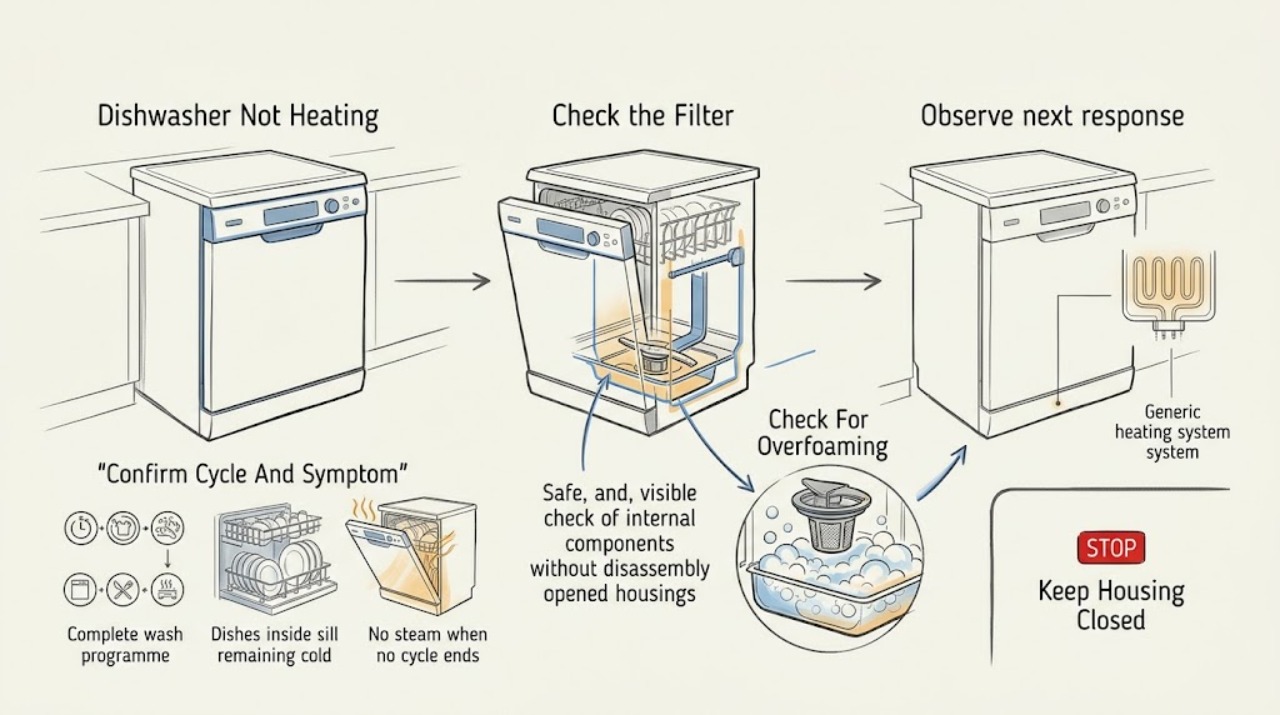
Work through in order
Diagnostic checks
Use only checks that match the exact appliance or system and its official guide.
-
Check 1
Let the cycle finish and note the selected Aeg programme, whether the load is unusually dirty, whether the dishes are cold, and whether there is steam when the door opens. Compare the programme with the exact user manual rather than judging heat from a quick programme alone.
Expected result: A quick or otherwise lower-intensity programme was selected, the cycle was interrupted, or a suitable programme completed with cold dishes and no steam.
Next step: If the programme was unsuitable or interrupted, use the manual to choose an appropriate programme and observe one complete cycle. If a suitable complete cycle remains cold, continue with the filter and sump check.
Stop if: Do not touch standing hot water or dismantle the dishwasher to measure temperature or inspect the heater.
Why this matters
Why: Programme selection or an incomplete cycle can explain poor washing or drying results without proving a heating-system failure. A suitable completed programme with both cold dishes and no steam makes a persistent heating problem more plausible, but it is still not a component diagnosis.
-
Check 2
Switch the dishwasher off, wait for the interior to be safe to reach, and clean only the removable filters and user-accessible sump area as shown in the Aeg user manual. Remove visible food particles without taking off covers or reaching into the cabinet.
Expected result: Food particles or residue are blocking the filters or sump, or the filters and sump are visibly clear.
Next step: If residue was present, refit the filters correctly according to the manual and run an appropriate complete programme. If the filters and sump were already clear, continue to the foam and reset checks.
Stop if: Do not force a filter, remove the pump or heater cover, use tools inside the sump, or work on the appliance while it is energized.
Why this matters
Why: Aeg lists blocked filters and sump as a possible contributor to poor results. Clearing visible residue can remove a circulation restriction, but clear filters do not prove that the heating system is healthy or faulty.
-
Check 3
Look at the tub after the programme for water and foam, and review whether washing-up liquid was used on the crockery or spilled into the rinse-aid chamber. From a safe position, remove accessible foam with a sponge or towels; do not start normal washing while the tub is still foaming.
Expected result: There is water and foam at the bottom, there is evidence of hand-washing liquid or rinse-aid spillage, or there is no visible foam.
Next step: If foam is present, remove what is safely accessible and follow the model manual or Aeg support guidance until the foam is gone. If washing-up liquid entered the rinse-aid chamber, stop and arrange service. If there is no foam, continue with the reset check.
Stop if: Do not add unapproved chemicals, run repeated cycles to chase foam, or continue using the dishwasher when washing-up liquid is in the rinse-aid chamber.
Why this matters
Why: Aeg treats over-foaming as a separate cause of poor results. Foam can interfere with the cycle, so its presence weakens the conclusion that the heater itself is the first cause. Washing-up liquid in the rinse-aid chamber requires a technician visit according to Aeg.
-
Check 4
After the interior is safe and any foam issue is addressed, switch the dishwasher off at the mains supply, wait five minutes, switch it back on, and restart an appropriate programme as Aeg describes. Do not repeat the reset if there is damage, smoke, a burning smell, water near electrical parts, or a breaker problem.
Expected result: The next complete appropriate programme heats normally, or the dishes remain cold and there is still no steam.
Next step: If heat returns, monitor the next normal load and keep the programme and filter condition noted. If the result is still cold, stop using the dishwasher, unplug it, and arrange qualified Aeg or appliance service.
Stop if: Do not open the cabinet, bypass a safety device, or test live voltage or internal wiring.
Why this matters
Why: Recovery after the reset makes a temporary control or interrupted-cycle condition more plausible. Persistent cold results after the programme, filter, foam, and reset checks make an internal heating fault more plausible, but they do not identify the failed component.
-
Check 5
Record the exact Aeg model and product number, the programme used, whether the dishes were cold and steam was absent, the filter and sump condition, any foam or detergent mistake, and the result of the five-minute reset.
Expected result: The dishwasher remains cold after the user-accessible checks, or the problem includes foam in the rinse-aid chamber, repeated electrical symptoms, damage, or an unsafe interior.
Next step: Leave the dishwasher unplugged and arrange qualified appliance service with the recorded information. Use the exact model manual and support route for any further model-specific instruction.
Stop if: Do not order or replace a heater, pump, control board, or other internal part based only on the cold-dish symptom.
Why this matters
Why: Aeg identifies a possibly faulty heating element when no heat remains and recommends a service engineer. The recorded pattern helps service distinguish a programme or foaming condition from a persistent internal fault without requiring the owner to name a part.
Use your observations
Decision map
Find the observation that best matches what you see, then follow the next safe action.
-
PATH 01Next step
What you see
The dishwasher used a quick or unsuitable programme, was interrupted, or has visible water and foam at the end of the cycle.
Do this next
Correct the programme using the exact manual, address the foam safely, and only then judge a complete cycle. If washing-up liquid entered the rinse-aid chamber, stop and arrange a technician visit.
-
PATH 02Next step
What you see
A suitable complete programme is cold, and the filters or sump contain food residue or other visible restriction.
Do this next
Clean and refit only the user-accessible filters as directed in the manual, then run one appropriate complete programme. Escalate if the load is still cold.
-
PATH 03Next step
What you see
A suitable programme completed with no steam and cold dishes after the filters and sump are clear, foam is absent or resolved, and the five-minute reset changes nothing.
Do this next
Stop using the dishwasher, unplug it, and arrange qualified appliance service. Do not open the cabinet or perform energized tests.
-
PATH 04Next step
What you see
There is smoke, a burning smell, visible electrical damage, water near electrical parts, repeated breaker operation, or washing-up liquid in the rinse-aid chamber.
Do this next
Keep the appliance disconnected and arrange qualified appliance or electrical service as appropriate. Do not attempt further cycles or internal inspection.
Helpful context
Understand the symptom
What the symptom tells you
Cold dishes at the end of a completed cycle and no steam when the door opens are consistent with the heating complaint, but they do not identify a failed heater by themselves. A quick or low-temperature programme, restricted filters or sump, and excess foam can affect washing and drying results. Use the checks below to separate those user-visible conditions from a fault that needs service.
Keep the checks at the user-accessible boundary
The useful checks are the programme choice, visible foam, and the removable filters and sump area described for the dishwasher. Do not remove cabinet panels, test wiring, or try to prove which internal component has failed. Aeg says the heating element may be faulty and recommends a service engineer when the no-heat problem remains.
Treat persistent no-heat as a service condition
If a suitable programme, clear filters and sump, and a five-minute mains reset do not restore heat, preserve the exact model and programme information for the technician. Leave the appliance unplugged until the problem is fixed, especially after repeated cold cycles, visible damage, unusual electrical behavior, or foam caused by washing-up liquid in the rinse-aid chamber.
When checks do not resolve it
Need a professional?
Arrange qualified appliance service when a suitable complete programme remains cold after the accessible filter, sump, foam, and reset checks, when the rinse-aid chamber contains washing-up liquid, or whenever the appliance shows an electrical or physical safety concern. Aeg says not to use the product until the problem is fixed and to unplug it until it is safe to reconnect.
Safety scope: Do not remove cabinet panels, test live voltage or wiring, bypass a safety device, force filters, or continue operating after smoke, burning odor, electrical damage, water near electrical parts, repeated breaker operation, persistent no-heat results, or washing-up liquid in the rinse-aid chamber.
Have this ready
- Exact Aeg model and product number
- Programme used and whether the cycle completed
- Cold-dish and no-steam observations
- Filter and sump condition
- Any foam, detergent, or rinse-aid mistake
- Result of the five-minute mains reset
Common questions
FAQ
Does cold crockery prove that the Aeg dishwasher's heating element has failed?
No. Aeg also lists programme selection, blocked filters or sump, and over-foaming as possible causes of poor results. Persistent cold dishes and no steam after those checks make service appropriate, but only a qualified technician should diagnose an internal part.
Should I clean the Aeg dishwasher filters when it is not heating?
Yes, clean only the user-accessible filters and sump area shown in the exact model manual. Visible food residue can contribute to poor results, but clear filters do not prove that the heating system is working or failed.
How do I reset an Aeg dishwasher that is not heating?
Aeg's support instruction is to switch the appliance off at the mains, wait five minutes, switch it back on, and restart it. Do not repeat this test when there is smoke, damage, water near electrical parts, a burning smell, or another safety concern.
Can washing-up liquid cause an Aeg dishwasher to stop heating?
Excess foam can lead to poor wash results, and Aeg says washing-up liquid in the rinse-aid chamber requires a technician visit. Remove only accessible foam safely and leave the dishwasher unused until the issue is resolved.
Read the exact guide
Official sources
- Your AEG Support - Customer Support | AEGAEG · AEG UK support and model/product-number information for arranging appliance help
- Dishwasher is not heating up waterAEG · AEG UK dishwasher heating symptoms, programme, filter and sump, reset, over-foaming, and service guidance
- Dishwasher is not heating up waterAEG · AEG Ireland dishwasher heating symptoms and the same user-level programme, filter, reset, foam, and service guidance
Community feedback
Share a repair observation
Share a plain-text repair observation. Accepted observations are published automatically; this page may take a moment to update.