
On this page
Start here
Quick answer
On an AEG dishwasher, i60 is used for a heating-related problem, including not heating or not drying, but it does not identify a failed heater by itself. For the assigned F45010W0, first record the complete display and rating-plate PNC, then confirm that the incoming water supply is not above 60°C. With the appliance safely unplugged and the exact manual permitting access, clear foam or debris from the filters and sump, reconnect once, and observe one suitable cycle. If i60 returns, the water stays cold, or drying remains absent, stop repeated resets and arrange service to test the model-specific heater, temperature sensor, wiring, control, and water-level conditions.
Before you begin
Safety first
- Do not open the cabinet, probe live wiring, bypass the heater or temperature sensor, defeat a water-level or flood protection, or keep testing when there is leaking water, smoke, a burning smell, exposed wiring, a damaged cord or plug, or repeated electrical tripping.
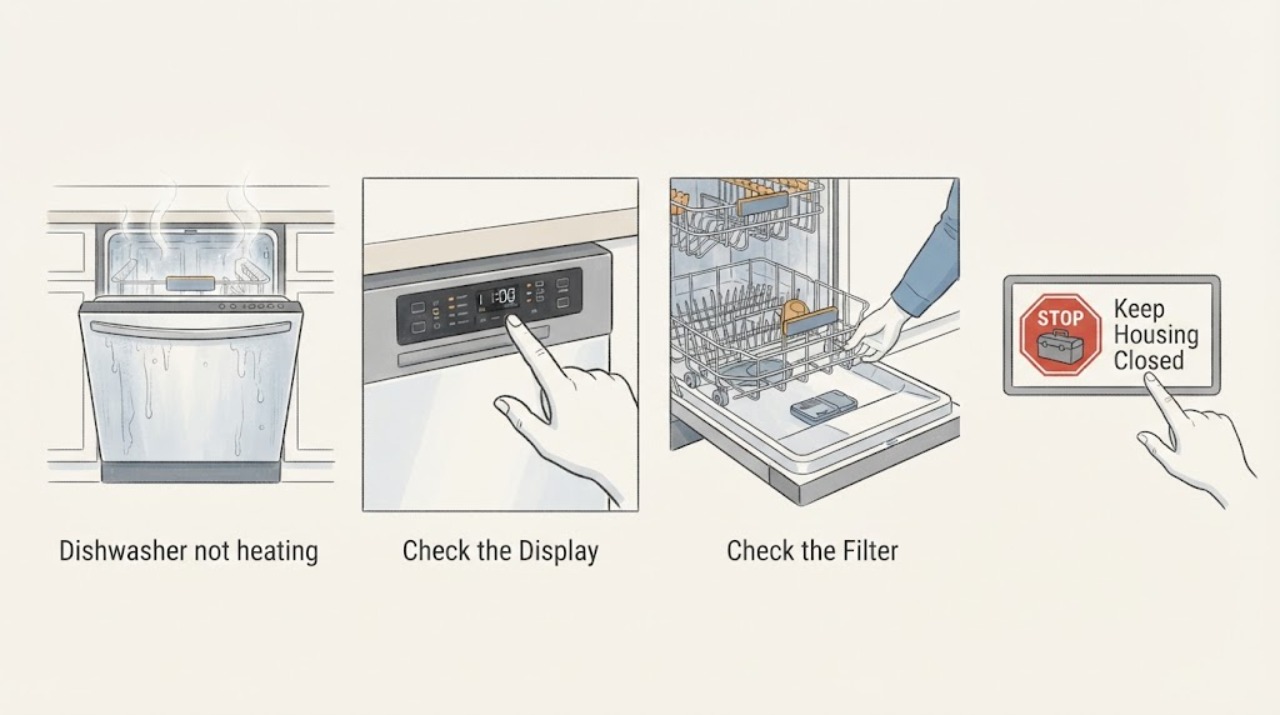
Work through in order
Diagnostic checks
Use only checks that match the exact appliance or system and its official guide.
-
Check 1
Before clearing anything, photograph the display and rating plate and write down the complete code, any beeps or flashes, the full model F45010W0, PNC, programme, and the stage at which the machine stops. Note whether the wash water feels cold only from a safe external observation, whether dishes remain wet, and whether there is water, foam, a burning smell, or an electrical trip.
Expected result: The display is clearly i60 during heating or drying, or the code is partial, different, or accompanied by a leak, smoke, burning smell, exposed wiring, or a breaker trip.
Next step: If the identity is clear and there is no hazard, continue with the checks below. If the identity is uncertain, retrieve the manual using the PNC. For a hazard or electrical trip, isolate power only if safe, close the water tap if leaking, and arrange qualified service.
Why this matters
Why: A clear i60 during the heating portion supports AEG's heating-related branch; a partial or different display cannot safely use that meaning. A hazard takes priority over troubleshooting.
-
Check 2
Check the incoming household water setup without opening the dishwasher or working on live plumbing. AEG says the incoming water at the connection point should not exceed 60°C; compare the safe accessible setting or measurement with that limit and keep the model manual and local plumbing instructions controlling.
Expected result: The incoming supply is above 60°C, its temperature cannot be established safely, or it is at or below 60°C.
Next step: Correct an over-temperature supply only through a safe, documented household or plumbing adjustment, then follow the exact manual. If the supply is within the limit or remains uncertain and i60 persists, continue to the power-isolated accessible check rather than changing a heater part.
Why this matters
Why: AEG warns that water above 60°C can adversely affect detergent enzymes and wash results; this check can explain poor performance or an unsuitable installation condition but does not prove the internal heater is sound. An unknown temperature is not evidence that the supply is correct.
-
Check 3
Switch the dishwasher off and unplug it before any accessible cleaning. Following the matching F45010W0 manual, inspect the filters and sump for foam, suds, or debris; remove only material that is accessible without removing panels, reaching into uncontrolled standing water, or touching heater, pump, sensor, or wiring parts.
Expected result: Foam or debris is present in the filters or sump, or these areas are clear but the appliance has standing water, a leak, or a damaged component visible.
Next step: Clear only the accessible foam or debris, refit the filters correctly, and keep the appliance disconnected until the area is safe. For a leak, standing water that cannot be controlled, or damage, close the water tap and arrange service instead of continuing.
Why this matters
Why: AEG specifically includes foam/suds and debris in its i60 reset guidance, so clearing an accessible obstruction is a distinct supported first check. A leak, uncontrolled water, or damage is outside a routine clean-and-reset and may indicate a separate safety or water-level issue.
-
Check 4
After the filters and sump are safely restored, reconnect power once, select a suitable programme, and observe without opening the cabinet or repeating resets. Note whether the programme reaches its heating stage, whether dishes dry, whether water remains cold, and whether i60 returns.
Expected result: The cycle completes normally, or i60 returns and the load remains cold or wet.
Next step: If the cycle completes, monitor the next load and keep the code record. If i60 returns, stop repeated testing and arrange authorised AEG or qualified appliance service with the PNC and observations; do not select a replacement part from the code alone.
Why this matters
Why: A normal cycle after the supported clean-and-reset suggests a temporary foam or debris condition may have contributed, but it does not certify the heater. A returning i60 with cold water or no drying is consistent with an unresolved heating, temperature-sensing, water-level, wiring, or control problem.
-
Check 5
Use the exact F45010W0 PNC and regional manual to check any model-specific user reset or service instruction. Do not remove the outer cabinet, perform live electrical tests, bypass a heater or temperature sensor, or substitute an i60 meaning from another AEG product line.
Expected result: The PNC identifies a matching manual with a documented user step, or the manual is unavailable, conflicts with the display, or the code continues after the supported checks.
Next step: Follow only a clearly documented user step from the matching manual. Otherwise stop and provide the PNC, display photo, cycle stage, incoming-water result, filter/sump condition, and cycle outcome to service.
Why this matters
Why: AEG's manual lookup is PNC-based, so the matching document controls model-specific procedures. Missing documentation or a continuing i60 leaves an internal fault unconfirmed and crosses the owner-safe boundary.
Use your observations
Decision map
Find the observation that best matches what you see, then follow the next safe action.
-
PATH 01Next step
What you see
The incoming supply is above 60°C or the household installation does not match the safe temperature requirement.
Do this next
Have the supply corrected safely according to the local installation instructions and the exact F45010W0 manual, then observe one suitable cycle. If i60 remains, arrange service.
Why this path and its safety boundary
Why it matters: The water supply is an installation condition that can affect washing and drying; it does not establish a failed internal heater or justify a heater replacement.
-
PATH 02Next step
What you see
Foam or debris is found in the accessible filters or sump and i60 does not return after a safe clean-and-reset cycle.
Do this next
Monitor the next load, use detergent and loading instructions from the exact manual, and arrange service if the code or no-heat symptom recurs.
Why this path and its safety boundary
Why it matters: A temporary suds or debris condition may have interfered with the monitored cycle, but one successful cycle does not prove the heating system is healthy.
-
PATH 03Next step
What you see
Filters and sump are clear, the supply is not above 60°C, and i60 returns with cold water or dishes that remain wet.
Do this next
Stop repeated cycles and arrange qualified service for the exact F45010W0 PNC. Ask the provider to test the heating circuit and temperature-sensing/control conditions before selecting a part.
Why this path and its safety boundary
Why it matters: The supported user checks have not resolved the heating-related report. A heater, temperature sensor, wiring, control, circulation, or water-level issue remains possible; i60 alone cannot select among them.
-
PATH 04Next step
What you see
The display is not i60, the F45010W0 identity or PNC cannot be matched, or several codes appear together.
Do this next
Use the exact PNC/manual or arrange service with a photo of the complete display. Do not borrow a code table or reset from another AEG dishwasher or appliance category.
Why this path and its safety boundary
Why it matters: The i60 interpretation is not established for that display or identity, and a mixed event cannot safely be reduced to one code or one component.
-
PATH 05Next step
What you see
There is a leak, uncontrolled standing water, burning smell, smoke, exposed wiring, a hot or damaged plug, or repeated electrical tripping.
Do this next
Stop the programme, close the water tap where applicable, disconnect power only if safe, keep clear of damaged parts, and arrange qualified service. Do not reopen the appliance to test it.
Why this path and its safety boundary
Why it matters: The situation may involve water or electrical hazards beyond an ordinary i60 heating symptom.
Helpful context
Understand the symptom
What i60 establishes
AEG's dishwasher support article groups i60, i61, i69, and i6C with a dishwasher that is not heating or not drying. That is a monitored heating-related symptom, not proof that the heater itself is the failed part. The article says the remaining cause may involve excessive water in the appliance or a temperature-sensor malfunction, so a recurring code needs model-specific service diagnosis.
Why the F45010W0 identity matters
This page is scoped to the assigned AEG dishwasher F45010W0, but AEG documents are retrieved by the exact model and PNC on the rating plate. Do not borrow a reset sequence, heater location, or component part from another AEG dishwasher, a different F45010W0 PNC variant, or another brand. If the display is not actually i60 or the model cannot be matched, use the exact manual instead of this code interpretation.
Only after diagnosis
Potential parts
- model-specific dishwasher heating system or temperature-sensor assembly
Consider a part only after service confirms that the recurring i60 is caused by a particular heater, temperature sensor, connector, wiring, or control fault. The official i60 guidance does not establish which component has failed.
Confirm the complete F45010W0 PNC and regional model documentation before ordering; i60 is not sufficient to prove part fit or authorise owner replacement.
When checks do not resolve it
Need a professional?
Arrange authorised AEG or qualified appliance service when i60 returns after the safe water-temperature, accessible filter/sump, and one-cycle observation checks; when the cycle remains cold or does not dry; when the exact PNC/manual cannot be matched; or whenever a leak or electrical hazard is present.
Safety scope: Do not open the cabinet, probe live wiring, bypass the heater or temperature sensor, defeat a water-level or flood protection, or keep testing when there is leaking water, smoke, a burning smell, exposed wiring, a damaged cord or plug, or repeated electrical tripping.
Have this ready
- Provide the full model F45010W0, rating-plate PNC and serial number, country, a photo or transcription of i60, programme and stage, any beeps or flashes, incoming-water temperature finding, filter/sump condition, whether the cycle completed, and any leak or electrical observations.
Common questions
FAQ
What does i60 mean on an AEG dishwasher?
AEG groups i60 with a dishwasher that is not heating or not drying. It is a heating-related report, not proof that the heater itself must be replaced; the exact PNC and service diagnosis remain important.
Can I reset AEG dishwasher i60 myself?
AEG's i60 guidance supports unplugging the dishwasher, checking the accessible filters and sump for foam or debris, reconnecting, and observing a suitable cycle. Use the exact F45010W0 manual for model-specific instructions and stop if the code returns or a safety hazard is present.
Does i60 prove that the AEG dishwasher heater is bad?
No. AEG's support guidance also identifies excessive water and a temperature-sensor malfunction as possible causes. A recurring i60 requires testing of the exact model's heating, sensing, wiring, control, and related water-level conditions.
Read the exact guide
Official sources
- Dishwasher displays an error code, how to fix it? | AEGAEG · The opened AEG support article identifies i60 or similar displays as a heating problem and routes readers to the specific i60 article; it does not establish a component or model-independent part diagnosis.
- Dishwasher displays error code i60 / i61 / i69 / i6C | AEGAEG · The opened AEG support article directly covers dishwasher i60-family displays, not-heating or not-drying symptoms, the incoming-water temperature check, the supported unplug/filter/sump reset, and the service boundary. It is a UK-locale support article, so exact F45010W0 PNC instructions must be checked separately.
- AEG User Manuals: How to Find & Download InstructionsAEG · The opened AEG guidance explains that owners should use the exact model and PNC from the rating plate to find the matching manual. It is evidence for the identity boundary and model-specific documentation route, not an i60 component definition.
Community feedback
Share a repair observation
Share a plain-text repair observation. Accepted observations are published automatically; this page may take a moment to update.