
On this page
Start here
Quick answer
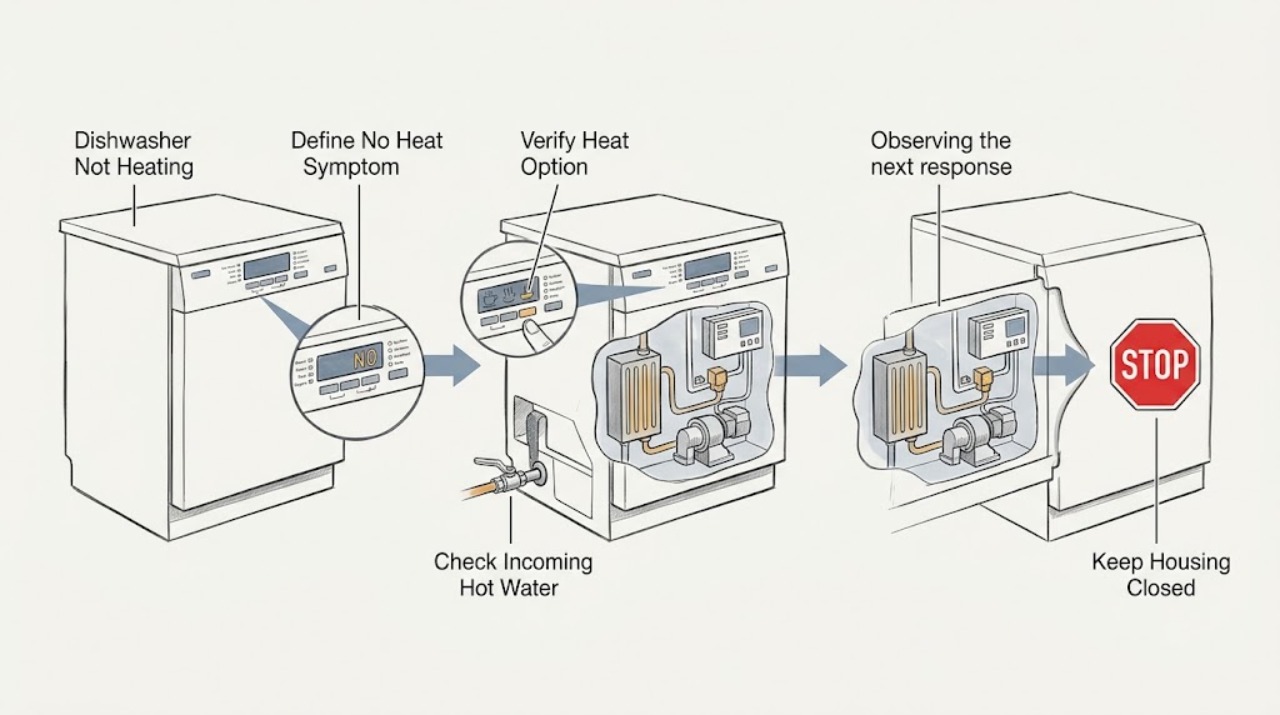
First decide whether the GE dishwasher truly fails to heat or is simply using a no-heat drying option. GE says natural-convection drying is expected when Heated Dry is not selected, and model options differ. Check the exact manual and select a cycle or heat option that is actually available on the model; then confirm the dishwasher receives hot water rather than a cold-water connection or a depleted hot-water line. Wet plastic or puddles in cup bottoms do not by themselves prove heater failure. GE dishwashers may use a visible Calrod heating element or a hidden heater integrated into the wash-pump assembly, so do not expect every model to show a glowing element or an exposed part. If the selected heat option is active but wash water and drying remain cold, dishes stay dirty, a fault appears, the element or tub is damaged, or a breaker trips, stop and arrange qualified service. Do not open panels, touch a heating element, probe wiring, or test the heater while energized.
Before you begin
Safety first
- This article supports cycle, water-supply, and ordinary-access visual checks only. Do not touch a hot element, open panels, remove a hidden heater or sump, test live wiring, disconnect plumbing, or operate a damaged or leaking appliance.
Work through in order
Diagnostic checks
Use only checks that match the exact appliance or system and its official guide.
-
Check 1
After a completed cycle and once the tub is safe to approach, record the cycle name, heat or dry options, dish temperature, residual water pattern, wash quality, and whether the complaint is about washing, rinsing, or drying.
Expected result: Record warm dishes with wet plastics only, cold or greasy dishes, no warmth after a heated option, pooled water in cup shapes, a cycle that was Rinse Only or no-heat dry, or an interrupted cycle.
Next step: Repeat only with a model-supported heated cycle if safe and appropriate, then compare the result without touching the element or opening service panels.
Stop if: Stop for smoke, burning odor, melting plastic, a damaged tub or element, water near electrical parts, or an interrupted cycle with an unresolved fault.
Why this matters
Why: Wet plastics, cup-bottom puddles, and no-heat settings do not establish a failed heater. Cold wash water or a consistently cold load on a model and cycle that should heat is a stronger service symptom.
-
Check 2
Use the exact GE dishwasher Owner's Manual to confirm whether the selected cycle supports Heated Dry, Added Heat, Hi-Temp Wash or Rinse, Power Dry, or another heat option, and select only an option shown for that model.
Expected result: Record a supported heat option selected, an unavailable option, a Rinse Only or energy-saving setting, an option that cancels or changes unexpectedly, or no user-facing heat option on the model.
Next step: Run one compatible cycle with the documented heat option and compare wash and dry results; if the option is selected but the result remains cold, continue to water and heater-architecture checks.
Stop if: Do not use a button sequence from another GE model, force a locked control, or open the control panel.
Why this matters
Why: GE says dishwasher options vary and that natural-convection drying occurs when a heating option is not selected. An unavailable or intentionally no-heat cycle can explain a cold or wet result without a component failure.
-
Check 3
From the faucet nearest the dishwasher, observe the hot-water supply before starting a cycle and verify from visible plumbing access that the dishwasher is not connected to a cold-water line; do not disconnect the appliance water line.
Expected result: Record hot water arriving promptly, a long wait for hot water, water that remains cool, recent use of another hot-water fixture, or a visible connection that cannot be identified safely.
Next step: Allow the nearby faucet to reach its normal hot condition before starting the next compatible cycle and have an installer or plumber correct an uncertain supply connection; if supply is appropriate and the load stays cold, arrange appliance service.
Stop if: Do not adjust a water heater by guesswork, disconnect pressurized tubing, pull out a built-in dishwasher, or work under a wet sink.
Why this matters
Why: GE says incoming water temperature affects wash and dry performance and that a dishwasher cannot make a cold-water connection hot enough for effective washing. A supply problem can mimic a dishwasher heater failure.
-
Check 4
Using the exact model manual or specifications, determine whether the dishwasher has a visible tub element or a hidden heater integrated into the wash-pump assembly; inspect only for a loose rack item or obvious melted plastic after the element is cool and without moving the heater.
Expected result: Record a visible element with no obstruction, a visible element with plastic or food against it, a hidden-heater model, an unknown architecture, or a damaged element, tub, rack, or pump area.
Next step: Remove only a loose, cool, accessible item if the manual permits and the element is undamaged; otherwise document the model and arrange service for heater, pump, sensor, or control diagnosis.
Stop if: Do not touch a hot element, scrape melted material, remove a hidden-heater cover, reach beneath the tub, or perform resistance or live-voltage tests.
Why this matters
Why: GE says heater architecture varies and a hidden heater is not visible because it is integrated with the wash pump. A visible element may be affected by an object, but heater continuity, temperature sensing, pump, and control faults cannot be determined by sight.
-
Check 5
After the model-supported cycle, heat-option, water-supply, and safe visual checks, document whether the dishwasher heats, dries, cleans, and completes without a fault or electrical symptom.
Expected result: Record normal heating after a setting or supply correction, persistent cold water and wet dishes, a fault or incomplete cycle, a breaker trip, burning odor, smoke, melting plastic, leak, or damaged element or tub.
Next step: Arrange qualified appliance service with the model, cycle, options, water observation, heater architecture, and symptom record; use qualified electrical or plumbing service when the issue is external.
Stop if: Do not open panels, probe wiring, bypass a thermal device, test energized parts, or continue operating with smoke, arcing, melting, leaks, or a damaged heater.
Why this matters
Why: A corrected setting or supply can explain the original symptom. Persistent no heat with appropriate settings and supply suggests a heater, hidden heater or pump assembly, sensor, control, wiring, or related fault; safety symptoms require immediate cessation.
Use your observations
Decision map
Find the observation that best matches what you see, then follow the next safe action.
-
PATH 01Safety boundary
What you see
The load is wet but the exact model's cycle used no Heated Dry or other heat option, or the result is limited to plastic and cup-bottom water.
Do this next
Use a compatible heated cycle or option shown in the exact manual and reassess wash and dry performance.
Why this path and its safety boundary
Why it matters: GE says natural convection, plastic shape, and pooled water can produce wet results without proving heater failure.
Safety stop: Call service if a supported heated cycle remains cold or creates a burning or melting-plastic symptom.
-
PATH 02Safety boundary
What you see
The dishwasher receives cool water, is connected to a cold line, or hot water is depleted when the cycle begins.
Do this next
Have the supply connection and hot-water availability corrected by the installer or qualified plumber, then reassess with a compatible cycle.
Why this path and its safety boundary
Why it matters: GE says the appliance cannot heat a cold-water connection enough for effective washing, so the supply can mimic a failed heater.
Safety stop: Do not disconnect pressurized lines or work under a wet sink.
-
PATH 03Safety boundary
What you see
The exact model has a visible tub element and a cool, accessible item or melted plastic is against or near it.
Do this next
With the dishwasher off and element fully cool, remove only a loose accessible item if the manual permits; arrange service for melted material, damage, or persistent no heat.
Why this path and its safety boundary
Why it matters: An external object can interfere with heating or create a burning odor, but the element may also be damaged and visual inspection cannot test it.
Safety stop: Do not touch a hot element, scrape it, use metal tools, or run the dishwasher with damaged plastic or element insulation.
-
PATH 04Safety boundary
What you see
The exact model uses a hidden heater integrated into the wash-pump assembly and the load remains cold despite a supported heat option and suitable incoming water.
Do this next
Stop at external checks and arrange qualified appliance service with the model and cycle results.
Why this path and its safety boundary
Why it matters: The heater is not an exposed tub part; pump assembly, sensor, control, and wiring diagnosis requires service.
Safety stop: Do not remove the stainless floor, sump, pump, heater, or control and do not perform energized tests.
-
PATH 05Safety boundary
What you see
A supported heated cycle receives appropriate hot water, but wash water and drying remain cold, dishes remain greasy or gritty, or a fault or incomplete cycle recurs.
Do this next
Arrange qualified appliance service; provide the model, cycle, options, water observation, and whether the heater is visible or hidden.
Why this path and its safety boundary
Why it matters: An internal heater, pump, temperature sensor, control, wiring, or related fault is more likely than a setting or supply issue.
Safety stop: Do not open panels, test continuity or voltage, bypass thermal protection, or order a heater or pump without model confirmation and technician diagnosis.
-
PATH 06Safety boundary
What you see
There is smoke, burning odor, melting plastic, arcing, a breaker trip, a damaged heater or tub, a leak, or water near electrical parts.
Do this next
Stop the dishwasher and arrange qualified appliance, plumbing, or electrical service as appropriate; disconnect only from a dry, safely reachable point without moving the appliance.
Why this path and its safety boundary
Why it matters: This is a safety stop and cannot be treated as ordinary no-heat troubleshooting.
Safety stop: Do not run another cycle, touch the element, scrape hot material, reset a tripping circuit repeatedly, or open the cabinet.
Helpful context
Understand the symptom
Separate no heat from poor drying
A wet load is not automatically a failed heater. GE says a dishwasher uses natural convection when a heating option is not selected, plastic items dry poorly, and water can remain pooled in the shape of a cup. Check whether the complaint is cold wash water, greasy or gritty dishes, no steam or warmth at the end of a heated cycle, or only wet plastics. Record the cycle and options before changing them.
Verify the selected cycle and available heat option
GE's options guidance lists model-dependent choices such as Heated Dry, Added Heat, Hi-Temp Wash, Hi-Temp Rinse, and Power Dry. These are options, not universal controls, and some models do not have all of them. Use the exact Owner's Manual to identify what the selected cycle is supposed to heat. A Rinse Only or energy-saving dry choice may intentionally provide less or no heater operation.
Check the incoming hot-water condition
GE says the dishwasher must be connected to the hot-water line and cannot heat a cold-water connection enough for effective washing. A long run to the water heater or simultaneous hot-water use can also make the first fill cooler. A safe faucet-side temperature observation can distinguish a supply problem from a dishwasher heater problem, but it cannot prove the condition of the internal heater or sensor.
Do not assume every GE dishwasher has the same heater
Some GE models have an exposed Calrod element in the tub; GE also documents hidden-heater models in which the heater is integrated into the wash-pump assembly beneath the stainless floor. A hidden heater will not be visible and should not be accessed. Even with a visible element, it may not glow during operation. Heater, pump, sensor, control, and wiring diagnosis belongs to a qualified technician.
Safety boundary
Stop conditions
- Do not open service panels, remove a hidden-heater or sump assembly, probe wiring, or test a heater while energized.
- Do not touch or scrape a heating element until it is fully cool; do not operate with a damaged element, tub, insulation, or melted plastic.
- Do not assume a visible heater exists on every GE dishwasher or borrow cycle and option instructions from another model.
- Stop for smoke, burning odor, melting plastic, arcing, a breaker trip, a leak, water near electrical parts, or abnormal heat.
- Do not disconnect pressurized water lines, pull out a built-in dishwasher, bypass thermal protection, or order a heater or pump without exact model confirmation.
When checks do not resolve it
Need a professional?
Arrange qualified appliance service when a model-supported heated cycle with suitable incoming hot water remains cold, the heater architecture is hidden or unknown, a fault or incomplete cycle recurs, a visible element or tub is damaged, or internal access or electrical testing would be needed. Use qualified plumbing service for a cold or incorrectly connected supply and qualified electrical service for breaker, cord, outlet, or wiring hazards. Stop immediately for smoke, burning odor, melting plastic, arcing, leaks, or water near electricity.
Safety scope: This article supports cycle, water-supply, and ordinary-access visual checks only. Do not touch a hot element, open panels, remove a hidden heater or sump, test live wiring, disconnect plumbing, or operate a damaged or leaking appliance.
Common questions
FAQ
How can I tell if my GE dishwasher heater is not working?
First rule out a no-heat cycle, wet plastics, cup-bottom puddles, and cool incoming water. If a model-supported heated cycle receives suitable hot water but the wash and dry results remain cold, arrange service; do not test the heater yourself.
Why are my dishes wet if the GE dishwasher is working?
GE says natural-convection drying occurs when a heat option is not selected, and plastic or shaped dishes can retain water. Check the exact cycle, Heated Dry or equivalent option, rinse aid, loading, and incoming water before assuming a component failure.
Does every GE dishwasher have an exposed heating element?
No. GE documents both visible Calrod elements and hidden heaters integrated into the wash-pump assembly. Use the exact model manual and never remove a hidden-heater or sump assembly.
Should a GE dishwasher heating element glow?
Not necessarily. GE says Calrod elements will not glow during operation. A non-glowing element is not a safe or reliable failure test, and checking continuity or live voltage requires service.
Can cold incoming water make a GE dishwasher seem like it is not heating?
Yes. GE says the dishwasher must be connected to the hot-water line and cannot heat a cold-water connection enough for effective washing. Verify the supply safely and have uncertain plumbing corrected.
When should I stop using a GE dishwasher that is not heating?
Stop for smoke, burning odor, melting plastic, arcing, a breaker trip, a damaged element or tub, a leak, or water near electrical parts. Persistent no heat after model-appropriate checks also needs qualified appliance service.
Read the exact guide
Official sources
- Dishwasher - Correct Water TemperatureGE Appliances · GE Appliances general dishwasher water-temperature guidance; plumbing connection corrections require model installation instructions or qualified service.
- Dishwasher - Not Washing ProperlyGE Appliances · GE Appliances general wash-performance guidance; exact water connection, options, filters, and service procedures depend on model.
- Dishwasher - Hidden HeaterGE Appliances · GE Appliances explanation for models equipped with a hidden heater; it does not establish that an unidentified model uses this design.
- Dishwasher - Calrod Wattage RatingsGE Appliances · GE Appliances technical context for Calrod heating elements; wattage and element arrangement must be confirmed for the exact model and are not a user test procedure.
- Dishwasher - Cleaning the InteriorGE Appliances · GE Appliances general cleaning guidance; sump-cover access and removable parts depend on the exact Owner's Manual.
- Dishwasher - Dry Cycle OperationGE Appliances · GE Appliances general dishwasher drying guidance; exact drying options and cycle behavior vary by model.
- Dishwasher - Poor DryingGE Appliances · GE Appliances general dishwasher drying guidance; available heat options and cycle behavior vary by model.
- Dishwasher - Option DefinitionsGE Appliances · GE Appliances general option glossary; individual cycles, option names, and availability require the exact Owner's Manual.
Community feedback
Share a repair observation
Share a plain-text repair observation. Accepted observations are published automatically; this page may take a moment to update.