
On this page
Start here
Quick answer
A Zanussi dishwasher door that will not latch may have a broken latch, but Zanussi also identifies leveling and latch/hinge misalignment as causes of a door that will not close or a program that will not start. First stop using the appliance, keep the door from being forced, and check only for an obvious obstruction or an installation/alignment problem. If the latch is visibly broken, do not bypass it or run the dishwasher with the door held shut. Zanussi publishes a latch-replacement procedure that requires power and water to be disconnected, the appliance kept upright, compatible parts and hand tools, and access to the inner door/control-panel wiring. Because no model number was supplied, use those replacement steps only when the exact user manual confirms the same latch and panel layout; otherwise arrange an authorized repair.
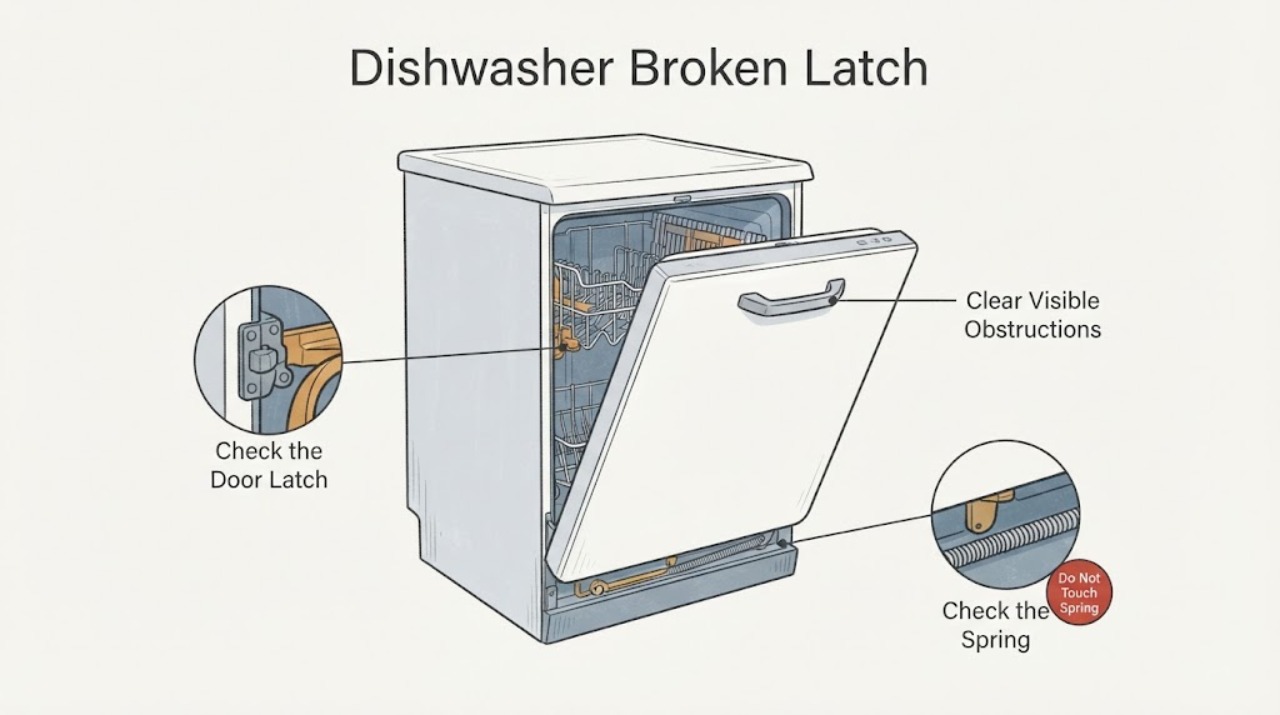
Work through in order
Diagnostic checks
Use only checks that match the exact appliance or system and its official guide.
-
Check 1
Stop using the dishwasher and inspect only the closed-door perimeter, racks, furniture front and latch opening for a visible obstruction or a door that is obviously sitting high, low or crooked. Do not force the handle, wedge the door shut or bypass the latch to run a cycle.
Expected result: A rack, panel or object blocks closure, the door is visibly misaligned, or the door reaches the frame but the latch does not engage.
Next step: Remove only a clearly visible loading obstruction and follow the exact installation manual for leveling. If the door remains crooked or the latch will not engage, leave the appliance off and arrange service rather than forcing it.
Why this matters
Why: Zanussi identifies leveling and latch/hinge alignment as possible causes in addition to a damaged latch; an obstruction or misalignment can make a good latch appear broken.
-
Check 2
Confirm the appliance type and model/PNC from its rating plate before ordering anything. Compare the latch, strike area, inner-door panel and hinge arrangement with the exact Zanussi manual or parts record; do not rely on a generic latch photograph or another Zanussi model.
Expected result: The exact model documentation identifies a matching latch assembly and door layout, or no exact compatibility information is available.
Next step: Use the exact manual and authorized parts information if a match is confirmed. If compatibility cannot be confirmed, do not order or install a part; give the model/PNC and photographs to Zanussi service.
Why this matters
Why: Zanussi's replacement guidance requires a compatible part and product manual. Without the model/PNC match, a latch, strike, hinge or connector cannot be safely assumed to fit.
-
Check 3
If the exact manual and latch guide match the appliance and a competent adult is performing the repair, deactivate the appliance, disconnect the mains plug, turn off the water supply, empty residual water and keep the dishwasher upright. Wear gloves for sharp edges and safety glasses if springs are involved.
Expected result: Power and water are isolated, the appliance is stable and upright, the compatible part is verified, and the person has the tools and knowledge for door-panel work, or any of those conditions is missing.
Next step: Proceed only when all manual safety conditions and compatibility checks are satisfied. If any condition is missing, keep the dishwasher out of service and use an authorized technician.
Why this matters
Why: Zanussi treats latch replacement as a repair with electrical-shock, injury, sharp-edge, spring and residual-water risks and warns that nonprofessional repair can have safety consequences.
-
Check 4
Only for a matching layout, follow the opened Zanussi latch guide: remove the specified inner-door screws with hand tools, lower the control panel carefully, disconnect the lock wiring without pulling the connectors, remove the lock screws, and reassemble in reverse. Do not improvise connector positions or screw locations if the exact manual differs.
Expected result: The exact manual shows the same panel and connector arrangement, or the panel, latch, wiring or screw layout differs from the generic guide.
Next step: Stop and request service when the physical layout differs or wiring cannot be positively identified. After any approved repair, do not operate the dishwasher until every panel and connector is secured and the latch closes without force.
Why this matters
Why: The official guide provides a sequence for a compatible Zanussi dishwasher, but a no-model task cannot prove that sequence applies to every product.
-
Check 5
After an authorized repair or installation correction, close the door gently and check that it sits flush and the latch engages without lifting, pressing or wedging. Do not run a cycle if the door opens, remains crooked, or the latch feels loose.
Expected result: The door closes squarely and latches with normal pressure, or it still requires force or will not stay closed.
Next step: Use the dishwasher only after the exact manual's post-repair checks pass. If the door still fails, keep water and power off and arrange authorized service.
Why this matters
Why: A proper latch result depends on alignment as well as the latch itself; a door that still does not close can indicate unresolved leveling or hinge/latch misalignment.
Use your observations
Decision map
Find the observation that best matches what you see, then follow the next safe action.
-
PATH 01Next step
What you see
A rack, furniture front, object or installation level prevents the door from reaching the latch.
Do this next
Remove only the visible obstruction and follow the exact leveling/installation guidance. Request service if the door remains crooked or will not close.
Why this path and its safety boundary
Why it matters: The documented issue may be obstruction or alignment rather than a broken latch assembly.
-
PATH 02Next step
What you see
The door reaches the frame but the latch is visibly broken, loose or unable to hold the door, and the exact model/PNC confirms a compatible replacement.
Do this next
Follow the exact model manual and the compatible Zanussi latch guide, or use an authorized technician. Do not operate with the interlock bypassed.
Why this path and its safety boundary
Why it matters: A latch repair may be appropriate, but the door and wiring must still be handled as a repair operation with power and water isolated.
-
PATH 03Next step
What you see
The exact model, compatible latch or connector layout cannot be confirmed, or the appliance is built in and would need moving.
Do this next
Do not order a generic latch or start disassembly. Keep the dishwasher off and provide the model/PNC and photos to Zanussi or an authorized service center.
Why this path and its safety boundary
Why it matters: The generic latch guide cannot establish fit or safe access for this appliance.
-
PATH 04Next step
What you see
After a verified repair the door still needs force, will not stay closed, or the latch does not align with the strike.
Do this next
Do not run a wash cycle. Request an authorized service inspection rather than bending the latch or bypassing the door safety.
Why this path and its safety boundary
Why it matters: The underlying leveling, hinge, furniture-panel or latch alignment problem remains unresolved.
Helpful context
Understand the symptom
A latch can be the symptom, not the whole cause
Zanussi's support guidance lists both leveling and a door-latch problem when a dishwasher door does not close or a program will not start. Before ordering a latch, check whether the door is being held away from the frame by an installation issue, furniture panel, rack or visible obstruction. Do not force the handle or wedge the door shut to make the dishwasher run.
Use the replacement guide only with a matching model layout
Zanussi publishes a complete-latch guide for dishwashers, but the task has no model number. That guide calls for the appliance to be deactivated, unplugged, disconnected from water and kept upright, and warns about sharp edges, springs, wiring connectors, compatible parts and nonprofessional repair. Treat its screw and connector sequence as conditional reference, not proof that every Zanussi dishwasher has the same door construction.
Do not defeat the door safety interlock
A dishwasher should not be operated with a broken or bypassed latch. If the door will not stay closed, the control panel wiring is exposed, the door is crooked, or the replacement part cannot be verified against the exact model manual, keep the appliance off and request authorized service. The safe endpoint is a correctly aligned, compatible latch installed with power and water isolated.
When checks do not resolve it
Need a professional?
Keep the dishwasher out of service and request an authorized technician if the latch is broken, the door is crooked, the appliance cannot be leveled, the model/part match is uncertain, the control-panel wiring is exposed, or the door will not close and latch without force.
Common questions
FAQ
Is the latch definitely broken if my Zanussi dishwasher will not close?
No. Zanussi also lists incorrect leveling and latch/hinge misalignment as causes. Check only visible obstructions and installation alignment; do not force the door or order a latch until the exact model/PNC is confirmed.
Can I run the dishwasher by holding or bypassing the latch?
No. The latch is part of the door safety operation. Keep the appliance out of service until the door closes and latches correctly; never bypass the interlock or wedge the door shut for a cycle.
Does Zanussi provide latch replacement instructions?
Yes, Zanussi publishes a generic complete-latch guide that requires power and water isolation, compatible-part verification, upright handling and careful access to the inner door/control-panel wiring. Because no model is supplied here, use it only when the exact manual confirms the same layout or use an authorized technician.
What information should I gather before ordering or requesting service?
Record the full model and PNC/rating-plate information, whether the appliance is integrated or freestanding, where the door sits crooked, whether the latch or strike is visibly damaged, and photos of the door edges and latch area. Compatibility cannot be established from the brand name alone.
Read the exact guide
Official sources
- Dishwasher door will not close properly or is crookedZanussi Support · Opened Zanussi's official support article. Used for level and latch/hinge alignment boundaries and the instruction to contact the installer or authorized service when alignment is unresolved.
- Dishwasher door will not stay openZanussi Support · Opened Zanussi's official integrated-dishwasher door article. Used only to flag furniture-front/hinge-spring context when visible door alignment is assessed; no spring adjustment is instructed.
- Dishwasher door does not closeZanussi Support · Opened Zanussi's official support article. Used for visible closure/leveling checks and the distinction between a latch problem and installation alignment; it directs unresolved cases to professional support.
- Dishwasher - How to replace the latchZanussi Support · Opened Zanussi's official latch replacement guide. Used for safety, compatible-part, power/water isolation, upright handling and the conditional inner-door/control-panel sequence. It is not treated as proof of fit for an unspecified model.
Community feedback
Share a repair observation
Share a plain-text repair observation. Accepted observations are published automatically; this page may take a moment to update.