
On this page
Start here
Quick answer
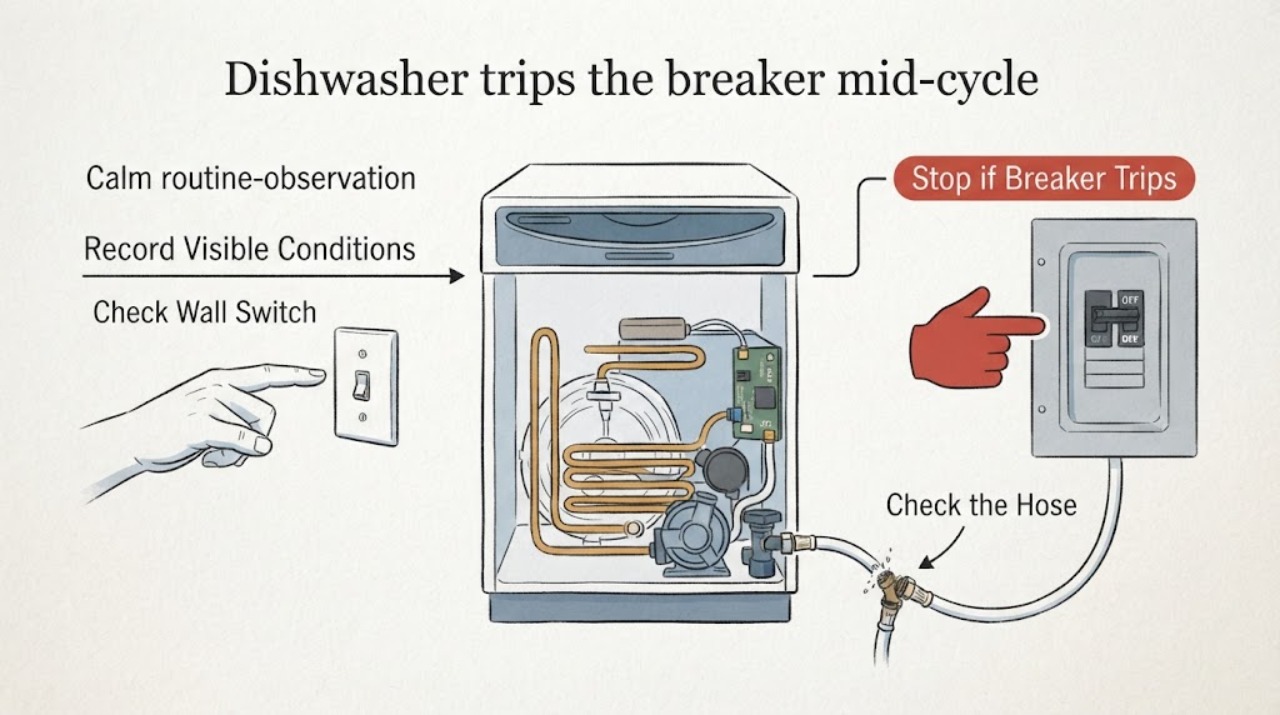
Stop using a Zanussi ZDT6053 that trips the RCD, fuse, or circuit breaker in the middle of a cycle, and do not keep resetting the protection or restarting the dishwasher. A mid-cycle trip is a timing clue, not proof that the heater failed: record whether the machine was filling, washing, draining, or hot, and whether water, odor, smoke, heat, or cord damage was visible. With the appliance and area dry, only inspect the accessible plug, cord, outlet or isolation switch, and whether other high-load appliances share the circuit; do not pull out this fully integrated dishwasher or open panels. Zanussi says a shared circuit or incorrect connection can trip protection, but a trip on a suitable circuit can indicate leakage, a short circuit, moisture, or an internal fault. Keep the ZDT6053 disconnected and arrange a qualified electrician for the supply or a Zanussi-authorized appliance technician for the dishwasher, especially when water or a heating-stage trip is involved.
Work through in order
Diagnostic checks
Use only checks that match the exact appliance or system and its official guide.
-
Check 1
Leave the dishwasher off after the trip. Do not reset the RCD or breaker and immediately restart the ZDT6053. From a dry, safe position, record the time in the programme, the selected programme if known, whether it was filling, circulating, draining, or hot, and whether the display, lights, or pump sound stopped.
Expected result: The trip happened at start-up, during filling or washing, during draining, after the water became hot, or at an uncertain point; water, smoke, odor, heat, or visible damage may also be present.
Next step: Keep the appliance disconnected and give the timing and any hazard signs to the electrician or authorized appliance technician. If the stage is uncertain, do not run another cycle to determine it.
Stop if: Do not keep re-energizing the dishwasher to reproduce a mid-cycle trip.
Why this matters
Why: The stage is a useful service observation but is not a component diagnosis. Zanussi's guidance treats a trip as possible ground leakage, short circuit, or circuit loading and directs service if the external supply explanation does not resolve it.
-
Check 2
With the dishwasher disconnected and the floor dry, inspect only the accessible plug, supply cord, outlet or isolation switch, and nearby cabinet edge for scorching, looseness, wetness, or damage. Note whether other high-load appliances share the same fuse or RCD circuit. Do not move the integrated dishwasher or use an extension lead.
Expected result: The external supply or cord is damaged or wet, several appliances share the circuit, the supply appears suitable, or the external condition cannot be safely seen.
Next step: For a supply, outlet, or circuit concern, arrange a qualified electrician. If the supply is confirmed suitable or the dishwasher alone trips, leave it unplugged and arrange Zanussi-authorized appliance service.
Stop if: Do not reset a breaker repeatedly, test insulation, probe the outlet, or substitute an extension cable.
Why this matters
Why: A shared or incorrectly connected circuit can open its protection, while a suitable circuit with a dishwasher-only trip leaves leakage, a short circuit, moisture, or an internal appliance fault possible. An inaccessible connection is not evidence that the dishwasher is safe.
-
Check 3
After power is isolated, inspect only the visible floor, cabinet edges, door perimeter, and accessible hose area for standing water, fresh droplets, or a wet base. Do not remove panels, tilt the dishwasher, reach into the sump, or run a cycle with a suspected leak.
Expected result: Water is present near the dishwasher, the area is dry but the trip occurred during filling or draining, or no water source can be determined.
Next step: Close the accessible water isolation valve if this can be done without reaching wet electrical parts, keep power off, protect the floor, and arrange authorized appliance service. Use an electrician as well if the supply or protection remains unsafe.
Stop if: Do not run the dishwasher to locate a leak, remove the base, or dry internal parts with heat.
Why this matters
Why: Water near an energized appliance raises both leak and electrical priorities; a dry floor does not rule out hidden moisture. Fill and drain timing should be reported as a clue, not converted into a pump or valve diagnosis.
-
Check 4
Record whether the dishes or inner door were warm when the trip occurred, without opening the machine during a fault or touching hot water. Do not infer a heater failure from a trip after heating; simply note whether the event followed a hot portion of the programme and whether the dishwasher had stopped heating or stopped completely.
Expected result: The trip followed a hot portion of the cycle, the load stayed cold, the appliance stopped before heating, or the heating state is unknown.
Next step: Keep the ZDT6053 off and give the stage and temperature observation to service. Do not remove the heater, bridge a thermal device, or perform a live electrical test.
Stop if: Do not restart a hot or wet programme merely to see if the trip occurs at heating again.
Why this matters
Why: Zanussi's heating guidance lists programme choice, filters or sump, foaming, and a possibly faulty heating element as separate causes of poor heating and recommends a service engineer. It does not establish that a mid-cycle breaker trip is caused by the heating element.
-
Check 5
Read the rating plate and record the complete ZDT6053 product number (PNC), serial information, market, and installation type. Use the official Zanussi model page to match the PNC before consulting a manual or discussing a repair; do not use a generic dishwasher code table or a similar Zanussi model as a substitute.
Expected result: The PNC matches one of Zanussi's listed ZDT6053 versions, the PNC or suffix is missing, or the rating plate cannot be safely accessed.
Next step: Give the full PNC and serial information, or a clear rating-plate photograph, to authorized service. If the identity is incomplete, keep the dishwasher disconnected rather than guessing from another ZDT6053 version.
Stop if: Do not pull out the integrated appliance or remove trim to reach the rating plate.
Why this matters
Why: Zanussi lists several PNC versions under ZDT6053 and requires the PNC to show compatible spares and documentation. Model-family identity alone does not establish the electrical layout, programme sequence, or service parts for this installation.
-
Check 6
Prepare a service handoff listing the programme, the exact mid-cycle stage, whether the trip was an RCD, fuse, or circuit breaker, supply-sharing observations, water or odor signs, warm or cold load, display state, PNC, and any prior repair. Keep the dishwasher off while waiting.
Expected result: The technician receives a repeatable time line and external safety evidence, or the event cannot be reconstructed beyond 'it tripped'.
Next step: Use a qualified electrician for confirmed supply or protection issues and Zanussi-authorized appliance service for a dishwasher-only or recurring trip. Ask for diagnosis before any part is ordered.
Stop if: Do not open the door wiring, remove the kick plate, measure insulation, or operate with panels removed.
Why this matters
Why: A complete time line helps separate installation or circuit loading from an appliance-side fault and prevents a heater, pump, or control part from being selected solely from the symptom. Even an incomplete time line still supports a no-use boundary after a recurring trip.
Use your observations
Decision map
Find the observation that best matches what you see, then follow the next safe action.
-
PATH 01Next step
What you see
The trip occurs only when several appliances share the circuit, the dishwasher and supply show no visible damage, and the electrician confirms a capacity or connection issue.
Do this next
Have the qualified electrician correct the circuit or connection; do not add an extension lead or keep resetting the protection.
Why this path and its safety boundary
Why it matters: Circuit loading or installation is more likely than a proven ZDT6053 internal fault, but the dishwasher should not be returned to use until the circuit is corrected and safe.
-
PATH 02Next step
What you see
The ZDT6053 trips by itself on a confirmed suitable circuit, whether the recorded stage is filling, washing, draining, or after heating.
Do this next
Leave the dishwasher disconnected and arrange Zanussi-authorized service; do not repeat cycles to compare stages.
Why this path and its safety boundary
Why it matters: A dishwasher-side leakage, short circuit, moisture issue, or internal electrical fault remains possible. The stage narrows the technician's inspection history but does not identify a heater, pump, valve, or control part.
-
PATH 03Next step
What you see
Water, a wet cabinet edge, smoke, burning odor, unusual heat, a damaged cord or outlet, or repeated protection trips accompanies the event.
Do this next
Keep power off, close the water isolation valve only from a safe dry position, protect people and the floor, and arrange qualified electrical and appliance help as appropriate.
Why this path and its safety boundary
Why it matters: This is an immediate water and electrical safety boundary, not a reset or filter-cleaning problem. A dry visible floor cannot rule out hidden moisture in an integrated appliance.
-
PATH 04Next step
What you see
The dishwasher is not heating or the dishes are cold, but no breaker trip is reproduced and there is no visible hazard.
Do this next
Do not use a trip-prone machine. Give service the cold-load observation and the exact PNC so heating and electrical protection can be assessed together.
Why this path and its safety boundary
Why it matters: Zanussi lists programme choice, filters or sump, foaming, and a possibly faulty heating element as separate poor-heating causes; this is not evidence that a breaker trip was caused by the heater.
Helpful context
Understand the symptom
The word mid-cycle describes when protection opened, not why. A trip while filling or draining raises a different inspection priority from a trip after the water has heated, but no user-visible timing can prove a heater, pump, insulation, or control failure. Do not recreate the event to find the stage; preserve the observation for service.
ZDT6053 is listed by Zanussi as a fully integrated dishwasher with several PNC versions. Use the rating plate and exact PNC when locating the manual or arranging service. Do not pull an integrated unit forward, remove its toe panel, or open an electrical enclosure merely to find the trip source.
When checks do not resolve it
Need a professional?
Call immediately after a recurring trip, any trip on a dishwasher-only suitable circuit, any mid-cycle trip after heating, any water or wet cabinet evidence, smoke, burning odor, unusual heat, damaged cord or outlet, or uncertainty about which protection opened. Do not use the dishwasher until the problem is completely fixed.
Have this ready
- Provide the complete ZDT6053 PNC and serial information, market and integrated installation details, the protection type that opened, programme and exact cycle stage, whether the load or door was warm, water or odor observations, shared-circuit information, and any prior repair.
Common questions
FAQ
Does a Zanussi ZDT6053 breaker trip in the middle of a cycle prove the heater is bad?
No. The cycle stage is useful history, but it does not identify the failed component. Zanussi's heating guidance lists a faulty heater among possible poor-heating causes and sends that problem to a service engineer; its trip guidance also covers circuit loading, leakage, short circuit, and internal faults.
Can I reset the breaker and run the dishwasher once more?
Do not keep resetting and restarting a dishwasher that has tripped protection. Zanussi says not to use the product until the problem is completely fixed and to unplug it until it is safe; arrange qualified electrical or authorized appliance service instead.
Should I try another socket to see whether the ZDT6053 works?
Do not move this fully integrated dishwasher or use an extension lead. A qualified electrician should assess the circuit and outlet. If the circuit is suitable and the dishwasher alone trips, leave it disconnected for authorized appliance service.
Why do I need the PNC if the model is already ZDT6053?
Zanussi lists several PNC versions under ZDT6053 and says the PNC is required to show compatible spares and accessories. The PNC helps service use the correct regional documentation and avoid assuming that every ZDT6053 version has the same parts or programme details.
Read the exact guide
Official sources
- Model ZDT6053 - Spares & Accessories - ZanussiZanussi · Exact model identity and PNC routing; it does not diagnose the breaker trip
- Dishwasher is not heating up waterZanussi · General Zanussi heating guidance; it does not prove that a mid-cycle breaker trip is a heater failure
- Dishwasher short-circuits, burns out fuses or trips RCD circuit breakersZanussi · General Zanussi dishwasher trip guidance; exact ZDT6053 internal cause is not inferred
- Too much load on the circuitZanussi · General supply guidance used to separate household circuit loading from a dishwasher-only trip
Community feedback
Share a repair observation
Share a plain-text repair observation. Accepted observations are published automatically; this page may take a moment to update.