
On this page
Start here
Quick answer
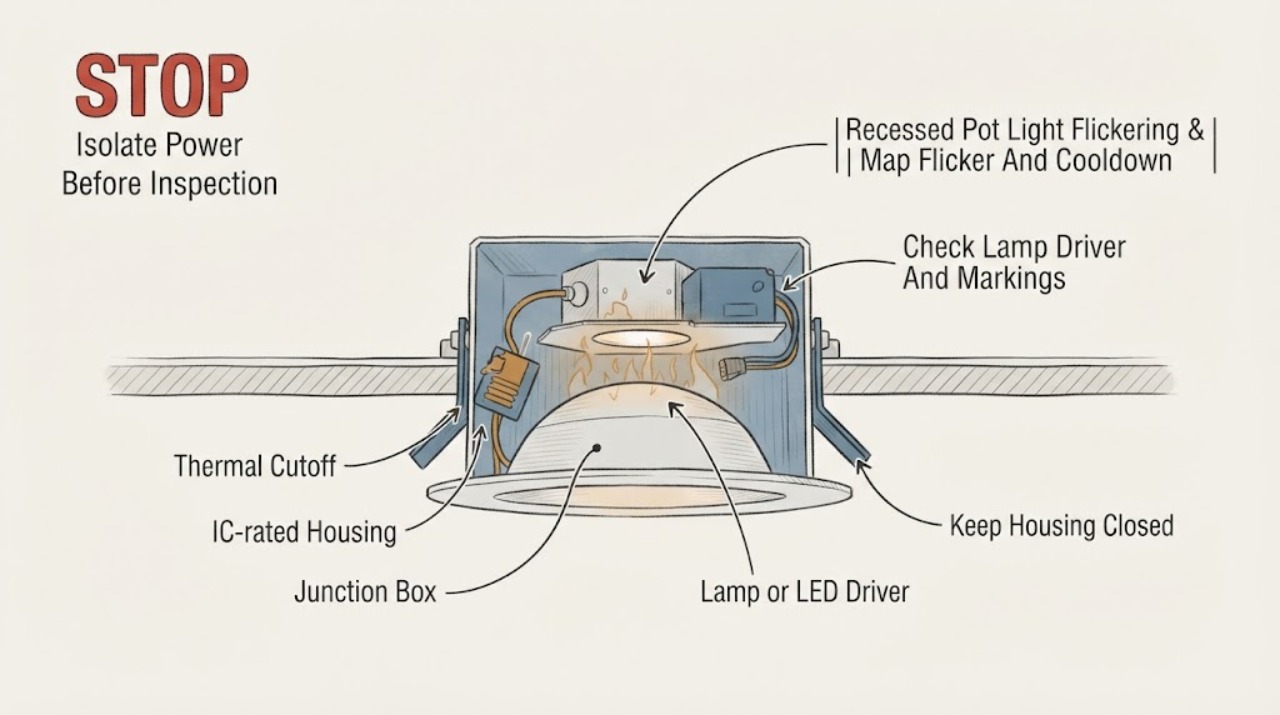
A recessed pot light that flickers, shuts off, then returns after cooling may be cycling its thermal protector. Overheating can follow an incorrect lamp, blocked heat path, insulation or other material used contrary to the fixture marking, a failed protector, or a driver or wiring fault. A thermal cutoff is a safety device, not a switch to bypass. Turn the light off at the wall and, before any inspection, switch off the correct breaker and verify the circuit is dead. From below, record whether one fixture or several are affected, whether the light returns after a cool-down, and whether a dimmer changes the pattern. Do not pull a junction box from the ceiling, move insulation, open energized wiring, bypass the cutoff, or substitute a lamp without checking the fixture label. Persistent cycling, heat damage, a burning smell, arcing, or an inaccessible junction box requires a licensed electrician.
Before you begin
Safety first
- This article covers symptom mapping, safe power isolation, reading visible markings, checking a lamp or source against its label, and observing visible heat or control patterns. A licensed electrician must handle junction boxes, ceiling access, insulation placement, line-voltage testing, dimmer wiring, thermal protectors, drivers, and branch-circuit diagnosis.
Work through in order
Diagnostic checks
Use only checks that match the exact appliance or system and its official guide.
-
Check 1
From a safe position, note whether the pot light flickers continuously, blinks in a regular pattern, shuts fully off, or returns after a cool-down. Record whether one light or several on the same switch are affected and whether the symptom changes with the dimmer setting.
Expected result: One fixture cycles off and returns after cooling, several fixtures change together, the symptom occurs only at one dimmer range, or the light stays off without recovery.
Next step: Turn the affected lights off and continue only with a cold, de-energized visual check. Arrange an electrician promptly for multiple fixtures, a circuit-wide symptom, or any heat or electrical warning.
Stop if: Stop immediately for a burning smell, smoke, sparks, crackling, heat-damaged trim or ceiling, a tripped breaker, or exposed conductors.
Why this matters
Why: A one-fixture off-and-return cycle is consistent with local thermal protection or a local fixture fault. Several lights together or a switch-position pattern shifts concern toward the control, shared wiring, or branch circuit. A light that stays off may have a failed lamp, driver, connection, or protector rather than an active thermal cycle.
-
Check 2
Turn the wall switch off, switch off the breaker that supplies the recessed light, and verify absence of voltage with a properly rated tester or have an electrician establish the safe isolation. Let the fixture cool before touching any trim or lamp.
Expected result: The correct breaker is identified and the fixture is cold and de-energized, or the breaker is unclear, the light remains warm, or voltage cannot be safely verified.
Next step: Proceed only with ordinary visible checks after safe isolation is confirmed. If safe isolation or testing is uncertain, leave the circuit off and call a licensed electrician.
Stop if: Do not rely on the wall switch alone, work in a damp ceiling, touch wiring, or use a household object as a voltage tester.
Why this matters
Why: A thermal protector and junction box are part of a line-voltage lighting assembly; a wall switch alone may not isolate all conductors. An unclear or energized condition is an electrical-service boundary.
-
Check 3
With power isolated and the fixture cold, read the visible housing or trim label and compare the installed lamp or LED module with its marked type, maximum wattage, voltage, and dimming requirement. For an integrated LED unit, record the driver or fixture model instead of fitting a different lamp.
Expected result: The lamp or module matches the marking, it is over-wattage or the type is unknown, the fixture is integrated LED, or the label cannot be seen without removing the housing or junction box.
Next step: Do not energize an over-wattage or unknown lamp installation. Use only the exact fixture documentation to identify a compatible light source; arrange service if the label, driver, or housing is inaccessible or the correct source does not resolve the symptom.
Stop if: Do not bypass the protector, increase wattage, install a non-rated lamp, modify an LED driver, or remove the housing to reach a hidden label.
Why this matters
Why: Improper lamping can raise fixture temperature and trigger thermal protection; NICOR and Cooper identify thermal protection as guarding against improper lamping or over-lamping. An unknown rating or inaccessible label means compatibility cannot be safely assumed.
-
Check 4
From below and without entering the ceiling cavity, inspect the visible trim, lens, lamp area, and ceiling surface for discoloration, melted plastic, soot, a loose trim, or a sign that material is blocking the fixture. Do not pull down a can or disturb insulation above it.
Expected result: The visible fixture is clean and undamaged, a trim or lens is heat-damaged, material appears to block the opening, or the relevant housing and insulation cannot be seen from below.
Next step: Leave a heat-damaged or obstructed fixture de-energized and have an electrician inspect the housing, insulation clearance, junction box, lamp or driver, and ceiling cavity. Do not attempt an above-ceiling correction from an unstable ladder or by pulling the fixture.
Stop if: Stop for scorched material, melted parts, smoke staining, a hot ceiling, loose fixture support, or any need to reach above the ceiling or into a junction box.
Why this matters
Why: Heat damage or blocked heat dissipation supports an overheating branch. IC markings allow insulation contact only for a luminaire actually marked Type IC; UL also notes that the fixture's own markings govern wiring and access.
-
Check 5
If the fixture label permits normal operation and no heat damage is present, note whether the symptom follows the dimmer level, smart control, timer, or one wall switch. Do not open the switch box or change wiring; compare only the observed light behavior at a safe distance.
Expected result: The light is stable at full output but flickers or drops out at a control setting, every light on the control changes together, or one light cycles independently of the control.
Next step: Stop experimenting with control settings if the light drops out or heats. Have an electrician verify the dimmer/load compatibility, connections, branch circuit, and fixture wiring; do not replace a control by guesswork.
Stop if: Do not remove the wall plate, rewire a dimmer, add a bypass device, or keep cycling a hot or damaged fixture.
Why this matters
Why: A control-linked or multi-fixture pattern makes a dimmer, control compatibility, shared neutral, branch wiring, or load issue more likely. An independent one-fixture cool-down cycle keeps the thermal protector or local fixture high on the list.
-
Check 6
Record the fixture count, trim or housing markings, lamp or LED model, switch or dimmer type, time until shutoff, cool-down recovery, breaker behavior, visible heat damage, and whether the junction box is accessible. Keep the affected circuit off if cycling continues.
Expected result: The pattern is repeatable and local, the pattern affects a shared control or circuit, the fixture model or marking is missing, or the symptom is accompanied by heat or electrical damage.
Next step: Arrange a licensed electrician for recurring shutoff, inaccessible junction-box work, circuit-linked flicker, any heat damage, or an unknown fixture rating. Provide photos taken only from safe, de-energized, ordinary-access positions.
Stop if: Do not restore power merely to reproduce a dangerous symptom, bypass a thermal cutoff, or make a ceiling or junction-box repair without electrical qualifications.
Why this matters
Why: A structured record helps an electrician distinguish thermal protection from improper lamping, insulation, driver, dimmer, loose connection, or branch-circuit problems. Missing markings or access prevents safe owner-level part selection.
Use your observations
Decision map
Find the observation that best matches what you see, then follow the next safe action.
-
PATH 01Safety boundary
What you see
One recessed light blinks or shuts off after operating, returns after cooling, and the symptom is not linked to a control setting.
Do this next
Leave the light off, verify the fixture's marking and lamp type only from safe access, and arrange an electrician if cycling repeats or the housing is not fully visible.
Why this path and its safety boundary
Why it matters: Automatic thermal protection or a local heat-producing fault is more likely than a normal lamp failure. Possible contributors include lamping, insulation or material placement, driver, protector, or local connection.
Safety stop: Do not bypass, bridge, remove, or substitute the thermal cutoff, and do not keep operating a fixture that cycles hot.
-
PATH 02Safety boundary
What you see
The installed lamp exceeds the fixture marking, the source type is unknown, the housing is not marked for the surrounding insulation, or visible heat damage is present.
Do this next
Keep power off and have an electrician correct the lamp, housing, insulation, junction-box, or heat path according to the exact fixture documentation.
Why this path and its safety boundary
Why it matters: Excess heat or an installation mismatch is more likely, and the thermal device may be responding as designed. IC status must be confirmed from the actual luminaire marking.
Safety stop: Do not increase lamp wattage, move insulation by reaching into the ceiling, or energize a scorched or melted fixture.
-
PATH 03Safety boundary
What you see
Several recessed lights flicker together, the symptom follows a dimmer or control level, or the breaker or switch behavior changes with the load.
Do this next
Stop using the affected control and have a licensed electrician check the control rating, connections, circuit, and fixture load without opening energized boxes.
Why this path and its safety boundary
Why it matters: A shared dimmer/load compatibility, control, neutral, connection, or branch-circuit issue is more likely than one thermal protector cycling independently.
Safety stop: Do not replace a dimmer by guesswork, install a bypass, or continue if the breaker trips, the switch is hot, or buzzing or arcing is heard.
-
PATH 04Safety boundary
What you see
The fixture has the correct marked source and no visible obstruction, but it still flickers, shuts off, stays off, or cycles independently after cooling.
Do this next
Leave the circuit off and arrange electrician diagnosis at the fixture and junction box. Replace a component only after exact model and electrical compatibility are confirmed.
Why this path and its safety boundary
Why it matters: A failed thermal protector, LED driver, lamp socket, junction-box connection, or fixture assembly is more likely; the visible symptom cannot identify the failed component.
Safety stop: Do not test live wiring, open the junction box, replace a protector, or bypass a safety device as a diagnostic experiment.
Helpful context
Understand the symptom
A cool-down pattern is a thermal clue
A fixture that blinks or goes dark after operating, then works again once it cools, is behaving differently from a lamp that fails once and stays dark. Sensata describes an automatic-reset thermal protector for recessed lighting that can make the fixture blink in a fault condition. Cooper and NICOR describe integral thermal protection in recessed housings. The pattern points to heat or protection, but it does not identify whether the cause is lamping, insulation, the protector, the driver, or wiring.
IC-rated does not mean any installation is acceptable
Type IC is an installation classification, not permission to ignore the fixture label. UL describes Type IC luminaires as suitable for contact with insulation, while its markings still identify the fixture, wiring compartment, and access conditions. A particular housing may also have lamp, driver, wattage, venting, or junction-box limits. Read the actual label or manual for the installed fixture; do not infer its rating from the trim shape alone.
The junction box is an electrical work boundary
The junction box may be integral to the luminaire, above the finished ceiling, or accessible only from above, depending on the housing. UL notes that integral junction boxes carry conductor and access markings. A flickering light can involve a loose connection, driver, thermal protector, or branch circuit that cannot be safely distinguished from below. Once the ordinary visible checks are complete, repeated cycling belongs with an electrician rather than a bypass or improvised ceiling access.
Safety boundary
Stop conditions
- Stop immediately for smoke, burning odor, sparks, crackling, arcing, a hot switch or ceiling, melted or scorched material, exposed conductors, or a tripped breaker.
- Do not bypass, bridge, short, remove, or defeat a thermal cutoff or protector; its cycling is a safety warning, not proof that the protector is defective.
- Do not rely on the wall switch alone, open a junction box, reach into the ceiling cavity, disturb insulation, or test live wiring without electrical qualifications.
- Do not exceed the fixture's marked lamp or driver rating, use an unknown source, infer IC status from the trim, or use a fixture with damaged housing or wiring.
- Stop after one cold, de-energized visible check when flicker or shutoff repeats, the source is inaccessible, several fixtures are affected, or a control or branch-circuit issue is suspected.
Only after diagnosis
Potential parts
- recessed-light thermal protector
Consider this category only when an electrician confirms the protector is the failed part after ruling out lamping, insulation, heat, driver, wiring, and control causes.
Confirm the exact luminaire model, protector type, voltage, temperature characteristics, approvals, and manufacturer's fit information; never bypass the device. - recessed LED driver or light source
Consider this category only when an electrician confirms a failed driver or integrated light source in the exact fixture after thermal and circuit checks.
Confirm the exact fixture model, input and output ratings, connectors, dimming method, and manufacturer's fit information before ordering. - IC-rated recessed housing or junction-box assembly
Consider this category only when an electrician confirms that the installed housing or junction-box assembly is damaged, incorrectly rated, inaccessible for repair, or incompatible with the ceiling installation.
Confirm the exact housing, aperture, ceiling construction, insulation classification, branch-circuit markings, and local installation requirements before ordering.
When checks do not resolve it
Need a professional?
Arrange a licensed electrician when a recessed light flickers and shuts off repeatedly, returns after cooling, has an unknown or mismatched lamp or driver, is not visibly accessible, affects several fixtures, follows a dimmer or shared circuit, shows heat damage, or may involve a junction box, thermal protector, insulation, wiring, or driver. Electrical isolation, ceiling-cavity access, live testing, and safety-device replacement require a qualified professional.
Safety scope: This article covers symptom mapping, safe power isolation, reading visible markings, checking a lamp or source against its label, and observing visible heat or control patterns. A licensed electrician must handle junction boxes, ceiling access, insulation placement, line-voltage testing, dimmer wiring, thermal protectors, drivers, and branch-circuit diagnosis.
Common questions
FAQ
Why does a recessed pot light flicker and then shut off?
If it returns after cooling, thermal protection is one possibility. Improper lamping, insulation or heat-path conditions, a driver, protector, local connection, dimmer, or branch circuit can produce similar symptoms. Turn it off and do not bypass the thermal device.
Does an IC-rated recessed light have a thermal cutoff?
Many IC-rated housings include thermal protection, but the actual fixture label and manual control. IC means the luminaire is classified for insulation contact under its listing; it does not identify the lamp, driver, wiring, or every permitted installation detail.
Can I bypass the thermal cutoff to stop the flickering?
No. A thermal protector is a safety device. Repeated cycling means the cause needs diagnosis, such as heat, lamping, insulation, driver, wiring, or the protector itself. Keep the circuit off and use an electrician for testing or replacement.
Should I pull the recessed light down to inspect the junction box?
Not as a first DIY step. The junction box may be integral, above the ceiling, or subject to access and conductor markings. Turn off power and inspect only ordinary visible areas; have a licensed electrician handle ceiling access, wiring, insulation, and junction-box work.
When should I call an electrician for a flickering recessed light?
Call when the light cycles off and back on, the source or IC marking is unknown, several lights flicker together, a dimmer changes the symptom, the junction box is inaccessible, or there is heat damage, odor, smoke, arcing, or a tripped breaker. Leave the affected circuit off for electrical warning signs.
Read the exact guide
Official sources
- 4 in. IC-Rated and Airtight Remodel HousingNICOR Lighting · Official NICOR product information used as a representative recessed-housing example; it is not a fitment claim for another fixture.
- RP Lighting ProtectorSensata Technologies · Official component-maker information used to explain thermal-protection behavior; it does not identify the protector in a particular fixture.
- No Job NameUL Solutions · UL guide information used for general marking and installation concepts; local code and the actual luminaire label control.
- New Construction Housings (Next Gen)Cooper Lighting Solutions (HALO) · Official HALO manufacturer information used for general housing and thermal-protection concepts; the installed luminaire marking controls.
Community feedback
Share a repair observation
Share a plain-text repair observation. Accepted observations are published automatically; this page may take a moment to update.