
On this page
Start here
Quick answer
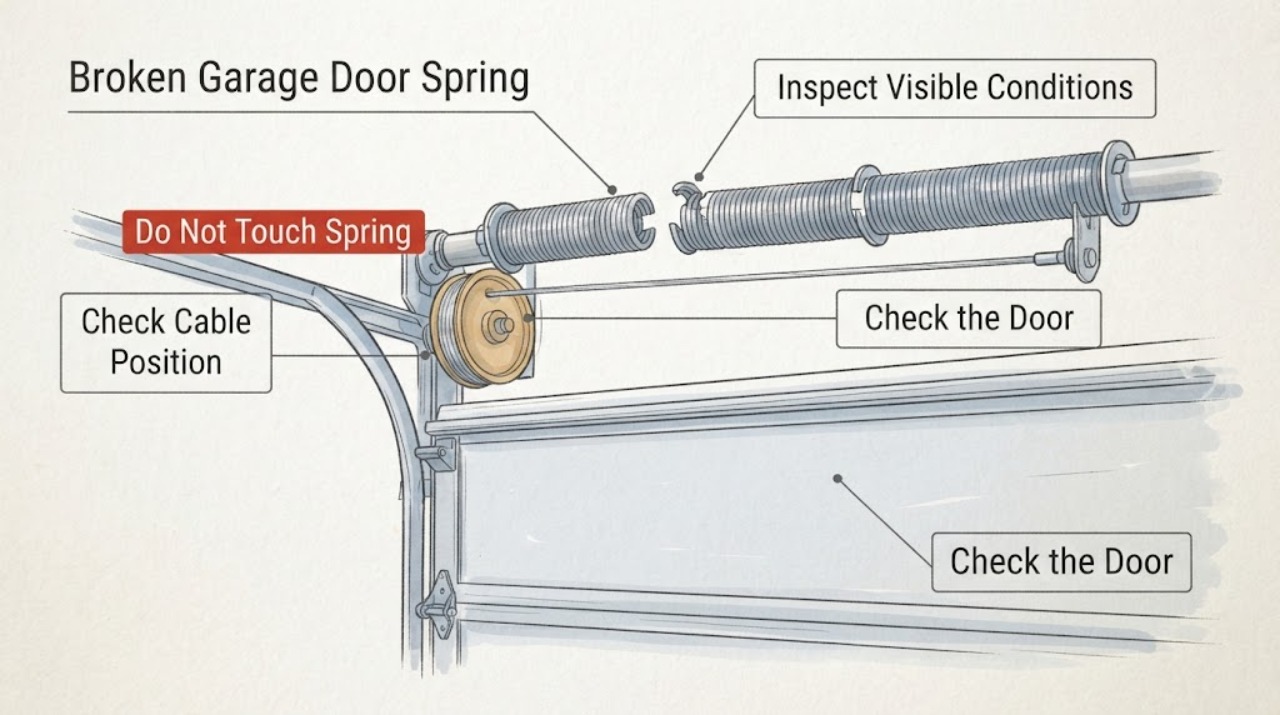
A broken garage-door spring removes the counterbalance that carries the door's weight, so the door may be unusually heavy, crooked, stuck, or unsafe to move. From the floor, look for a gap or separation in the torsion spring above the door, a stretched or broken extension spring along the track, a loose or frayed lift cable, and a door that is partly open or tilted. Do not operate the door manually or with the opener, pull the emergency release to test it, adjust or replace the spring, loosen brackets, or handle cables. Keep people and vehicles clear and arrange a trained garage-door technician to inspect and repair the complete counterbalance system.
Work through in order
Diagnostic checks
Use only checks that match the exact appliance or system and its official guide.
-
Look for a spring break from a safe standing position
Keep the garage door stationary and stand outside the travel path. From the floor, use ordinary lighting to look at the torsion spring above the opening or the extension spring running alongside the track. Look only for a visible gap, separation, stretch, fracture, rusted damage, or a spring that is no longer in its normal line; do not climb, touch, probe, or move the spring.
Expected result: There is a clear gap or fracture, an extension spring is stretched or separated, the spring has obvious damage, or the spring cannot be seen clearly from the floor.
Next step: Record the visible location and take a photo only from a safe distance. Leave the door in place and request a trained garage-door technician for diagnosis and matched repair.
Stop if: Do not wind, unwind, pull, cut, clamp, remove, lubricate, or replace the spring, and do not use a ladder or reach over the door to obtain a closer view.
Why this matters
Why: A gap, fracture, or abnormal stretch is consistent with a failed or damaged counterbalance spring and means the door should not be operated. An obscured view is uncertainty, not evidence that the spring is safe; the spring may be inside a cover or the failure may be in another counterbalance part.
-
Inspect the lift cables and door position without handling them
From the floor and outside the door's travel path, look at both visible lift cables, their drums or pulleys, the bottom brackets, and the door sections. Do not pull the red release, lift the door, push it down, place hands near a bracket, or reach under a partly open door.
Expected result: A cable is frayed, broken, kinked, off the drum, or hanging loose; a bottom bracket appears bent or loose; the door is tilted, partly open, off track, or visibly sagging; or the components look aligned from the available viewpoint.
Next step: Keep the opening isolated and give the technician the side and component where the abnormality appears. Treat any damaged or unstable condition as a prompt service call rather than an opener problem to overcome.
Stop if: Never reconnect, re-seat, tension, cut, splice, loosen, or replace a cable, drum, pulley, bottom bracket, track fastener, or other spring-attached hardware.
Why this matters
Why: A damaged cable, bracket, crooked door, or off-track position can make the heavy door unstable and can accompany a spring failure. An apparently aligned view does not prove that tension or balance is safe to test.
-
Distinguish an opener symptom without operating a suspect door
If a broken or damaged spring is visible, do not press the wall control or remote. If no spring or cable damage is visible and the door is fully closed and stable, record whether the opener has power and whether it previously made a click, hum, or motor sound, using only existing observations; do not run another cycle to reproduce the fault.
Expected result: The opener was silent, the motor ran while the door stayed still, the door tried to move and stopped, or the failure followed a loud snap or sudden heavy door.
Next step: Tell the technician exactly what sound or movement was observed and whether a spring break preceded it. Keep the opener from being cycled until the door system is inspected.
Stop if: Do not increase force or travel settings, bypass sensors, pull the emergency release, remove the opener cover, or keep cycling a door with a suspected spring failure.
Why this matters
Why: A motor sound without door movement can coexist with a failed spring, disconnected drive, or another door-hardware fault; a silent opener may add a power or control issue. A loud snap or sudden heavy door makes counterbalance failure the priority, so opener symptoms do not make the door safe to use.
-
Identify the spring layout for the service call
From a safe distance, note whether the system appears to use a torsion spring above the door opening or extension springs along the horizontal tracks, and note whether there is one spring or more than one visible. Do not infer a replacement size or part from appearance and do not touch any spring, shaft, cable, or fastener.
Expected result: The spring is above the opening, the spring runs beside a track, multiple springs are visible, a containment cable is visible, or the configuration is concealed or unclear.
Next step: Include the layout and any visible gap, fracture, or cable condition in the service request. If the layout is unclear, report that uncertainty instead of opening covers or removing hardware.
Stop if: Do not measure spring tension, count coils as a replacement specification, remove a spring cover, loosen set screws, or substitute a spring based on a visual match.
Why this matters
Why: The layout helps a technician prepare for the correct type of counterbalance inspection. It does not identify a safe replacement: door weight, dimensions, lift arrangement, and the complete hardware condition determine the repair.
-
Make the area safe while arranging professional service
Keep children, pets, people, and vehicles away from the doorway and leave the door in its current position. From a safe distance, document whether it is closed, partly open, tilted, or blocking an exit, and note any loud bang, impact, storm, or recent work before the failure. Do not improvise a prop, tie, clamp, or lifting method for the door.
Expected result: The door is closed and stable, partly open, crooked or off track, the opening is needed for an exit, or there are signs of falling movement, smoke, impact damage, or loose hardware.
Next step: Arrange prompt service and provide the door position, spring and cable observations, and photos taken from the floor. Use another safe entrance if available and do not approach an unstable door.
Stop if: Stop immediately for movement, a falling panel, a loose cable or bracket, a loud new snap, smoke, burning odor, or anyone entering the door's path; do not attempt to stabilize or lower the door yourself.
Why this matters
Why: A closed stable door still needs repair but is easier to isolate. A partly open, crooked, off-track, or falling door can move without warning; a blocked exit or impact damage raises urgency and may require the area to remain unused until inspected.
Use your observations
Decision map
Find the observation that best matches what you see, then follow the next safe action.
-
PATH 01Safety boundary
What you see
A torsion spring has a visible gap or fracture, or an extension spring is visibly stretched, separated, or damaged.
Do this next
Keep the door stationary, stop opener use, isolate the opening, and request prompt service from a trained garage-door technician for the spring and associated hardware.
Why this path and its safety boundary
Safety stop: Do not adjust, remove, replace, wind, unwind, cut, clamp, or handle the spring or attached hardware.
-
PATH 02Safety boundary
What you see
A lift cable is frayed, off its drum, or hanging loose, or a bottom bracket is bent or loose.
Do this next
Treat the door as unstable, keep everyone clear, and arrange prompt professional inspection of the spring, cable, drum, pulley, bracket, and door alignment.
Why this path and its safety boundary
Safety stop: Do not pull the release, lift or lower the door, re-seat the cable, loosen fasteners, or work beneath a partly open door.
-
PATH 03Safety boundary
What you see
The door is partly open, tilted, off track, sagging, moving unexpectedly, or blocking a needed exit after a loud snap or impact.
Do this next
Leave the area isolated and seek prompt garage-door service; report the door position and any falling or impact history before the technician arrives.
Why this path and its safety boundary
Safety stop: Do not prop, tie, clamp, force, manually move, or repeatedly cycle the door.
-
PATH 04Safety boundary
What you see
No clear spring break is visible, but the door is heavy, the opener runs without moving it, the failure followed a loud snap, or the cause remains uncertain.
Do this next
Keep the door closed and request diagnosis of the spring, cable, balance, track, drive connection, and opener rather than assuming the spring is intact.
Why this path and its safety boundary
Safety stop: Do not test balance by lifting the door, change force settings, or operate the door repeatedly to obtain more evidence.
Helpful context
Understand the symptom
What a broken spring changes
The spring is part of the door's counterbalance system, not just an opener accessory. When it fails, the opener may run without safely moving the door, or the door may become heavy, crooked, or unable to stay in a safe position. A loud snap, a visible gap in a torsion spring above the opening, or a stretched or fractured extension spring along a track supports the suspicion, but the homeowner check should stop at visual observation from the floor.
Treat the spring system as a hard stop
A spring can retain dangerous energy even when the door is closed, and the door itself can weigh hundreds of pounds. Springs, lift cables, drums, pulleys, bottom brackets, and other attached hardware should not be wound, unwound, pulled, cut, loosened, removed, or replaced as a DIY repair. Keep the door stationary, isolate the area, and give the technician the door position, visible damage, cable condition, and sound or event that preceded the failure.
Why a spring inspection includes cables and the door position
The spring works with cables and brackets to lift the door. A cable that is frayed, off its drum, or hanging loose can leave the door uneven or allow an unexpected movement, while a partly open or off-track door is unstable. These observations change the urgency and the technician's preparation, but they are not invitations to pull the release, lift the door, secure it with improvised supports, or force it through the opener.
Only after diagnosis
Potential parts
- matched garage-door counterbalance spring assembly
Consider this category only after a trained technician confirms that the spring is broken and identifies the door's counterbalance design, dimensions, weight, and required repair.
A visual match or generic spring is not enough to establish fit or safe tension; the complete door system and professional installation must be confirmed. - garage-door lift cable and related counterbalance hardware
Consider this category only if inspection confirms that a cable, drum, pulley, or attached hardware was damaged or displaced along with the spring failure.
Confirm the door's lift configuration and have a trained technician determine the correct component and installation; no homeowner replacement is assumed.
When checks do not resolve it
Need a professional?
Request prompt service whenever a spring is visibly broken or gapped, the door becomes heavy or crooked, a cable or bracket is damaged, the door is partly open or off track, a loud snap preceded the failure, or the cause cannot be confirmed safely from the floor. Seek urgent help when the door is falling, unstable, blocking a needed exit, or has impact damage.
Common questions
FAQ
How can I tell whether my garage-door spring is broken?
From the floor, look for a visible gap or separation in a torsion spring above the door, or a stretched, fractured, or separated extension spring along a track. A loud snap, suddenly heavy door, or crooked door is another warning pattern. Stop at visual inspection and have a technician confirm the failure.
Can I open my garage door with a broken spring?
Do not operate it manually or with the opener. The spring normally counterbalances the door, so a failed spring can leave the door extremely heavy or unstable and can make the opener or attached hardware unsafe to use. Keep the opening clear and arrange professional service.
Can I replace a broken garage-door spring myself?
No. Springs and connected cables, drums, pulleys, and brackets can carry extreme tension, and the door itself is heavy. Do not wind, unwind, remove, loosen, or replace these parts; a trained garage-door technician should inspect and repair the complete counterbalance system.
What if I do not see a break but the door is still heavy?
A concealed or partially failed spring, cable, balance, track, or opener connection may still be involved. Do not test by lifting the door or increase opener force. Record the door position and prior sounds, leave it stationary, and request a professional diagnosis.
Read the exact guide
Official sources
- Garage Door Opener SafetyThe Genie Company · Supports not operating a door with a broken spring and not removing, repairing, or adjusting springs or attached brackets, cables, and related items.
- Maintaining Your Garage DoorThe Genie Company · Supports visual clues such as gapped or fractured springs, damaged cables and brackets, the relationship between spring failure and door weight, and professional-only spring adjustment.
- Why Garage Doors Get Stuck - Causes & FixesClopay · Supports the loud-bang and visible-gap clues, the heavy-door mechanism, visual-only spring inspection, and the no-DIY repair boundary.
- Garage Door Safety InformationOverhead Door · Supports visual inspection of springs, cables, and pulleys and the rule against homeowner repair of high-tension springs and cables.
- Emergency Garage Door ServiceClopay · Supports prompt professional attention for a broken spring, stuck or partly open door, damaged cable, and heavy or unstable components.
- Garage Door Replacement Parts GuideClopay · Supports treating springs and related repair as professional work, inspecting cables and tracks, and not removing or adjusting damaged or improperly tensioned springs.
Community feedback
Share a repair observation
Share a plain-text repair observation. Accepted observations are published automatically; this page may take a moment to update.