
On this page
Start here
Quick answer
A garage door spring that looks stuck, or a door that stops or feels stuck, is not a safe adjustment problem for a homeowner. Springs, bottom brackets, cables, and related supports can carry high or extreme tension. From the floor and without touching the spring hardware, look for a separated coil, a loose or frayed cable, a crooked door, an off-track roller, an engaged manual lock, or an obstruction. Do not wind, unwind, stretch, loosen, replace, or disconnect a spring or its brackets, and do not force the door with the opener. Keep people away from the door and call a trained garage-door technician when the spring or cable is damaged, the door is heavy or uneven, or the cause is not obvious.
Before you begin
Safety first
- The homeowner should limit checks to visual observation from a safe position and clearly loose obstructions outside the travel path. Spring adjustment, cable or bracket work, manual balance tests, track correction, and component replacement belong to a trained technician.
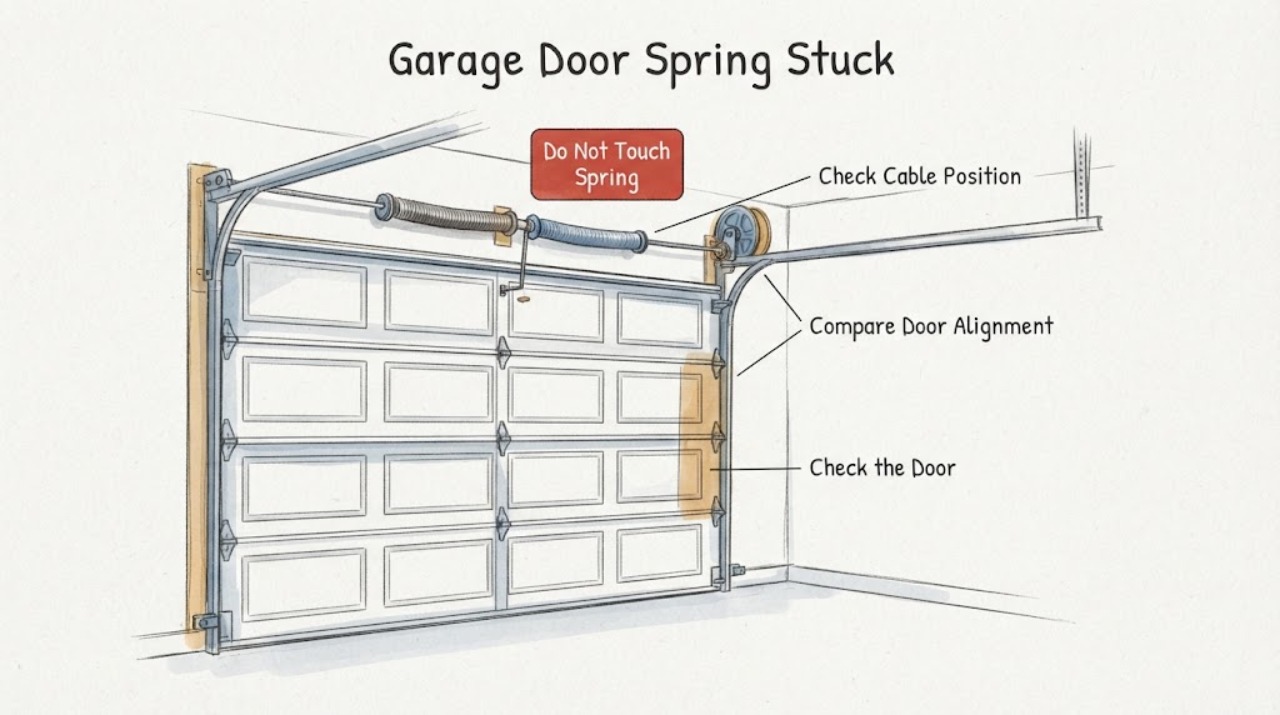
Work through in order
Diagnostic checks
Use only checks that match the exact appliance or system and its official guide.
-
Check 1
With the door stopped and from a standing position on the floor, visually inspect the spring area, both cables, their visible anchor points, and nearby brackets. Use a flashlight only from a safe distance; do not touch, pull, loosen, wind, or probe any component.
Expected result: Look for a gap in a coil, a spring that is visibly displaced, a loose or frayed cable, a hanging cable, a bracket that has shifted, or no visible damage.
Next step: If any damage or displacement is visible, stop using the door, keep the area clear, and arrange a trained door-systems technician. If nothing is visible, continue with the door and track observation without touching the spring hardware.
Stop if: Stop immediately if a cable is loose, a spring is separated, a bracket is bent, parts are hanging, or any component moves while you observe it.
Why this matters
Why: A separated spring or damaged cable supports a spring or counterbalance failure, but an intact-looking spring does not prove it is safe or correctly balanced. DASMA identifies these components as high-tension or dangerous and assigns their repair to trained technicians.
-
Check 2
From outside the door's travel path, inspect the closed door, vertical and horizontal tracks, rollers, hinges, and floor area for a visible obstruction or impact. Compare the door's left and right sides without pushing the door or reaching between sections.
Expected result: The door is level and clear, or it sits crooked, has a roller visibly out of the track, shows a bent track or hinge, or contacts an obstruction.
Next step: Remove only a loose object that is clearly outside the door and can be moved without entering the travel path. For an off-track door, bent hardware, or uncertain obstruction, leave the door in place and call a trained technician.
Stop if: Do not straighten a track, reseat a roller, lift the door, place fingers between sections, or stand under a raised or partially supported door.
Why this matters
Why: A crooked door, off-track roller, bent hardware, or obstruction can make the door appear spring-stuck and can create a dangerous load on the spring and opener. DASMA treats improper or difficult operation as a reason for technician assistance, not forceful adjustment.
-
Check 3
Without moving the door, look for a manual slide lock, a lock bar, or another visible latch that may be engaged, and note whether the door is fully closed, partially open, or hanging at an unusual height.
Expected result: A lock is visibly engaged, the door is fully closed and aligned, or the door is partially open, tilted, or unsupported.
Next step: If a lock is clearly engaged and the door is fully closed, consult the door's model-specific instructions before any normal operation. If the door is partially open, tilted, or unsupported, do not release, lift, or force it; call a trained technician.
Stop if: Do not defeat a lock, pull an emergency release, manually lift or lower a questionable door, or place yourself under the door to test it.
Why this matters
Why: An engaged lock can stop a door independently of the spring. A partially open, tilted, or unsupported door may move unexpectedly and cannot safely be used as a balance test by an untrained homeowner.
-
Check 4
From a clear position away from the door, note what happens when the wall control is used only if there is no visible spring, cable, track, door, or obstruction damage. Keep the door in sight and do not repeat the command if it stalls, strains, reverses, or moves unevenly.
Expected result: The opener is silent, hums without moving the door, stops or reverses, or the door begins to move unevenly or heavily.
Next step: Stop operating the door and give the symptom to a trained technician. Do not increase force settings, bypass safety sensors, or continue cycling the opener to make it move.
Stop if: Stop at the first stall, strain, reversal, unusual noise, crooked movement, or visible change; keep everyone clear of the travel path.
Why this matters
Why: A silent or reversing opener can have a control or safety-sensor issue, while straining, heavy, or uneven movement can indicate a counterbalance, door, or track problem. The observation cannot safely identify which spring or adjustment is needed.
-
Check 5
Photograph the spring and cable area from the floor, the door's alignment, tracks, visible locks, and the opener label without removing covers. Record whether the problem followed a loud snap, impact, power interruption, or a gradual change in operation.
Expected result: The record shows a broken or displaced component, a door or track alignment issue, an opener-only symptom, or no clear cause.
Next step: Send the information with a service request and keep the door out of use until the technician confirms the system is safe. Follow the exact manufacturer manual only for non-tension user controls.
Stop if: Do not remove the spring cover, loosen red fasteners or brackets, handle cables, or attempt a spring replacement while collecting information.
Why this matters
Why: These differences help a trained technician choose the correct inspection path, but a photograph cannot confirm spring tension, balance, or safe manual operation.
Use your observations
Decision map
Find the observation that best matches what you see, then follow the next safe action.
-
PATH 01Next step
What you see
A coil is separated, a cable is loose or frayed, a bracket has shifted, or spring hardware is displaced.
Do this next
Stop using the door, keep the travel path clear, and call a trained door-systems technician. Do not touch or adjust the spring, cable, or bracket.
Why this path and its safety boundary
Why it matters: The counterbalance system may be damaged while still retaining dangerous tension.
-
PATH 02Next step
What you see
The door is crooked, a roller is visibly off track, a track or hinge is bent, or an obstruction is in the travel path.
Do this next
Remove only a clearly loose object outside the travel path. Leave the door and hardware in place and arrange trained service for any alignment or hardware problem.
Why this path and its safety boundary
Why it matters: The door system may be binding independently of the spring and could shift if forced.
-
PATH 03Next step
What you see
A manual lock or lock bar is visibly engaged while the door is fully closed and otherwise aligned.
Do this next
Use only the model-specific owner instructions to identify the normal user control. Do not defeat the lock or cycle the opener against it; call a technician if the state is unclear.
Why this path and its safety boundary
Why it matters: The lock may be stopping normal operation, but the opener and lock can be damaged if operated against each other.
-
PATH 04Next step
What you see
The door stalls, strains, reverses, hangs crooked, is unusually heavy, or moves unevenly.
Do this next
Stop operation and keep people clear. Arrange trained door-system service instead of changing force settings or attempting a manual balance test.
Why this path and its safety boundary
Why it matters: The spring system, door hardware, track, or opener may be out of balance or damaged.
-
PATH 05Next step
What you see
No visible spring, cable, door, track, or lock problem is found, but the door remains stuck or the opener symptom recurs.
Do this next
Keep the door out of use, provide the technician with photos and model information, and have the system inspected before further operation.
Why this path and its safety boundary
Why it matters: A covered spring system, internal hardware fault, sensor issue, or less-visible balance problem remains possible.
Helpful context
Understand the symptom
A stuck spring is a symptom, not a repair diagnosis
A door can stop because a spring has broken or lost balance, but a locked door, an obstruction, an off-track roller, a damaged cable, or an opener problem can look similar. A spring may also be noisy during normal operation. The useful first distinction is whether the door or spring hardware shows visible damage or abnormal alignment. Because spring force can move the door or release hardware unexpectedly, the homeowner checks below are observational only.
Why spring adjustment is a professional boundary
DASMA warns that springs are under high tension and specifically tells homeowners not to loosen or adjust bottom brackets, red fasteners, cables, or supports. A spring that appears stuck may still be loaded even when it is broken, stretched, or inside a covered system. Do not insert winding tools, pull on cables, remove a bracket, or substitute a spring based on appearance.
Keep the door and people safe while waiting
Keep children and pets away from the door and its moving parts. Do not repeatedly run the opener against a door that stops, binds, hangs crooked, or appears heavy. Photograph the visible condition and record whether the problem happens with the opener, during a prior power outage, or after impact. Give the technician the door and opener model information so the correct instructions can be used.
Safety boundary
Stop conditions
- Do not wind, unwind, stretch, loosen, replace, or remove a garage door spring.
- Do not loosen bottom brackets, red fasteners, cables, spring supports, or other counterbalance hardware.
- Do not lift, lower, release, or catch a door that is partially open, crooked, heavy, unsupported, or off track.
- Do not put fingers between door sections, stand under a questionable door, bypass safety sensors, or increase opener force settings.
- Stop operation and call a trained technician for any damaged spring or cable, unusual movement, repeated stall, heavy door, or uncertain cause.
When checks do not resolve it
Need a professional?
Safety scope: The homeowner should limit checks to visual observation from a safe position and clearly loose obstructions outside the travel path. Spring adjustment, cable or bracket work, manual balance tests, track correction, and component replacement belong to a trained technician.
Common questions
FAQ
Can I adjust a garage door spring that is stuck?
No. A stuck, separated, or apparently loose spring can still hold dangerous tension. Do not wind, unwind, loosen, stretch, or replace it; have a trained door-systems technician inspect and repair the counterbalance system.
What can make a garage door look like the spring is stuck?
A broken or out-of-balance spring, loose cable, off-track roller, bent track, engaged manual lock, obstruction, or opener or sensor issue can produce similar symptoms. Visual checks can narrow the category but cannot establish safe spring tension or balance.
Should I keep pressing the opener button if the door will not move?
No. Stop at the first stall, strain, reversal, unusual noise, crooked movement, or visible damage. Repeated operation can worsen a door, track, opener, or counterbalance problem; keep clear and arrange trained service.
What should I photograph before calling for service?
From the floor, photograph the spring area, cables, brackets, door alignment, tracks, visible locks, and opener label. Do not remove covers or touch tension hardware; tell the technician whether the issue began with a snap, impact, outage, or gradual change.
Read the exact guide
Official sources
- Safety TipsDoor and Access Systems Manufacturers Association International · Warns that springs and bottom brackets are dangerous, cables should be replaced by trained technicians, and improper or difficult door operation warrants professional help.
- Automatic Garage Door Opener Safety & Maintenance GuideDoor and Access Systems Manufacturers Association International · Warns that springs are under high tension, limits adjustment of brackets, cables, and supports to trained technicians, and directs service for damaged or improperly operating systems.
Community feedback
Share a repair observation
Share a plain-text repair observation. Accepted observations are published automatically; this page may take a moment to update.