
On this page
Start here
Quick answer
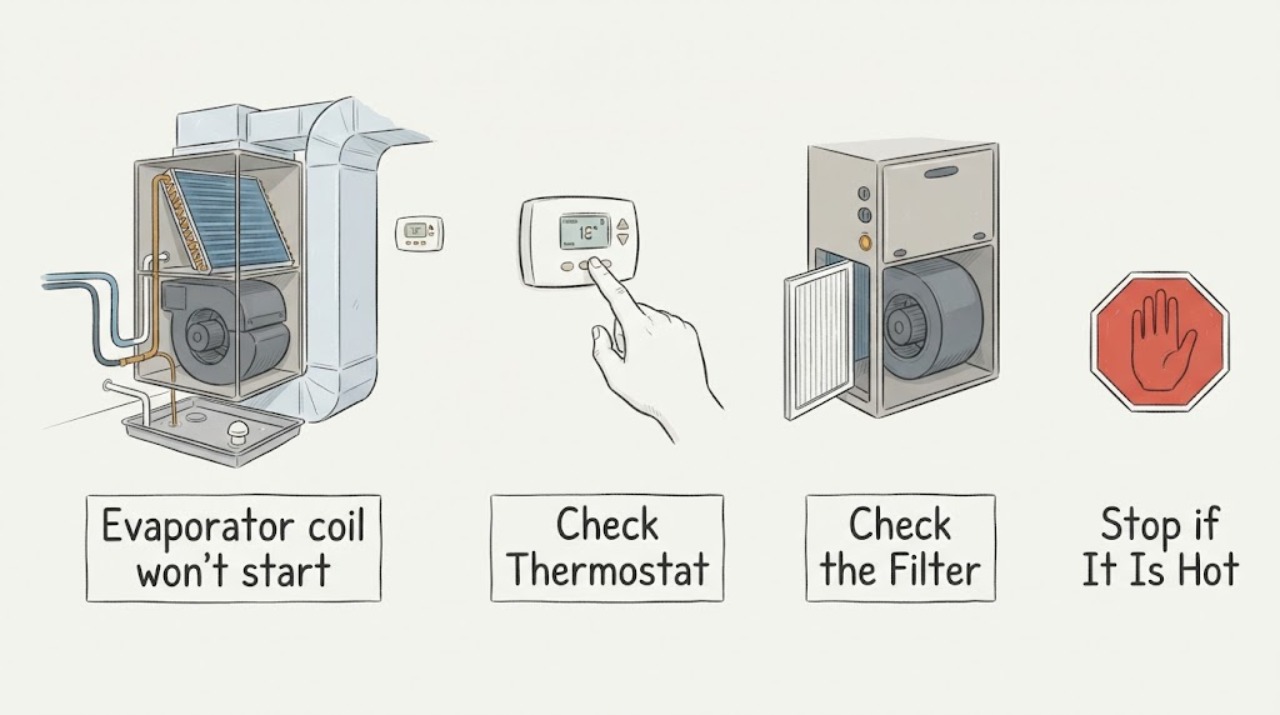
An evaporator coil itself does not start like a motor; it is the indoor heat-absorbing coil that works with the blower, condenser, controls, and refrigerant circuit. If an air conditioner seems not to start, first identify whether the thermostat calls for cooling, the indoor blower moves air, and the outdoor unit responds. Check only the thermostat settings, an accessible air filter and return grilles, and visible ice or water from a safe position. A blank control, no blower, repeated breaker trip, frozen coil, refrigerant clue, capacitor symptom, or damaged wiring needs professional HVAC diagnosis. Do not open the air handler, remove a panel, touch a capacitor or wiring, test live voltage, chip ice, or handle refrigerant.
Before you begin
Safety first
- This article is for safe observation and triage. A qualified HVAC professional determines whether the issue involves the blower, thermostat or controls, drain protection, airflow, frozen or leaking evaporator coil, refrigerant circuit, motor, capacitor, or another system component, and performs all panel access, electrical testing, refrigerant work, and part selection.
Work through in order
Diagnostic checks
Use only checks that match the exact appliance or system and its official guide.
-
Check 1
From normal user locations, call for cooling at the thermostat and observe the display, supply-air movement, indoor blower sound, and outdoor-unit response without touching equipment or opening a cover.
Expected result: The thermostat is blank or does not call for cooling; the indoor blower runs but air is warm; there is no indoor airflow; the outdoor unit runs while the indoor blower does not; or neither unit responds.
Next step: Record exactly which parts respond and whether the home is cooling, then continue only with the thermostat and filter observations if there is no ice, odor, smoke, or electrical hazard.
Stop if: Stop immediately for smoke, a burning smell, exposed wiring, water near electrical equipment, severe noise, or a breaker that has tripped again; leave the system off and arrange qualified service.
Why this matters
Why: A coil is not independently failing to start. A blank control points toward control power or thermostat issues; no airflow points toward the air handler, blower, filter, drain protection, or controls; outdoor-only or indoor-only operation narrows the service report but does not identify a component.
-
Check 2
At the thermostat, verify that the mode is COOL, the selected temperature is below the room temperature, the fan setting matches the intended operation, and any schedule is expected; if the display uses batteries, check the owner instructions for a normal battery replacement.
Expected result: The mode, target, schedule, fan setting, or display is clearly wrong; the display is blank or repeatedly resets; or the control appears correct but the system still does not respond.
Next step: Correct only the visible setting or replace user-accessible thermostat batteries when the manual permits it, then make one normal cooling call. If the display remains unreliable or the system remains unresponsive, request HVAC service.
Stop if: Do not remove the thermostat, jumper terminals, alter wiring, bypass a safety switch, or repeatedly cycle power as a test.
Why this matters
Why: A wrong setting or dead thermostat battery can prevent a cooling call. A correct display does not rule out a failed thermostat, drain safety interruption, low-voltage control fault, or equipment problem.
-
Check 3
With the system off at the thermostat, inspect the accessible air filter and return grilles from ordinary safe access; replace a disposable filter only with the specified type and size, and do not enter the air-handler cabinet.
Expected result: The filter is loaded, wet, collapsed, or backward; a return grille is blocked; the filter and returns look clear; or the filter location/specification is unknown.
Next step: Restore the specified filter and clear only movable items in front of return grilles, then make one observation of airflow. If the blower remains off, cooling is weak, or ice appears, stop and arrange professional diagnosis.
Stop if: Do not run the system without its specified filter, force a filter, wipe the hidden coil, or remove an air-handler panel.
Why this matters
Why: Restricted airflow can keep the evaporator coil from working correctly and can contribute to freezing or weak cooling. A clear filter does not rule out a dirty internal coil, blower fault, refrigerant issue, control fault, or drain protection.
-
Check 4
From the air-handler entry or another safe position, look for visible frost or ice on the cabinet or refrigerant tubing, water below the indoor unit, or unusually weak airflow; do not touch the coil, tubing, condensate pan, or ice.
Expected result: Ice or frost is visible; water is present below the unit; airflow is weak with no visible ice; or no abnormal moisture or ice is visible.
Next step: If ice is visible, switch COOL to OFF at the thermostat and schedule HVAC service; document where water or ice appears. If there is water near electrical equipment, keep clear and request prompt service.
Stop if: Do not chip ice, apply heat, pour water on the coil, add refrigerant, open the cabinet, or bypass a condensate or safety control.
Why this matters
Why: Trane associates a frozen evaporator coil with restricted airflow, low refrigerant, and thermostat issues, and notes that water can appear as ice thaws. Weak airflow without visible ice still warrants service if the system will not cool. Absence of visible ice does not prove the coil is operating.
-
Check 5
During one normal cooling call, compare the indoor supply airflow with the outdoor unit's audible response from a safe distance; do not look through a grille while moving parts are accessible and do not remove the outdoor disconnect or panel.
Expected result: The indoor blower runs with no outdoor response; the outdoor unit runs with no indoor airflow; the outdoor fan does not spin; the unit hums, rattles, or stops; or both sides respond but the air remains warm.
Next step: Keep the system off when a fan is stalled, noise is severe, or the two sides do not coordinate; provide the observation to a qualified HVAC professional for control, motor, capacitor, airflow, and refrigerant checks.
Stop if: Do not reach toward a fan, touch a capacitor, remove a grille, test voltage, or attempt to replace a motor or electrical component.
Why this matters
Why: Trane distinguishes the indoor blower from the outdoor condenser fan and notes that no-start, intermittent operation, humming, or a non-spinning fan can involve a motor or run capacitor. These observations identify the service symptom, not a safe part replacement diagnosis.
-
Check 6
Record when the symptom began and whether it followed filter changes, thermostat work, maintenance, a storm, a drain overflow, or a system replacement; include room temperature behavior and whether the issue is constant or intermittent.
Expected result: The symptom started after a known change; it has existed since installation; it occurs only during cooling; or there is no clear trigger.
Next step: Give the timeline, photos of safe visible clues, thermostat behavior, filter condition, airflow comparison, and any water or ice history to the HVAC professional.
Stop if: Do not select an evaporator coil, blower, capacitor, thermostat, or refrigerant repair solely from the history.
Why this matters
Why: Timing can focus the professional visit on a control, airflow, drain, commissioning, or equipment fault, but it cannot establish a failed coil or justify a replacement part.
Use your observations
Decision map
Find the observation that best matches what you see, then follow the next safe action.
-
PATH 01Safety boundary
What you see
The user is describing an air conditioner or air handler that does not start, rather than a motorized part visibly failing to start.
Do this next
Report the thermostat, indoor blower, outdoor-unit, airflow, ice, and water observations separately; do not diagnose the passive evaporator coil from the wording alone.
Why this path and its safety boundary
Safety stop: Do not open the air handler to make the coil start.
-
PATH 02Safety boundary
What you see
The thermostat is blank, not set to cooling, not calling below room temperature, or repeatedly resets.
Do this next
Correct only a visible setting or user-accessible battery issue allowed by the thermostat instructions; if the call remains absent, arrange HVAC service for controls and power diagnosis.
Why this path and its safety boundary
Safety stop: Do not jumper, rewire, or bypass the thermostat.
-
PATH 03Safety boundary
What you see
The accessible filter is loaded, the return path is blocked, or indoor airflow is weak.
Do this next
Restore the specified filter and unobstructed return path, then observe once. If airflow stays weak or the system still does not cool, request professional blower, coil, duct, and control assessment.
Why this path and its safety boundary
Safety stop: Do not access the hidden coil or blower cabinet.
-
PATH 04Safety boundary
What you see
Frost or ice is visible on the evaporator area, cabinet, or refrigerant tubing, or the system has weak cooling with thaw water.
Do this next
Turn COOL to OFF and arrange qualified HVAC service to assess airflow and refrigerant-related causes; protect the area from water while staying clear of electrical equipment.
Why this path and its safety boundary
Safety stop: Do not chip, heat, wash, or otherwise force-thaw the coil, and do not add refrigerant.
-
PATH 05Safety boundary
What you see
The outdoor unit responds but the indoor blower does not, or the indoor blower runs without a coordinated outdoor response.
Do this next
Stop repeated start attempts and request HVAC diagnosis of controls, blower motor, drain protection, circuit, and related equipment.
Why this path and its safety boundary
Safety stop: No panel access, live electrical testing, capacitor handling, or safety-switch bypass is included.
-
PATH 06Safety boundary
What you see
A breaker trips again, smoke or a burning odor appears, wiring is damaged, or a motor makes severe abnormal noise.
Do this next
Stop using the system, keep people clear, and contact a qualified HVAC or electrical professional; use the property's emergency response for active smoke or fire.
Why this path and its safety boundary
Safety stop: Do not reset repeatedly, touch the equipment, or perform live electrical diagnosis.
-
PATH 07Safety boundary
What you see
Settings, accessible filter, and visible airflow clues are normal but the air handler or air conditioner still will not start or cool.
Do this next
Arrange a prompt HVAC diagnostic visit and provide the symptom timeline and component-by-component observation log.
Why this path and its safety boundary
Safety stop: Do not order a replacement coil or other part from the symptom alone.
Helpful context
Understand the symptom
A coil is not the part that starts
In a split air conditioner, the evaporator coil sits in or beside the indoor air handler and absorbs heat from returning indoor air. The blower moves air across it, while the outdoor equipment and controls complete the cooling cycle. Therefore, “the evaporator coil won't start” usually means the air conditioner is not starting, the indoor airflow is absent, or the coil is frozen or not cooling. Identify the absent behavior before choosing any repair.
Use visible clues without opening the air handler
Trane lists incorrect thermostat settings, clogged filters, blocked return grilles, a tripped circuit, a frozen evaporator coil, a clogged drain, and motor or capacitor faults among possible reasons an air conditioner will not start or cool. Safe observations can separate these clues, but they cannot prove which component failed. The indoor coil is often not easily accessible, and the refrigerant circuit and electrical compartments are professional work.
Ice changes the next step immediately
Visible frost or ice on the indoor coil, cabinet, or refrigerant tubing can accompany restricted airflow or low refrigerant. Turn cooling off at the thermostat and arrange service; do not chip at the ice or keep operating a frozen system. Water below the air handler after thawing is also useful information for the technician, not permission to open the cabinet or bypass a safety control.
Only after diagnosis
Potential parts
- air filter
Consider this only when an accessible filter is visibly loaded, damaged, or due for replacement under the equipment instructions; a filter cannot repair a blower, coil, refrigerant, drain, or control fault.
Confirm the exact size and specification from the installed filter or equipment documentation before installing. - evaporator coil
Consider this only if a qualified technician confirms the coil itself is leaking, damaged, or otherwise beyond service; a no-start symptom alone does not establish coil failure.
A professional must verify the equipment model, coil dimensions, refrigerant circuit, and approved fit before any replacement. - blower motor or run capacitor
Consider either component only after qualified testing identifies an electrical or motor fault; absent airflow, humming, or intermittent starting is not enough to select a part.
Confirm exact electrical and equipment requirements through qualified service; do not handle the capacitor or wiring.
When checks do not resolve it
Need a professional?
Arrange qualified HVAC service when the air conditioner or air handler still will not start after the safe thermostat and filter checks, when indoor and outdoor responses do not coordinate, when cooling remains weak, or when the evaporator area may be frozen. Treat smoke, a burning odor, repeated breaker trips, exposed wiring, water near electrical equipment, or severe mechanical noise as an immediate stop condition and keep the system off.
Safety scope: This article is for safe observation and triage. A qualified HVAC professional determines whether the issue involves the blower, thermostat or controls, drain protection, airflow, frozen or leaking evaporator coil, refrigerant circuit, motor, capacitor, or another system component, and performs all panel access, electrical testing, refrigerant work, and part selection.
Have this ready
- Whether the thermostat calls for cooling and whether the indoor blower and outdoor unit respond
- Thermostat mode, display behavior, schedule, fan setting, and symptom timeline
- Filter condition, return-grille access, airflow strength, and whether the issue is constant or intermittent
- Visible frost, ice, thaw water, unusual sounds, odor, smoke, or breaker-trip observations
- Recent filter, thermostat, drain, maintenance, storm, or system-replacement history
Common questions
FAQ
Does an evaporator coil have a motor that needs to start?
No. The evaporator coil is a heat-absorbing part of the indoor air handler, not a motor. If the system does not start, separate the thermostat call, indoor blower, outdoor unit, airflow, ice, and control symptoms before arranging service.
What should I check when the evaporator coil seems inactive?
Check the thermostat mode and display, observe whether the indoor blower moves air, inspect the accessible filter and return grilles, and look for visible ice or water from a safe position. Do not open the air handler or handle electrical or refrigerant components.
Can a frozen evaporator coil stop an air conditioner from working?
Yes. Restricted airflow, a dirty coil, thermostat issues, or low refrigerant can be associated with freezing. Turn COOL to OFF when ice is visible, do not chip it, and arrange qualified HVAC service.
Why does the indoor blower run but the cooling does not start?
That pattern means the blower is responding while another part of the cooling call may not be. Record the thermostat and outdoor-unit behavior, then have a professional assess controls, outdoor equipment, airflow, and refrigerant rather than opening the unit.
Can I replace the run capacitor if the system will not start?
No. A run capacitor stores an electrical charge, and a no-start or humming symptom does not prove it is the cause. Keep the panel closed and have a qualified technician diagnose and replace any electrical component.
Read the exact guide
Official sources
- AC Fan Not Working? Reasons Why It Stopped SpinningTrane · Supports distinguishing indoor blower and outdoor condenser fan behavior and escalating no-start, humming, intermittent, or capacitor-related symptoms.
- Why Is My Air Handler Freezing Up?Trane · Supports turning cooling off for a frozen coil, not chipping ice, and separating airflow, filter, return, thermostat, and refrigerant causes.
- Coils Troubleshooting GuideTrane · Supports the role of the coil, no-heating/no-cooling clues, frost escalation, and the distinction between visible fin damage and professional coil service.
- Air Conditioner Troubleshooting: Why Your AC Is Not CoolingTrane · Supports separating no-start from no-cooling symptoms, checking thermostat and accessible filter clues, and professional escalation for refrigerant, motor, drain, and electrical issues.
Community feedback
Share a repair observation
Share a plain-text repair observation. Accepted observations are published automatically; this page may take a moment to update.