
Repair problem
Won T Start Troubleshooting Guides
Published FixGraph guidance for diagnosing and responding to won t start.
Matching published guides
Choose a guide that matches the service, equipment, and conditions you are seeing.
-
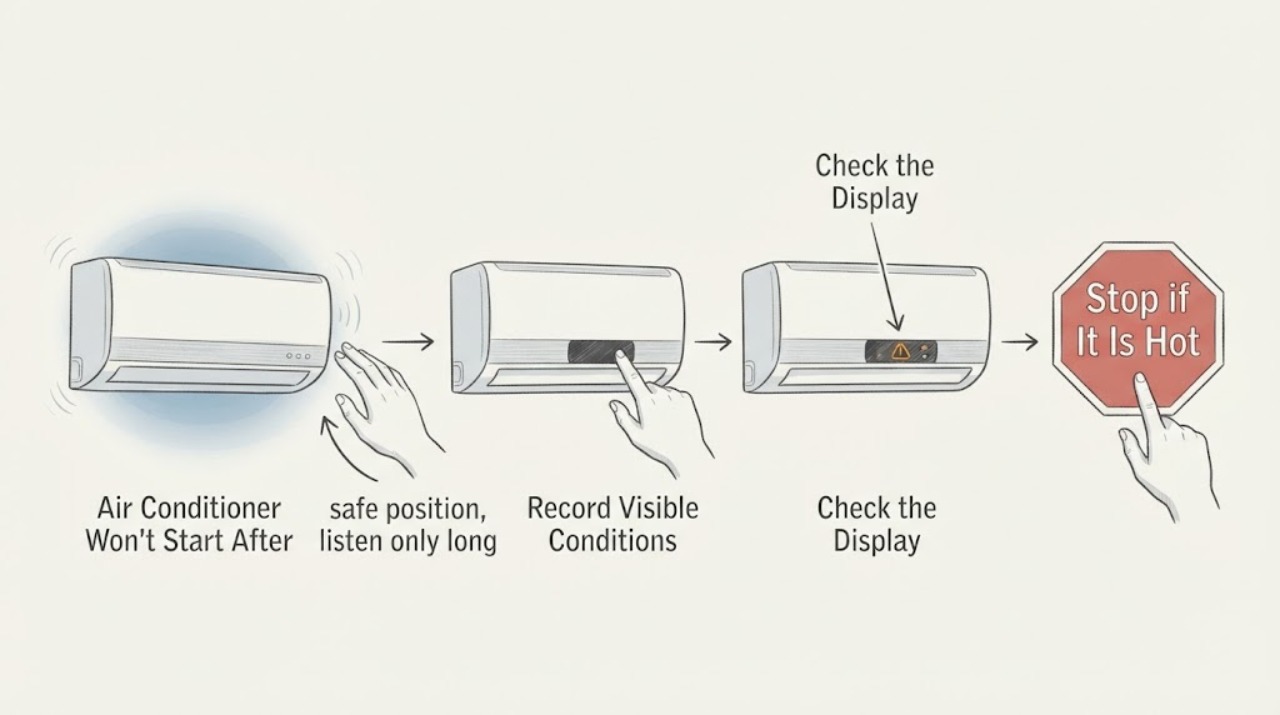
Air Conditioner Won't Start After Buzzing: Safe Checks and Service Boundaries
If an air conditioner buzzed and then would not start, treat the sound as useful evidence rather than repeatedly trying to start it. First note whether the buzz came from the thermostat, indoor air handler, outdoor cabinet, or electrical service area, and whether it occurred during a cooling call, at shutdown, or repeatedly.
-
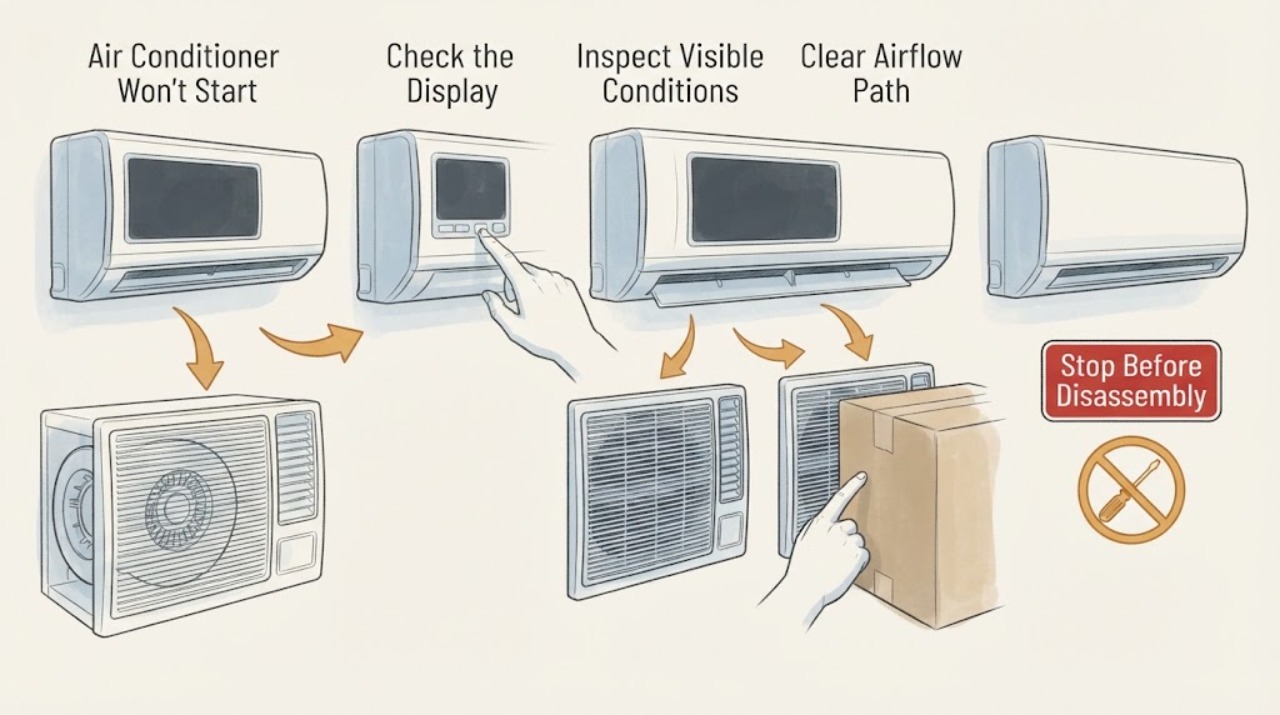
Air Conditioner Won't Start: Safe Blower Motor Checks
When an air conditioner will not start and the suspected component is the blower motor, first determine whether the indoor blower is actually silent, whether the thermostat is calling for cooling, and whether the system has visible power. Check the thermostat mode and schedule, inspect the accessible filter and supply/return airflow, and note whether the outdoor unit or indoor fan responds.
-
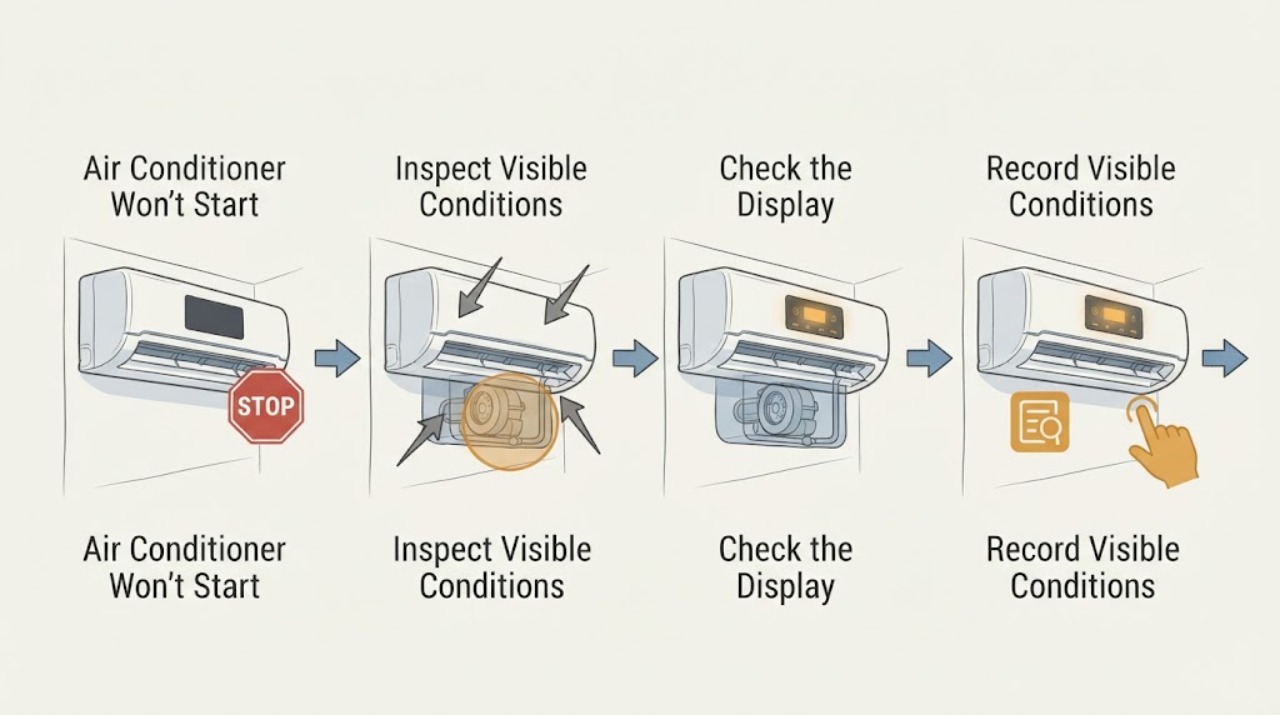
Air Conditioner Won't Start: Check the Thermostat, Drain Line, and Blower Safely
An air conditioner that will not start may have a thermostat command or power problem, a condensate drain blockage that has tripped a float switch, or an internal blower-motor, capacitor, control, or safety fault. Start with the thermostat display, mode, setpoint, batteries if applicable, and the exact symptom: no display, no indoor airflow, or no outdoor response.
-
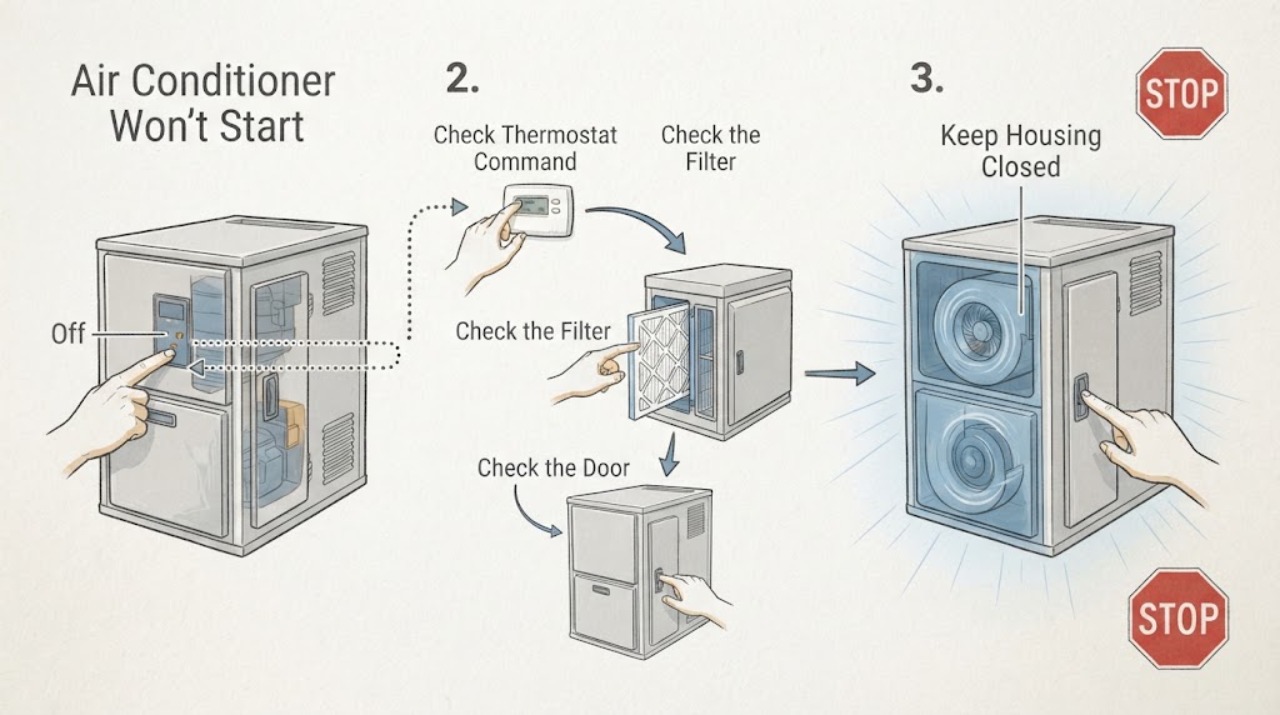
Air Conditioner Won't Start: Check the Blower Motor and Filter Safely
When an air conditioner will not start, first separate a thermostat or power command problem from an indoor airflow problem. Check the thermostat mode, setpoint, fan setting, display, and schedule; then look at the accessible filter and registers.
-
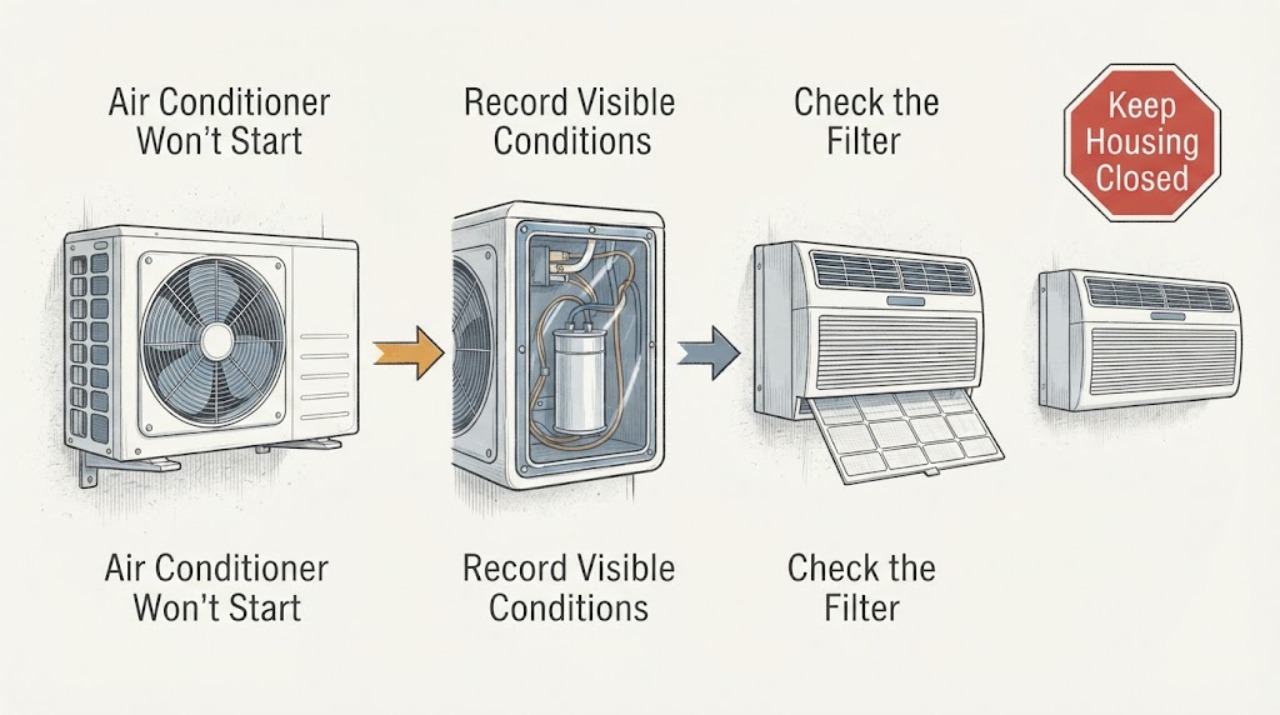
Air Conditioner Won't Start: Is the Capacitor the Cause?
A failed run or start capacitor can keep an air conditioner's outdoor fan or compressor from starting, but a no-start symptom does not prove the capacitor is bad. Check only the thermostat mode and setpoint, the accessible filter, indoor airflow, visible ice or water, and the outdoor unit's response from a safe distance.
-
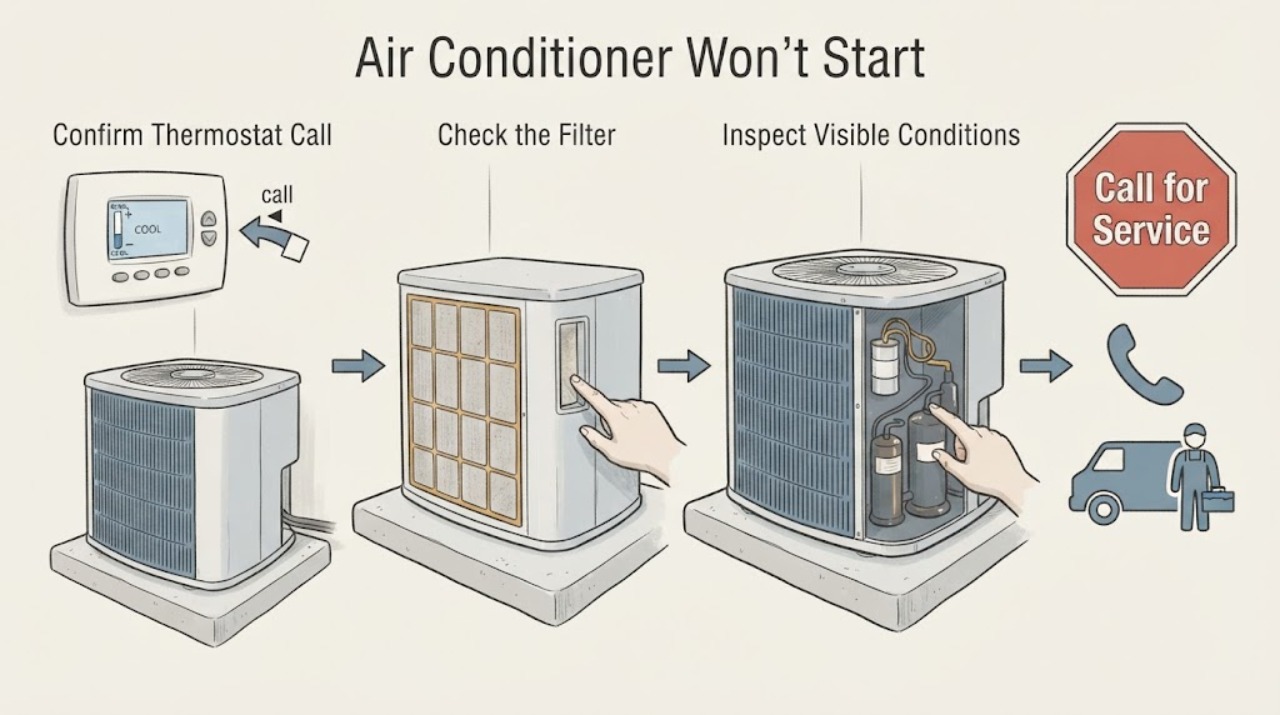
Air Conditioner Won't Start: Check the Thermostat and Filter Before Calling HVAC
Start with the user-safe checks: confirm the thermostat is calling for cooling and inspect the accessible air filter for blockage. Then note whether the indoor blower, outdoor fan, or compressor produces any response, and whether there is ice, water, burning odor, or unusual noise.
-
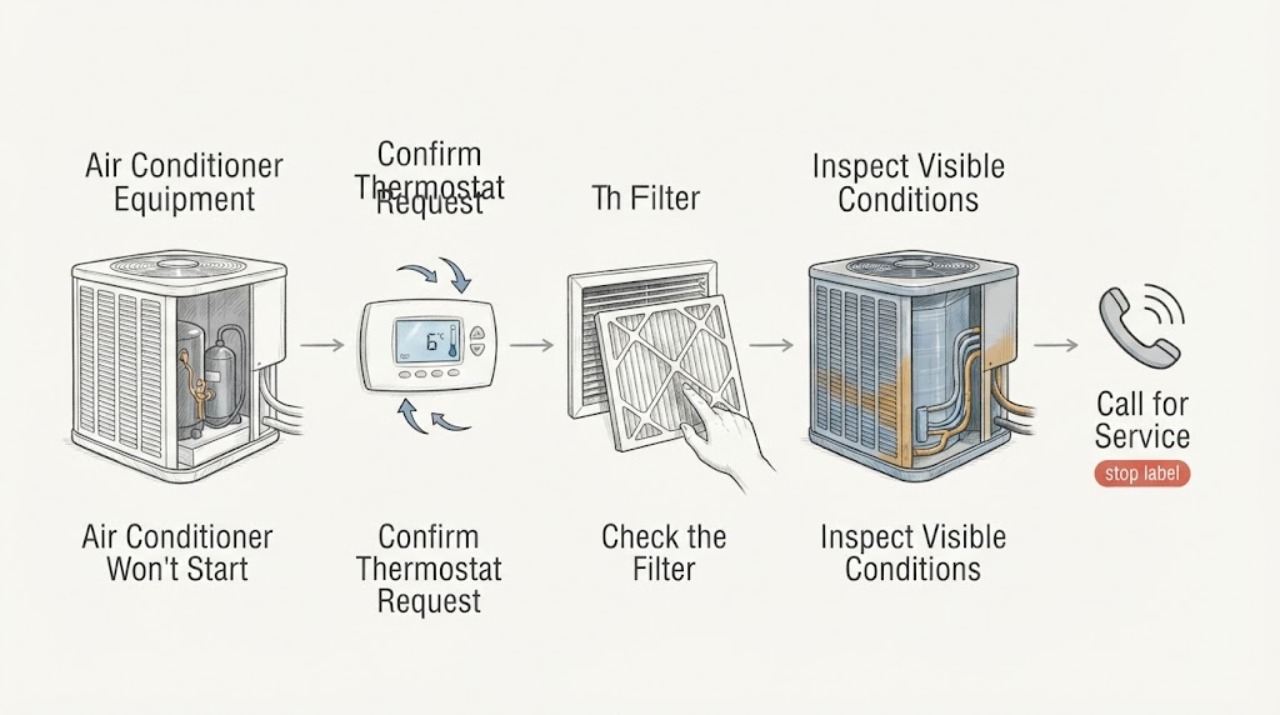
Air Conditioner Won't Start: Check the Thermostat and Filter Before Compressor Service
Confirm the thermostat is calling for cooling and inspect the accessible air filter before treating a no-start as a compressor failure. Then observe from a safe distance whether the indoor blower, outdoor fan, or compressor area responds, and record any hum, click, ice, water, odor, or protection trip without opening equipment.
-
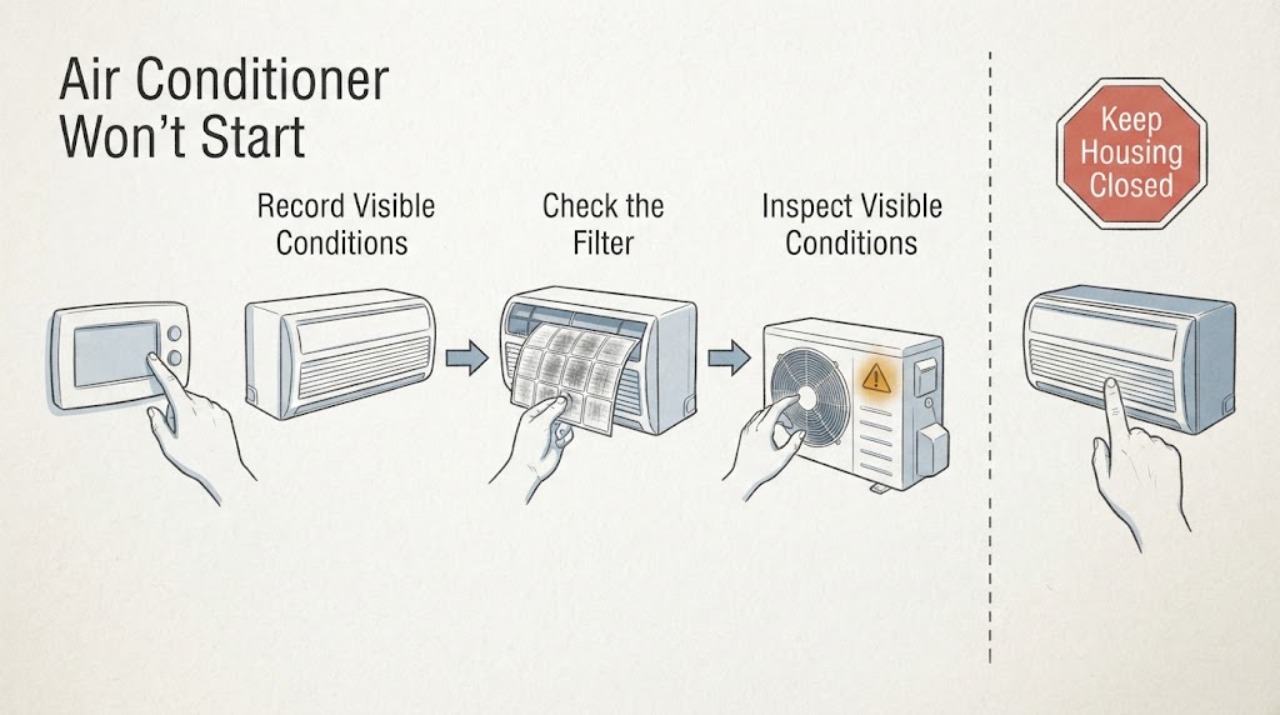
Air Conditioner Won't Start: Check the Thermostat Before the Compressor
If an air conditioner will not start, first check whether the thermostat is actually calling for cooling, then distinguish a blank indoor unit, no indoor airflow, and an outdoor unit that stays silent. Check only the thermostat mode and setpoint, an accessible filter, visible registers, and clearly visible power status.
-
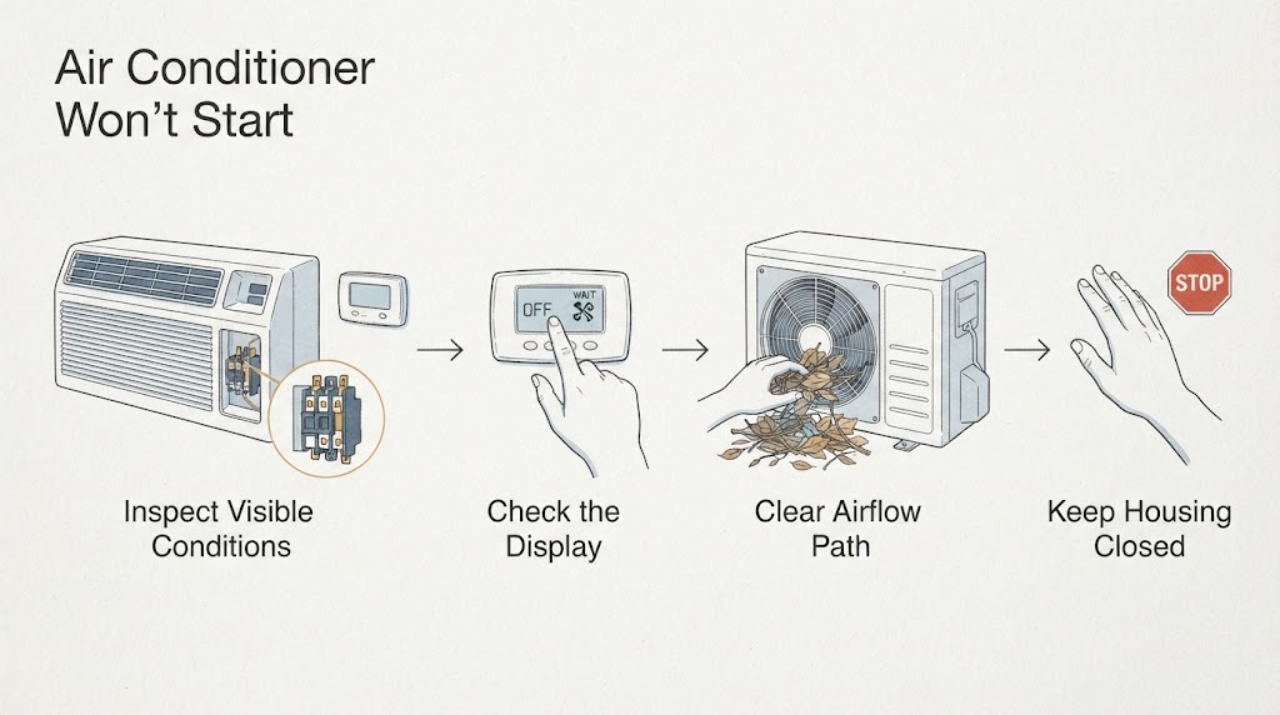
Air Conditioner Won't Start: Check the Thermostat Before Calling HVAC
Use the thermostat and other visible responses to separate a simple call-for-cooling problem from an HVAC equipment fault. Confirm that the thermostat has power, is set to Cool, and is calling for a temperature below the room temperature; allow any normal startup delay.
-
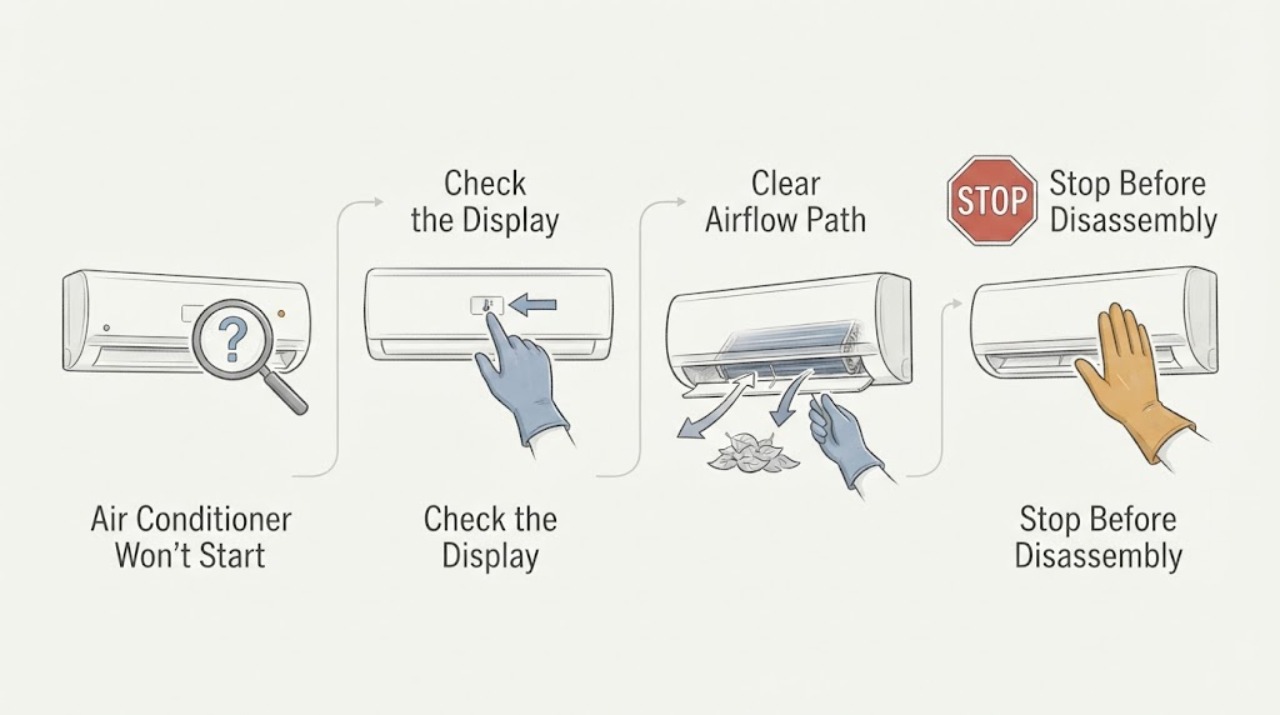
Air Conditioner Won't Start: Safe Evaporator Coil Checks
An air conditioner that will not start may have a thermostat or power problem, restricted airflow, a frozen evaporator coil, a condensate safety shutdown, or a professional-level electrical or refrigerant fault. Check the thermostat call, accessible filter, clear registers and return, visible breaker or service-switch state, and any ice or water you can see without opening the equipment.
-
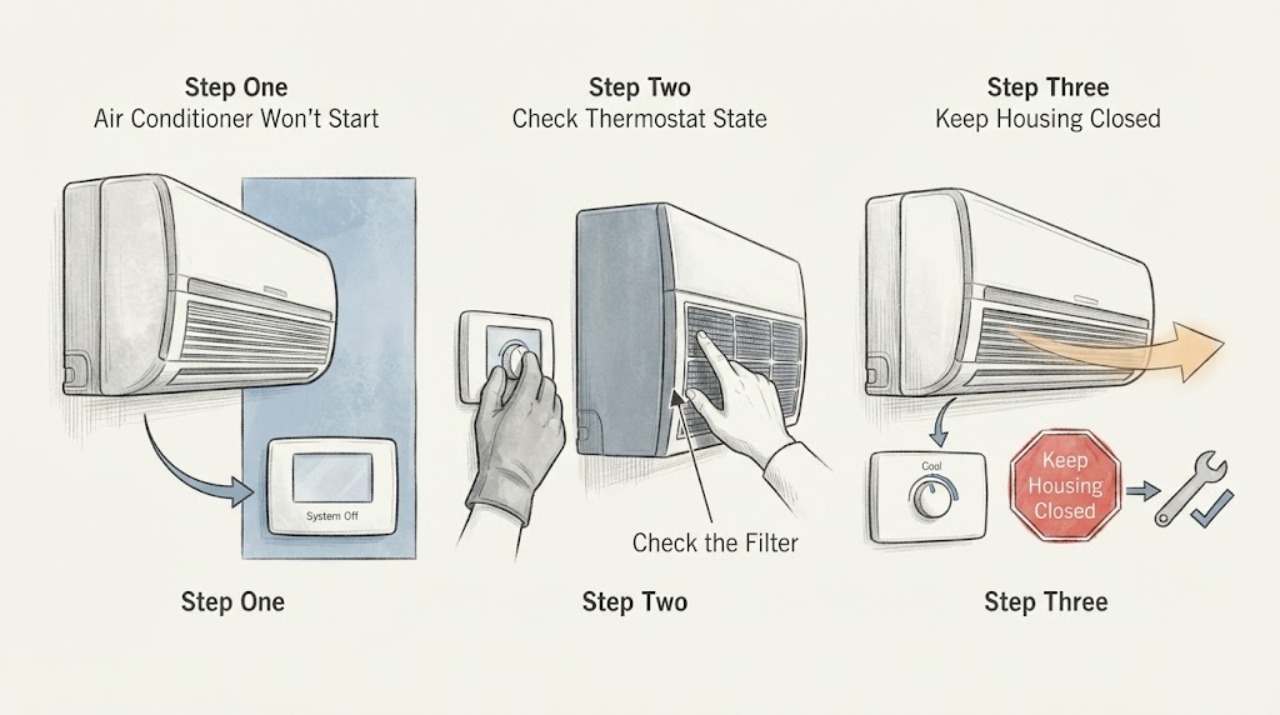
Air Conditioner Won't Start: Check the Thermostat and Filter
When an air conditioner will not start, begin at the thermostat and filter rather than opening the unit. Confirm the thermostat mode, setpoint, fan setting, schedule, display, and batteries, then inspect an accessible filter and visible registers.
-
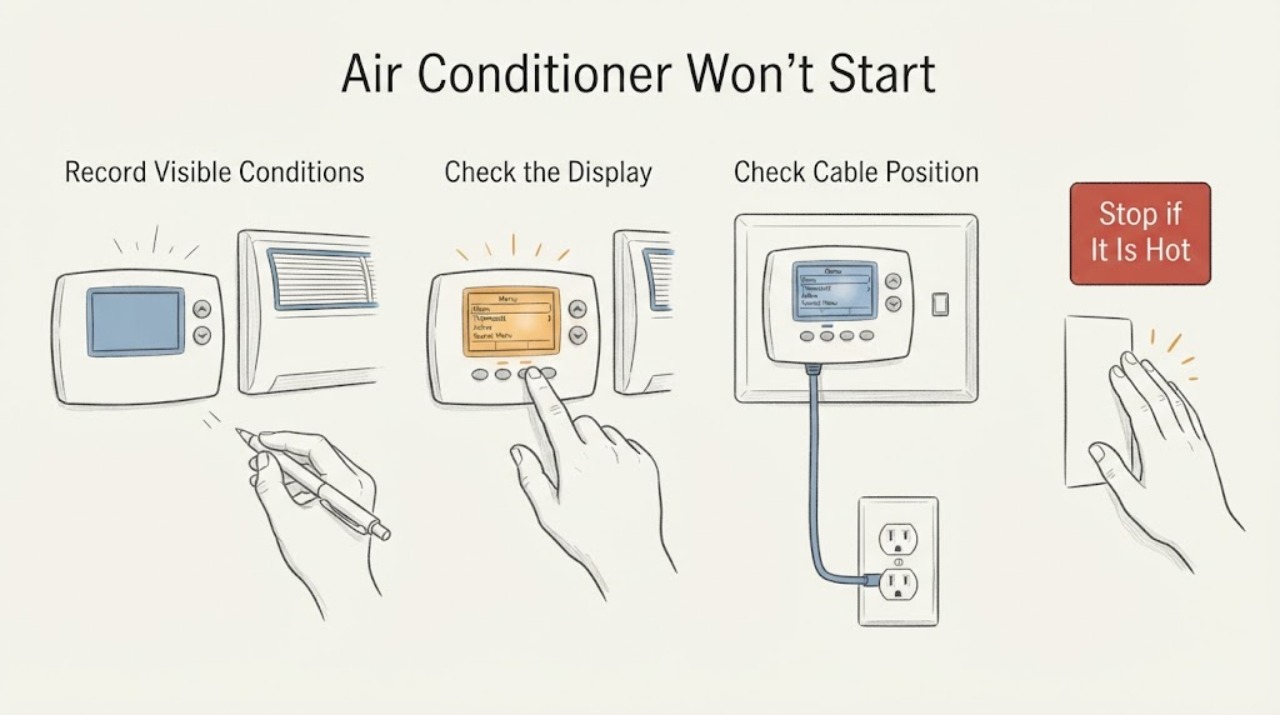
Air Conditioner Won't Start: Check the Thermostat First
If an air conditioner will not start and the thermostat is the suspected component, confirm that the control is awake, set to Cool, and below the current room temperature. Check whether a schedule, hold, Eco or away mode, fan-only setting, lock, or displayed delay is preventing a cooling call.
-
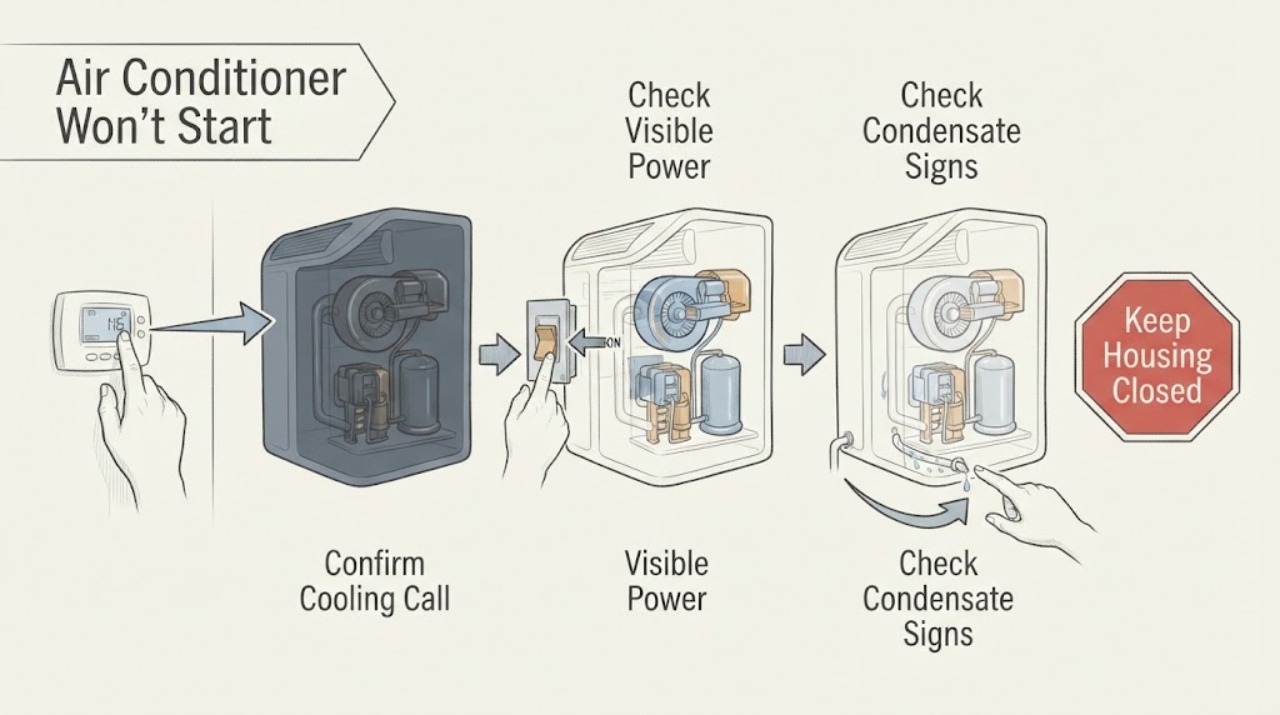
Air Conditioner Won't Start: Blower Motor, Compressor, and Contactor Checks
If an air conditioner will not start, first determine whether the thermostat is actually calling for cooling, whether the indoor blower responds, and whether the outdoor unit responds. From ordinary safe access, check the thermostat setting, the visible power status, the filter, and signs of condensate or an overflow shutdown; do not open panels or test live voltage.
-
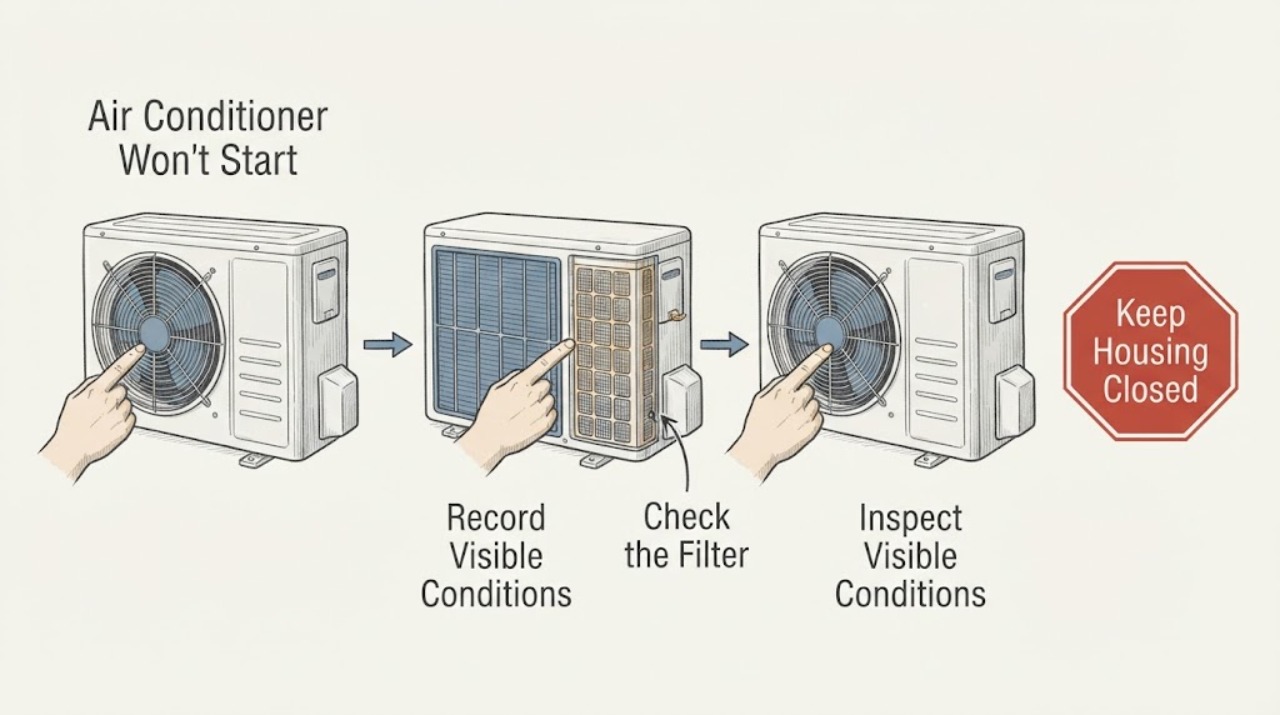
Air Conditioner Won't Start: Check the Safe Causes Before Ordering Parts
When an air conditioner will not start, first separate no thermostat call, no indoor response, and an outdoor unit that stays silent. Check the thermostat mode and setpoint, the accessible air filter, visible supply and return airflow, and whether a clearly labeled HVAC protective device is open.
-
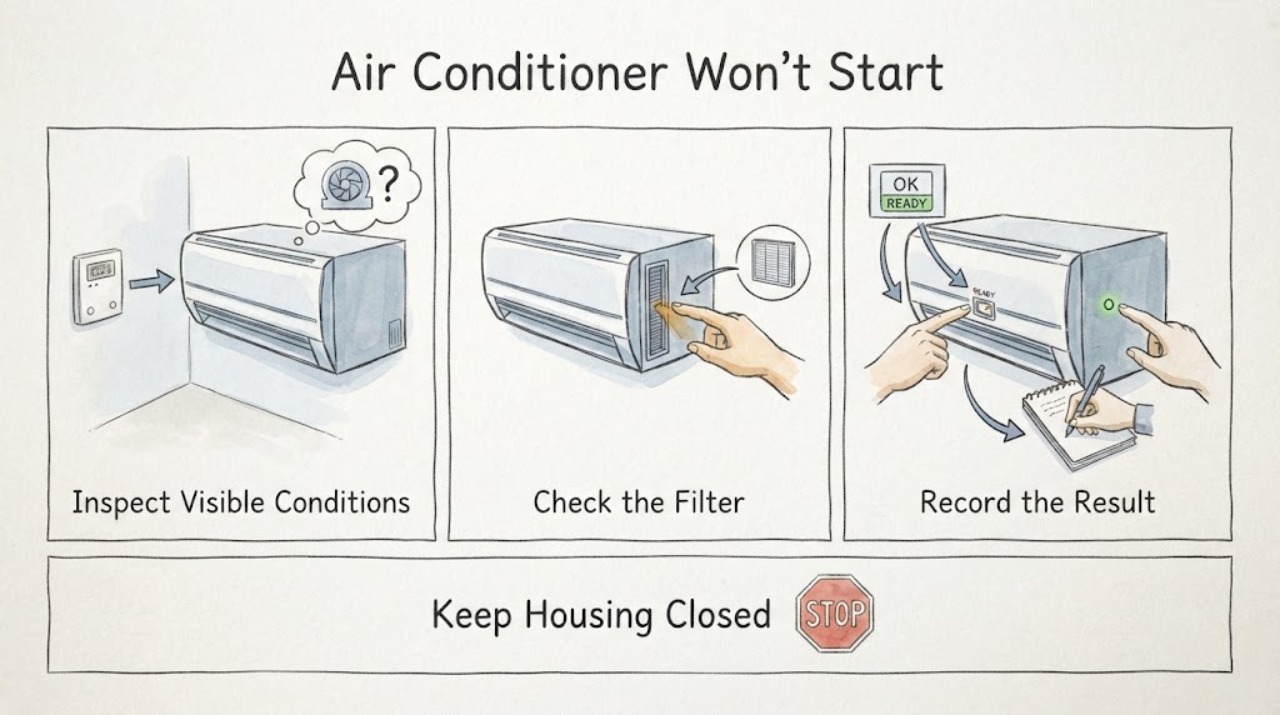
Air Conditioner Won't Start: Check the Thermostat, Blower, and Outdoor Unit
If an air conditioner will not start, first determine whether the thermostat is actually calling for cooling, whether the indoor blower moves air, and whether the outdoor unit responds. Check only the thermostat settings, the user-accessible air filter, visible registers, and the breaker or disconnect from a safe dry position; do not open a cabinet, touch wiring, reach into a fan, test a capacitor, or handle refrigerant.
-
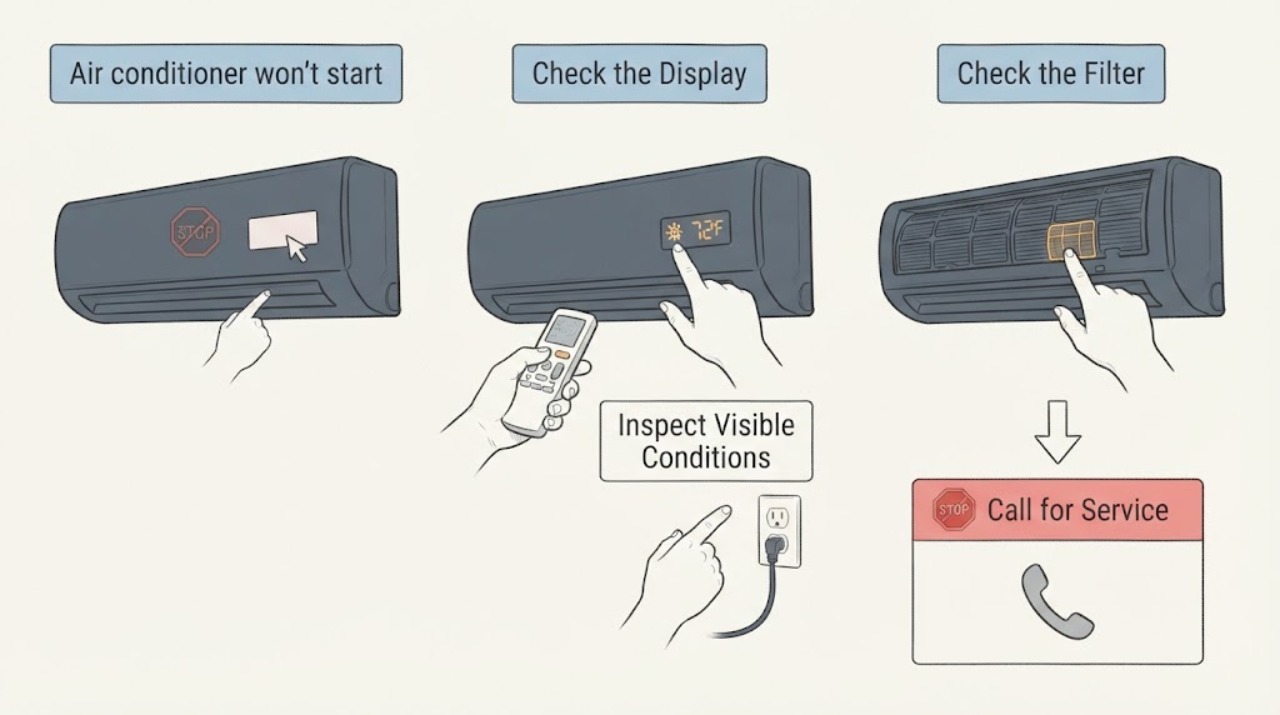
Air conditioner won't start: safe checks before calling for service
Start at the thermostat: confirm Cool mode, a set temperature below the room temperature, and the expected fan setting. Then check the air filter and look at the indoor and outdoor power switches or breakers without opening equipment.
-
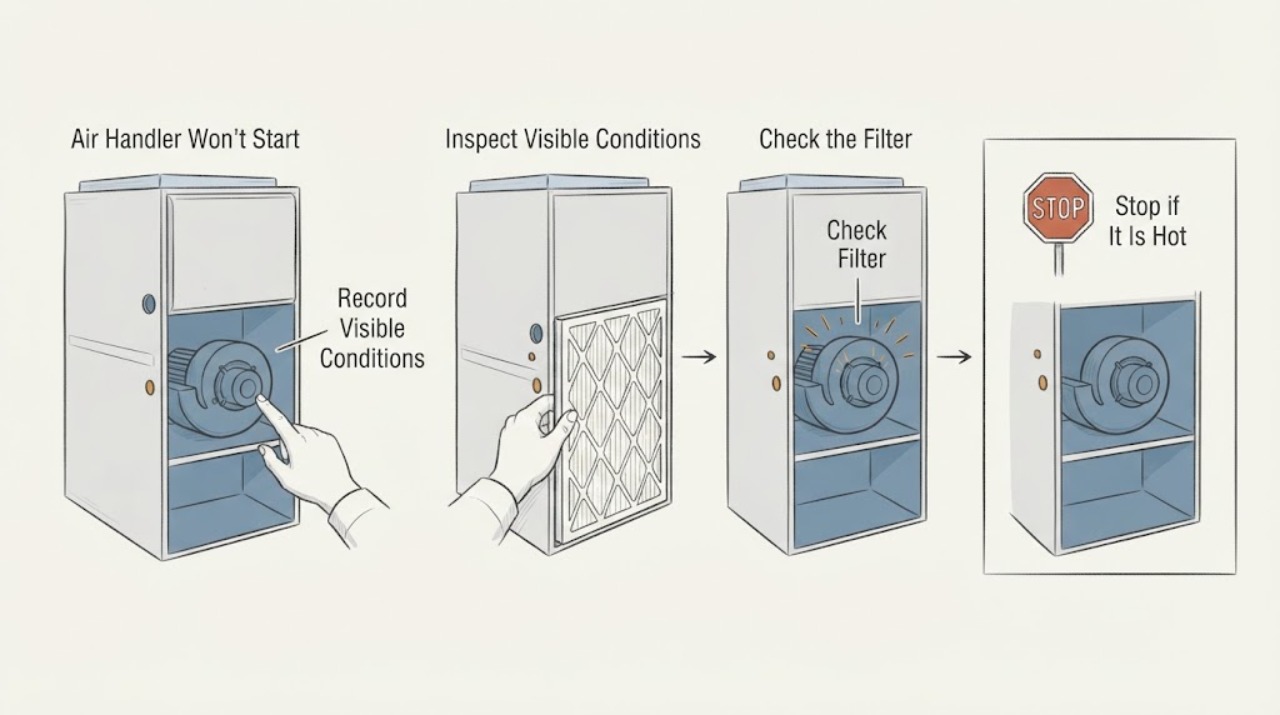
Air Handler Won't Start: Safe Blower Motor and Airflow Checks
If an air handler will not start and the blower motor is suspected, begin at the thermostat: confirm the display is active, the system is calling for the intended heating or cooling mode, and the fan setting is appropriate. Observe any visible power indicator or nearby service-switch position without opening equipment or resetting a breaker.
-
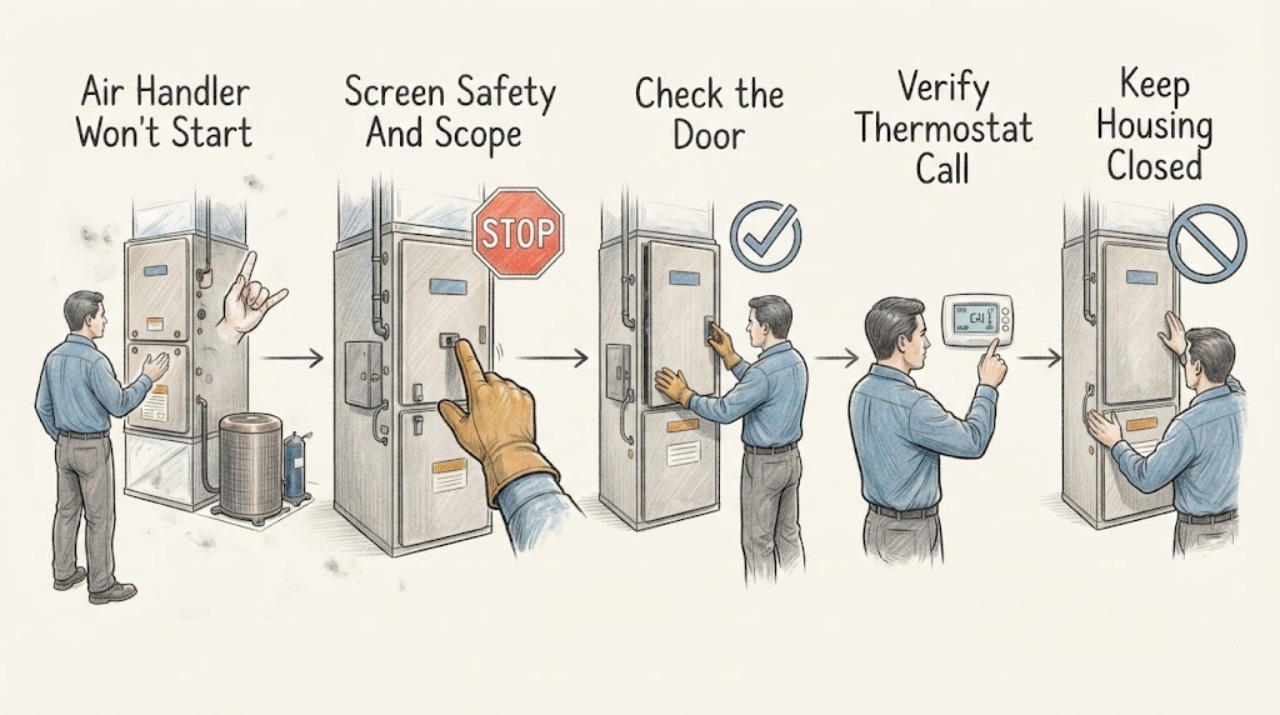
Air Handler Won't Start: Check Controls, Power, Filter, and Drain Safely
An air handler that will not start may have no indoor power, an incorrect thermostat call, a dirty filter or blocked airflow, a condensate overflow safety switch, an accessible service-door interlock, or an internal blower, control, wiring, compressor, or refrigerant problem. First determine whether the indoor fan is silent, whether the thermostat display and call are present, and whether the outdoor unit is also silent.
-
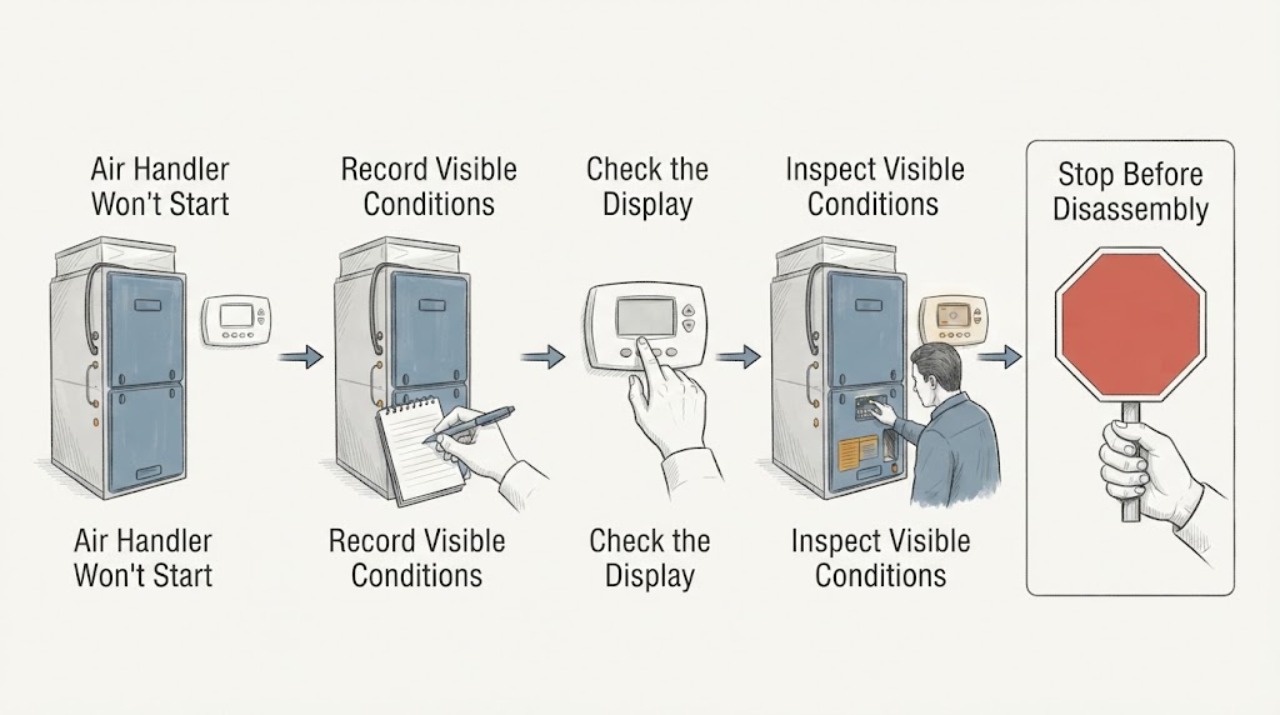
Air Handler Won't Start: Check the Thermostat and Power Safely
When an air handler will not start, first check the thermostat's mode, setpoint, schedule or hold, display, and any normal time delay. If the model uses batteries, replace them only as directed; otherwise check the clearly labeled HVAC breaker and indoor service switch from a dry, safe position.
-
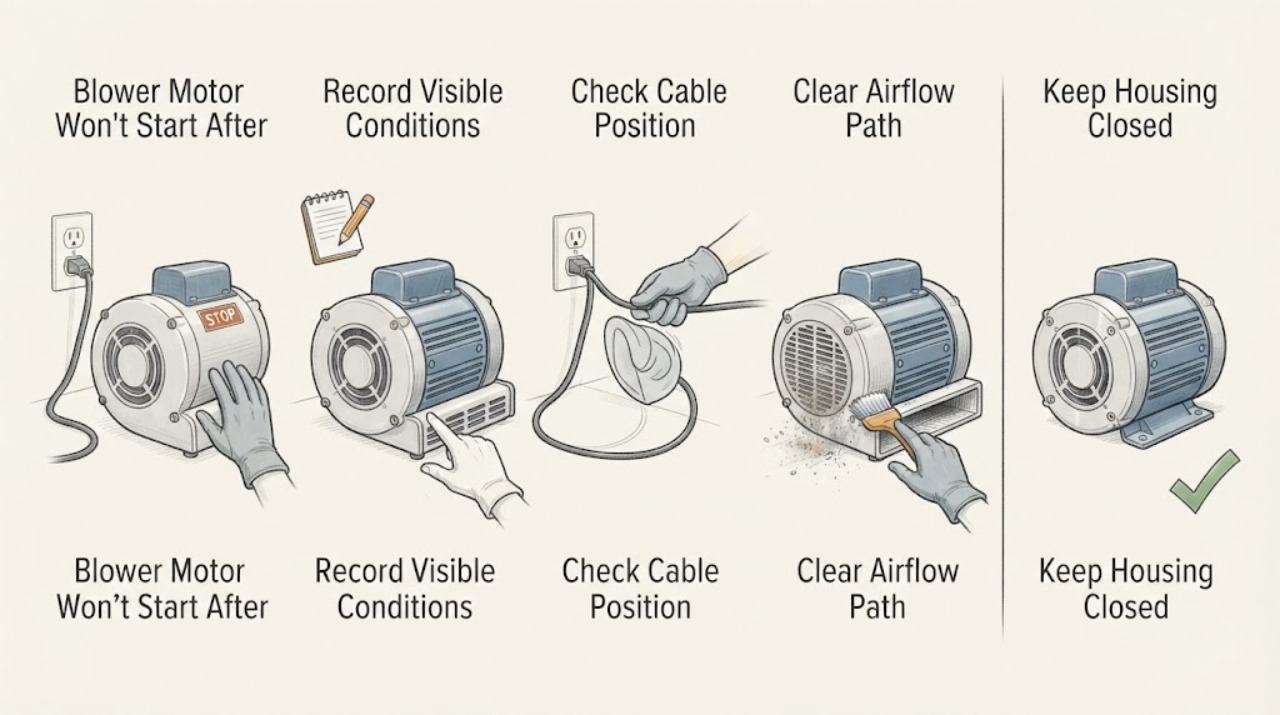
Blower Motor Won't Start After Spinning Manually
If an HVAC blower motor still will not start after someone spun the wheel manually, that hand movement does not prove the motor, capacitor, control, or power circuit is healthy. Do not repeat the hand-spin test while the equipment is connected or energized, and do not reach through a grille or access panel.
-
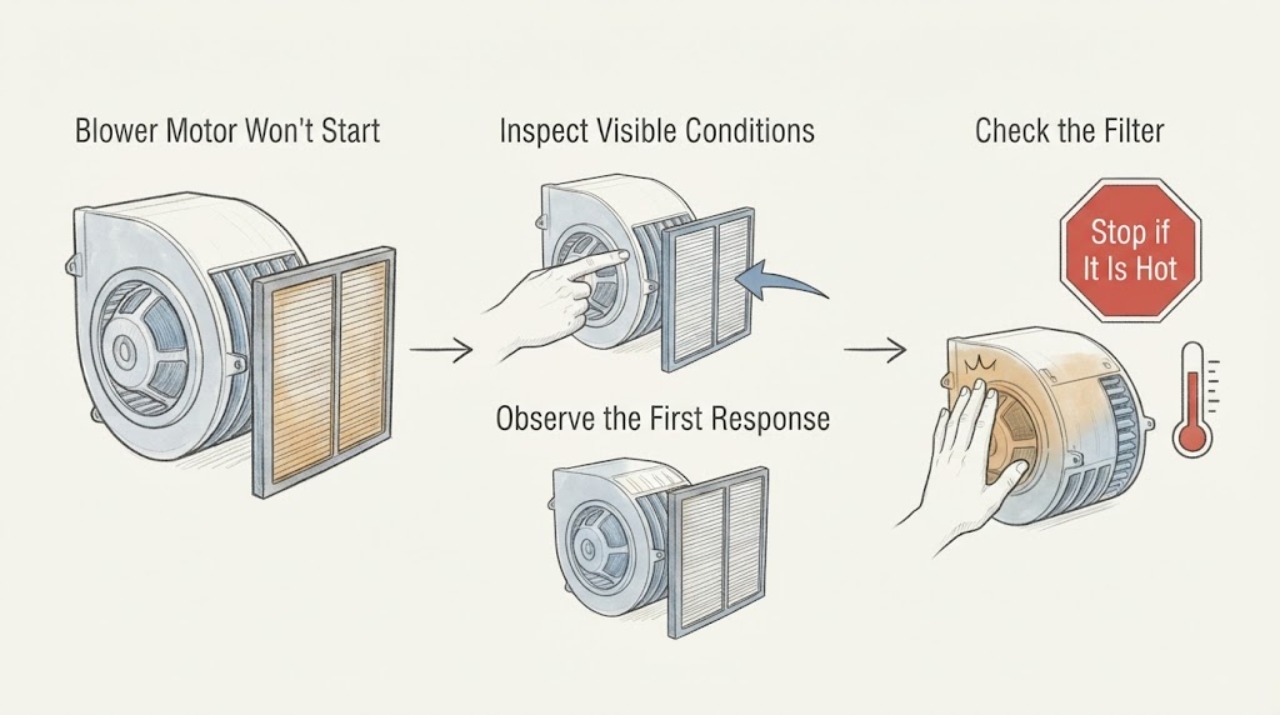
Blower Motor Won't Start: Check the Filter and Airflow Before HVAC Service
If the HVAC blower motor will not start, first separate a thermostat command problem from a loss of power, a loaded filter, blocked airflow, an open access-door safety switch, or a failed motor or starting component. Confirm the thermostat call, observe whether the indoor fan and outdoor unit respond, inspect only the accessible filter and grilles, and look for visible ice or water.
-
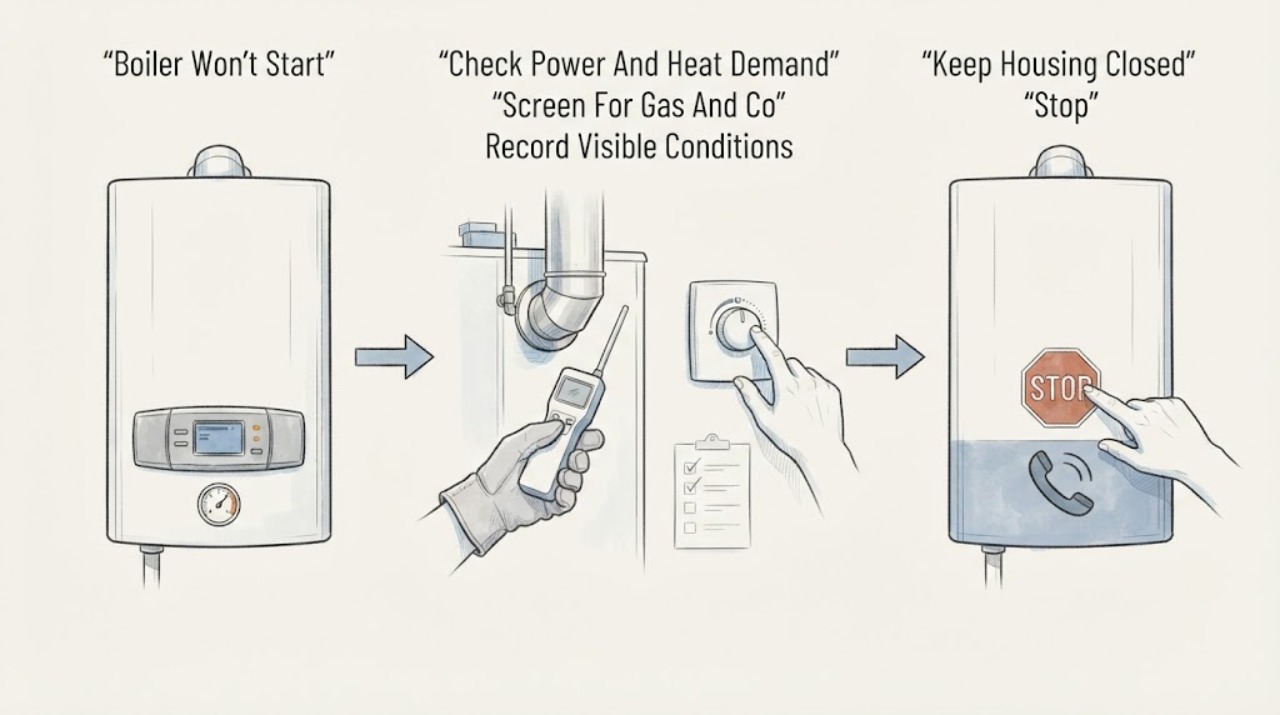
Boiler Won't Start: Check Safety, Power, Demand, and the Model-Specific Fault
If a boiler will not start, first check for a gas odor, carbon-monoxide alarm, smoke, unusual combustion noise, or illness; leave immediately and contact emergency help for a gas or CO warning. If the area is safe, record whether the boiler display has power, whether the programmer or thermostat is asking for heat, whether the fuel supply is available without operating a suspected leak, and what error code or lockout is shown.
-
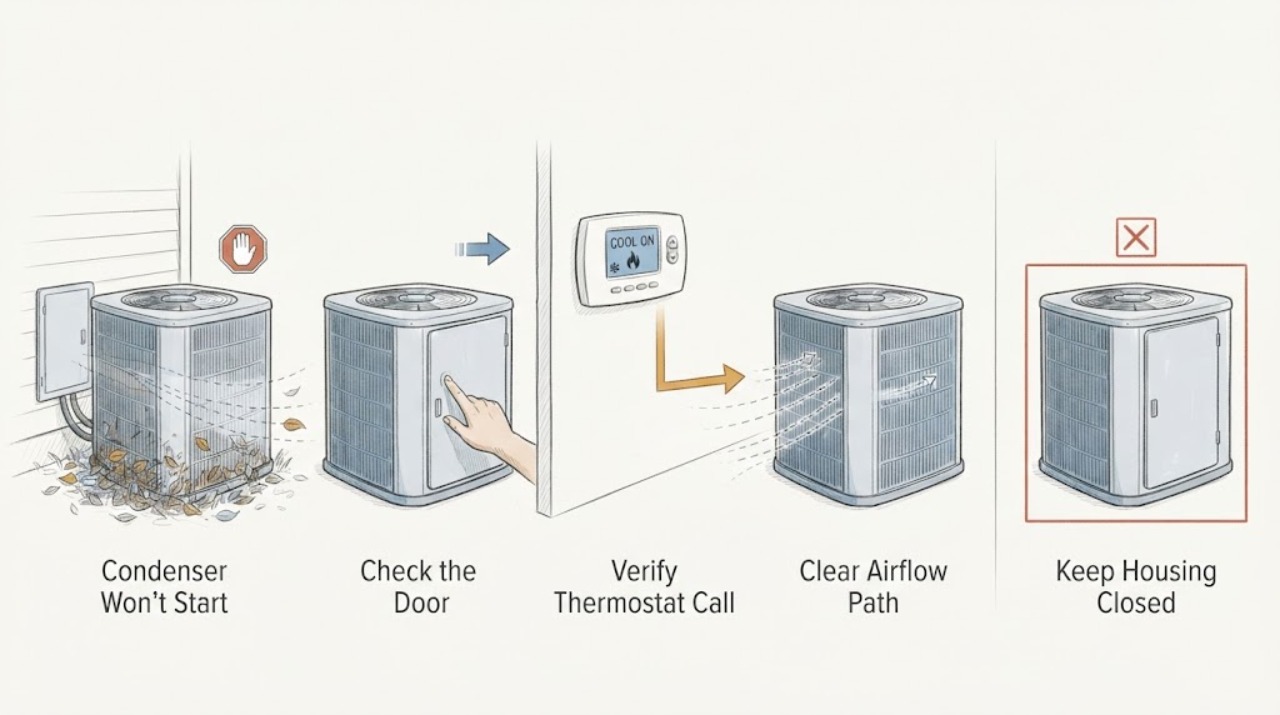
Condenser Won't Start: Safe HVAC Checks
First separate an indoor-airflow problem from an outdoor-condenser problem: set the thermostat to Cooling with a temperature below the room temperature, then listen and look from a safe distance for the outdoor unit to start. Check only user-accessible conditions such as a blank thermostat, a dirty filter, visible debris around the cabinet, and whether a breaker appears tripped.
-
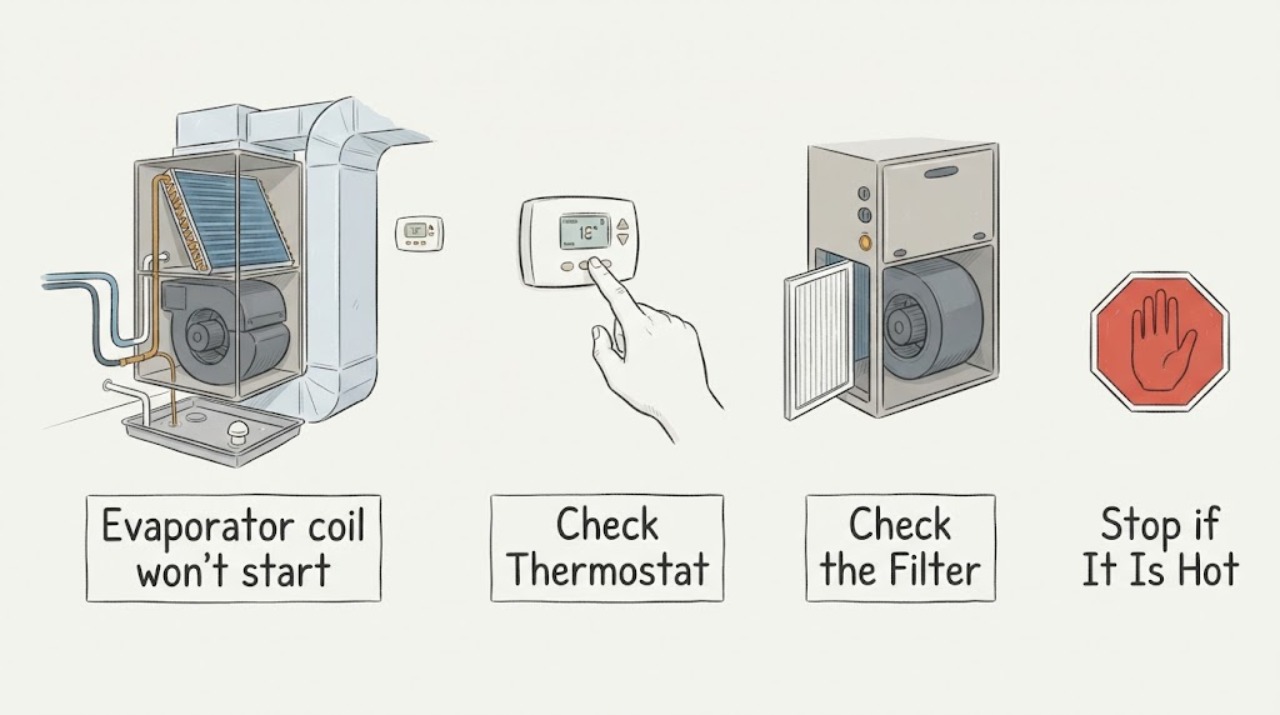
Evaporator coil won't start: Separate a coil symptom from an AC start failure
An evaporator coil itself does not start like a motor; it is the indoor heat-absorbing coil that works with the blower, condenser, controls, and refrigerant circuit. If an air conditioner seems not to start, first identify whether the thermostat calls for cooling, the indoor blower moves air, and the outdoor unit responds.
-
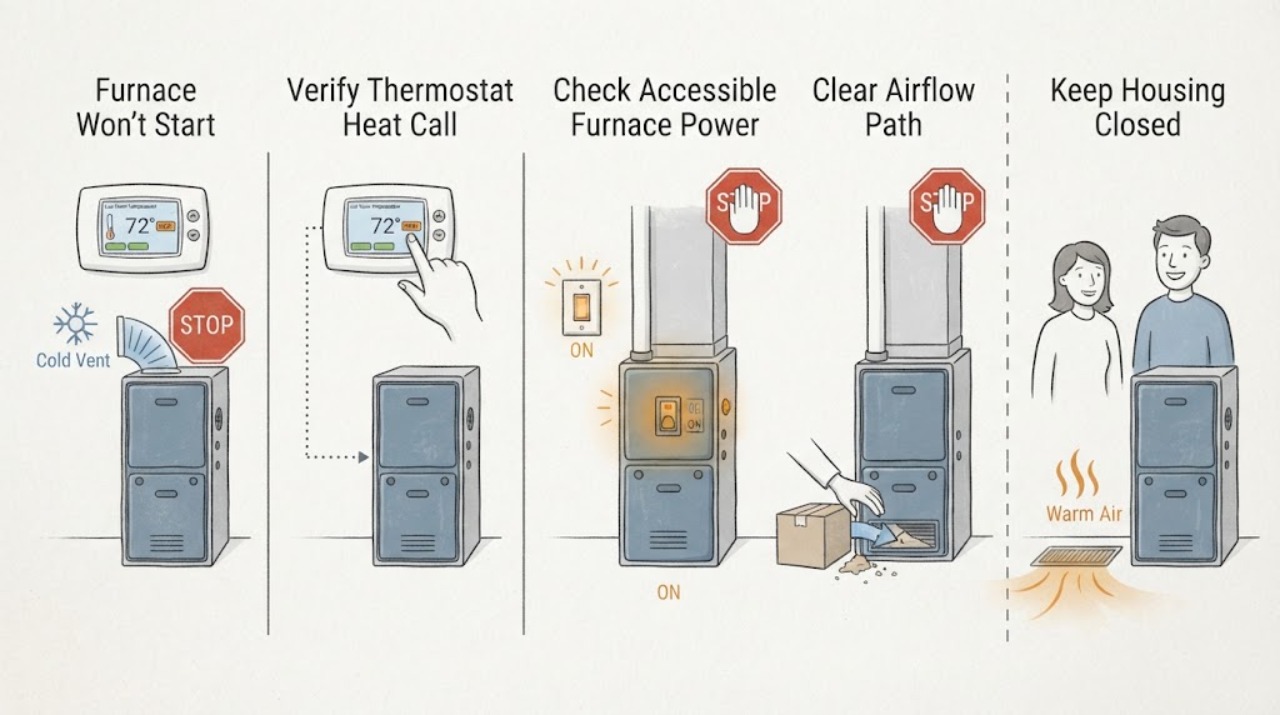
Furnace Won't Start: Safe HVAC Checks
Set the thermostat to Heat with a target above the room temperature, then note whether the thermostat is powered, the furnace's accessible service switch is on, and the air filter is blocked. A furnace can fail to start because of settings, loss of power, restricted airflow, ignition or flame-sensing faults, or a fuel-supply issue, but the internal diagnosis is not a homeowner repair.
-
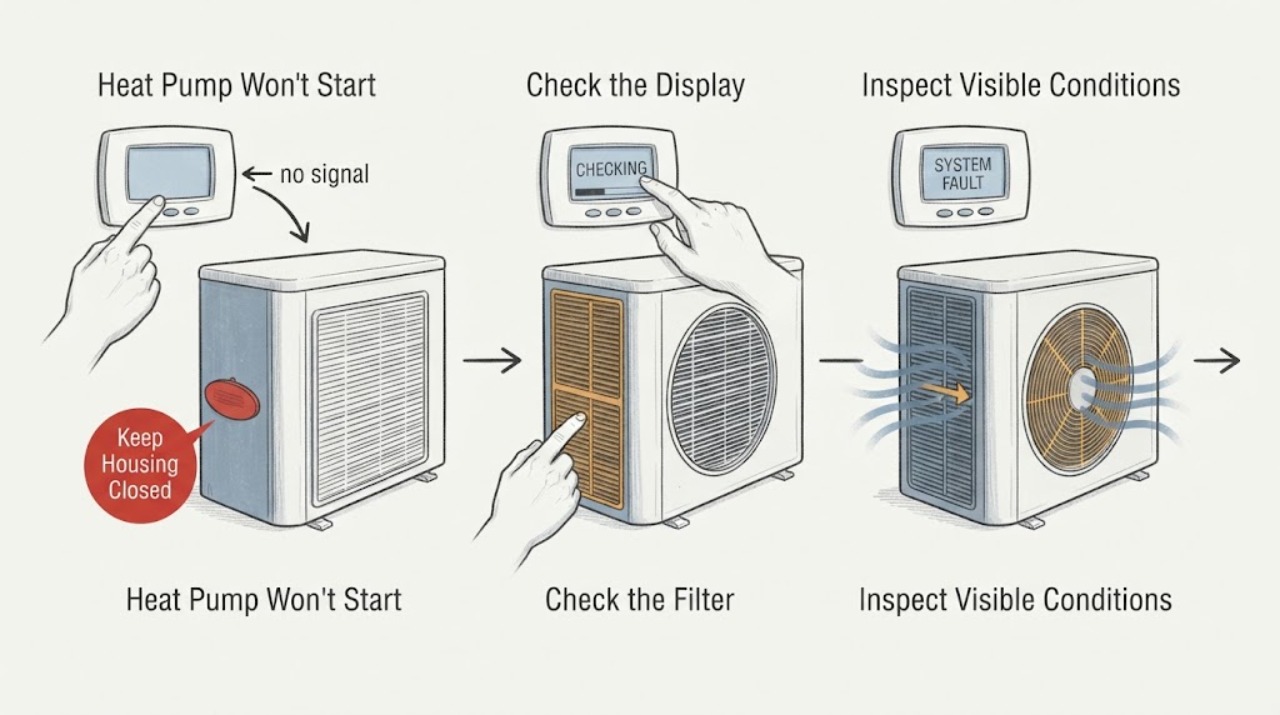
Heat Pump Won't Start: Check the Thermostat, Airflow, and Power Safely
If a heat pump will not start, begin at the thermostat: confirm the system is set to Heat or Cool as intended, the setpoint is calling for the chosen mode, and the display has power. Then inspect the accessible air filter, open return grilles, and clear loose leaves or snow from around the outdoor unit.
-
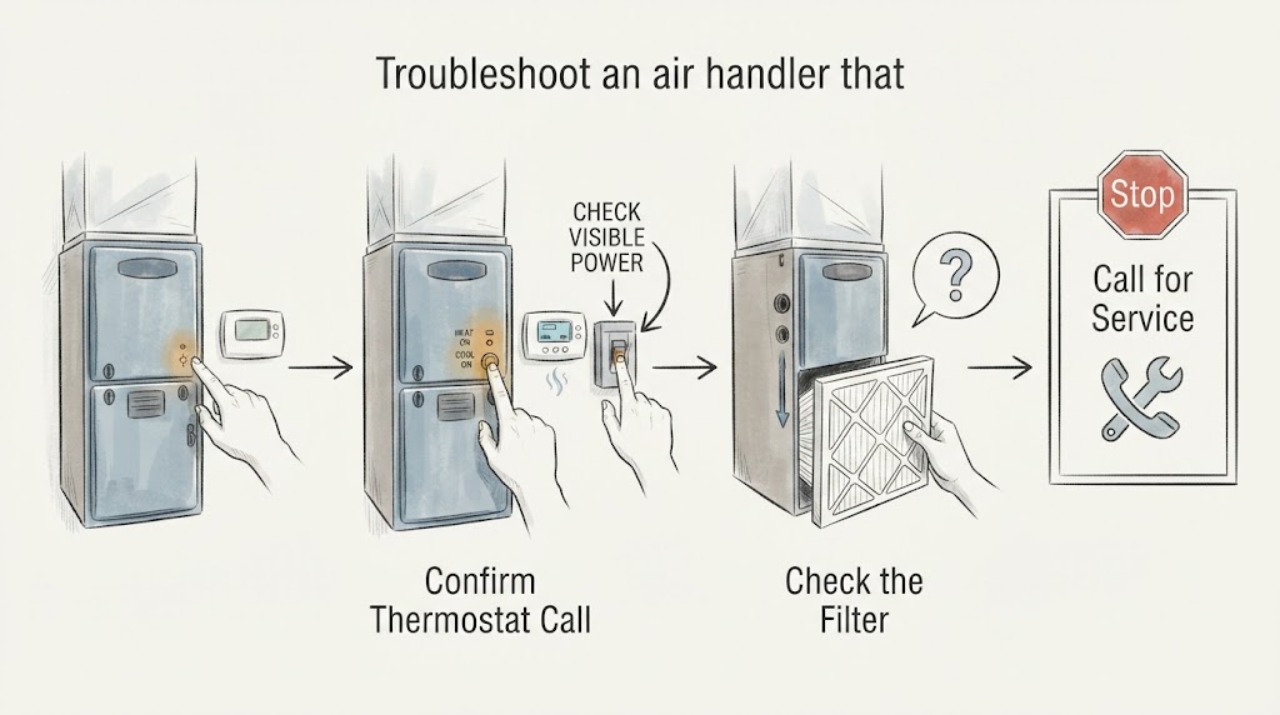
How to troubleshoot an air handler that won't start
Start with the thermostat: confirm it is calling for heat or cooling, the fan is set to On or Auto, and any thermostat batteries are usable. Then inspect the accessible filter and check that the nearby service switch is On, but do not open the air handler or reset a tripped breaker just to make it run.
-
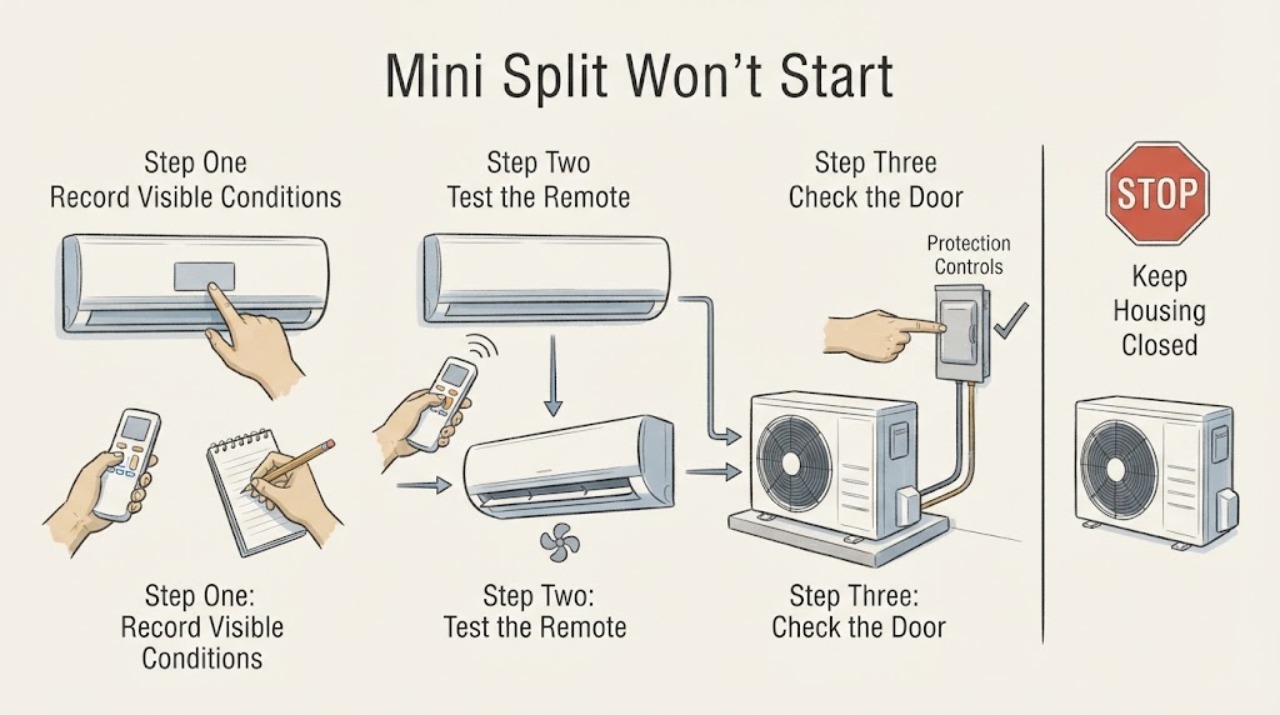
Mini Split Won't Start: Safe Checks Before HVAC Service
If a mini split will not start, first determine whether the indoor unit has no lamp, has a flashing lamp, responds to the remote but does not run, or runs the indoor fan while the outdoor unit or compressor stays off. Check the remote batteries, operating mode and timer, then inspect the breaker or outdoor disconnect only from the normal user position.
-
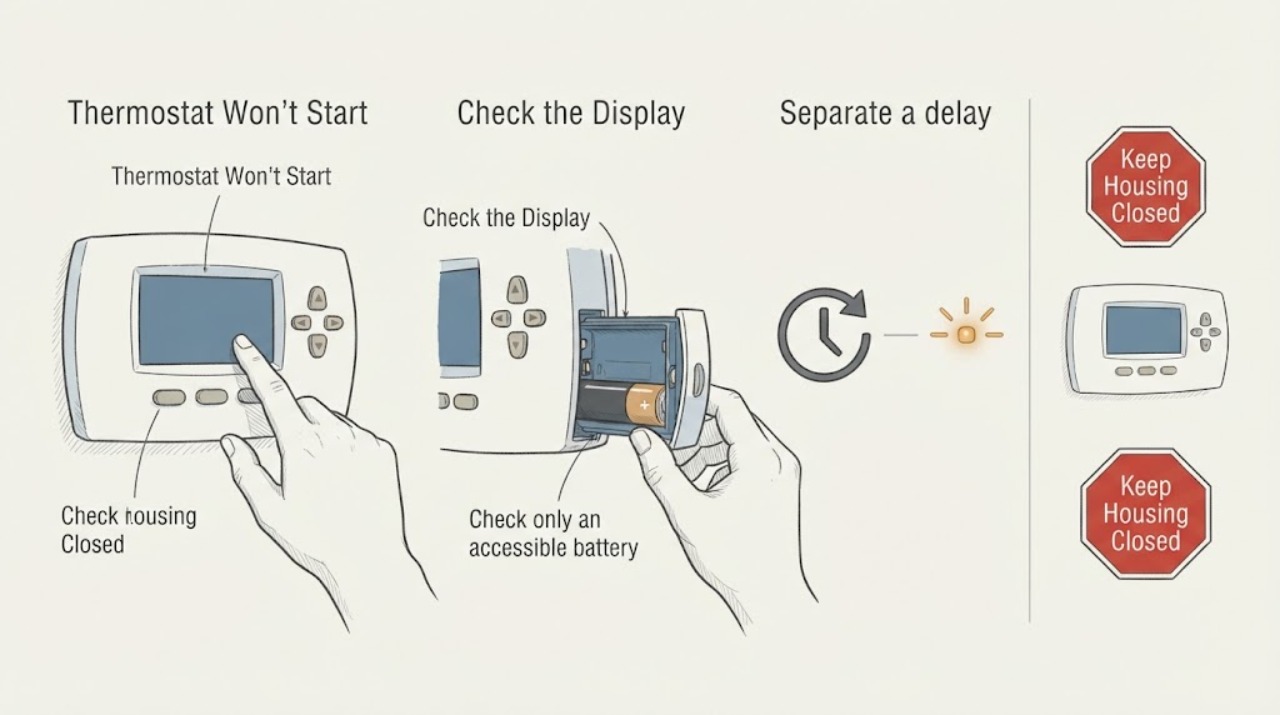
Thermostat Won't Start: Safe Checks and Next Steps
If a thermostat won't start, first distinguish a sleeping display from a dead or unpowered thermostat. Wake it with the normal screen, button, dial, or app control, then record whether the display is blank, dim, showing a low-battery notice, showing an error, or showing a delay.
-
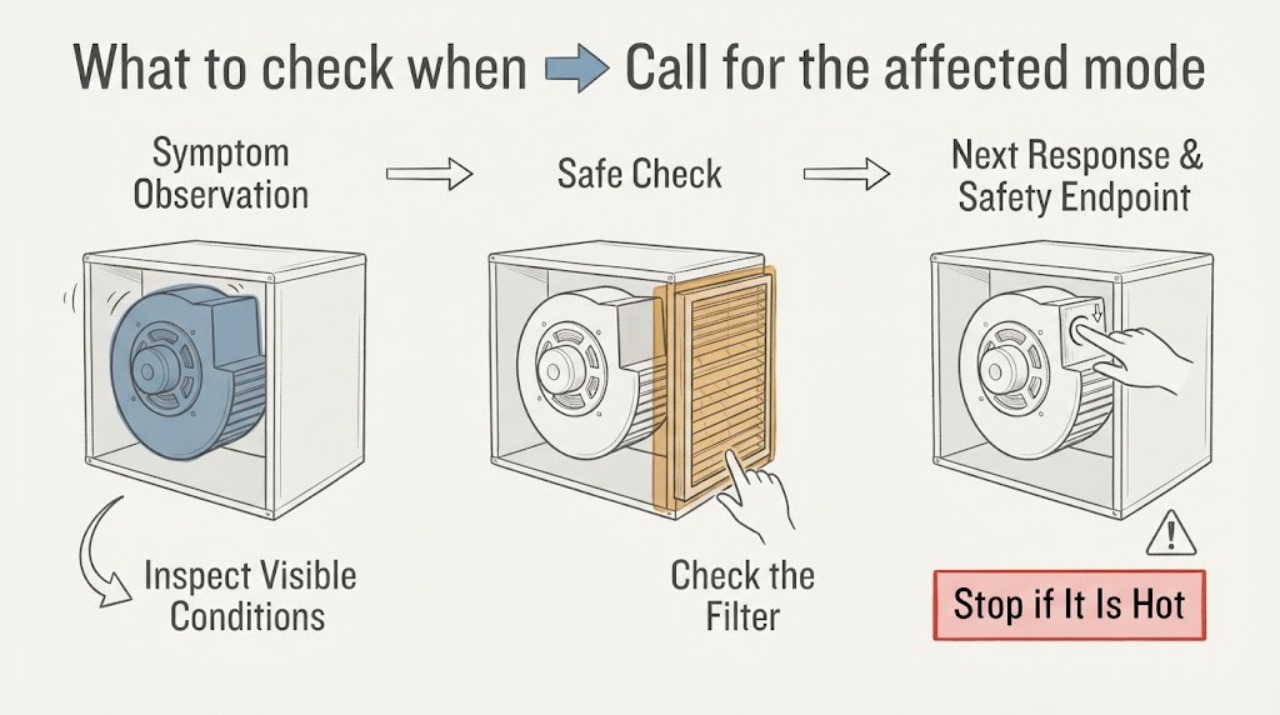
What to check when an HVAC blower motor will not start
A blower motor that will not start can be blocked from receiving a call or power, or it can have an airflow, capacitor, control, wiring, or motor fault. Start with low-risk observations: confirm the thermostat is calling for heating or cooling, make sure the fan setting is not accidentally off, check the accessible air filter and return grilles, and note whether the indoor unit is silent, hums, starts and stops, or trips a breaker.