
On this page
Start here
Quick answer
When an air conditioner will not start, begin at the thermostat and filter rather than opening the unit. Confirm the thermostat mode, setpoint, fan setting, schedule, display, and batteries, then inspect an accessible filter and visible registers. A thermostat that is not calling, a clogged filter, a tripped breaker, a blocked airflow path, or a safety shutdown can leave the system inactive; a blower motor, capacitor, relay, wiring, coil, compressor, or refrigerant fault requires HVAC service. Observe whether the indoor air handler and outdoor unit respond, but do not open a cabinet, touch wiring or a capacitor, take live measurements, or repeatedly reset a breaker. Stop for ice, smoke, burning odor, unusual heat, water near electrical parts, arcing, or a repeated power trip.
Before you begin
Safety first
- This article covers ordinary thermostat, filter, register, visible-power, and safe-distance observations only. Blower motors, capacitors, wiring, controls, coils, compressors, refrigerant, cabinet access, and live measurements belong to qualified HVAC professionals.
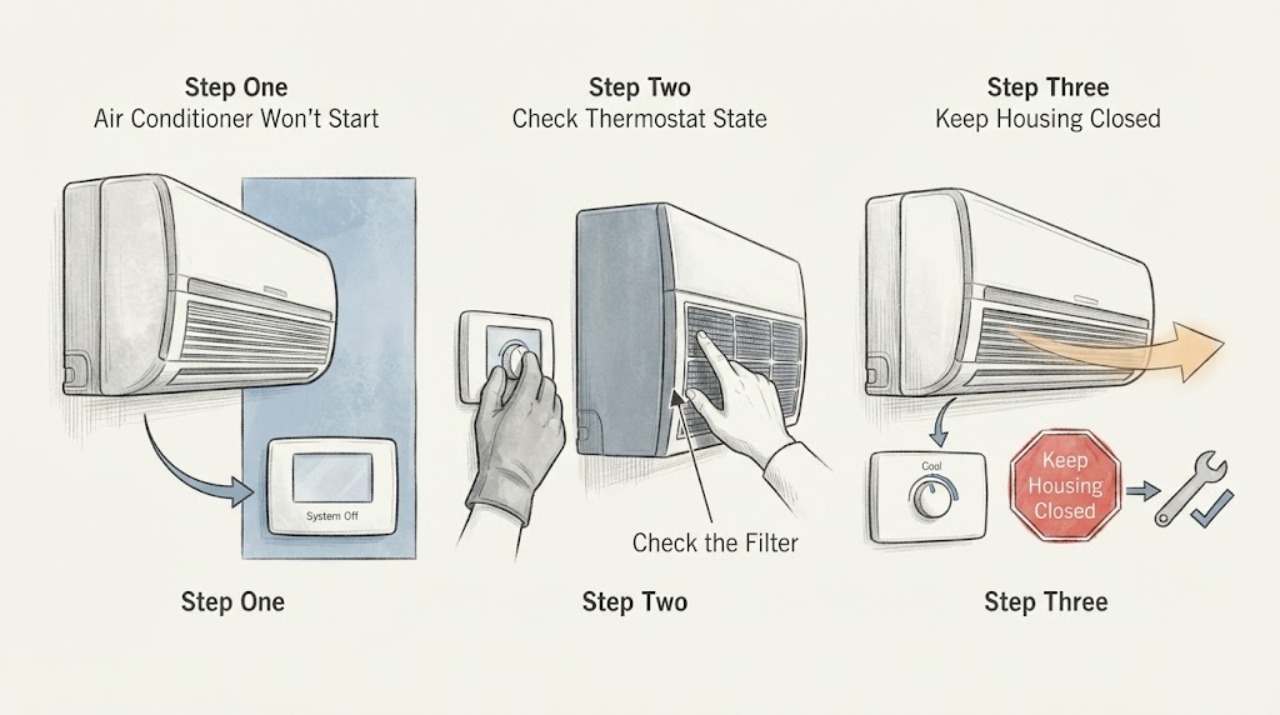
Work through in order
Diagnostic checks
Use only checks that match the exact appliance or system and its official guide.
-
Check 1
Read the thermostat display, mode, setpoint, fan setting, schedule or hold state, and battery indication; make only a normal user adjustment described by the installed thermostat instructions.
Expected result: The display is blank, the mode or setpoint does not call for cooling, a schedule is suppressing the call, the fan is set to On or Auto, or the settings appear correct.
Next step: Correct only an obvious setting or battery condition and observe one normal call. Record the result and stop changing settings if the system remains inactive.
Why this matters
Why: A display, mode, schedule, fan, battery, or setpoint issue can prevent a start command. Correct settings with no system response move attention toward power, airflow, blower, control, or outdoor-unit causes.
-
Check 2
With the system not running, inspect the filter at its ordinary access point without opening the air handler; replace it only if it is safely accessible and the equipment instructions allow routine replacement.
Expected result: The filter is visibly gray or blocked, the filter is clean, the filter is missing, or access would require opening a cabinet or disturbing wiring.
Next step: Restore only the documented filter condition and observe one call. If the system still will not start, stop user-level checks and arrange HVAC service.
Why this matters
Why: A blocked filter can restrict airflow and contribute to overheating, freezing, or a fan shutdown. A clean or inaccessible filter does not clear a blower motor, control, power, coil, or refrigerant issue.
-
Check 3
Look at visible supply and return registers and listen at the indoor air handler during one confirmed cooling call; do not reach into a grille or remove a panel.
Expected result: There is normal airflow, weak airflow, no airflow, a blocked register or return, or a humming or unusual sound without air movement.
Next step: Open only an accidentally closed register. If airflow stays weak or absent, turn the system off at the thermostat and call an HVAC technician.
Why this matters
Why: Normal airflow with no cooling response leaves the outdoor section or refrigeration path in scope. Weak or absent airflow focuses on filter, indoor blower, control, power, or frozen-coil causes; a hum without movement is not a reason to touch the motor or capacitor.
-
Check 4
From safe access, observe whether the indoor air handler and outdoor unit respond to one normal cooling call; do not remove an outdoor grille or touch the fan, coil, disconnect, or wiring.
Expected result: Neither section responds, the indoor blower is absent while the outdoor unit sounds active, the indoor section responds while the outdoor unit is silent, or both respond but no conditioned air is delivered.
Next step: Turn the system off at the thermostat if a blower is stopped while another section sounds active, and arrange HVAC service. Do not use a tool or hand to start a fan.
Why this matters
Why: A silent whole system keeps thermostat and power in scope. Outdoor response without indoor airflow points to the indoor filter, blower, motor, capacitor, control, or power path. Indoor-only response points toward the outdoor power, fan, compressor, contactor, control, or a safety lockout.
-
Check 5
Look at the visible indoor service switch, outdoor disconnect indication, and labeled HVAC breaker from a dry, safe position without opening covers; record whether any is off, tripped, blank, damaged, or returning to a trip state.
Expected result: A visible switch is off, a breaker appears tripped, the thermostat is blank, both sections appear powered, or the power device trips again after a normal documented reset.
Next step: Follow only the equipment documentation's one-time reset guidance when there is no smoke, odor, water, heat, arcing, or visible damage. If it trips again or will not hold, leave it alone and call an HVAC or electrical professional.
Why this matters
Why: Indoor and outdoor sections can use separate power paths. A repeat trip indicates an unresolved electrical or equipment fault rather than a simple reset problem.
-
Check 6
Prepare a service note with thermostat state, filter and register condition, indoor and outdoor response, visible power positions, blower sound, ice or water, error text, recent maintenance, and the time the no-start symptom began.
Expected result: The record isolates a thermostat or filter issue, an indoor airflow response, a power boundary, an outdoor-unit response, or no safe visible cause.
Next step: Give the note and safe-distance photos to a qualified HVAC technician. Leave the system off when a stopped blower, ice, repeat power trip, or hazard is present.
Why this matters
Why: A structured handoff lets a technician distinguish a filter or thermostat symptom from a blower, control, coil, compressor, or refrigerant issue without opening the system.
Use your observations
Decision map
Find the observation that best matches what you see, then follow the next safe action.
-
PATH 01Safety boundary
What you see
The display is blank, the mode or setpoint does not call for cooling, the schedule suppresses the call, or the battery indication is present.
Do this next
Correct only the documented user setting or battery condition, then observe one normal call. If the display or system remains inactive, arrange HVAC service.
Why this path and its safety boundary
Why it matters: The no-start symptom may be a thermostat command or power issue rather than a filter or blower fault.
Safety stop: Do not open the thermostat, change wiring, or bypass a control.
-
PATH 02Next step
What you see
The filter is visibly restricted or registers and return airflow are blocked, with no immediate smoke, odor, water, heat, or electrical hazard.
Do this next
Restore only the routine filter or register condition allowed by the system instructions and observe one call. If the blower remains stopped, airflow is weak, or ice remains, call an HVAC technician.
Why this path and its safety boundary
Why it matters: Restricted airflow may have contributed to overheating, freezing, or shutdown, but it does not prove the blower motor is healthy.
-
PATH 03Safety boundary
What you see
The thermostat calls for cooling and the outdoor unit responds, but indoor airflow is absent, weak, humming, or stopped.
Do this next
Turn the system off at the thermostat and request prompt HVAC service; provide the airflow, filter, sound, and ice observations.
Why this path and its safety boundary
Why it matters: The indoor filter, blower motor, capacitor, relay, control, power path, or frozen coil may be involved.
Safety stop: Do not open the air handler, handle the capacitor, force the blower, or continue running the outdoor unit without indoor airflow.
-
PATH 04Next step
What you see
A visible switch or breaker is off or tripped, the system is silent, or the breaker trips again after a normal documented reset.
Do this next
Leave a repeat-tripping device alone and call an HVAC or electrical professional. Do not replace a fuse, alter a rating, or bypass protection.
Why this path and its safety boundary
Why it matters: Power may be interrupted at one section, or the protective device may be responding to an equipment or wiring fault.
-
PATH 05Safety boundary
What you see
Thermostat, filter, register, and visible power checks are normal, but the air conditioner still will not start or the symptom returns.
Do this next
Stop further user-level checks and request qualified HVAC diagnosis. Provide the service note and model information.
Why this path and its safety boundary
Why it matters: A motor, capacitor, relay, control, wiring, coil, compressor, refrigerant, or safety fault remains possible.
Safety stop: Do not take live measurements, handle refrigerant or capacitors, or open the cabinet.
-
PATH 06Safety boundary
What you see
Smoke, burning odor, arcing, exposed wiring, unusual heat, water near electrical equipment, a damaged fan, persistent ice, or a strong repeated buzz is present.
Do this next
Stop the system, keep people away, leave the area for smoke or fire risk, and seek emergency help from a safe location; arrange HVAC or electrical service when safe.
Why this path and its safety boundary
Why it matters: This is a shock, fire, or equipment-damage hazard and not a routine no-start check.
Safety stop: Do not touch the equipment, apply water, restore power, or open any cover.
Helpful context
Understand the symptom
Start with what the thermostat is asking for
A blank display, a schedule that is not calling, a setpoint that does not demand cooling, and a thermostat that calls normally are different states. Check the user-facing controls first. If the thermostat is calling but the air handler is silent, the filter, power, blower, control, or wiring boundary becomes more important than the setpoint.
A filter can affect starting without proving a failed motor
A visibly blocked filter can restrict the air path and contribute to overheating or freezing. Inspect only the filter's normal access point and follow the equipment instructions for routine replacement. If the filter is clear or the system still will not start, do not assume the thermostat or blower is safe to open; arrange professional diagnosis.
Separate indoor and outdoor response
The indoor air handler and outdoor unit may have separate power and controls. No airflow with an outdoor response focuses the indoor blower, filter, control, or power path. A silent outdoor unit with indoor airflow can leave the outdoor disconnect, compressor, fan, contactor, or control in scope. Motors, capacitors, refrigerant, wiring, and cabinet work are HVAC tasks.
Safety boundary
Stop conditions
- Stop immediately for smoke, burning odor, arcing, exposed wiring, unusual heat, water near electrical equipment, a damaged fan, persistent ice, or a breaker that trips again.
- Do not open the thermostat, indoor or outdoor cabinet, remove covers, touch the blower motor, capacitor, coil, wiring, or electrical controls, or take live measurements.
- Do not force or spin a fan, chip ice, pour hot water on a coil, handle refrigerant, or run the system without a working blower.
- Do not repeatedly reset a breaker or disconnect, replace a fuse as a guess, bypass a safety device, or alter thermostat wiring.
- Stop any inspection during lightning, flooding, unstable footing, or unsafe access and arrange qualified HVAC service.
Only after diagnosis
Potential parts
- air filter
Consider this category only when the installed system uses a safely accessible filter that is visibly restricted or due for routine replacement.
Confirm exact size, orientation, airflow requirement, and system instructions before ordering. - thermostat
Consider this category only if a qualified HVAC technician confirms that the thermostat or sensor is faulty and identifies a compatible replacement.
Confirm equipment type, stage configuration, wiring, power, and manufacturer compatibility before ordering. - blower motor or run capacitor
Consider this category only after a qualified HVAC technician confirms a motor or capacitor fault and identifies the exact equipment requirement.
Confirm equipment model, motor or capacitor specification, electrical requirements, and installation procedure with the technician; do not handle the part as a user check.
When checks do not resolve it
Need a professional?
Call a qualified HVAC technician when the air conditioner remains inactive after safe thermostat, filter, register, and visible-power checks; when airflow is weak or absent, a blower is stopped, ice persists, a breaker trips again, or motor, capacitor, control, wiring, coil, compressor, or refrigerant work may be needed. For smoke, fire, arcing, dangerous heat, water near electrical parts, or exposed wiring, stop the system and seek emergency or qualified help from a safe location.
Safety scope: This article covers ordinary thermostat, filter, register, visible-power, and safe-distance observations only. Blower motors, capacitors, wiring, controls, coils, compressors, refrigerant, cabinet access, and live measurements belong to qualified HVAC professionals.
Common questions
FAQ
What should I check first when my AC will not start?
Check the thermostat mode, setpoint, fan, schedule, display, and batteries, then inspect an accessible filter and visible registers. After that, observe whether the indoor and outdoor sections respond without opening the equipment.
Can a dirty filter stop an air conditioner from starting?
A restricted filter can reduce airflow and contribute to overheating, freezing, or shutdown. Replace it only through the normal documented access; a stopped blower after a clear filter needs HVAC diagnosis.
What if the outdoor unit runs but there is no indoor airflow?
Turn the system off at the thermostat and call an HVAC technician. The filter, blower motor, capacitor, relay, control, power path, or frozen coil may be involved.
Should I reset the AC breaker repeatedly?
No. Follow only the equipment documentation's normal one-time reset when there is no hazard. If the breaker trips again or will not hold, leave it alone and arrange HVAC or electrical service.
Can I replace the thermostat or blower motor myself?
Do not change thermostat wiring or open the air handler as a troubleshooting step. Blower motors, capacitors, wiring, controls, coils, compressors, and refrigerant circuits require qualified HVAC procedures.
Read the exact guide
Official sources
- Air Handler Fan Not Working: Causes and SolutionsTrane · Manufacturer homeowner guidance used for low-risk filter, control, and visible-power checks; motor, capacitor, wiring, cabinet, and coil diagnosis require HVAC service.
- Thermostat Troubleshooting: Solutions for Common IssuesTrane · Manufacturer thermostat guidance used for ordinary setting and display observations; model-specific controls and electrical issues require professional handling.
- AC Unit Not Turning On: Reasons Why And What To DoCarrier · Manufacturer homeowner guidance used for basic controls, filter, and visible power context; internal components and refrigerant require qualified service.
Community feedback
Share a repair observation
Share a plain-text repair observation. Accepted observations are published automatically; this page may take a moment to update.