
On this page
Start here
Quick answer
Use the thermostat and other visible responses to separate a simple call-for-cooling problem from an HVAC equipment fault. Confirm that the thermostat has power, is set to Cool, and is calling for a temperature below the room temperature; allow any normal startup delay. Then observe whether the indoor fan, outdoor unit, or neither responds. If the thermostat calls but the outdoor unit stays silent, or if you hear buzzing, smell burning, see damaged wiring, find water at the indoor unit, or a breaker trips, stop and call an HVAC professional. The contactor and other high-voltage parts are not homeowner checks.
Before you begin
Safety first
- Do not remove HVAC panels, touch a contactor or capacitor, measure voltage, handle refrigerant, bypass a safety switch, repeatedly reset a breaker, or work on wet equipment.
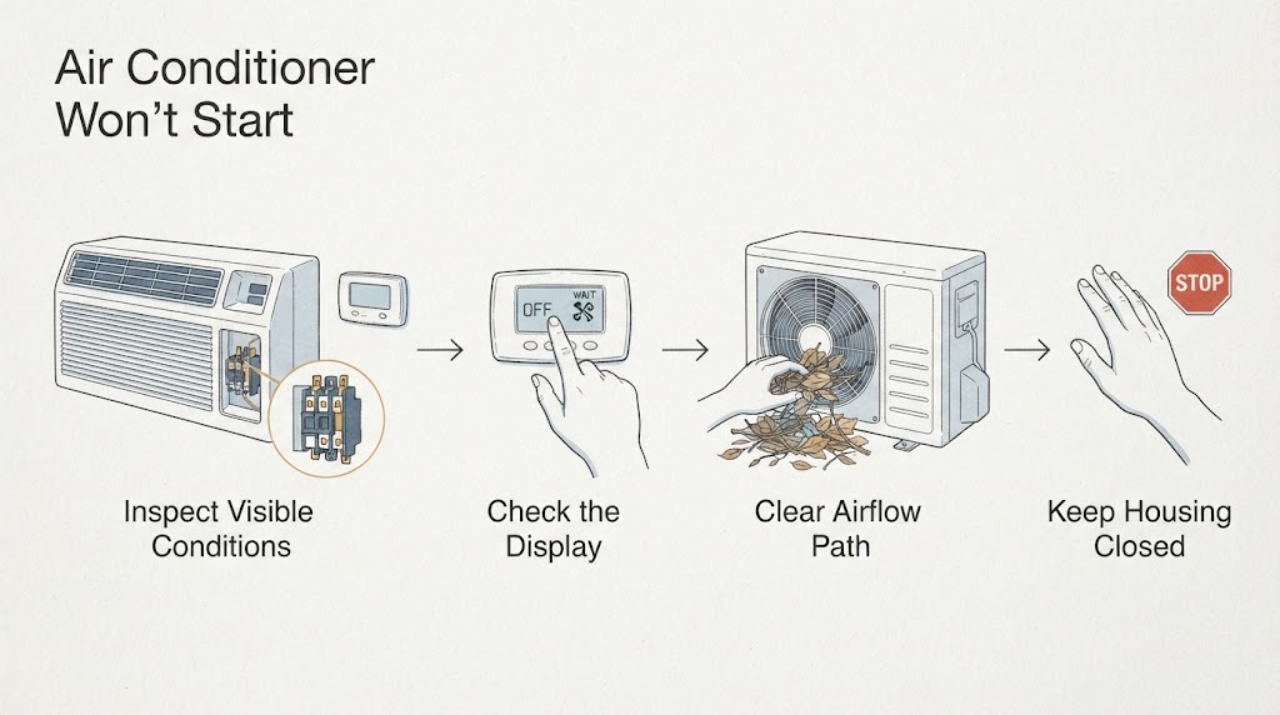
Work through in order
Diagnostic checks
Use only checks that match the exact appliance or system and its official guide.
-
Check 1
Look at the thermostat without removing it from the wall. Record whether the screen is blank, whether it displays Cool, the indoor temperature, the set temperature, and any cooling icon, alert, or delay message.
Expected result: The screen is blank, the mode is Off or Heat, the set temperature is not below the room temperature, or the thermostat shows a cooling call but the equipment does not respond.
Next step: If the thermostat uses replaceable batteries, change them only as the thermostat instructions specify. Otherwise correct the mode and setpoint once, then observe the system without opening wiring or equipment.
Stop if: Stop for a cracked or hot thermostat, exposed conductors, a burning smell, or an alert that the manual says needs service.
Why this matters
Why: A blank screen can indicate lost thermostat power or batteries; an incorrect mode or setpoint does not request cooling. A valid call with no equipment response points beyond the basic thermostat setting.
-
Check 2
Set the thermostat to Cool, choose Fan Auto unless the exact thermostat instructions say otherwise, and set the target below the current room temperature. Make one change and note the time and the display response.
Expected result: The cooling indicator appears, disappears immediately, remains active while no air moves, or the thermostat reports a delay.
Next step: Allow the displayed or manufacturer-specified delay once. If the call remains active without indoor or outdoor response, keep the settings unchanged and proceed to visible response checks and professional service.
Stop if: Do not repeatedly toggle the mode, rapidly lower the setpoint, or bypass a thermostat lock or safety message.
Why this matters
Why: A persistent cooling call means the thermostat is requesting operation; an immediate cancellation may be a schedule, lockout, or control issue. A displayed delay can be intentional equipment protection rather than a failed contactor.
-
Check 3
From a safe location, listen and feel for normal airflow at a supply register after the cooling call. Do not reach into equipment or remove a panel.
Expected result: The indoor blower runs but the outdoor unit is silent, neither indoor airflow nor outdoor sound appears, or the system starts and stops rapidly.
Next step: Record the response and stop troubleshooting internal components. Have an HVAC technician inspect the system, including the contactor and safety controls, if the outdoor unit does not respond to a valid call.
Stop if: Stop immediately for buzzing, grinding, smoke, burning odor, visible arcing, or a hot or damaged electrical enclosure.
Why this matters
Why: Indoor-only response separates an outdoor-unit, power, control, or contactor path from a thermostat-only setting. No response suggests a wider power, control, or safety interruption; rapid cycling needs attention rather than repeated restarts.
-
Check 4
Inspect only the accessible air filter and the visible area around the indoor unit or condensate drain for a severely blocked filter, standing water, or an obvious overflow indicator. Do not open the air handler or handle wet electrical parts.
Expected result: The filter is visibly blocked, the indoor drain area has water, or the filter and visible drain area look normal.
Next step: Replace a filter only with the size and orientation specified for the system, and arrange service for standing water or a recurring drain problem. If those visible areas are normal and the AC still will not start, stop DIY diagnosis.
Stop if: Stop for standing water near electrical equipment, ice, mold or sewage contamination, a damaged filter rack, or any need to remove an equipment panel.
Why this matters
Why: Restricted airflow can contribute to freezing or shutdown, and a blocked condensate path can activate a safety switch on some systems. A normal visible check does not clear internal controls or the contactor.
-
Check 5
Check the thermostat or equipment display for a recurring alert, code, or service message and record the exact text, time, indoor temperature, and whether the alert returns after one authorized reset described in the owner's instructions.
Expected result: The alert clears once and the system starts, returns immediately, or cannot be cleared without opening equipment or changing wiring.
Next step: Use the exact owner manual for the model and give the recorded message to the HVAC technician. Do not bypass the alert or interpret a code from another brand.
Stop if: Stop for an unknown high-voltage warning, exposed wiring, smoke, burning odor, or a fault that returns after the authorized reset.
Why this matters
Why: A one-time control message may be recoverable through the manufacturer's procedure, while a recurring message indicates an unresolved fault or safety lockout. The code meaning is model-specific.
-
Check 6
Make a single visual check of the labeled HVAC breaker or indoor system switch only if the panel and floor are dry and there is no heat, odor, arcing, or damage. Do not remove the panel cover, perform electrical measurements, or keep resetting a tripped breaker.
Expected result: The breaker or switch is visibly off or tripped, it trips again, or it appears on while the thermostat calls and the unit remains silent.
Next step: If it is visibly tripped, leave it off and call HVAC service rather than repeatedly resetting it. If it appears on but the system remains unresponsive, provide the observation to the technician.
Stop if: Stop immediately for a warm panel, burning odor, crackling, exposed wiring, moisture, or any repeat trip.
Why this matters
Why: A tripped protective device can indicate a serious electrical or equipment fault; an apparently on device does not prove the outdoor contactor or high-voltage circuit is healthy.
-
Check 7
Prepare a service handoff with the thermostat brand and model, display state, exact settings, time of the call, indoor airflow response, outdoor sound response, filter and drain observations, alerts, and any breaker event. Keep the system off if a safety symptom occurred.
Expected result: The AC still does not start after the safe thermostat and visible checks, or the contactor or another internal part is suspected.
Next step: Call a qualified HVAC technician and request diagnosis of the thermostat signal, power path, contactor, safety controls, and equipment condition. Do not purchase or install a contactor based only on symptoms.
Stop if: Stop all homeowner testing once internal access, electrical measurement, refrigerant work, or a repeated failure is involved.
Why this matters
Why: The remaining possibilities include internal controls, a contactor, capacitor, wiring, safety switch, motor, refrigerant-related lockout, or a model-specific fault that cannot be distinguished safely from outside.
Use your observations
Decision map
Find the observation that best matches what you see, then follow the next safe action.
-
PATH 01Next step
What you see
The thermostat screen is blank or unresponsive.
Do this next
Use only the thermostat's battery instructions and check for a safe, visible power indication; call HVAC service if the screen remains blank or wiring would need to be exposed.
Why this path and its safety boundary
Why it matters: The thermostat may have lost power or battery power, but the cause is not proven from the screen alone.
-
PATH 02Next step
What you see
The thermostat displays Cool and a cooling call, but the indoor fan and outdoor unit do not respond.
Do this next
Stop at visible observations and have HVAC service inspect the system; do not access the contactor or high-voltage compartment.
Why this path and its safety boundary
Why it matters: A power, safety, control, or equipment fault is more likely than a simple setpoint error.
-
PATH 03Next step
What you see
The indoor fan runs but the outdoor unit remains silent.
Do this next
Record the pattern and call HVAC service rather than resetting or opening the outdoor unit.
Why this path and its safety boundary
Why it matters: The outdoor power path, safety control, contactor, capacitor, or outdoor equipment may be involved.
-
PATH 04Next step
What you see
The system has a blocked filter, visible condensate water, ice, or a recurring safety alert.
Do this next
Perform only the documented filter replacement or authorized reset; leave the system off and call HVAC service if water, ice, or the alert persists.
Why this path and its safety boundary
Why it matters: Airflow or condensate protection may be preventing operation on some systems, and the condition may damage equipment if ignored.
-
PATH 05Next step
What you see
There is buzzing, burning odor, smoke, visible arcing, exposed wiring, water near electrical equipment, or a breaker trips again.
Do this next
Stop immediately, keep clear, and contact HVAC service or emergency electrical help as appropriate. Do not retest.
Why this path and its safety boundary
Why it matters: This is a safety hazard and may involve high-voltage equipment or an electrical fault.
Helpful context
Understand the symptom
An air conditioner that will not start can have a thermostat issue, a power or safety interruption, restricted airflow, a condensate problem, or an internal control such as a contactor. The safest first diagnosis uses the thermostat display and visible system response; it does not involve removing panels or probing wiring.
A thermostat showing Cool does not prove that the outdoor equipment received the start signal. Record what the display says, whether it shows a cooling call, whether the indoor fan moves air, and whether the outdoor unit makes any sound. Those observations give an HVAC technician a useful handoff without turning a homeowner check into electrical repair.
Some controls intentionally delay a restart to protect the system from rapid cycling. Make one controlled thermostat call and wait according to the thermostat or equipment instructions. Repeatedly changing the setpoint or resetting power can hide the symptom and is not a substitute for diagnosing a contactor, capacitor, safety switch, or wiring fault.
Do not open the outdoor disconnect, remove the condenser or air-handler panel, touch a contactor or capacitor, measure voltage, or bypass a safety switch. If the system has a burning odor, visible arcing, exposed wiring, water near electrical equipment, or a breaker that trips again, leave it off and arrange professional service.
When checks do not resolve it
Need a professional?
Safety scope: Do not remove HVAC panels, touch a contactor or capacitor, measure voltage, handle refrigerant, bypass a safety switch, repeatedly reset a breaker, or work on wet equipment.
Common questions
FAQ
Why does the thermostat say Cool but the air conditioner does not start?
The thermostat may be making a valid cooling call while power, a safety control, the outdoor contactor, capacitor, motor, or another internal part prevents startup. Record indoor and outdoor responses and call HVAC service instead of opening the equipment.
Should I keep resetting the breaker when the AC will not start?
No. A tripped breaker can indicate an equipment or electrical fault. Leave it off when it trips again or when there is heat, odor, buzzing, smoke, or damage, and have a qualified professional diagnose it.
Can a dirty filter stop an air conditioner from starting?
A severely restricted filter can reduce airflow and contribute to freezing or a protective shutdown on some systems. Inspect or replace it only as the equipment instructions specify; water, ice, repeated shutdown, or a persistent no-start needs HVAC service.
Read the exact guide
Official sources
- Common Thermostat Issues and How to TroubleshootCarrier · Thermostat display, settings, delay, visible maintenance, alerts, and high-voltage safety boundaries
- AC Unit Not Turning On: Reasons Why And What To DoCarrier · General residential air conditioner no-start symptoms, thermostat, filter, power, contactor, and professional service boundaries
- AC Not Turning OnTrane · Residential air conditioner thermostat settings, startup response, filter, condensate, power, and professional diagnosis
- Maintenance ChecklistENERGY STAR · Residential HVAC filter, condensate, controls, and safe maintenance boundaries
Community feedback
Share a repair observation
Share a plain-text repair observation. Accepted observations are published automatically; this page may take a moment to update.