
On this page
Start here
Quick answer
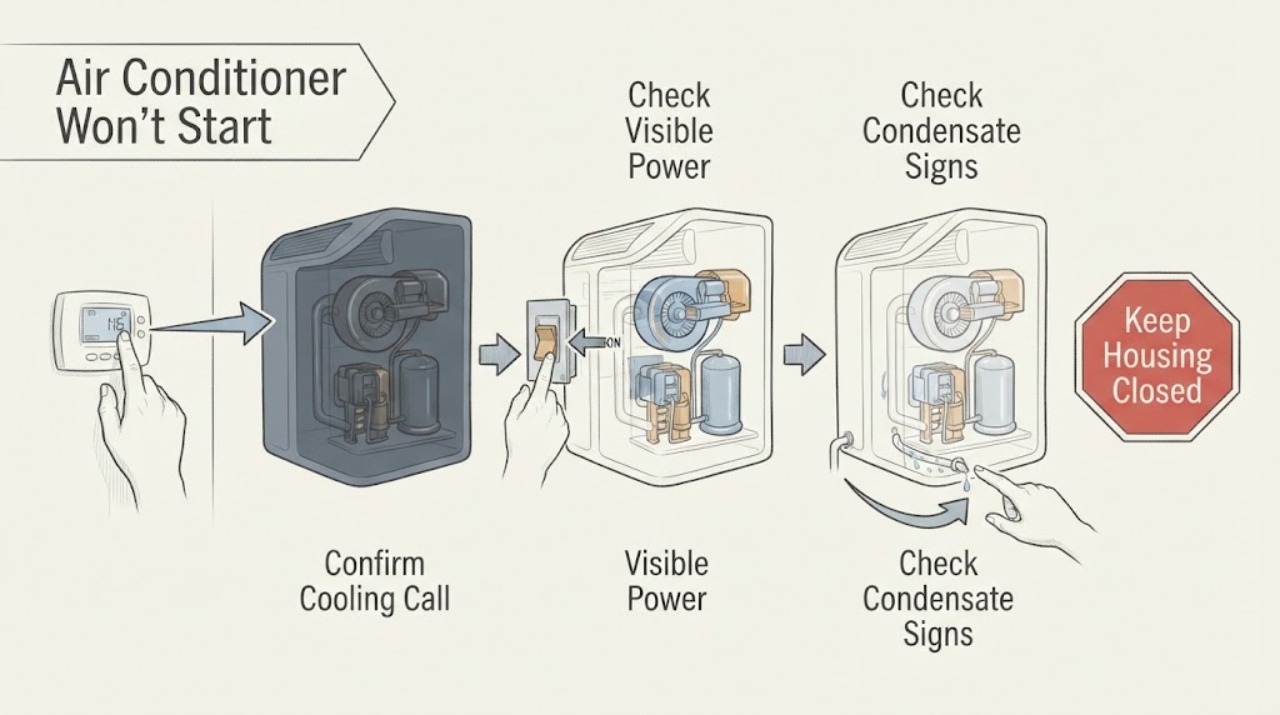
If an air conditioner will not start, first determine whether the thermostat is actually calling for cooling, whether the indoor blower responds, and whether the outdoor unit responds. From ordinary safe access, check the thermostat setting, the visible power status, the filter, and signs of condensate or an overflow shutdown; do not open panels or test live voltage. A blank thermostat, a water or drain warning, a breaker that trips again, or smoke, burning odor, arcing, or a hot outlet is a stop-use condition. A missing indoor blower response can involve the blower motor or controls, while a silent outdoor unit can involve the contactor, compressor, disconnect, or another electrical/control fault; those components require qualified HVAC diagnosis rather than a reset-and-retry cycle.
Before you begin
Safety first
- This article covers thermostat, visible power, filter, grille, condensate-sign, and sound observations only. A qualified professional must handle internal electrical parts, the blower motor, compressor, contactor, capacitors, high-voltage measurements, and refrigerant work.
Work through in order
Diagnostic checks
Use only checks that match the exact appliance or system and its official guide.
-
Check 1
From a normal standing position, read the thermostat display and record the mode, set temperature, room temperature, fan setting, any delay or fault message, and whether the display is blank; make only the ordinary mode and setpoint selection allowed by the thermostat instructions.
Expected result: The thermostat is blank, shows a cooling call, shows a delay or fault, or appears normal but the system does not respond after the normal call delay.
Next step: If the display is blank or a fault persists, record the exact message and model information for HVAC service. If a cooling call is present, continue with the safe power and water observations below without opening equipment.
Stop if: Stop if the thermostat, wiring, wall, or nearby equipment is wet, scorched, sparking, hot, or damaged; do not remove the thermostat or touch wiring.
Why this matters
Why: A blank display points first to thermostat power or its controls. A cooling call with no response moves the check toward equipment power, condensate protection, controls, the blower motor, the contactor, or the compressor rather than toward a setpoint mistake.
-
Check 2
With no smoke, burning smell, water contact, or other immediate hazard, observe the accessible service-panel breaker position and any plainly visible equipment disconnect position without removing covers, touching wiring, or repeatedly cycling the breaker.
Expected result: The breaker or disconnect appears tripped or off, the breaker trips again when the normal manufacturer-approved reset is attempted once, or the visible power devices remain on while the equipment is silent.
Next step: If a protective device trips again, leave the equipment off and arrange qualified HVAC or electrical service. If power appears normal, document which unit responds in the next check; do not open the disconnect, air handler, or condenser.
Stop if: Do not repeatedly reset a breaker, install a larger breaker, use an extension cord, open a panel, measure voltage, handle a capacitor, or touch a hot outlet, arc, damaged cord, or exposed conductor.
Why this matters
Why: A tripped protective device can explain a no-start, but a repeat trip indicates a possible electrical or equipment fault. Power appearing normal while the indoor or outdoor unit is silent shifts attention to controls, the condensate safety circuit, the blower motor, contactor, compressor, or another service-level fault.
-
Check 3
From ordinary safe access, look for standing water, a full visible drain pan, water staining, or a condensate alarm near the indoor air handler; do not reach into the equipment, pour chemicals into a drain, or work near wet electrical parts.
Expected result: The pan or surrounding area is dry, there is visible water or staining, or the drain and safety arrangement cannot be identified without removing a cover.
Next step: Keep the air conditioner off when water is present, protect nearby finishes without contacting electrical equipment, and request HVAC service for the pan, drain, float switch, or related cause. Continue only with dry, safe observations.
Stop if: Stop for standing water near wiring or an outlet, active leakage, a wet control, or any need to remove an air-handler panel or use chemical drain cleaner.
Why this matters
Why: Water or an overflow condition can activate equipment protection and stop the compressor or fans. A dry, accessible area does not prove the drain is clear, and an unidentifiable arrangement needs a model-specific service decision rather than improvised clearing.
-
Check 4
If the filter is designed for ordinary user access and the area is dry and safe, note its size and orientation, inspect whether it is visibly loaded with dust, and confirm that return and supply grilles are not covered by furniture or loose items; do not reach into the blower compartment.
Expected result: The filter is visibly blocked, the airflow openings are obstructed, a visible coil or line is heavily iced, or the filter and openings look clear while the system still will not start.
Next step: Use only the exact filter replacement or cleaning procedure specified for the equipment, then leave the system off and arrange HVAC service if it remains silent, iced, or abnormal. Do not substitute an unverified filter or disturb internal parts.
Stop if: Do not scrape ice, pour water into the unit, bypass a filter, remove an access panel, or continue operation with smoke, burning odor, water, or an abnormal electrical sound.
Why this matters
Why: Restricted airflow can contribute to cooling and freeze problems, but a clear filter does not clear the blower motor, controls, contactor, compressor, power, or refrigerant boundary. Ice is a sign to stop cooling operation, not a reason to scrape it or keep restarting the unit.
-
Check 5
After the thermostat is calling for cooling and the area is safe, listen and observe from a normal distance for the indoor blower response and the outdoor unit response; do not remove the condenser cover or place hands near a fan, belt, contactor, compressor, or capacitor.
Expected result: The indoor blower runs while the outdoor unit is silent, the outdoor unit responds while indoor airflow is absent, both are silent, or there is humming, clicking, grinding, burning odor, smoke, or repeated cycling.
Next step: Record the response, sound, timing, exact thermostat message, and whether water or a protective trip was present. Give those observations to a qualified HVAC technician; do not attempt component testing or a refrigerant intervention.
Stop if: Stop immediately for smoke, fire, arcing, gas odor, a hot enclosure, a fan that behaves abnormally, exposed moving parts, or any need to enter the equipment compartment.
Why this matters
Why: An indoor-only failure can involve the blower motor or indoor controls. An outdoor-only failure can involve the contactor, compressor, disconnect, controls, or protection circuit. Silence at both units can begin with the call, power, or condensate protection. Humming, grinding, smoke, burning odor, or repeated cycling raises the stop-use priority and does not identify a part safely from sound alone.
-
Check 6
Before calling service, record the equipment make and model from its exterior label, the thermostat mode and message, the indoor and outdoor response, breaker or disconnect history, filter condition, water or ice evidence, and when the no-start began; do not remove a cover to find a label.
Expected result: The record shows a repeatable indoor-only, outdoor-only, both-silent, water-related, protective-trip, or hazardous symptom, or the pattern is inconsistent.
Next step: Keep the system out of service when the pattern is hazardous, water-related, repeatedly tripping, or unresolved, and schedule qualified HVAC service. Use emergency or electrical service when the stop conditions below apply.
Stop if: Do not continue observation if the equipment develops smoke, fire, gas odor, arcing, a burning smell, unsafe heat, water near electrical equipment, or a repeated protective trip.
Why this matters
Why: The response pattern helps the technician choose between a controls/power review, condensate protection, blower-motor evaluation, contactor/compressor diagnosis, or a broader HVAC assessment, but it cannot confirm a component failure remotely.
Use your observations
Decision map
Find the observation that best matches what you see, then follow the next safe action.
-
PATH 01Safety boundary
What you see
There is smoke, fire, arcing, a burning odor, a hot outlet or enclosure, gas odor, exposed wiring, active water near electrical equipment, or a breaker trips again.
Do this next
Stop using the air conditioner and leave the area when appropriate. From a safe location contact emergency, electrical, gas, or HVAC service as the symptom requires; do not re-energize or retest.
Why this path and its safety boundary
Why it matters: This is a safety event, not a blower-motor, compressor, or contactor identification exercise.
Safety stop: Do not touch hot or wet equipment, open panels, reset repeatedly, use water on an electrical fire, or search for a gas leak.
-
PATH 02Safety boundary
What you see
The thermostat display is blank or its message does not permit a cooling call.
Do this next
Record the display and model, use only the thermostat's ordinary documented checks, and request HVAC service if the display remains blank or abnormal without touching wiring.
Why this path and its safety boundary
Why it matters: The initial issue is the thermostat/control power path or a documented control state, not proof of compressor failure.
Safety stop: Stop for wet, scorched, loose, sparking, or damaged thermostat wiring or wall equipment.
-
PATH 03Safety boundary
What you see
Standing water, a full pan, staining, or a condensate alarm is present near the indoor unit.
Do this next
Leave the system off and arrange HVAC service for the drain, pan, float switch, and underlying cause; do not use chemical cleaner or open the air handler.
Why this path and its safety boundary
Why it matters: A drain or overflow protection event may have stopped the compressor and fans, and continued operation risks water damage.
Safety stop: Stop if water reaches electrical equipment, the leak is active, or safe isolation cannot be confirmed.
-
PATH 04Safety boundary
What you see
The thermostat calls, but the indoor blower is absent while an outdoor response is observed.
Do this next
Keep hands and tools out of the air handler, record the timing and sound, and request qualified HVAC diagnosis.
Why this path and its safety boundary
Why it matters: The blower motor, indoor control, airflow protection, or another indoor fault is possible; the observation does not authorize a motor or capacitor test.
Safety stop: Do not remove an air-handler panel, handle a capacitor, bypass a switch, or measure live voltage.
-
PATH 05Safety boundary
What you see
The indoor blower responds to a cooling call, but the outdoor unit remains silent or only hums/clicks.
Do this next
Stop repeated start attempts and arrange qualified HVAC service with the response pattern and model information.
Why this path and its safety boundary
Why it matters: The contactor, compressor, disconnect, outdoor controls, protection circuit, or supply may be involved; sound alone cannot distinguish them safely.
Safety stop: Stop immediately for smoke, burning odor, arcing, an unusually hot enclosure, or a breaker trip.
-
PATH 06Safety boundary
What you see
The thermostat calls, no water or immediate hazard is visible, and both indoor and outdoor units remain silent.
Do this next
Provide the safe observations and any breaker or disconnect history to a qualified HVAC technician rather than opening equipment or repeatedly resetting power.
Why this path and its safety boundary
Why it matters: The cause may be a power, control, thermostat, condensate-protection, or equipment fault; the blower motor, contactor, and compressor cannot be ranked from silence alone.
Safety stop: Stop if any electrical, water, smoke, burning, gas, or repeated-trip symptom appears.
Helpful context
Understand the symptom
Start by separating a no-call problem from an equipment no-start
A thermostat with no display or no cooling call is a different starting point from a thermostat that calls for cooling while the indoor blower or outdoor unit remains silent. Note the exact display, setpoint, room temperature, mode, and delay indication before changing anything. Do not assume that a silent outdoor cabinet means the compressor itself has failed: a control, contactor, disconnect, condensate protection, or supply problem can produce the same symptom.
Treat water protection and electrical symptoms as stop conditions
Condensate normally leaves through a pan and drain. A blockage, overflow, or safety switch can stop cooling equipment, and running a leaking system can add water and electrical risk. Keep the system off for standing water or a wet electrical area. Repeated breaker trips, a hot receptacle, burning odor, smoke, or arcing are not troubleshooting invitations; use the appropriate HVAC, electrical, or emergency service boundary.
Leave the blower motor, compressor, and contactor to the technician
The named components are inside the professional diagnostic boundary. A technician can distinguish a missing blower response from an outdoor contactor or compressor problem and verify the disconnect, controls, capacitors, high-voltage circuit, airflow, and refrigerant condition with the correct procedures. This article limits the homeowner checks to normal controls and visible, safe observations; it does not authorize opening the air handler or condenser, measuring live voltage, handling capacitors, or opening a refrigerant circuit.
Safety boundary
Stop conditions
- Stop using the system for smoke, fire, arcing, burning odor, gas odor, abnormal heat, exposed wiring, or a hot outlet or enclosure.
- Stop and keep the system off when water or standing condensate reaches electrical equipment, a pan overflows, or an active leak cannot be safely isolated.
- Do not repeatedly reset a breaker, install a larger protective device, use an extension cord, or retest a unit after a repeat trip.
- Do not open the air handler or condenser, remove an access cover, handle a capacitor or contactor, measure live voltage, bypass a safety switch, or open a refrigerant circuit.
- Do not scrape ice, pour chemicals into a condensate drain, reach near moving fans, or continue operation when a fan, motor, compressor, or control behaves abnormally.
Only after diagnosis
Potential parts
- blower motor
Consider this category only if a qualified HVAC diagnosis establishes that the indoor blower motor is defective and the exact system model supports replacement.
Confirm the equipment model, motor type, electrical rating, controls, and manufacturer fit information with the technician before ordering. - contactor
Consider this category only if a qualified technician identifies the outdoor contactor as the failed cause of the no-start condition.
Confirm the exact outdoor-unit model, electrical ratings, terminal configuration, and manufacturer-approved part with a qualified professional; do not handle the contactor. - compressor
Consider this category only after a qualified HVAC diagnosis confirms a compressor fault and evaluates the complete electrical and refrigerant system.
Compressor selection, refrigerant handling, electrical testing, and installation require qualified HVAC service and exact equipment compatibility.
When checks do not resolve it
Need a professional?
Arrange qualified HVAC service when the thermostat calls but the indoor blower or outdoor unit does not respond, the system remains silent after safe observations, a drain or overflow condition appears, ice returns, or the problem recurs. Ask for a technician to distinguish the blower motor, compressor, contactor, controls, disconnect, condensate protection, airflow, and refrigerant boundaries. Use electrical or emergency service for repeated breaker trips, arcing, smoke, burning odor, hot equipment, exposed wiring, or fire risk.
Safety scope: This article covers thermostat, visible power, filter, grille, condensate-sign, and sound observations only. A qualified professional must handle internal electrical parts, the blower motor, compressor, contactor, capacitors, high-voltage measurements, and refrigerant work.
Common questions
FAQ
Does a silent outdoor unit prove that the compressor failed?
No. A silent outdoor unit can also reflect a missing cooling call, power or disconnect problem, condensate protection, controls, or a contactor issue. A qualified HVAC technician must distinguish those possibilities without homeowner access to high-voltage parts.
Can I keep resetting the breaker if the air conditioner will not start?
No. Do not repeatedly reset it. If the protective device trips again, leave the system off and arrange qualified HVAC or electrical service; smoke, arcing, a burning odor, hot equipment, or fire risk requires the appropriate emergency response.
Can a clogged condensate drain stop an air conditioner from starting?
Yes. Water in a pan or a condensate overflow switch can stop a compressor and fans on systems equipped with that protection. Keep a leaking or water-affected system off and have the drain, pan, switch, and underlying cause assessed; do not improvise chemical clearing or open the air handler.
Read the exact guide
Official sources
- Air Conditioner Troubleshooting: Why Your AC Is Not CoolingTrane · Trane residential air-conditioner troubleshooting for thermostat, power, drain, motor, airflow, and refrigerant boundaries
- CPSC Guide to Home Wiring HazardsU.S. Consumer Product Safety Commission · CPSC consumer guidance on circuit breakers, appliance electrical hazards, arcing and qualified service
- How to Fix a Clogged AC Drain Line | How to Unclog AC Drain LineCarrier · Carrier residential AC drain-line symptoms and qualified service
- HVAC Air Handler Overflow SwitchTrane · Trane air handlers, condensate pans, drain lines and overflow switch behavior
- Electrical safety after a floodElectrical Safety First · Electrical Safety First guidance on water-affected electrical equipment, exposed wiring, arcing, overheating and professional assessment
Community feedback
Share a repair observation
Share a plain-text repair observation. Accepted observations are published automatically; this page may take a moment to update.