
On this page
Start here
Quick answer
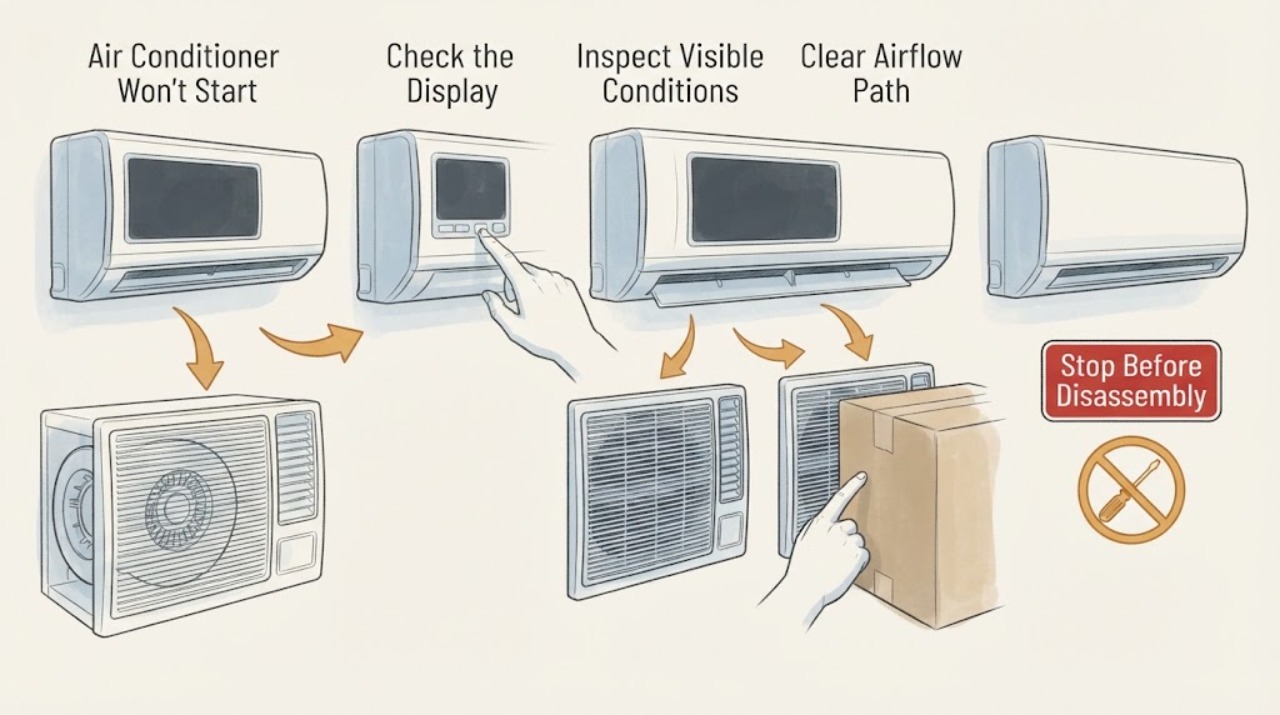
When an air conditioner will not start and the suspected component is the blower motor, first determine whether the indoor blower is actually silent, whether the thermostat is calling for cooling, and whether the system has visible power. Check the thermostat mode and schedule, inspect the accessible filter and supply/return airflow, and note whether the outdoor unit or indoor fan responds. Do not open the air handler, touch wiring, test voltage, discharge a capacitor, or try to spin a fan. A blower motor, capacitor, relay, frozen coil, control, or power fault requires HVAC diagnosis, especially if there is heat, smoke, a burning smell, ice, water, buzzing, or a repeated breaker trip.
Work through in order
Diagnostic checks
Use only checks that match the exact appliance or system and its official guide.
-
Check 1
Stand at a supply register and return grille while using the thermostat normally. Confirm whether the display is on, whether it is set to Cool with a cooling demand, and whether the indoor fan is set to Auto or On according to the equipment's normal behavior.
Expected result: Record no airflow, weak airflow, normal airflow with warm air, or an indoor fan that starts and stops. Also record whether the thermostat is blank, showing an alert, or showing a cooling call.
Next step: Correct only an obvious mode, schedule, or fan-setting mistake. If a cooling call still produces no indoor airflow, continue with external power and filter observations rather than opening the unit.
Why this matters
Why: No airflow with a cooling call makes the indoor blower/air-handler path relevant. A thermostat setting, schedule, blank display, or no cooling call can mimic a blower failure, while normal airflow points away from a stopped blower motor.
-
Check 2
From outside the electrical panel and without removing any cover, read the visible HVAC breaker or indicator. Look for a clearly labeled, user-accessible indoor service switch near the air handler, but do not open the cabinet or touch a wet or damaged installation.
Expected result: Record whether the breaker appears on, off, or tripped-looking, and whether the nearby service switch appears on. Note heat, discoloration, buzzing, burning odor, smoke, exposed wiring, or repeated tripping without touching the source.
Next step: Only when the area is dry and free of warning signs, follow the equipment instructions for no more than one normal user reset. If it trips again or the fan remains off, leave it alone and arrange HVAC service.
Why this matters
Why: A power interruption can stop both the blower and the rest of the AC. A breaker that trips or will not remain on indicates an unresolved electrical fault, not a reason to keep resetting or to assume the blower motor is the cause.
-
Check 3
Inspect the air filter only where the filter is designed to be removed by the user. Note its condition and airflow arrow, and replace it only with the exact model-approved type and orientation; do not remove an air-handler cover to reach hidden components.
Expected result: A visibly loaded filter, collapsed filter, or filter installed backward is a relevant airflow finding. A clean, correctly seated filter that does not restore airflow points away from a simple filter restriction.
Next step: After a safe filter change, allow the system to follow its normal start behavior without repeatedly cycling it. If there is ice, water, unusual noise, or still no airflow, shut the system off and call HVAC service.
Why this matters
Why: Restricted airflow can make the system overheat or freeze and can cause a protective shutdown that looks like a blower failure. A clean filter does not prove the blower motor or capacitor is good.
-
Check 4
Check the supply registers and return grille for obvious blockage from furniture, a closed register, or a dirty accessible grille. Do not reach into the duct or air handler and do not remove grilles that expose moving parts.
Expected result: If only one register is weak while others have normal airflow, the issue may be local to that register or duct. If every register is dead during a cooling call, the indoor blower or its power/control path becomes more likely.
Next step: Remove only an obvious external obstruction. If all registers remain without airflow, preserve the system state for the technician and do not attempt an internal inspection.
Why this matters
Why: The pattern of airflow helps separate a single blocked outlet from a system-wide blower symptom; it does not identify a motor or capacitor failure by itself.
-
Check 5
Listen from a safe distance for the indoor unit during one normal cooling call, without opening the cabinet or placing hands near any grille. Note silence, a brief click, humming, grinding, repeated starting attempts, or a fan that starts and stops.
Expected result: A silent blower with no airflow, a hum without movement, abnormal mechanical noise, or cycling after an attempted start are distinct observations. Record any hot smell, smoke, excessive heat, ice, or water instead of moving closer.
Next step: If the unit hums, grinds, smells hot, becomes unusually warm, or repeatedly tries to start, turn the system off at the normal control if safe and arrange HVAC service. Do not open the unit or touch the capacitor.
Why this matters
Why: The sound pattern can help a technician distinguish a control/power symptom from a motor, capacitor, bearing, obstruction, or frozen-coil symptom. Humming or heat is not a safe invitation to test or spin the fan.
-
Check 6
From a safe exterior view, check whether the outdoor condenser fan responds while the indoor registers remain without airflow. Do not remove the outdoor grille, touch the fan, or deliberately cycle the system to reproduce the symptom.
Expected result: Outdoor fan running with no indoor airflow suggests an indoor air-handler/blower path issue. Neither fan running, or an outdoor unit that is silent while the thermostat calls, suggests a broader power, control, safety, or outdoor-unit issue.
Next step: Record the comparison and stop at observation. Leave high-voltage components, refrigerant, capacitors, wiring, and motor testing to an HVAC technician.
Why this matters
Why: Indoor and outdoor fans are separate parts of a split system. This comparison narrows the service report but cannot prove that the blower motor, capacitor, or control is defective.
-
Check 7
Prepare a service note with the thermostat state, cooling-call result, airflow pattern, filter condition, visible breaker/switch state, indoor and outdoor fan observations, timing, and any ice, water, odor, heat, or noise.
Expected result: A precise note distinguishes no-start, no-airflow, weak-airflow, and outdoor-only symptoms and tells the technician whether a breaker or filter check changed anything.
Next step: Request HVAC service for an air conditioner that will not start with suspected blower-motor involvement, and keep the system off when a safety warning or frozen/wet condition is present.
Why this matters
Why: If the AC still will not start or the blower remains off after safe checks, professional diagnosis is the next useful step; a guessed motor or capacitor replacement is not.
Use your observations
Decision map
Find the observation that best matches what you see, then follow the next safe action.
-
PATH 01Safety boundary
What you see
Do this next
Resolve only an obvious user setting or model-approved battery issue. If the display remains blank or the system has no visible power, treat it as a power/control service issue before blaming the blower motor.
Why this path and its safety boundary
Safety stop: Continue with the indoor-airflow and power-path observations.
-
PATH 02Safety boundary
What you see
Do this next
Only if dry and free of warning signs, perform one normal user reset or restore the clearly labeled switch. If it trips again, will not stay on, or the blower does not start, stop and call HVAC service.
Why this path and its safety boundary
Safety stop: Do not keep resetting. A normal-looking breaker does not prove the air handler, low-voltage controls, motor, or capacitor is healthy.
-
PATH 03Safety boundary
What you see
Do this next
Replace an accessible filter only if the model allows it; if ice is present, turn the system off at the normal control and arrange HVAC service. Do not chip ice, open the coil cabinet, or continue running the blower test.
Why this path and its safety boundary
Safety stop: Continue with safe airflow and indoor/outdoor response observations.
-
PATH 04Safety boundary
What you see
Do this next
Report an indoor air-handler/blower symptom. A blower motor, capacitor, relay, control, safety switch, or frozen-coil condition may be involved; these require HVAC testing.
Why this path and its safety boundary
Safety stop: If both indoor and outdoor units remain silent, report a broader power or control symptom rather than selecting a blower part.
-
PATH 05Safety boundary
What you see
Do this next
Stop immediately. Turn the system off using a normal control only if it is safe to do so, keep clear of the equipment, and obtain qualified HVAC or electrical service. Do not open the unit, touch the motor or capacitor, or reset repeatedly.
Why this path and its safety boundary
Safety stop: If the blower remains off after the safe checks, schedule HVAC diagnosis and provide the recorded symptom pattern.
Helpful context
Understand the symptom
Separate the blower symptom from a complete AC power failure
The blower motor is the indoor fan motor that moves air through the ducts. A dark thermostat, no outdoor response, and no indoor airflow suggest a broader power or control interruption. A live thermostat with a cooling call but no air from the registers points more toward the air handler, blower motor, capacitor, relay, airflow restriction, or a frozen coil. Seeing the outdoor fan run does not prove that the indoor blower is healthy, and seeing no outdoor response does not prove the blower motor failed.
Why blower-motor work is not a homeowner test
The air handler can contain line-voltage parts, a charged capacitor, moving fan components, controls, and wiring. A homeowner-safe check stops at settings, accessible filter and vent observations, visible switch or breaker status, and symptoms heard or seen from a safe distance. Do not remove the air-handler cover, reach through a grille, spin the wheel, bridge a relay, or measure voltage. The technician can determine whether the motor, capacitor, control, safety switch, airflow, or coil is responsible.
Safety boundary
Stop conditions
- Stop immediately for smoke, sparks, arcing, burning smell, hot or discolored equipment, shock, exposed or damaged wiring, or a breaker that trips again.
- Stop if ice, standing water, or condensate is near electrical equipment; do not touch wet equipment, chip ice, or continue operating the system to test it.
- Do not open the air handler or electrical panel, reach toward the blower wheel, spin a fan, touch wiring, discharge or test a capacitor, bypass a relay or safety switch, or measure live voltage.
- Do not repeatedly reset a breaker, repeatedly start a humming motor, or run the system with a damaged blade, severe vibration, or abnormal heat.
When checks do not resolve it
Need a professional?
Call a qualified HVAC technician when the indoor blower does not start during a valid cooling call after safe setting, filter, airflow, and visible power checks; when the outdoor fan and indoor airflow disagree; or when a motor, capacitor, relay, control, frozen coil, safety switch, or wiring fault is suspected.
Common questions
FAQ
How can I tell whether the problem is the blower motor or the whole air conditioner?
Check whether the thermostat makes a cooling call, whether the indoor registers have airflow, and whether the outdoor fan responds from a safe distance. Outdoor operation with no indoor airflow points toward the indoor air-handler path, but it cannot prove a motor failure; both units being silent suggests a broader power or control issue.
Can a dirty filter stop the AC blower from starting?
A severely restricted filter can reduce airflow and contribute to overheating or a frozen coil, which may produce a shutdown symptom. Replace only an accessible, model-approved filter; if there is ice, water, heat, or no improvement, stop and arrange HVAC service.
Can I replace the blower motor or capacitor myself?
Do not treat either part as a homeowner test or replacement. The air handler can contain high-voltage wiring and a charged capacitor, and the correct motor and controls depend on the exact equipment. Leave internal diagnosis and replacement to a qualified HVAC technician.
Should I keep trying to start the AC if the blower hums?
No. A hum without airflow, repeated starting attempts, unusual noise, heat, burning odor, smoke, ice, water, or a repeated breaker trip is a stop condition. Turn the system off using a normal control only when safe and obtain HVAC service; do not spin the fan or touch the capacitor.
Read the exact guide
Official sources
- AC Fan Not Working? Reasons Why It Stopped SpinningTrane · Trane residential AC indoor blower versus outdoor condenser fan symptoms and service boundaries.
- Troubleshoot an AC Not WorkingCarrier · Carrier residential AC troubleshooting for thermostat, filter, breaker, airflow, frozen coil, outdoor unit, and high-voltage service boundaries.
- AC Unit Not Turning On: Reasons Why And What To DoCarrier · Carrier residential air-conditioner no-start troubleshooting, including thermostat, filter, power, blower motor, and professional boundaries.
- Air Handler Fan Not Working: Causes and SolutionsTrane · Trane residential air-handler fan troubleshooting, including filters, power, controls, capacitors, blower motors, and frozen coils.
Community feedback
Share a repair observation
Share a plain-text repair observation. Accepted observations are published automatically; this page may take a moment to update.