
On this page
Start here
Quick answer
If an air conditioner buzzed and then would not start, treat the sound as useful evidence rather than repeatedly trying to start it. First note whether the buzz came from the thermostat, indoor air handler, outdoor cabinet, or electrical service area, and whether it occurred during a cooling call, at shutdown, or repeatedly. From a dry, safe position, check the thermostat call, accessible filter and visible water or ice, and compare indoor and outdoor response. A persistent or hot buzz, burning smell, smoke, arcing, water near electrical equipment, ice, or a breaker that opens again is a stop condition. Capacitors, contactors, motors, controls, wiring, and refrigerant circuits are model- and installation-specific service work; do not open the cabinet, touch those parts, or keep cycling the system. Arrange qualified HVAC service with the exact sound, timing, response, and safety symptoms.
Before you begin
Safety first
- Keep the system off for abnormal sound, odor, heat, water, ice, smoke, arcing, exposed wiring, or repeated protective-device operation. Cabinet, wiring, capacitor, contactor, motor, compressor, and refrigerant work belongs to qualified HVAC personnel.
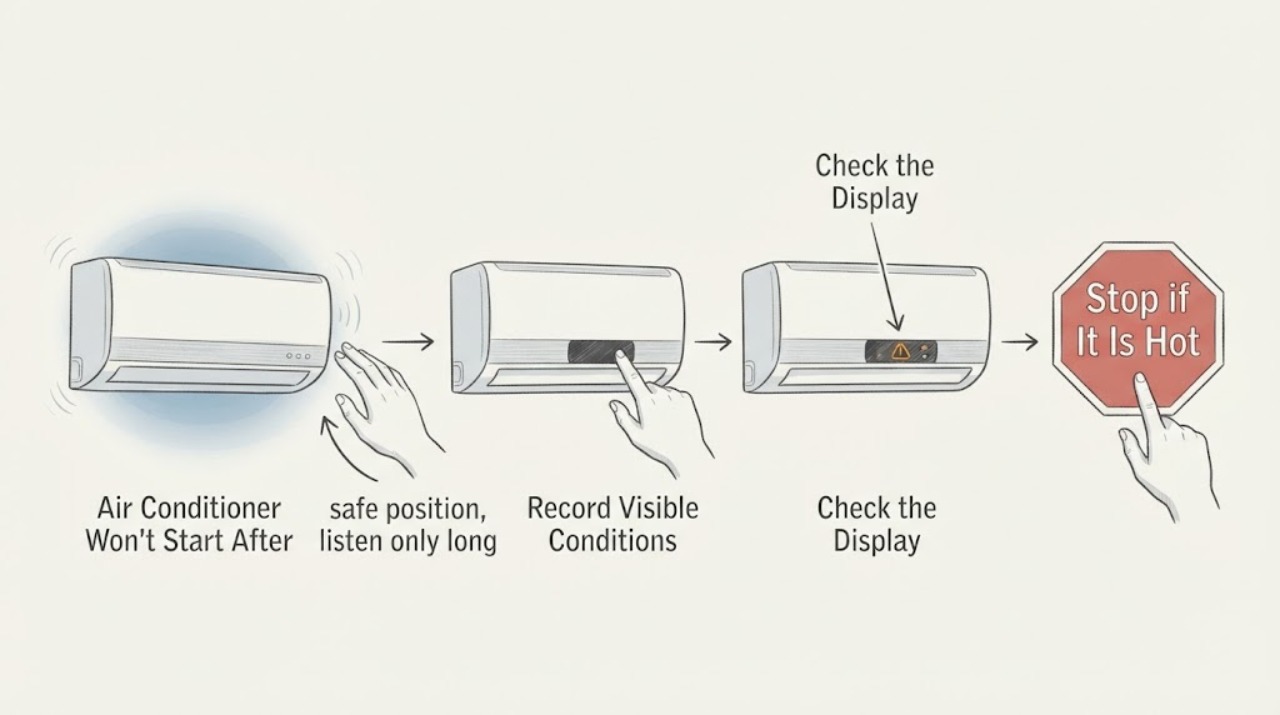
Work through in order
Diagnostic checks
Use only checks that match the exact appliance or system and its official guide.
-
Check 1
From a dry, safe position, listen only long enough to note whether the buzz is accompanied by smoke, a burning or melted-plastic odor, a hot surface, visible arcing, water near equipment, ice, exposed wiring, or a breaker opening; do not approach a wet or damaged installation.
Expected result: A warning sign is present, or the buzz is loud, continuous, rapidly repeating, or associated with heat or an odor.
Next step: Stop the cooling call using a safe accessible control if possible, keep clear, and arrange emergency or qualified HVAC help. If there is smoke or fire, leave and use the local emergency route from a safe location.
Stop if: Stop immediately for smoke, fire, burning odor, visible arc, hot equipment, water near electrical parts, ice with continued operation, or repeated protective-device operation.
Why this matters
Why: The no-start is no longer a routine control check; fire, electrical, water-damage, mechanical, or refrigeration-related risk is possible.
-
Check 2
With the system not being repeatedly cycled, write down the apparent sound location—thermostat, indoor air handler, outdoor cabinet, or service area—and whether it happened when cooling was requested, while a fan was expected to start, at shutdown, or without a call.
Expected result: The sound is indoor, outdoor, at the control, or near electrical service, and it is one brief event, a repeated start attempt, or continuous.
Next step: Keep the note for the technician and make no more than one normal observation cycle if there is no hazard. Do not remove panels or reach toward a motor, capacitor, contactor, or compressor.
Stop if: Stop if the sound becomes louder, continuous, hot, smoky, arcing, or accompanied by an odor or water.
Why this matters
Why: Location and timing separate a control symptom from an indoor blower response, an outdoor start failure, or an electrical warning; they do not identify a replaceable component by themselves.
-
Check 3
At the thermostat, confirm Cool is selected, the target is below the room reading, the fan is in the normal Auto setting, and no schedule, away state, lock, delay, or low-battery alert is preventing a call; use only documented user controls.
Expected result: The thermostat was off, in the wrong mode, set above the room reading, locked, scheduled away, alerting, or calling normally while the equipment stayed silent.
Next step: Correct only an obvious setting through the thermostat manual and make one normal cooling request. If the display calls but the equipment remains idle or buzzes again, leave the settings alone and continue to external checks.
Stop if: Stop for a wet, hot, cracked, or damaged control, exposed wiring, smoke, burning odor, or a request to touch terminals.
Why this matters
Why: A control state can mimic a dead air conditioner. A valid call with no response shifts attention toward power, safety, control, or equipment faults.
-
Check 4
From outside equipment enclosures, note whether the indoor unit and outdoor unit show any normal response during one valid call, and inspect only the visible position of a labeled breaker or disconnect if the area is dry and undamaged; do not open a cover or repeatedly reset protection.
Expected result: Neither unit responds, only the indoor blower responds, only the outdoor unit buzzes or responds, or a breaker or disconnect is open.
Next step: Follow the equipment instructions for at most one safe external reset only when there is no odor, heat, water, smoke, or visible damage. If it opens again or the response remains split, leave the system off and call HVAC or electrical service.
Stop if: Stop for a repeat trip, hot panel, smoke, arcing, exposed wiring, wet equipment, or any need to access the service compartment.
Why this matters
Why: The pattern may reflect a power interruption, separate control or safety path, drain shutdown, blower or outdoor start fault, or wiring problem; an open protective device is evidence to investigate, not permission to keep resetting it.
-
Check 5
With the system stopped through its normal control, inspect the accessible filter and supply or return grilles; replace a visibly loaded filter only in the orientation and type specified by the equipment manual, and look for visible ice without scraping or heating it.
Expected result: The filter is blocked, airflow was weak, ice is visible, airflow is normal but the indoor fan is silent, or no restriction is visible.
Next step: After a safe filter change, make no further cooling request if ice, water, odor, or abnormal noise is present. Otherwise make one normal call; if the fan remains silent or ice returns, arrange HVAC service with the observations.
Stop if: Stop for ice, water, smoke, burning odor, severe noise, a hot cabinet, or any need to reach the blower or electrical parts.
Why this matters
Why: Restricted airflow can contribute to freeze or safety shutdowns. A silent blower with a clear filter leaves control, power, starting-component, motor, or safety causes possible; a clear filter does not rule out an internal fault.
-
Check 6
From outside the cabinet, look for standing water, a wet-switch indication, a full accessible secondary pan, water on the floor, or an overflow outlet that is discharging unexpectedly; keep the air handler closed and do not bypass a safety switch.
Expected result: Water, overflow, a tripped water indication, or a recent leak is present, or no visible condensate symptom is present.
Next step: For water, overflow, or a suspected safety trip, keep the system off, protect the area from further damage, and arrange qualified HVAC drain service. Do not use chemicals, open the air handler, or bypass the safety device.
Stop if: Stop for standing water near electrics, ceiling or floor damage, an overflowing pan, or a need to touch a float, pump, drain wiring, or cabinet interior.
Why this matters
Why: A drain or pan problem can activate an installation-specific safety control and stop cooling to limit water damage. No visible water does not rule out a hidden blockage or a different shutdown cause.
-
Check 7
Prepare a service note with the equipment model, thermostat display and mode, setpoint, buzz location and timing, indoor and outdoor response, filter and ice state, water or odor evidence, recent power events, and whether the system worked before; leave capacitors, contactors, motors, compressors, wiring, controls, and refrigerant work to a qualified HVAC technician.
Expected result: Safe external checks do not restore operation, the buzz recurs, one section responds while another stays silent, or the system starts and stops without cooling.
Next step: Keep the system off for abnormal sound, odor, heat, water, ice, or electrical symptoms and request HVAC service. Provide the response sequence so the technician can choose the correct safe diagnostic path.
Stop if: Stop all user diagnosis if it would require opening an enclosure, touching a motor, capacitor, contactor, compressor, or wiring, bypassing a safety control, or handling refrigerant.
Why this matters
Why: The remaining possibilities include a starting component, motor, contactor, control or safety circuit, drain issue, power fault, refrigerant issue, or another model-specific internal condition.
Use your observations
Decision map
Find the observation that best matches what you see, then follow the next safe action.
-
PATH 01Next step
What you see
The buzz is accompanied by smoke, burning odor, heat, arcing, water near electrics, ice with operation, or a repeat protective-device opening.
Do this next
Stop the system from a safe accessible control, keep clear, leave for smoke or fire, and arrange emergency or qualified HVAC help from a safe location.
Why this path and its safety boundary
Why it matters: This is a possible fire, electrical, water-damage, mechanical, or refrigeration event.
-
PATH 02Next step
What you see
The thermostat is blank, locked, scheduled away, in the wrong mode, set incorrectly, or showing a battery or system alert.
Do this next
Use only the manual's user controls or battery procedure; call HVAC if the display stays abnormal, the alert returns, or the buzz/no-start persists.
Why this path and its safety boundary
Why it matters: The wall control or its power may be preventing a cooling call.
-
PATH 03Next step
What you see
The thermostat calls or the outdoor unit responds, but the indoor blower is silent, hums, or stops immediately.
Do this next
Stop repeated calls and request HVAC service; keep the blower compartment closed.
Why this path and its safety boundary
Why it matters: A blower motor, starting component, control, power, filter, or safety condition is possible and cannot be identified safely from sound alone.
-
PATH 04Next step
What you see
The indoor fan runs or the thermostat calls, but the outdoor unit buzzes and then stays silent.
Do this next
Do not keep cycling the unit or open its disconnect or cabinet; arrange qualified HVAC diagnosis.
Why this path and its safety boundary
Why it matters: An outdoor power, control, safety, starting-component, motor, compressor, or refrigerant-related condition may prevent the cooling cycle.
-
PATH 05Next step
What you see
Visible water, a full pan, a wet-switch indication, or ice is present.
Do this next
Keep the system off and arrange HVAC service; do not scrape ice, add heat, open the cabinet, or bypass a safety control.
Why this path and its safety boundary
Why it matters: A condensate safety shutdown, restricted airflow, low refrigerant, drain issue, or control fault may be protecting the installation.
-
PATH 06Next step
What you see
Neither indoor nor outdoor equipment responds to a valid call, or a visible protective device is open.
Do this next
Only follow one safe external reset allowed by the equipment instructions when the area is dry and undamaged; if it opens again or no response remains, call HVAC or electrical service.
Why this path and its safety boundary
Why it matters: A power interruption, control issue, drain safety shutdown, wiring fault, or another system-level condition is possible.
-
PATH 07Next step
What you see
A setting, battery change, or single permitted external action restores operation but the buzz or no-start returns.
Do this next
Record the recurrence and arrange HVAC service instead of repeating resets or guessing at a component replacement.
Why this path and its safety boundary
Why it matters: A temporary control state may have cleared while a recurring power, drain, airflow, motor, or internal fault remains.
Helpful context
Understand the symptom
What the buzzing detail changes
A buzz before a no-start can be a short control or relay sound, a motor that cannot get moving, a failed starting component, or a sign of electrical stress. Sound alone cannot identify a part. The useful distinction is where it came from, whether it repeats, what started at the same time, and whether there is heat, odor, smoke, water, ice, or a protective device opening. Record those observations once and avoid turning an intermittent symptom into repeated restart attempts.
Keep indoor and outdoor observations separate
The thermostat, indoor air handler, and outdoor condenser have separate visible symptoms and may have separate power or safety paths. A normal thermostat display with a silent indoor fan is not the same fault pattern as an indoor fan that runs while the outdoor unit buzzes and stops. Do not infer a failed compressor, contactor, capacitor, or blower motor from a sound recording alone; those parts require equipment-specific diagnosis.
Water and ice are not restart invitations
Cooling can produce condensate, and restricted airflow or another fault can produce ice. Water near an air handler can damage surrounding materials and become an electrical hazard; ice can indicate an airflow, refrigerant, or control problem. Keep the cabinet closed and arrange HVAC service when water, ice, or a tripped safety indication is visible.
Safety boundary
Stop conditions
- Stop immediately for smoke, fire, burning or melted-plastic odor, visible arcing, a hot connection or cabinet, or a breaker or disconnect that opens again.
- Stop for water near electrical equipment, an overflowing pan, ceiling or floor damage, exposed wiring, or a wet installation.
- Stop for visible ice, loud or continuous buzzing, grinding, repeated start attempts, or a motor that appears to overheat.
- Do not open the air handler or outdoor cabinet, touch a capacitor, contactor, motor, compressor, control, or wiring, bypass a float or safety switch, or handle refrigerant.
- If smoke or fire is present, leave the area and contact the local emergency route from a safe location; do not return to investigate.
Only after diagnosis
Potential parts
- blower motor or outdoor fan motor
- start capacitor or contactor
- condensate safety switch or drain component
When checks do not resolve it
Need a professional?
The buzz repeats, persists, becomes hot or loud, or is followed by silence and no start., The thermostat calls normally but neither unit starts, or the indoor and outdoor units have split responses., The indoor blower is silent, humming, grinding, overheated, or stops immediately after a call., Water, ice, a full pan, a wet-switch indication, a suspected condensate blockage, or a repeat protective-device opening is present., Operation returns only temporarily, cooling does not resume, or diagnosis would require opening an enclosure or touching electrical, motor, or refrigerant components.
Safety scope: Keep the system off for abnormal sound, odor, heat, water, ice, smoke, arcing, exposed wiring, or repeated protective-device operation. Cabinet, wiring, capacitor, contactor, motor, compressor, and refrigerant work belongs to qualified HVAC personnel.
Common questions
FAQ
Why does an air conditioner buzz but not start?
The sound can accompany a control, power, motor, capacitor, contactor, safety, or other equipment fault. Because a buzz does not identify the part, record its location and timing and stop if it repeats, heats, smells, smokes, arcs, or opens a protective device.
Should I keep resetting the breaker when the AC buzzes?
No. Only follow the equipment instructions for one safe external reset when the area is dry and undamaged. If protection opens again, leave the system off and arrange HVAC or electrical service.
What if the indoor fan runs but the outdoor unit buzzes?
That split response points to a separate outdoor power, control, safety, starting, motor, compressor, or related condition. Do not open the outdoor cabinet or keep cycling it; provide the timing and response to an HVAC technician.
Can I replace the AC capacitor or contactor myself?
Do not use a sound as a part diagnosis or open the equipment to reach those components. Capacitor, contactor, motor, control, wiring, and refrigerant work should be handled by qualified HVAC personnel.
Does water or ice explain a buzzing no-start?
It can. A drain or pan safety condition, restricted airflow, low refrigerant, or control issue may stop operation, but the exact cause depends on the installation. Keep the system off for visible water or ice and arrange HVAC service.
Read the exact guide
Official sources
- HVAC Emergency RepairCarrier · Carrier residential HVAC emergency guidance; local emergency response and equipment-specific isolation instructions vary.
- AC Unit Not Turning On: Reasons Why And What To DoCarrier · Carrier residential air-conditioner guidance; exact equipment, controls, wiring, safety switches, and service procedures vary by model and installation.
- Troubleshoot an Air Conditioner: 6 Steps to Fix an AC Not WorkingCarrier · Carrier central-air troubleshooting guidance; equipment type, controls, and safe access vary by installation.
- Introduction to electrical safetyHealth and Safety Executive · UK regulator electrical-safety introduction; the hazard principles apply broadly, while local codes and emergency routes vary by location.
Community feedback
Share a repair observation
Share a plain-text repair observation. Accepted observations are published automatically; this page may take a moment to update.