
On this page
Start here
Quick answer
An air conditioner that will not start may have a thermostat command or power problem, a condensate drain blockage that has tripped a float switch, or an internal blower-motor, capacitor, control, or safety fault. Start with the thermostat display, mode, setpoint, batteries if applicable, and the exact symptom: no display, no indoor airflow, or no outdoor response. Look for standing water at the indoor unit and a visible drain outlet, but do not open the air handler, touch wiring, reach the blower, or work on refrigerant or electrical parts. A float switch can shut the system down when a drain pan fills, so water and a no-start symptom should be handled as a drain and water-damage concern. If a breaker trips again, smoke or burning odor appears, ice is present, water approaches electrical equipment, or the blower motor is suspected, turn the system off and arrange qualified HVAC service.
Before you begin
Safety first
- Keep the system off for water near electrics, ice, smoke, burning odor, abnormal noise, exposed wiring, a hot connection, repeated protective-device operation, or any need to open a cabinet or bypass a safety control.
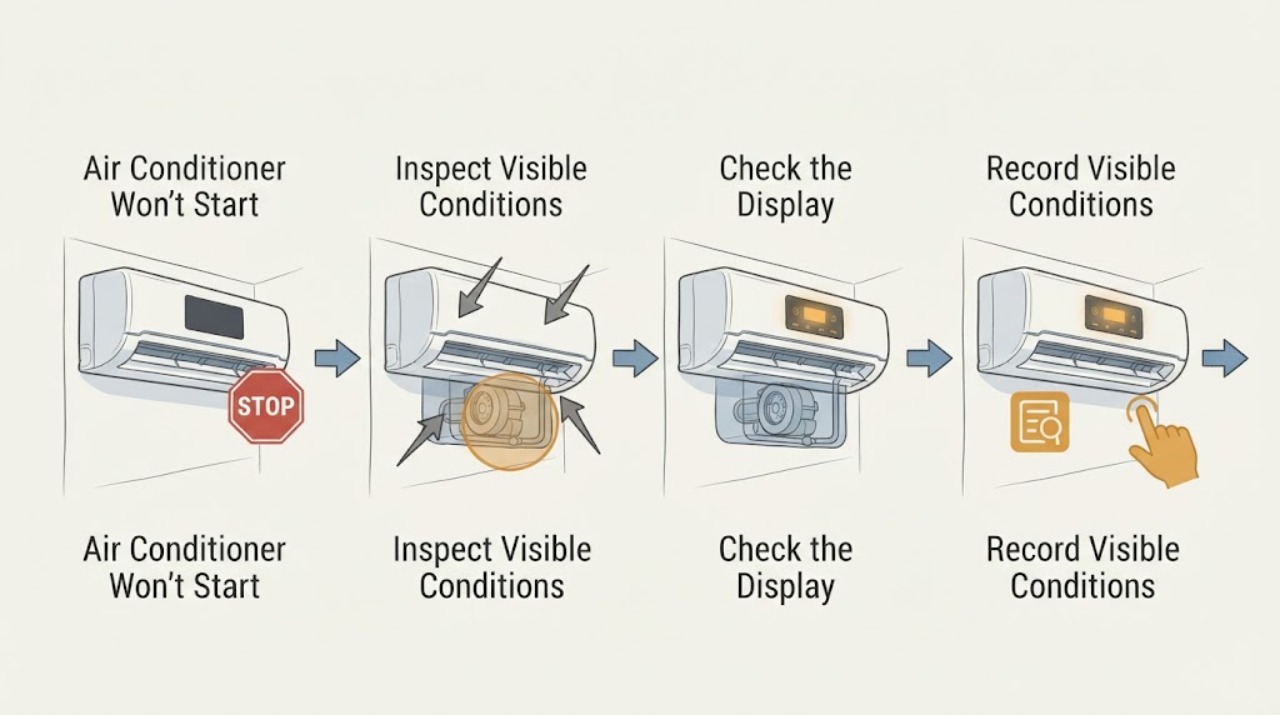
Work through in order
Diagnostic checks
Use only checks that match the exact appliance or system and its official guide.
-
Check 1
From a dry, safe position, look for smoke, burning or melted-plastic odor, water near the indoor unit or electrical equipment, exposed wiring, ice, a hot connection, loud mechanical noise, or a breaker that opens as soon as the system is called; do not approach a wet or damaged installation.
Expected result: Any warning sign is present, or the system is in a wet, hot, smoky, icy, or visibly damaged state.
Next step: Turn the system off using a safe accessible control, keep clear, and arrange emergency or qualified HVAC help. If water is near electrical equipment, isolate power only from a dry safe location and do not restart to test.
Stop if: Stop immediately for smoke, fire, burning odor, exposed wiring, water near electrics, visible ice, a hot connection, severe noise, or repeated protective-device operation.
Why this matters
Why: This is a possible fire, electrical, water-damage, refrigerant, or mechanical event rather than a routine thermostat check.
-
Check 2
At the thermostat, confirm the system is set to Cool, the target is below the room reading, the fan is on the normal Auto setting, and no schedule, away state, lock, or delay is preventing a call; use only the documented user controls.
Expected result: The thermostat was off, in the wrong mode, set above the room reading, locked, scheduled away, or calling for cooling while the system remains silent.
Next step: Correct only the obvious setting through the manual and make one normal cooling request. If the display calls but the system remains idle, continue without changing wiring or configuration.
Stop if: Stop for a cracked, wet, hot, or loose control, exposed wiring, a recurring alert, or any need to remove the wall control.
Why this matters
Why: A control-state issue can mimic a dead air conditioner. A valid cooling call with no indoor or outdoor response shifts attention to power, drain safety, control, or equipment faults.
-
Check 3
Record whether the thermostat screen is blank, flickering, normal, or showing a low-battery or system alert; if the model has user-replaceable batteries, replace them only as directed by its manual and keep the control mounted.
Expected result: The screen is blank or unstable, a battery alert is present, the display is normal but the indoor fan does not run, or an alert returns.
Next step: Follow the exact manual for a battery or alert state and perform no more than one documented restart if allowed. If the display remains blank, the alert returns, or the unit stays idle, arrange HVAC service.
Stop if: Stop for exposed control wiring, a hot or damaged wall control, smoke, burning odor, water, or any instruction that requires touching terminals.
Why this matters
Why: A battery or control-power problem can prevent a call. A normal display with no equipment response points toward a system power, safety, communication, control, or motor issue; alert meanings are model-specific.
-
Check 4
With the system stopped through its normal control, inspect the accessible air filter and supply or return grilles; replace a visibly loaded filter in the exact orientation and type specified by the equipment manual, and leave the blower compartment closed.
Expected result: The filter is blocked, airflow was weak before the failure, airflow is normal but the indoor fan does not start, or airflow is normal and the outdoor unit is also silent.
Next step: After a safe filter change, make one normal call only if there is no water or hazard. If the fan remains idle or the system still does not start, leave the air handler closed and request HVAC diagnosis.
Stop if: Stop for water around the air handler, a frozen coil, burning odor, smoke, abnormal noise, or any need to reach the fan or motor.
Why this matters
Why: Restricted airflow can cause freeze or safety shutdowns, while a silent blower with a clear filter leaves power, control, capacitor, motor, or safety causes possible. A clear filter does not rule out a drain switch.
-
Check 5
From outside the equipment cabinet, look for standing water in an accessible secondary pan, a wet-switch indicator, water on the floor, an overflow outlet discharging unexpectedly, or a normally visible condensate drain exit with no discharge during recent cooling; do not open the pan or bypass a float switch.
Expected result: Water is present, the pan or wet-switch indicator appears tripped, the drain outlet is blocked or overflowing, or no water symptom is visible.
Next step: Turn the system off and arrange qualified HVAC drain service for water, overflow, or a suspected float trip. Only follow a model-specific, power-off drain-clearing procedure when the manual explicitly allows it; do not use chemicals or bypass the safety device.
Stop if: Stop for standing water near electrics, ceiling or floor damage, an overflowing pan, a damaged drain, or any need to touch the float, pump, or wiring.
Why this matters
Why: A clogged drain or full pan may have activated a float or sensor that shuts down the compressor and supply fan. No visible water does not rule out a hidden blockage or a system without an external switch.
-
Check 6
During one normal cooling request, observe from a safe distance whether the indoor blower starts, whether the outdoor unit responds, whether one starts and the other stays silent, and whether the system stops soon after the call; do not remove a service-panel cover or reach toward the blower motor.
Expected result: Neither unit starts, the indoor blower is silent while the outdoor unit responds, the blower runs while the outdoor unit is silent, or both start and then stop.
Next step: Record the exact response and arrange HVAC service for any persistent no-start or split response. A technician should diagnose the blower motor and starting components, drain safety, controls, and power using the model's service information.
Stop if: Stop for humming, grinding, smoke, burning odor, a hot cabinet, exposed wiring, ice, water, or repeated breaker operation.
Why this matters
Why: Neither unit responding can reflect thermostat, power, drain safety, or control issues. A silent indoor blower raises blower motor, capacitor, control, or safety possibilities; split indoor/outdoor response can also indicate separate power or control faults.
-
Check 7
Prepare a service note with the thermostat display and mode, setpoint, battery result, filter state, drain or water evidence, indoor and outdoor response, sounds or odors, recent power events, and whether the blower or cooling worked before; leave the blower motor, drain-line access, wiring, capacitor, and high-voltage work to a qualified HVAC technician.
Expected result: Safe external checks do not restore operation, the drain switch appears active, the blower is silent or noisy, or the unit starts and stops without cooling.
Next step: Keep the system off when water, ice, odor, noise, or electrical symptoms are present and request HVAC service. Provide the response sequence so the technician can inspect the model-specific drain path and blower circuit efficiently.
Stop if: Stop all user diagnosis if it would require opening the cabinet, touching the motor or wiring, bypassing a float switch, handling refrigerant, or working around high voltage.
Why this matters
Why: The remaining fault may be a condensate blockage or switch, blower motor or starting component, control, power, refrigerant, or another internal safety condition.
Use your observations
Decision map
Find the observation that best matches what you see, then follow the next safe action.
-
PATH 01Next step
What you see
The thermostat is blank, in the wrong mode, set incorrectly, battery-depleted, locked, or not issuing a normal cooling call.
Do this next
Correct only the documented setting or replace user-accessible batteries. Arrange HVAC service for a recurring blank display, alert, or no response and do not touch control wiring.
Why this path and its safety boundary
Why it matters: The no-start symptom may be caused by the wall control or its power rather than the blower or drain line.
-
PATH 02Next step
What you see
Standing water, an overflow indication, a wet switch, or a full condensate pan appears near the air handler.
Do this next
Leave the system off and arrange qualified HVAC drain service. Do not bypass the switch, open the air handler, or continue cooling tests while water is present.
Why this path and its safety boundary
Why it matters: A blocked drain line or pan may have activated a float or sensor that prevents the system from starting to limit water damage.
-
PATH 03Next step
What you see
The outdoor unit responds but the indoor supply fan stays silent, hums, grinds, or stops immediately.
Do this next
Turn the system off for abnormal sound or heat and arrange HVAC service to inspect the blower circuit and air handler safely.
Why this path and its safety boundary
Why it matters: A blower motor, capacitor, control, power, filter, or safety fault is possible; the motor is not a user-replaceable diagnosis from sound alone.
-
PATH 04Next step
What you see
The indoor fan runs or the thermostat calls, but the outdoor unit remains silent.
Do this next
Stop repeated cycling and request qualified HVAC diagnosis. Do not open the outdoor disconnect or equipment cabinet.
Why this path and its safety boundary
Why it matters: A separate outdoor power, control, safety, capacitor, contactor, compressor, or refrigerant-related condition may prevent the cooling cycle.
-
PATH 05Next step
What you see
Neither indoor nor outdoor equipment responds to a valid thermostat call, or a protective device is open.
Do this next
Use only a safe, single external check permitted by the equipment instructions; if power does not return or the protective device opens again, leave the system off and call HVAC or electrical service.
Why this path and its safety boundary
Why it matters: A power interruption, control issue, safety shutdown, or wiring fault is possible.
-
PATH 06Next step
What you see
Ice is visible on the indoor or outdoor coil, or water appears after a prior freeze or overflow.
Do this next
Turn the system off and arrange qualified HVAC service. Do not scrape ice, use heat, or open the refrigerant circuit.
Why this path and its safety boundary
Why it matters: Restricted airflow, low refrigerant, drain trouble, or a defrost or control issue may be present and can damage the system if it continues running.
-
PATH 07Next step
What you see
The air conditioner starts after a setting, battery, or single safe control action but later stops again or fails to cool.
Do this next
Record the recurrence and arrange HVAC service rather than repeating resets or replacing a motor or drain component without diagnosis.
Why this path and its safety boundary
Why it matters: A temporary control state may have cleared, but a recurring drain, blower, airflow, power, or internal fault remains possible.
Helpful context
Understand the symptom
Separate thermostat, indoor, and outdoor symptoms
A blank thermostat, a live display with no indoor airflow, and an indoor fan that runs while the outdoor unit stays off are different starting points. Write down which parts respond to a normal call and whether the failure began after a storm, a filter change, a drain leak, or service work. That evidence is more useful than repeatedly pressing Start or resetting a protective device.
Why the drain line can stop the whole system
Cooling creates condensate at the indoor coil. If the pan or drain line fills, an installed float or water sensor may interrupt the system to limit overflow. Not every air handler has the same switch, and drain exits, pans, and access points vary. Standing water near the air handler is a reason to stop the call and arrange HVAC service, not a reason to reach into the blower compartment.
The blower motor is not a safe first replacement
A silent indoor fan can reflect a thermostat signal, power, safety switch, control, capacitor, motor, or airflow problem. A humming, hot, or noisy motor can also be failing. The motor and its starting components may involve stored or hazardous electrical energy, so use external observations and let a technician identify the failed component.
Safety boundary
Stop conditions
- Stop immediately for smoke, burning odor, exposed wiring, a hot cabinet or connection, loud grinding or buzzing, visible arcing, water near electrical equipment, or a breaker that opens again.
- Do not open the air handler or outdoor cabinet, reach the blower motor, touch wiring or capacitors, bypass a float or safety switch, handle refrigerant, or use an energized electrical check.
- Stop for standing water, an overflowing pan, a wet switch, ice, ceiling or floor damage, or a drain line that would require unsafe access or chemical treatment.
- Do not keep cycling a silent or failed system. After a safe external check does not restore operation, leave it off and arrange qualified HVAC service.
Only after diagnosis
Potential parts
- condensate drain line, pan, pump, or overflow switch
Consider a drain component only after qualified inspection confirms blockage, leakage, pump failure, pan damage, or a defective float or wet switch as the reason for the shutdown.
Drain layout, pump, pan, switch, access, and control connection vary by air-handler model and installation. Do not bypass a safety switch or select a part by appearance. - blower motor or motor starting component
Consider a blower component only when a qualified technician confirms that the indoor fan circuit or motor is defective after the drain, filter, thermostat, and power paths are assessed.
Motor, capacitor, control, speed, and mounting details are model-specific and may involve hazardous electrical energy. Confirm diagnosis and fit before replacement. - thermostat or HVAC control
Consider a control replacement only after the technician confirms a thermostat, communication, or control-board fault rather than a drain safety or blower problem.
Heat-pump, staged, communicating, and conventional systems use different controls and configuration. Confirm the complete equipment setup before selecting a replacement.
When checks do not resolve it
Need a professional?
The thermostat calls normally but neither unit starts, or the indoor and outdoor units have split responses., The indoor blower is silent, humming, grinding, overheated, or stops immediately after a call., Standing water, a full pan, a wet-switch indication, an overflow outlet, or a suspected condensate drain blockage is present., A breaker or disconnect opens again, wiring or a connection is damaged, or the system shows smoke, burning odor, or ice., The system starts temporarily but the no-start symptom returns or cooling does not resume., Diagnosis would require opening the air handler, touching a motor or capacitor, changing wiring, bypassing a float switch, or handling refrigerant.
Safety scope: Keep the system off for water near electrics, ice, smoke, burning odor, abnormal noise, exposed wiring, a hot connection, repeated protective-device operation, or any need to open a cabinet or bypass a safety control.
Common questions
FAQ
Can a clogged AC drain line make the air conditioner refuse to start?
Yes. If condensate fills the pan, an installed float or water sensor may shut down the compressor and supply fan to limit overflow. Standing water or a wet-switch indication needs the system off and qualified drain service; not every air handler uses the same switch.
What does it mean if the indoor blower does not start?
A silent blower can reflect thermostat communication, power, filter or airflow restriction, a safety shutdown, control trouble, a starting component, or a failed blower motor. Do not reach the motor or open the air handler; record whether the outdoor unit responds and arrange HVAC diagnosis.
What should I check first when my AC will not turn on?
Check the thermostat display, mode, setpoint, schedule, and applicable batteries, then inspect the accessible filter, visible water, and the indoor and outdoor response. Use only safe external controls and stop for water, ice, odor, smoke, abnormal noise, or repeated protective-device operation.
Should I bypass the condensate float switch to make the AC run?
No. The switch is intended to stop the system when water reaches an unsafe level. Bypassing it can permit overflow and damage, so have a qualified HVAC technician inspect the pan, drain line, switch, and cause of the water.
When is a no-start AC problem an emergency?
Treat smoke, burning odor, exposed wiring, a hot connection, visible arcing, water near electrical equipment, thick ice, loud mechanical noise, or a breaker that opens again as an immediate stop condition. Turn the system off safely and obtain emergency or qualified HVAC help.
Read the exact guide
Official sources
- AC Unit Not Turning On: Reasons Why And What To DoCarrier · Carrier residential air-conditioner guidance; exact equipment, wiring, safety switches, and service procedures vary by model and installation.
- HVAC Air Handler Overflow SwitchTrane · Trane residential air-handler guidance; not every air handler has the same overflow switch and access varies by installation.
- How to Clean AC Drain LineCarrier · Carrier residential drain guidance; drain access and homeowner actions depend on the installation and model.
- Troubleshoot an Air Conditioner: 6 Steps to Fix an AC Not WorkingCarrier · Carrier central-air guidance; equipment type, controls, and safe access vary by installation.
Community feedback
Share a repair observation
Share a plain-text repair observation. Accepted observations are published automatically; this page may take a moment to update.