
On this page
Start here
Quick answer
Start at the thermostat: confirm Cool mode, a set temperature below the room temperature, and the expected fan setting. Then check the air filter and look at the indoor and outdoor power switches or breakers without opening equipment. A breaker that trips again, a blank thermostat that stays blank, buzzing or burning smell, visible ice, a non-running fan, or water around the unit is a stop-use condition. Do not open the condenser, handle refrigerant, replace a capacitor, or probe wiring; those checks require a qualified HVAC professional.
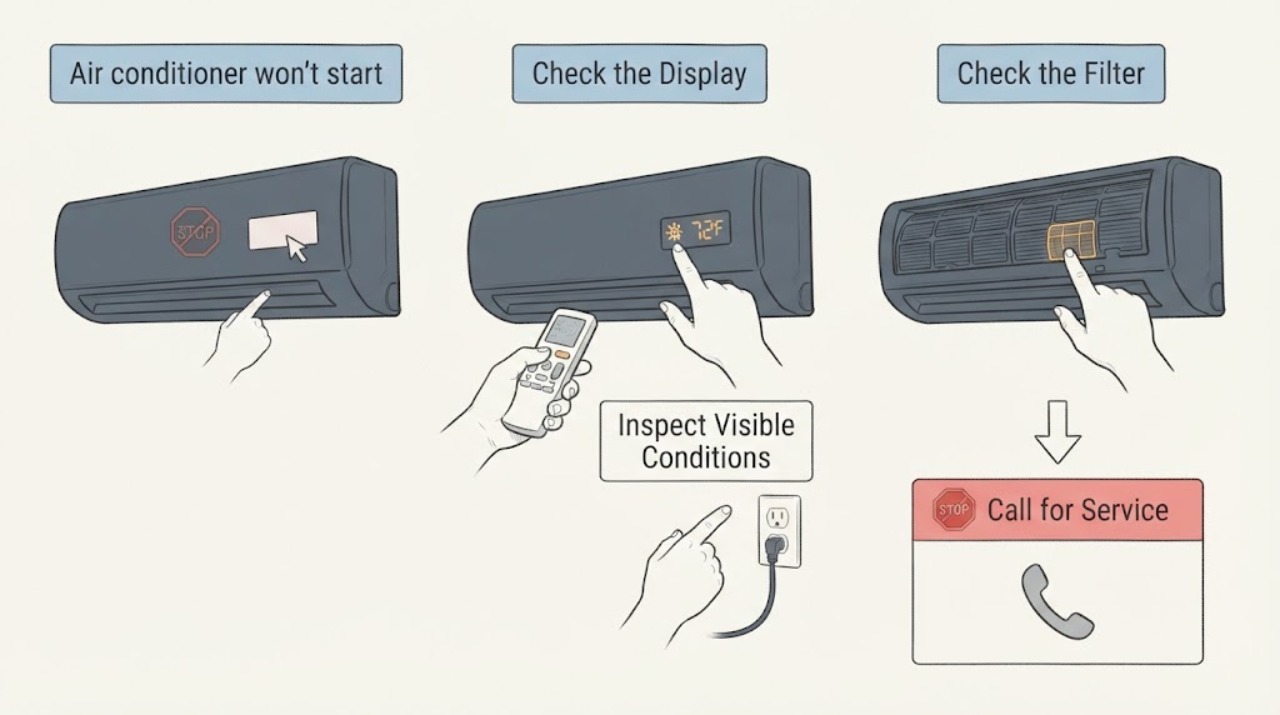
Work through in order
Diagnostic checks
Use only checks that match the exact appliance or system and its official guide.
-
Check 1
At the thermostat, select Cool, set the target below the current room temperature, check the fan setting, and verify that a programmed schedule or hold is not preventing a cooling call; note whether the thermostat display is blank.
Expected result: The thermostat was off, not in Cool, set above the room temperature, overridden by a schedule, or blank; alternatively, it calls for cooling but the equipment stays silent.
Next step: Correct only the visible setting or replace thermostat batteries when the model uses them, then observe one start attempt. If the display remains blank or the call is ignored, continue with the power observation and arrange service if needed.
Why this matters
Why: An incorrect setting can prevent a cooling call, while a blank display can indicate lost thermostat power or dead batteries. A live cooling call with no equipment response points beyond a simple setting.
-
Check 2
Look at the electrical panel and any clearly labeled indoor or outdoor HVAC disconnect from a dry, safe position; check whether an HVAC breaker or switch is visibly off or in a middle position, but do not remove covers or repeatedly reset a tripped device.
Expected result: A breaker or disconnect is visibly off, it trips again after a reset, or every visible power control appears on but the system remains inactive.
Next step: If a device trips again, leave it off and call a qualified HVAC professional or electrician. If power appears normal, continue to the filter and condensate checks without opening the equipment.
Why this matters
Why: A power interruption can keep an air conditioner from starting. A repeat trip indicates an electrical or equipment fault, not permission to keep resetting the circuit; an apparently powered system may have a control or component failure.
-
Check 3
With the system off, inspect the accessible air filter and replace it only with the size and type specified by the equipment documentation if it is visibly dirty, collapsed, wet, or blocked.
Expected result: The filter is clogged or damaged and airflow improves on a later start attempt, or the filter is clean and correctly fitted but the air conditioner still will not start.
Next step: Secure the replacement and make one brief start attempt. If the system remains off or freezes again, stop using it and request service rather than installing a more restrictive filter as a guess.
Why this matters
Why: A dirty filter can restrict airflow, make the system work harder, freeze the evaporator coil, and contribute to shutdown. A clean filter makes a filter restriction less likely and shifts attention to power, drainage, or internal components.
-
Check 4
Look for standing water around the indoor unit, a full drain pan, or an accessible condensate drain that is visibly blocked; do not pour chemicals into the line or dismantle the drain assembly.
Expected result: Water is present, the drain is visibly blocked, or the area is dry and the unit still does not respond to a cooling call.
Next step: Turn cooling off and arrange HVAC service for water or a suspected blocked drain, especially if water is near electrical parts. If dry, continue with the fan and ice observations.
Why this matters
Why: A plugged condensate drain can cause water damage and can activate a safety switch on some systems, preventing operation. A dry area does not rule out a control, blower, or other fault.
-
Check 5
During one cooling call, observe the indoor airflow and the outdoor condenser fan from a safe distance; do not reach through a grille, remove a panel, or touch a humming unit.
Expected result: The indoor blower is silent, the outdoor fan does not spin, the unit only hums, or loud/unusual noise occurs; alternatively, both fans operate normally but the compressor or cooling cycle does not begin.
Next step: Turn the system off and request professional service. Do not replace or discharge a capacitor, bypass a control, or probe electrical terminals.
Why this matters
Why: The indoor and outdoor fans have different roles, and a non-running fan, hum, or unusual noise can indicate a motor, capacitor, contactor, or compressor fault. These are not safe component-level DIY repairs.
-
Check 6
Inspect only for visible frost or ice on accessible refrigerant tubing or near the indoor coil area, and note whether cooling was weak, the system ran continuously, or water appeared as ice began to thaw.
Expected result: Ice or frost is visible, cooling is inadequate, or excess water appears; alternatively, there is no ice and no water around the unit.
Next step: Turn cooling off and contact a qualified HVAC professional. Do not use a heat source, open the coil cabinet, or handle refrigerant; if no ice is present, continue to the final service boundary.
Why this matters
Why: A frozen evaporator coil can result from restricted airflow or low refrigerant and can stop normal cooling. Ice is a stop-use signal; it is not a reason to scrape the coil or add refrigerant.
-
Check 7
After only an obvious setting or filter correction and with no warning signs, make one brief start attempt and record the sequence: thermostat call, indoor airflow, outdoor fan, sounds, and whether the system stays on.
Expected result: The system starts and remains normal, starts then stops, or never starts despite a valid thermostat call and apparently normal visible power.
Next step: Monitor only when operation is steady and safe. For a repeat no-start or abnormal cycle, leave the equipment off and give the technician the recorded sequence; do not keep resetting it.
Why this matters
Why: Stable operation after a simple correction supports that correction as the immediate cause. A short cycle or persistent no-start points to a safety control, motor, capacitor, refrigerant, wiring, or other fault that needs diagnosis.
Use your observations
Decision map
Find the observation that best matches what you see, then follow the next safe action.
-
PATH 01Next step
What you see
The thermostat is blank or does not call for cooling.
Do this next
Check the visible thermostat setting and model-approved batteries; if the screen remains blank or the call is ignored, arrange HVAC service without opening the thermostat wiring.
-
PATH 02Next step
What you see
An indoor or outdoor breaker/disconnect is off, or a breaker trips again.
Do this next
Do not repeatedly reset it; leave the system off and call a qualified HVAC professional or electrician for the power fault.
-
PATH 03Next step
What you see
The filter is dirty or blocked.
Do this next
Replace it with the documented filter while the system is off and make one brief test; escalate if the unit remains off or freezes again.
-
PATH 04Next step
What you see
Water is around the indoor unit or a condensate drain appears blocked.
Do this next
Turn cooling off and request HVAC service, especially when water is near electrical parts or the system has a condensate safety switch.
-
PATH 05Next step
What you see
A fan does not run, the system hums or makes unusual noise, ice is visible, or the system starts and stops abnormally.
Do this next
Stop using the air conditioner and obtain professional diagnosis; do not open equipment or work on capacitors, refrigerant, motors, compressors, or wiring.
-
PATH 06Next step
What you see
The air conditioner starts normally after one simple documented correction and no warning sign returns.
Do this next
Monitor operation and maintain the filter; arrange service if the no-start returns.
Helpful context
Understand the symptom
Determine what has actually stopped
Listen and look without touching the equipment. A thermostat with no display, an indoor blower that does not move air, and an outdoor condenser that does not start are different symptoms. If the indoor blower runs but the outdoor unit does not, the outdoor power path or a high-voltage component may be involved. If neither runs, begin with the thermostat and shared power checks.
A reset is not a repair
A single correction of an obvious setting or dirty filter may restore operation. A breaker that trips again, a code or shutdown that returns, or a system that starts and stops abnormally is evidence of an unresolved fault. Leave the system off and give the technician the sequence of events rather than repeatedly cycling power.
When checks do not resolve it
Need a professional?
Use professional service for persistent no-start symptoms, repeated shutdowns, electrical concerns, drainage safety switches, frozen coils, refrigerant diagnosis, and component-level repairs.
Common questions
FAQ
What is the first thing to check when an air conditioner will not start?
Check that the thermostat is in Cool mode, the target is below the room temperature, and the fan setting is appropriate. Then inspect the filter and visible power state. If the breaker trips again or the unit still does not respond, stop and call a professional.
Should I keep resetting the AC breaker?
No. A breaker that trips again can signal an electrical or equipment fault. Leave it off and have a qualified HVAC professional or electrician diagnose the cause rather than repeatedly restoring power.
Why does the indoor fan run but the outside AC unit does not?
The outdoor unit may have a separate power interruption, or a high-voltage component such as a capacitor, contactor, motor, or compressor may have failed. Observe without opening the unit and arrange professional service.
Can a dirty filter stop an air conditioner from starting?
Yes. A clogged filter restricts airflow and can lead to overheating or a frozen evaporator coil, which may result in shutdown. Replace a dirty filter with the documented type, but call for service if the unit remains off or freezes again.
Read the exact guide
Official sources
- AC Fan Not Working? Reasons Why It Stopped SpinningTrane · Residential split-system air conditioners
- AC Unit Not Turning On: Reasons Why And What To DoCarrier · Residential air-conditioning systems
- AC Not Turning OnTrane · Residential central air-conditioning systems
- Maintenance ChecklistENERGY STAR · Central air conditioners, furnaces, and heat pumps
- Troubleshoot an Air Conditioner: 6 Steps to Fix an AC Not WorkingCarrier · Residential split-system air conditioners
Community feedback
Share a repair observation
Share a plain-text repair observation. Accepted observations are published automatically; this page may take a moment to update.