
On this page
Start here
Quick answer
If an air conditioner will not start, first determine whether the thermostat is actually calling for cooling, whether the indoor blower moves air, and whether the outdoor unit responds. Check only the thermostat settings, the user-accessible air filter, visible registers, and the breaker or disconnect from a safe dry position; do not open a cabinet, touch wiring, reach into a fan, test a capacitor, or handle refrigerant. A thermostat setting, lost power, protective-device interruption, dirty filter, frozen coil, blower motor problem, compressor or outdoor-unit fault, or control issue can all look like one no-start symptom. Stop for smoke, burning odor, arcing, hot or damaged electrical parts, water near equipment, ice, or a repeated breaker trip. Arrange qualified HVAC service when the blower, compressor, or controls need diagnosis.
Before you begin
Safety first
- Keep the system off for ice with water, smoke, arcing, burning odor, hot or damaged electrical parts, shock, refrigerant release, or repeated breaker trips. Do not open cabinets, touch wiring, reach into fans, test capacitors, measure live circuits, or handle refrigerant.
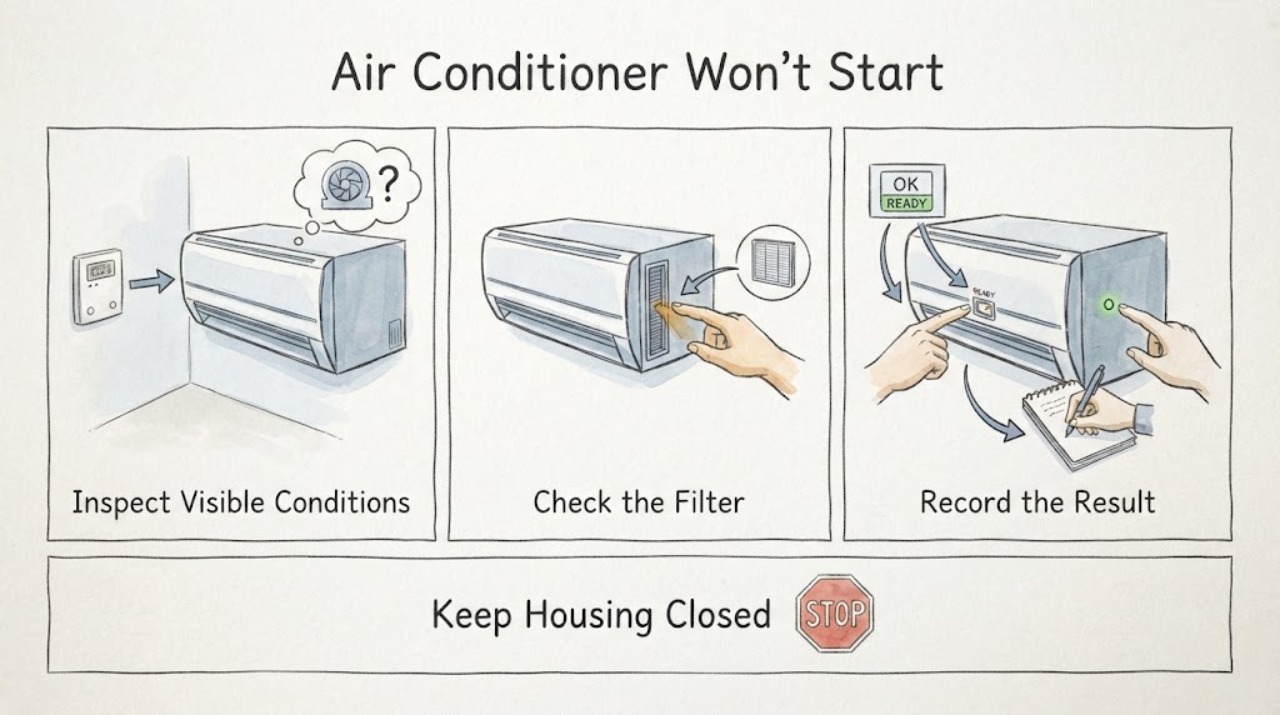
Work through in order
Diagnostic checks
Use only checks that match the exact appliance or system and its official guide.
-
Check 1
Look at the thermostat from a dry position. Record whether its display is on, Cooling is selected, the setpoint is below room temperature, the fan is set as intended, and any alert or schedule is shown. Do not remove the thermostat cover or touch its wiring.
Expected result: The display is blank, Cooling is not selected, the setpoint is not below room temperature, a schedule or alert is active, or a valid cooling call is present.
Next step: Correct only an obvious user setting and observe one normal call. If the display stays blank or the system does not respond to a valid call, leave wiring untouched and arrange HVAC or electrical service.
Why this matters
Why: A blank display or incorrect mode can prevent a start; a valid call with no response moves the issue toward power, controls, blower, or outdoor equipment.
-
Check 2
With the thermostat call ended and the equipment cabinet closed, inspect the user-accessible filter and the visible return grille and supply registers. Clean or change the filter only as the equipment instructions allow, and keep registers open and unobstructed.
Expected result: The filter is visibly loaded, the return is blocked, several registers are closed, airflow was already weak, or the filter and registers look clear.
Next step: Correct an obvious filter or register issue and make one supervised call only when there is no ice, water, odor, or electrical warning. If airflow remains absent or weak, stop and request HVAC service.
Why this matters
Why: Restricted airflow can make the system run poorly or contribute to a frozen coil, but a clear filter does not clear the blower motor, ductwork, coil, or controls.
-
Check 3
From outside a closed panel, observe the indoor supply airflow during one normal cooling call. Note whether there is no air, weak air, room-temperature air, or normal airflow; stop if a hum, harsh noise, smoke, odor, heat, or water appears.
Expected result: The indoor blower is silent with no airflow, it hums but does not move air, airflow is weak, or airflow is normal while the outdoor unit does not start.
Next step: Leave the equipment off for a silent or humming blower, abnormal sound, or safety sign and arrange qualified HVAC service. Do not reach into a fan or open the air handler.
Why this matters
Why: No or weak airflow can involve the blower motor, filter, duct path, ice, or control. Normal indoor airflow with a silent outdoor unit points toward the outdoor power, controls, compressor, fan, or related start path.
-
Check 4
From a safe dry position, inspect the visible breaker handle or disconnect face for an obvious off or middle position, heat, water, cracking, or discoloration. Record whether other home circuits work; do not remove a cover, touch terminals, or use a meter.
Expected result: The air-conditioner breaker or disconnect appears interrupted, the whole home or several circuits are out, the device is hot or damaged, or the power indicators look normal.
Next step: Do not repeatedly reset a breaker or handle. Keep the system off and contact a qualified HVAC or electrician; contact the utility if the home or area has lost power.
Why this matters
Why: An interruption can explain a no-start condition, but heat or damage is a safety fault. A normal-looking handle does not prove that the equipment has a safe supply.
-
Check 5
Look from a safe distance for frost or ice on visible tubing, excess water near the indoor unit, or water in a condensate area. If ice is present, end the cooling call and leave the system off for natural thaw; do not chip ice or apply heat.
Expected result: Ice is visible, water is pooling or draining abnormally, both are absent, or the system becomes wet during thaw.
Next step: Keep cooling off and arrange HVAC service to identify airflow, drain, coil, and refrigerant causes. Keep electrical items away from water and do not open the equipment.
Why this matters
Why: A frozen coil can restrict airflow and can be associated with a dirty filter or low refrigerant; abnormal water can indicate condensate or thawing trouble. Absence of visible ice does not rule out an internal problem.
-
Check 6
During one ordinary call, observe the outdoor unit from well clear of the fan and grille. Record whether it is silent, clicks and stops, hums, starts the fan, or runs normally while the indoor air remains warm; do not touch the cabinet or try to start the fan.
Expected result: The outdoor unit never responds, starts and stops rapidly, hums without normal operation, or runs while the indoor air is not cooling.
Next step: Leave the system off and arrange qualified HVAC service. Do not open the disconnect, test a capacitor, reach through the grille, or handle refrigerant.
Why this matters
Why: The outdoor section includes the compressor, condenser fan, and controls. A no-start or rapid-cycle pattern can need electrical, capacitor, compressor, control, or refrigerant diagnosis.
-
Check 7
Prepare a service record with the thermostat display and setting, indoor airflow, filter condition, visible ice or water, breaker or disconnect position, outdoor response, sounds, odors, and whether the system stopped after a storm, cleaning, power event, or maintenance visit.
Expected result: The no-start pattern follows a setting or power event, is limited to the blower, is limited to the outdoor unit, or affects both sections.
Next step: Leave the affected system off for a returning fault and request qualified HVAC service. Report any hazardous sign immediately rather than making another start attempt.
Why this matters
Why: The pattern helps a technician focus on thermostat and control, blower motor, compressor or outdoor-unit, or shared power paths without unsafe homeowner testing.
Use your observations
Decision map
Find the observation that best matches what you see, then follow the next safe action.
-
PATH 01Next step
What you see
The thermostat display is blank or does not show a cooling call.
Do this next
Check only the user settings and visible home power status. Leave thermostat wiring untouched and arrange HVAC or electrical service if the display remains blank.
Why this path and its safety boundary
Why it matters: The system may have lost thermostat power, have a setting or schedule issue, or have a control fault before the blower and compressor are commanded.
-
PATH 02Next step
What you see
A valid cooling call is present but the indoor blower is silent or only hums.
Do this next
Turn the call off and arrange qualified HVAC service. Do not reach into the blower, open the air handler, or test a capacitor.
Why this path and its safety boundary
Why it matters: The blower motor, control, power path, filter or ice condition may be involved; the motor cannot be safely confirmed from outside.
-
PATH 03Next step
What you see
Indoor airflow is normal but the outdoor unit is silent, clicks and stops, or hums.
Do this next
Leave the system off and request HVAC diagnosis. Do not touch the fan, open the disconnect or cabinet, test a capacitor, or repeat start attempts.
Why this path and its safety boundary
Why it matters: Power, controls, the condenser fan, compressor, capacitor, or another outdoor-unit fault may prevent a complete start.
-
PATH 04Next step
What you see
A breaker or disconnect is off or between positions, or it trips again after the system is started.
Do this next
Do not repeatedly reset it. Leave the system off and call a qualified HVAC technician or electrician; use emergency help for smoke, arcing, burning odor, or hot electrical parts.
Why this path and its safety boundary
Why it matters: A power interruption, overload, short, equipment fault, or wiring problem may be present.
-
PATH 05Next step
What you see
Ice is visible, airflow is falling, or water appears around the indoor unit.
Do this next
Turn cooling off and allow natural thaw. Keep the equipment closed and arrange HVAC service to identify the cause before resuming cooling.
Why this path and its safety boundary
Why it matters: A frozen evaporator coil, restricted airflow, low refrigerant, or condensate issue may be stopping safe operation.
-
PATH 06Next step
What you see
The indoor blower and outdoor unit both run normally, but the house remains warm or the system cycles rapidly.
Do this next
Stop changing settings and request qualified HVAC service. Do not handle refrigerant or open either unit to find the cause.
Why this path and its safety boundary
Why it matters: Thermostat control, refrigerant charge or leak, coil condition, ductwork, compressor performance, or another system fault may need professional measurement.
-
PATH 07Next step
What you see
Smoke, arcing, burning odor, a hot or damaged electrical part, water near equipment, or a shock occurs.
Do this next
Stop immediately, keep clear, do not operate the equipment or reset power, and obtain emergency, electrical, or HVAC help as appropriate.
Why this path and its safety boundary
Why it matters: The no-start symptom is accompanied by a fire, shock, moisture, or equipment hazard.
Helpful context
Understand the symptom
First separate the three start questions
“Won't start” can mean the thermostat display is blank, the thermostat calls but the indoor blower does not move air, or the blower runs while the outdoor unit is silent. It can also mean the system starts and stops quickly rather than completing a normal cycle. Record the thermostat display, mode, setpoint, indoor airflow, outdoor-unit sound, and breaker position before changing anything. These observations distinguish a control or power path from a blower motor or compressor-side path.
Use only low-risk exterior checks
A homeowner can verify a cooling call, inspect an accessible filter, look at open registers, and observe the outdoor unit from a safe distance. The blower motor, compressor, capacitor, wiring, refrigerant circuit, and internal controls require trained service. ENERGY STAR lists voltage and current measurements, control checks, condensate inspection, blower adjustment, and refrigerant checks as contractor maintenance tasks, not casual live testing.
Power loss and a mechanical fault can look alike
If no air comes from the registers and the home is warm, Carrier advises looking for a fuse or tripped breaker, while noting that the outdoor unit may have its own disconnect or circuit breaker. If a breaker trips again, stop and arrange professional service. A silent outdoor unit, a blower that hums without airflow, or rapid cycling can indicate a motor, compressor, capacitor, control, or refrigerant problem that cannot be confirmed from the outside.
Ice changes the next step
Frost or ice on visible refrigerant tubing or around the indoor unit is not a reason to keep trying the start command. Carrier links a frozen evaporator coil with inadequate cooling, restricted airflow, dirty filters, and low refrigerant, and recommends shutting the system down and obtaining professional help. Allow natural thaw only; do not chip ice, apply a heater, or open the equipment cabinet.
Safety boundary
Stop conditions
- Stop immediately for smoke, flame, arcing, burning odor, a hot or discolored disconnect, breaker, plug, or wiring, a shock, or a repeated breaker trip. Keep clear and obtain qualified or emergency help.
- Stop for visible ice, water near the air handler or electrical equipment, a full condensate area, or falling airflow. Turn cooling off, allow natural thaw only, and arrange HVAC diagnosis.
- Do not open the indoor or outdoor cabinet, reach into a fan, test or discharge a capacitor, measure voltage, handle refrigerant, loosen sealed connections, or use an extension lead as a workaround.
- Stop after the thermostat, filter, visible airflow, and safe outdoor observation do not restore a normal start. Leave the equipment off and have a qualified HVAC professional diagnose the blower motor, compressor, thermostat, controls, and power path.
Only after diagnosis
Potential parts
- thermostat
Consider this only after a qualified diagnosis confirms a failed or incompatible thermostat rather than a setting, power, wiring, or equipment fault.
Thermostat compatibility depends on system type, control wiring, and equipment configuration. Have the technician identify the correct device. - blower motor or blower control
Consider this only when qualified testing confirms that the indoor blower motor or its control is not operating after thermostat demand and power are verified.
Motor and control details vary by air handler and furnace. Do not select a part from a hum or no-air symptom alone. - compressor or outdoor start component
Consider this only after a qualified HVAC diagnosis distinguishes compressor, capacitor, fan, control, wiring, or refrigerant causes of an outdoor no-start.
Outdoor components require system-specific identification and professional installation; do not order by appearance or symptom.
When checks do not resolve it
Need a professional?
Call HVAC service for a no-start condition that persists after an obvious thermostat setting and accessible filter check, for no indoor blower, a silent or humming outdoor unit, rapid cycling, ice, water, or suspected compressor, blower motor, thermostat, control, capacitor, or refrigerant fault. Call an electrician for a supply or breaker issue.
Safety scope: Keep the system off for ice with water, smoke, arcing, burning odor, hot or damaged electrical parts, shock, refrigerant release, or repeated breaker trips. Do not open cabinets, touch wiring, reach into fans, test capacitors, measure live circuits, or handle refrigerant.
Common questions
FAQ
What should I check first when my air conditioner will not start?
Confirm Cooling mode and a setpoint below room temperature, then note whether the thermostat display, indoor blower, and outdoor unit respond. Inspect only the accessible filter and visible registers. Leave wiring and equipment covers closed.
Why does the blower run but the outdoor unit does not?
The outdoor power or control path, condenser fan, compressor, capacitor, or refrigerant-related protection may be involved. Observe from a safe distance, then leave the system off and request qualified HVAC diagnosis; do not open the outdoor unit or test a capacitor.
Can a dirty filter prevent an air conditioner from starting?
A dirty filter can reduce airflow and contribute to poor cooling or a frozen coil, and the resulting protection or system fault can look like a no-start. Change or clean only an accessible filter as the equipment instructions allow; persistent no-air or ice needs service.
Should I reset the breaker if the air conditioner will not start?
Do not repeatedly reset it. If the breaker or disconnect is hot, damaged, wet, or trips again, leave the system off and call a qualified electrician or HVAC technician. A protective interruption needs a cause diagnosed before normal operation resumes.
What does ice mean when the air conditioner will not start?
Ice can accompany restricted airflow or low refrigerant and can reduce cooling. Turn cooling off and allow natural thaw; do not chip ice or apply heat. Have HVAC service identify the cause before restarting normal cooling.
Read the exact guide
Official sources
- Troubleshooting an AC Not WorkingCarrier · Carrier homeowner guidance used for general symptom categories; exact equipment procedures vary by model.
- Maintenance ChecklistENERGY STAR · General residential checklist; model manuals and qualified service determine access and repair procedure.
Community feedback
Share a repair observation
Share a plain-text repair observation. Accepted observations are published automatically; this page may take a moment to update.