
On this page
Start here
Quick answer
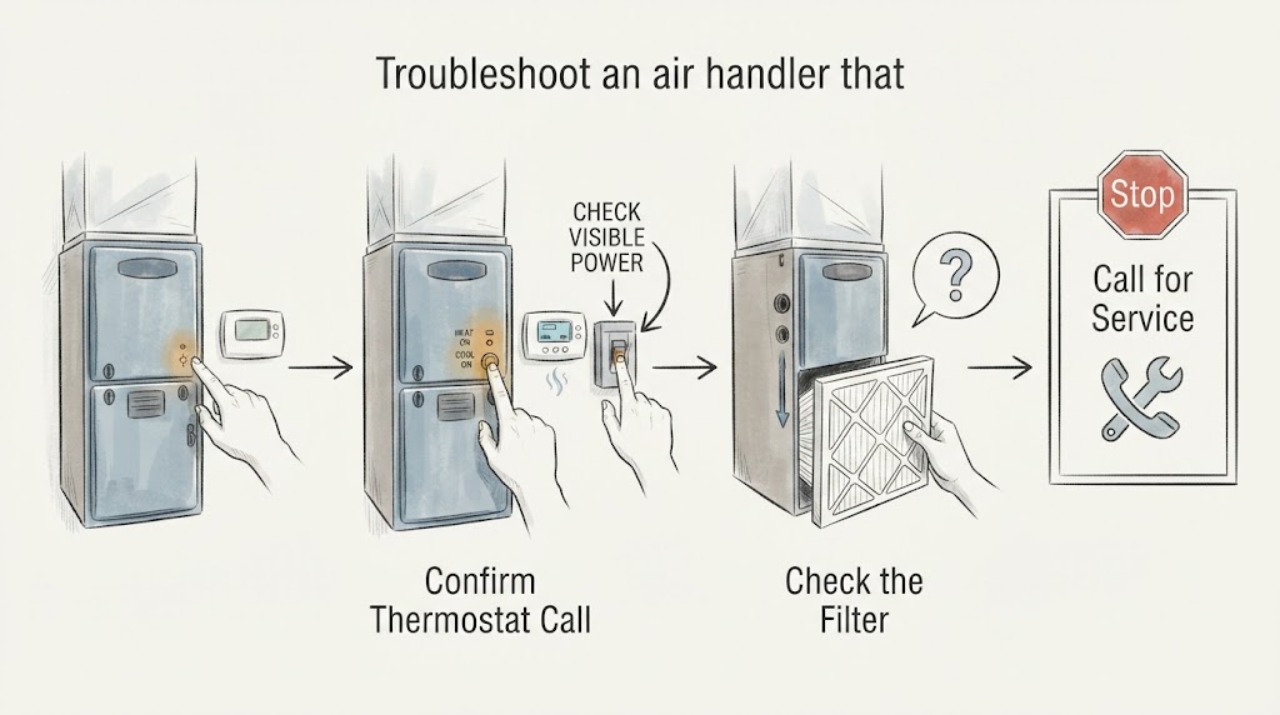
Start with the thermostat: confirm it is calling for heat or cooling, the fan is set to On or Auto, and any thermostat batteries are usable. Then inspect the accessible filter and check that the nearby service switch is On, but do not open the air handler or reset a tripped breaker just to make it run. A dirty filter, frozen coil, failed blower component, control fault, or wiring problem can stop the unit; if the breaker is tripped, the blower is silent, the motor has overheated, or you see frost or water, leave the system off and call a qualified HVAC technician.
Work through in order
Diagnostic checks
Use only checks that match the exact appliance or system and its official guide.
-
Check 1
At the thermostat, select the intended Heat or Cool mode, set the target beyond the current room temperature, and set the fan to On or Auto. If the thermostat uses batteries, replace them only according to its instructions.
Expected result: The thermostat display is active and the air handler starts, or the display remains blank and the air handler remains silent.
Next step: If the unit starts, monitor a normal cycle. If it does not, continue with the visible power and filter checks without opening equipment.
Stop if: Stop for a blank display with signs of damaged wiring, a burning odor, or any need to remove the thermostat or air-handler cover.
Why this matters
Why: A mode, set-point, fan, or battery issue can prevent a call for operation; a blank display or no response after correct settings shifts the problem toward power or controls.
-
Check 2
Look for the accessible service switch near the air handler and confirm it is in the On position. Look at the electrical panel for a visibly tripped HVAC breaker, but do not remove the panel cover and do not flip a tripped breaker back on as a troubleshooting experiment.
Expected result: The service switch is Off, the breaker is tripped, or both appear On with no sound or airflow from the air handler.
Next step: If the switch was Off, return it to On only if the area is dry and there are no hazard signs, then make one thermostat call. If the breaker is tripped or the unit remains silent, leave it alone and call HVAC service.
Stop if: Stop for repeated trips, smoke, burning smell, water near electrical equipment, damaged conductors, or any request to test live terminals.
Why this matters
Why: An Off switch can interrupt the unit; a tripped breaker may signal an air-handler fault, and restoring power without resolving it can damage the system.
-
Check 3
Using the owner's guide, inspect the accessible air filter without opening a service panel. If it is visibly clogged, replace it with the type specified for the system; do not run the air handler without a required filter.
Expected result: The filter is heavily loaded, wet, or otherwise damaged, or it is clean and dry.
Next step: After a safe replacement, make one call for operation. If there is no start, weak airflow, frost, water, or unusual noise, turn the system off and arrange service.
Stop if: Stop for a wet filter, standing water, visible ice, an inaccessible filter, or any need to reach into the blower or remove an access panel.
Why this matters
Why: A clogged filter can restrict airflow, overheat the unit, and contribute to a shutdown. A wet filter or a clean filter with no start points toward a condensate, coil, motor, power, or control issue.
-
Check 4
From outside the cabinet, look for frost on accessible coil or line surfaces, water dripping below the air handler, and a blower that is silent or making abnormal noise. Do not scrape ice, pour water into the unit, or remove the coil/blower panel.
Expected result: Frost or water is present, or the unit is dry with no unusual noise.
Next step: If frost or water is present, turn the thermostat Off and call for diagnosis. If no visible hazard is present, continue only to the outdoor-unit comparison.
Stop if: Stop immediately for frost, standing water near electrical components, smoke, a hot cabinet, burning odor, or an unusual electrical/mechanical noise.
Why this matters
Why: A frozen coil can prevent normal airflow and can be linked to restricted airflow or a refrigerant problem; water can accompany the freeze or a drainage fault. A silent or overheated blower is an internal repair issue.
-
Check 5
During a valid thermostat call, observe the outdoor condenser or heat-pump unit from a safe distance. Do not remove its panels, touch the fan or capacitor, or change the disconnect.
Expected result: The outdoor unit runs while the air handler is silent, neither unit runs, or the outdoor unit makes an unusual sound.
Next step: Record what you observed and turn the system Off if it is not operating normally. Give those details to a qualified HVAC technician.
Stop if: Stop for exposed wiring, a burning smell, smoke, a seized fan, refrigerant/oil residue, or any need to open the outdoor unit.
Why this matters
Why: Indoor and outdoor equipment work together; an outdoor unit running without an indoor blower narrows the symptom toward the air handler's power, filter, motor, control, or coil. An unusual outdoor sound or a fully inactive system needs professional diagnosis.
Use your observations
Decision map
Find the observation that best matches what you see, then follow the next safe action.
-
PATH 01Next step
What you see
The thermostat was in the wrong mode, had an unsuitable set point, had the fan setting changed, or had depleted batteries.
Do this next
Correct the setting or battery condition according to the thermostat instructions.
-
PATH 02Next step
What you see
The accessible service switch near the air handler is Off and no hazard signs are present.
Do this next
Return the switch to On and make one thermostat call.
-
PATH 03Safety boundary
What you see
The air-handler breaker is visibly tripped.
Do this next
Do not flip it back on; leave it alone and arrange HVAC repair.
Why this path and its safety boundary
Safety stop: True
-
PATH 04Next step
What you see
The accessible filter is clogged and the unit shows no ice, water, odor, or electrical damage.
Do this next
Replace the filter with the system-specified type and make one controlled thermostat call.
-
PATH 05Safety boundary
What you see
Frost is visible on the air handler or line, or water is dripping below the unit.
Do this next
Turn the thermostat Off and stop operating the system.
Why this path and its safety boundary
Safety stop: True
-
PATH 06Safety boundary
What you see
Settings, visible power, and filter checks are normal but the air handler remains silent, or the blower motor is noisy, overheated, or failed.
Do this next
Stop homeowner troubleshooting and do not open the cabinet.
Why this path and its safety boundary
Safety stop: True
Helpful context
Understand the symptom
Define “won't start” before opening anything
An air handler may be completely silent, may have a thermostat that is not calling, or may have an outdoor unit running while the indoor blower does not. Those are different clues. Start with settings and visible conditions; the control board, relay, capacitor, blower motor, and internal wiring are technician-level components.
A filter can be a shutdown clue
A clogged filter restricts airflow and can make the air handler overheat or shut down as a safety measure. Replacing an accessible dirty filter is a reasonable homeowner check, but it does not establish that the motor, capacitor, coil, or control system is healthy. If the new filter does not restore operation, stop escalating the test.
Treat frost, water, and repeat trips as stop signs
Frost on the cabinet or refrigerant line, water below the unit, a motor that has overheated, or a breaker that has tripped can indicate a fault that will worsen if the system is forced to run. Do not remove access panels, test live terminals, replace a capacitor, or repeatedly restore power to an unresponsive air handler.
When checks do not resolve it
Need a professional?
The air handler remains silent after the thermostat, service-switch, and filter checks., The breaker is tripped, trips again, or the unit has a burning odor or damaged wiring., Frost, water, blower overheating, unusual noise, or an outdoor-unit/indoor-unit mismatch is present., Diagnosis would require opening panels or testing a relay, capacitor, motor, control board, or refrigerant circuit.
Common questions
FAQ
Why won't my air handler start even though the thermostat is on?
Check that the thermostat is actually calling for heat or cooling and that the fan is set to On or Auto. Then inspect the accessible filter and service switch. If the breaker is tripped or the unit remains silent, the cause may be internal power, controls, wiring, capacitor, motor, or coil trouble that needs professional diagnosis.
Should I reset the air-handler breaker?
Do not reset a tripped breaker as a test. A trip may indicate an air-handler fault, and restoring power without resolving it can damage the system. Leave it alone and call HVAC service.
Can a dirty filter keep an air handler from starting?
Yes. A clogged filter can restrict airflow, cause overheating, and make the unit shut down as a safety measure. Replace an accessible dirty filter with the specified type, but call for service if the unit does not restart or if frost, water, or noise is present.
What does it mean if the outdoor unit runs but the air handler does not?
The two units work together, so an operating outdoor unit with a silent indoor air handler points toward the air handler's power, filter, blower, controls, wiring, or frozen-coil condition. Turn the system off if the indoor unit will not run and arrange professional diagnosis.
What should I do if the air handler has frost or dripping water?
Turn the thermostat Off and stop operating the system. Frost can be associated with restricted airflow or a refrigerant problem, and water can accompany a frozen coil or drainage fault. Have a qualified HVAC technician find the cause rather than scraping the ice or opening the unit.
Read the exact guide
Official sources
- Air Handler Fan Not Working? Read ThisTrane · Filter, thermostat, power, controls, wiring, capacitor, blower, and frozen-coil boundaries
- Air Handler Not Working But Outside Unit IsTrane · Indoor/outdoor symptom comparison, filter shutdown, frozen coil, blower, capacitor, and control board service boundaries
- Air Handler Not Turning On? Find Out WhyTrane · Thermostat, service switch, breaker, filter, and professional air-handler diagnosis
Community feedback
Share a repair observation
Share a plain-text repair observation. Accepted observations are published automatically; this page may take a moment to update.