
On this page
Start here
Quick answer
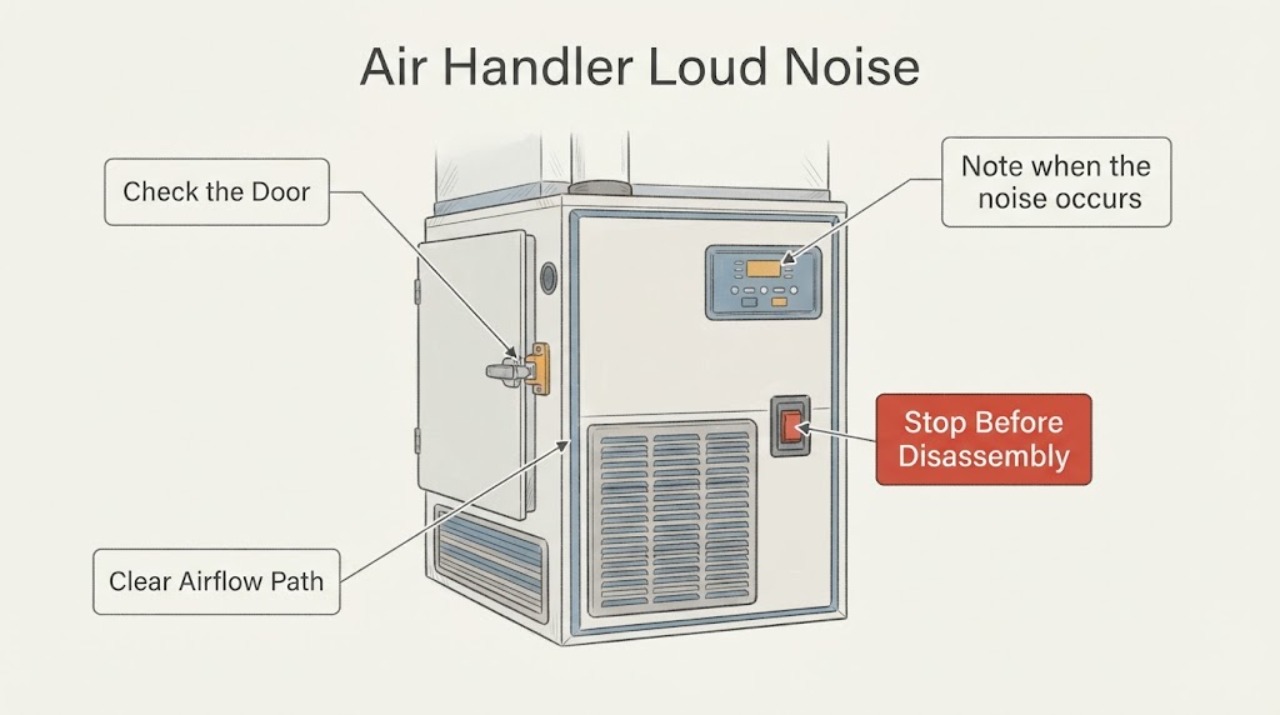
A loud air-handler noise is not enough to prove a contactor is failing. First identify whether the sound comes from the indoor air handler, ductwork, registers, or the outdoor unit, and whether it occurs at startup, shutdown, or continuously. From a safe exterior position, check the accessible filter, blocked grilles, visible cabinet movement, and any ice, water, heat, odor, smoke, arcing, or unusual vibration. A contactor, control board, motor, capacitor, and internal wiring require HVAC diagnosis; do not open the cabinet or electrical panel, touch a relay or contactor, test voltage, or keep running a unit that buzzes with heat, smoke, burning odor, or arcing.
Work through in order
Diagnostic checks
Use only checks that match the exact appliance or system and its official guide.
-
Check 1
From a safe position, identify where the loudest sound originates: the indoor air-handler cabinet, a nearby duct/register, the thermostat or wall area, or the outdoor unit. Do not remove a panel or place hands near a grille.
Expected result: Record the apparent source and whether the noise is a click, buzz, hum, rattle, grinding, squeal, bang, or vibration. Note whether airflow changes when the sound occurs.
Next step: Continue only with the branch matching the safe location; do not assume the named contactor is at the point where the sound seems loudest.
Why this matters
Why: An indoor-cabinet sound keeps the blower, fan, cabinet, control, or contactor path in consideration. A duct or register sound may be airflow or expansion, while an outdoor sound may be a separate condenser control or motor issue.
-
Check 2
Note when the noise occurs during one normal operating opportunity: as the fan or system starts, while it runs, when it stops, or when a mode changes. Do not repeatedly cycle the thermostat to reproduce the sound.
Expected result: Record a single start click, a continuous buzz, a sound that follows blower speed, a stop-time knock, or a noise that continues when the system should be idle. Note whether cooling or heating output changes.
Next step: Give the timing and mode to the technician. If the sound is continuous, worsening, or accompanied by heat, odor, smoke, or arcing, stop the system and follow the stop conditions.
Why this matters
Why: Timing helps separate a normal relay event or duct response from a persistent electrical, motor, or mechanical symptom. A new or worsening sound is more significant than a long-standing normal operating sound.
-
Check 3
Inspect the user-accessible air filter and visible supply/return grilles. Replace a filter only at the documented access point with the model-specified size and airflow direction; do not remove an air-handler cabinet cover.
Expected result: Record a clogged or collapsed filter, blocked return, closed register, or normal airflow path. Note whether the noise changes with airflow without deliberately running an unsafe test.
Next step: Correct only an obvious accessible filter or grille issue. If loud noise persists, continue with external observations and schedule HVAC service.
Why this matters
Why: Restricted airflow can strain the air handler and make noise or weak output more likely. A clean filter does not rule out a contactor, motor, control, bearing, or cabinet problem.
-
Check 4
Look from outside the unit for visible cabinet shaking, loose trim, unusual vibration, condensate leakage, ice, or objects contacting the housing. Do not press the cabinet, remove fasteners, or reach inside.
Expected result: Record stable operation, visible panel movement, strong vibration, water or rust near the pan, or ice on accessible surfaces. Note whether airflow is weak or uneven.
Next step: If vibration is severe, water is present, or ice is visible, switch the system off using the normal control when safe and arrange HVAC service. Do not open the unit.
Why this matters
Why: A loose cabinet, fan or motor issue, drainage problem, blocked airflow, or frozen coil can accompany noise. These observations narrow the service report but cannot establish a contactor defect.
-
Check 5
Check the visible HVAC breaker or clearly labeled indoor service switch from a dry, safe position without removing an electrical-panel or equipment cover. Do not touch a hot, wet, damaged, or buzzing installation.
Expected result: Record on, off, or tripped-looking status and whether the noise is associated with a recent outage or breaker event. Note any heat, discoloration, smell, smoke, arcing, or repeat trip.
Next step: Only if dry and free of warning signs, follow the system instructions for no more than one normal user reset. If it trips again or the noise returns, leave it off and call HVAC/electrical service.
Why this matters
Why: A power interruption can stop or change air-handler operation, but a normal-looking breaker does not prove the contactor or control is safe. A repeated trip is an unresolved electrical fault.
-
Check 6
From a safe distance, record whether the sound is accompanied by a burning or metallic odor, unusual warmth, smoke, spark, visible electrical damage, or a change in airflow or temperature. Do not move closer to identify an electrical source.
Expected result: Separate a sound-only symptom from a sound with heat, odor, smoke, arcing, shock, or severe vibration. Record the first time the combined symptom appeared.
Next step: For any warning sign, stop using the system and arrange qualified service. Do not reset, open the panel, or attempt to inspect the contactor.
Why this matters
Why: Noise combined with heat, odor, smoke, or arcing changes the problem from routine observation to a safety stop. A sound-only symptom still needs service if it is new, loud, or persistent.
-
Check 7
Prepare a service note with the sound type, apparent location, operating stage, filter and grille condition, visible vibration or water, breaker/switch status, airflow change, timing, and any odor or heat.
Expected result: A detailed record lets the technician compare an indoor air-handler symptom with an outdoor contactor, blower, motor, cabinet, duct, or electrical symptom without repeated homeowner tests.
Next step: Request HVAC service and keep the system off when a safety warning, severe vibration, water, or persistent electrical noise is present.
Why this matters
Why: If the noise remains after safe filter and external checks, the next useful step is professional diagnosis of the contactor, controls, blower, fan, cabinet, and electrical supply.
Use your observations
Decision map
Find the observation that best matches what you see, then follow the next safe action.
-
PATH 01Safety boundary
What you see
Do this next
Record it and monitor without repeated cycling. If the sound becomes louder, longer, or different from the established normal pattern, schedule HVAC service.
Why this path and its safety boundary
Safety stop: Continue with the location, timing, filter, vibration, and power observations.
-
PATH 02Safety boundary
What you see
Do this next
Report an indoor air-handler symptom involving possible filter, blower, fan, cabinet, control, coil, or contactor-related operation. Do not select or replace a component from the sound alone.
Why this path and its safety boundary
Safety stop: If airflow is normal, use sound location and timing to separate cabinet/duct noise from an electrical control symptom.
-
PATH 03Safety boundary
What you see
Do this next
Correct only the accessible filter or external obstruction as documented. If the noise or weak airflow persists, arrange HVAC service for internal airflow and motor diagnosis.
Why this path and its safety boundary
Safety stop: A clean external airflow path does not rule out internal mechanical or electrical faults; continue only with safe observations.
-
PATH 04Safety boundary
What you see
Do this next
Perform no more than one normal user reset only when dry and free of warning signs. If it trips again or the noise persists, leave it off and obtain qualified HVAC/electrical service.
Why this path and its safety boundary
Safety stop: Do not infer that the contactor is healthy from the visible breaker position; continue with the service note and professional diagnosis.
-
PATH 05Safety boundary
What you see
Do this next
Stop immediately. Turn the system off using the normal control only if safe, keep people away, and obtain qualified HVAC/electrical service. Do not open the cabinet, touch a contactor, or reset repeatedly.
Why this path and its safety boundary
Safety stop: If the loud noise is new or persistent after safe checks, schedule HVAC service rather than attempting internal contactor or motor work.
Helpful context
Understand the symptom
A loud sound does not identify the contactor by itself
The contactor is an electrical switching component, but homeowners often hear a sound from somewhere nearby and assign it to the wrong part. Indoor air handlers also contain a blower, fan wheel, controls, filters, coils, and drainage components; duct expansion, a loose panel, or airflow restriction can sound loud without a contactor fault. A clicking or humming sound at startup may be important, but only a technician can identify the source safely.
Treat new electrical noise as an escalation clue
A normally quiet indoor unit that suddenly becomes loud, or a unit that buzzes with heat, odor, smoke, or vibration, should not be used for repeated tests. The air handler may contain energized and moving parts even when the thermostat is off. Keep checks outside the cabinet and preserve the timing and sound pattern for HVAC service.
Safety boundary
Stop conditions
- Stop immediately for smoke, sparks, arcing, burning or metallic odor, hot/discolored equipment, shock, exposed wiring, or a breaker that trips again.
- Stop for water near electrical equipment, ice, severe vibration, a loose or damaged cabinet, or any condition that makes approaching the air handler unsafe.
- Do not open the air-handler cabinet or electrical panel, touch a contactor, relay, motor, capacitor, or wiring, test live voltage, or remove internal parts.
- Do not repeatedly cycle the system, reset a breaker, hold a noisy relay, or continue running the unit to see whether the sound changes.
When checks do not resolve it
Need a professional?
Call a qualified HVAC technician when an air handler makes a new, loud, persistent, or unexplained noise; when airflow changes; when a contactor, relay, motor, control, or internal wiring is suspected; or when the unit shows vibration, water, ice, heat, odor, smoke, arcing, or a repeated breaker trip.
Common questions
FAQ
Does a loud air-handler buzz prove the contactor is bad?
No. The sound may come from a blower, motor, loose cabinet, duct, control, fan, airflow restriction, or another component. A contactor is a professional electrical diagnosis, especially if the sound includes heat, odor, smoke, arcing, or a repeated breaker trip.
What can I safely check when the air handler is loud?
Record the location and timing, check an accessible filter and external grilles, observe visible vibration or water from a safe position, and read the visible breaker or switch status without opening covers. Do not touch the contactor, wiring, motor, capacitor, or panel.
Should I keep running an air handler that is buzzing?
Do not keep running it when the buzz is new, loud, persistent, or accompanied by heat, burning odor, smoke, arcing, severe vibration, water, ice, or a breaker trip. Turn it off using the normal control only if safe and arrange HVAC service.
Can I open the air-handler panel to look at the contactor?
No. The air handler can contain energized electrical parts, moving components, and stored electrical energy. Leave the panel, contactor, wiring, motor, and capacitor to a qualified HVAC technician and provide the sound/timing record instead.
Read the exact guide
Official sources
- Is This Normal? HVAC Smells and Sounds, ExplainedTrane · Trane residential HVAC sound timing, indoor humming, clicking, rattling, high-pitched noise, electrical warning signs, and service escalation.
- Air Handler Repair: Restoring Efficiency and ComfortCarrier · Carrier residential air-handler components, loud-noise symptoms, airflow, condensate, blower, controls, and professional repair boundaries.
- Air Handler MaintenanceTrane · Trane residential air-handler maintenance, filter, airflow, unusual noise, vibration, odor, and professional service guidance.
Community feedback
Share a repair observation
Share a plain-text repair observation. Accepted observations are published automatically; this page may take a moment to update.