
On this page
Start here
Quick answer
An air handler that is not cooling may have no cooling call, restricted airflow, a frozen coil, a condensate or protection shutdown, or a fault in the blower motor or another HVAC component. First separate no cold air with normal airflow from no airflow at all: check the thermostat, accessible filter, return and supply registers, and visible ice or water from a safe position. A blower that is silent, a frozen coil, recurring water, a tripped breaker, refrigerant concerns, or smoke, burning odor, arcing, or overheating requires the system to stay off and qualified HVAC service. Do not open the air handler, handle a capacitor, measure live voltage, or attempt refrigerant work.
Before you begin
Safety first
- This article supports thermostat, room-side airflow, accessible filter, and visible ice or water observations only. A qualified HVAC professional must handle the blower motor, capacitor, controls, energized or moving parts, coil access, compressor, and refrigerant work.
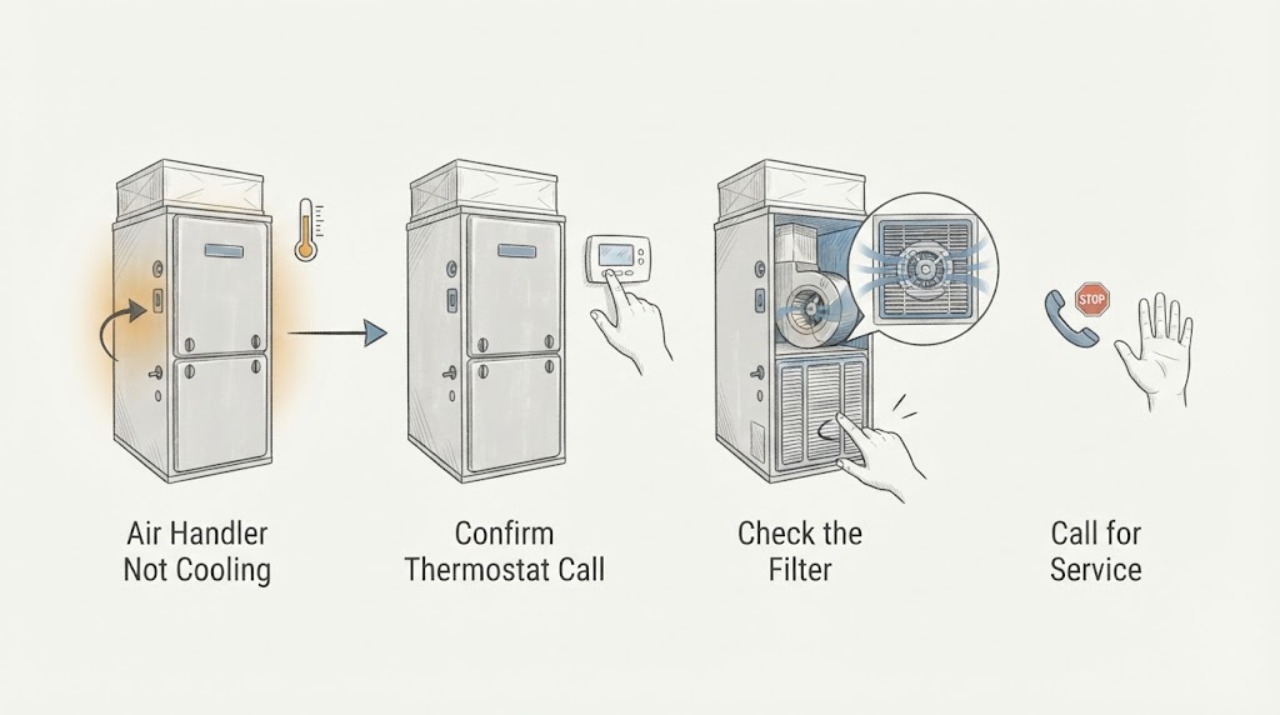
Work through in order
Diagnostic checks
Use only checks that match the exact appliance or system and its official guide.
-
Check 1
From a normal standing position, record the thermostat mode, set temperature, room temperature, fan setting, display, and any delay or fault message, then use only the ordinary setting selection allowed by the thermostat instructions.
Expected result: The thermostat is not calling for cooling, shows a delay or fault, calls for cooling while the blower is silent, or calls for cooling while air is moving but warm.
Next step: Record the exact display and response, then continue only with dry, safe filter, register, and visible-condition checks. Arrange HVAC service for a persistent call with no cooling or no airflow.
Stop if: Stop for a wet, scorched, loose, sparking, or damaged thermostat or wiring; do not remove the thermostat or touch conductors.
Why this matters
Why: A missing cooling call or incorrect fan mode can mimic an air-handler failure. A valid call with no airflow moves the check toward indoor power, controls, condensate protection, the blower motor, or a frozen coil; a valid call with airflow but warm air also requires the outdoor and refrigerant side to be assessed.
-
Check 2
If the filter is designed for ordinary access and the air-handler area is dry, inspect it for heavy dust, moisture, collapse, or incorrect seating and record its size and airflow direction without reaching into the blower compartment.
Expected result: The filter is visibly loaded or wet, the filter is clean and correctly seated, or it cannot be reached without removing an equipment panel.
Next step: Replace or clean an accessible filter only as the exact equipment instructions allow, then leave the system off if airflow or cooling remains abnormal and request HVAC service.
Stop if: Do not operate without the required filter, force it into place, remove a panel, or continue if the filter is wet or the system has an odor, smoke, heat, or electrical sound.
Why this matters
Why: A clogged filter can reduce airflow and cooling and can stress the blower motor or contribute to coil freezing. A clean filter does not rule out a blower motor, capacitor, frozen coil, power, control, or refrigerant issue.
-
Check 3
From the room side, compare several supply registers and return grilles while the system is in its normal cooling call, noting whether air is absent, weak, warm, or moving normally; clear only loose furniture or fabric that blocks a grille without touching the equipment.
Expected result: All registers have no airflow, only some rooms have weak airflow, the return is obstructed, airflow is normal but warm, or airflow pulses or stops.
Next step: Record room-by-room results and whether clearing a safe obstruction changed airflow. Request HVAC diagnosis for absent, weak, pulsing, or persistently warm airflow.
Stop if: Do not insert tools into registers, remove duct covers, alter dampers, or continue if there is smoke, burning odor, water, arcing, or abnormal heat.
Why this matters
Why: No airflow throughout the home supports an indoor blower, power, control, protection, or frozen-coil branch. A room-specific issue may involve a register, duct, damper, or zone path. Normal airflow with warm air shifts attention toward the cooling call, outdoor unit, coil, refrigerant, or compressor side.
-
Check 4
From safe external access, look for frost or ice on visible tubing or near the indoor coil cabinet, standing water, excessive condensate, a wet drain pan, or a condensate alarm; do not scrape ice, pour chemicals into a drain, or reach inside the cabinet.
Expected result: No ice or water is visible, ice is present, water or a full pan is present, or the area cannot be inspected without opening the equipment.
Next step: Turn cooling off and arrange HVAC service for visible ice, recurring water, a full pan, or an unknown internal condition; protect finishes without touching electrical equipment.
Stop if: Do not scrape or chip ice, pour water or chemical cleaner into the unit or drain, remove the pan, or operate near standing water or wet wiring.
Why this matters
Why: A frozen coil can reduce cooling and airflow and may be linked to restricted airflow, a blower problem, or refrigerant conditions. Water can indicate condensate or protection trouble. Neither symptom identifies a safe homeowner repair.
-
Check 5
From a safe distance, observe whether the indoor blower moves air and whether the outdoor unit responds during a normal cooling call; do not remove an outdoor cover, approach moving parts, or repeat a cycle that produces a harsh sound or electrical symptom.
Expected result: The indoor blower is absent, the indoor blower runs but the outdoor unit is silent, both sides respond but air is warm, or the system hums, clicks, cycles, or trips.
Next step: Record the response and timing for the HVAC technician and keep the system off for abnormal, repeated, or hazardous behavior; do not identify or replace a motor or capacitor from sound alone.
Stop if: Stop for smoke, burning odor, arcing, hot equipment, exposed moving parts, a gas symptom, water near electricity, or a protective-device trip.
Why this matters
Why: An absent indoor blower can involve the blower motor, capacitor, controls, power, or a frozen coil. Indoor airflow with a silent outdoor unit can involve the outdoor controls, contactor, compressor, disconnect, or protection. Both units running with warm air moves the issue toward airflow, coil, outdoor heat rejection, or refrigerant diagnosis.
-
Check 6
Record the exterior make and model, thermostat settings, room-side airflow, filter condition, visible ice or water, indoor and outdoor response, noise, breaker or disconnect history, and when cooling changed without opening the equipment.
Expected result: The record points to no airflow, warm airflow, filter or register restriction, ice or condensate, power or protection, or an unresolved blower and cooling fault.
Next step: Keep the system out of service when the symptom is severe, recurring, frozen, wet, electrically abnormal, or unresolved and arrange qualified HVAC service.
Stop if: Do not continue observing or restart after smoke, burning odor, arcing, abnormal heat, water near electricity, or repeated protective-device trips.
Why this matters
Why: The pattern helps a technician prioritize airflow and filter, condensate protection, blower motor, controls, coil, outdoor unit, compressor, and refrigerant checks without assuming one component from the symptom.
Use your observations
Decision map
Find the observation that best matches what you see, then follow the next safe action.
-
PATH 01Safety boundary
What you see
There is smoke, burning odor, arcing, unsafe heat, exposed wiring, water near electrical equipment, a gas symptom, or a protective device trips again.
Do this next
Turn the system off using a normal accessible control if safe, keep clear, and obtain qualified HVAC or electrical service. Use emergency response for fire, smoke, shock, or an immediate hazard.
Why this path and its safety boundary
Why it matters: This is a safety event, not an air-handler cooling diagnosis.
Safety stop: Do not touch wet or hot equipment, open panels, repeatedly reset protection, or restart to reproduce the symptom.
-
PATH 02Safety boundary
What you see
The thermostat calls for cooling but little or no air comes from the registers.
Do this next
Check only the accessible filter, registers, visible ice, and water signs, then arrange HVAC service for the blower motor, capacitor, controls, frozen coil, and electrical boundary.
Why this path and its safety boundary
Why it matters: The indoor blower, power, controls, condensate protection, filter restriction, or frozen coil is more relevant than a simple temperature-setting issue.
Safety stop: Do not open the air handler, handle a capacitor, scrape ice, or perform live testing.
-
PATH 03Safety boundary
What you see
The blower provides normal or weak airflow, but the air remains warm during a valid cooling call.
Do this next
Record outdoor response, filter and register results, ice or water signs, and timing, then request qualified HVAC diagnosis rather than adjusting refrigerant or opening equipment.
Why this path and its safety boundary
Why it matters: The issue may be thermostat/control, outdoor-unit response, coil, airflow, refrigerant, compressor, or another cooling-side fault.
Safety stop: Stop if ice, water, smoke, odor, arcing, abnormal heat, or repeated cycling appears.
-
PATH 04Safety boundary
What you see
The filter is loaded or a safe room-side obstruction is blocking return or supply airflow.
Do this next
Restore the exact filter arrangement and clear the safe obstruction; if airflow or cooling remains abnormal, keep the system off as needed and request HVAC service.
Why this path and its safety boundary
Why it matters: Restricted airflow can reduce cooling and stress the blower or coil, but it does not prove that the motor is healthy.
Safety stop: Do not operate without the filter, alter ductwork, or continue if the filter is wet or ice or water is present.
-
PATH 05Safety boundary
What you see
Visible frost or ice, excessive condensate, a full pan, or water is present near the indoor unit.
Do this next
Leave cooling off and arrange HVAC service for the coil, blower, drain, pan, protection, airflow, and refrigerant boundaries.
Why this path and its safety boundary
Why it matters: A frozen coil or condensate condition can reduce airflow and cooling and may activate protection; continued operation can worsen damage.
Safety stop: Do not scrape ice, use chemical drain cleaner, remove panels, or operate near standing water or wet electrical equipment.
-
PATH 06Safety boundary
What you see
The indoor blower and outdoor unit respond, but the home remains warm and there is no obvious filter, register, ice, water, or immediate electrical hazard.
Do this next
Stop escalating homeowner checks and provide the service record to a qualified HVAC technician; do not adjust refrigerant or open a panel.
Why this path and its safety boundary
Why it matters: Cooling capacity, outdoor heat rejection, coil condition, refrigerant, compressor, sizing, or controls may need professional evaluation.
Safety stop: Stop for a new noise, smoke, burning odor, arcing, water, abnormal heat, or repeated protective-device event.
Helpful context
Understand the symptom
No cold air and no air movement are different problems
If air is moving but feels warm, the thermostat, filter, outdoor system, refrigerant circuit, or coil may be involved. If little or no air leaves the registers, the indoor blower, power, controls, filter restriction, frozen coil, or condensate protection becomes the priority. An air handler circulates conditioned air; it does not by itself prove that the outdoor cooling side is operating.
Use only ordinary-access checks
A filter and room-side registers can often be checked without opening the equipment. A dirty filter can reduce airflow and contribute to motor or coil problems, but a clean filter does not clear the blower motor, capacitor, wiring, refrigerant, or control boundary. Keep the model and exact system instructions with the service request.
Ice, water, and electrical symptoms change the stop decision
Visible frost or ice, excessive condensate, a wet area, or a protective-device trip is not a reason to keep restarting the system. Smoke, burning odor, arcing, hot equipment, or exposed wiring requires immediate stop-use action. A qualified HVAC professional must handle the blower motor, capacitor, high-voltage parts, coil, refrigerant, and internal controls.
Safety boundary
Stop conditions
- Stop cooling operation for smoke, burning odor, arcing, unsafe heat, exposed wiring, gas symptoms, water near electrical equipment, or a repeated protective-device trip.
- Do not open the air-handler or condenser cabinet, handle a capacitor, reach toward a blower or fan, measure live voltage, bypass a safety device, or adjust refrigerant.
- Do not scrape or chip ice, pour water or chemical cleaner into the unit or drain, remove a condensate pan, or operate near standing water or wet wiring.
- Do not operate without the required filter, alter registers or ductwork as a test, or repeatedly restart a unit with no airflow, harsh cycling, or abnormal sounds.
- Do not enter an unsafe attic or crawlspace or continue checks that require moving the equipment, opening a panel, or disturbing concealed wiring or refrigerant lines.
Only after diagnosis
Potential parts
- air-handler filter
Consider this category only if an accessible filter is missing, wet, damaged, or loaded and the exact equipment instructions identify a compatible replacement.
Confirm the exact model, dimensions, airflow direction, and manufacturer requirements; do not operate without the required filter. - blower motor
Consider this category only after a qualified HVAC diagnosis confirms a blower-motor fault and the exact equipment supports replacement.
Confirm motor type, controls, electrical ratings, mounting, and manufacturer fit information with the technician before ordering. - condensate drain or protection component
Consider this category only when a qualified HVAC diagnosis confirms a drain, pan, float switch, or protection fault and identifies the exact system part.
Confirm the exact equipment, drain arrangement, safety-switch type, and approved installation procedure with a qualified professional.
When checks do not resolve it
Need a professional?
Arrange qualified HVAC service when the air handler has no airflow, airflow is weak or warm, a blower does not respond, ice or condensate returns, a filter and register check does not restore cooling, or the outdoor unit and indoor blower response do not match. Ask the technician to evaluate the blower motor, capacitor, controls, coil, condensate protection, outdoor unit, compressor, airflow, and refrigerant boundaries. Use electrical or emergency service for smoke, arcing, burning odor, hot equipment, shock, fire, water near electricity, or repeated trips.
Safety scope: This article supports thermostat, room-side airflow, accessible filter, and visible ice or water observations only. A qualified HVAC professional must handle the blower motor, capacitor, controls, energized or moving parts, coil access, compressor, and refrigerant work.
Common questions
FAQ
What is the difference between an air handler not cooling and not blowing air?
No cold air with normal airflow points toward the cooling call, outdoor unit, coil, airflow, refrigerant, or compressor side. Little or no airflow points toward the indoor blower, power, controls, protection, filter restriction, or frozen coil. A technician must confirm the cause.
Can a dirty filter make an air handler stop cooling?
Yes. A dirty filter can restrict airflow, reduce cooling, stress the blower, and contribute to coil freezing or shutdown. Replace or clean an accessible filter only as the exact equipment instructions allow; do not assume that a clean filter clears an internal fault.
Should I keep running the system to defrost or test it?
No. Turn cooling off for visible ice, water, absent airflow, smoke, burning odor, arcing, abnormal heat, or repeated cycling and arrange HVAC service. Do not scrape ice, open the air handler, adjust refrigerant, or repeatedly restart the system.
Read the exact guide
Official sources
- Air Conditioner Not Cooling | AC Not Blowing Cold AirCarrier · Carrier residential guidance on thermostat, filter, vents, frozen evaporator coils, condensate, compressor, and refrigerant service boundaries
- Air Handler Troubleshooting - Contact a Local DealerTrane · Trane residential air-handler troubleshooting for filters, frozen coils, blower motor, power, and professional service
- Air Handler Fan Not Working: Causes and SolutionsTrane · Trane air-handler filter, thermostat, power, frozen-coil, blower motor, capacitor, wiring, and repair boundaries
- AC Fan Not Working? Reasons Why It Stopped SpinningTrane · Trane distinction between indoor blower and outdoor condenser fan, thermostat, power, frozen-coil, and capacitor boundaries
Community feedback
Share a repair observation
Share a plain-text repair observation. Accepted observations are published automatically; this page may take a moment to update.