
On this page
Start here
Quick answer
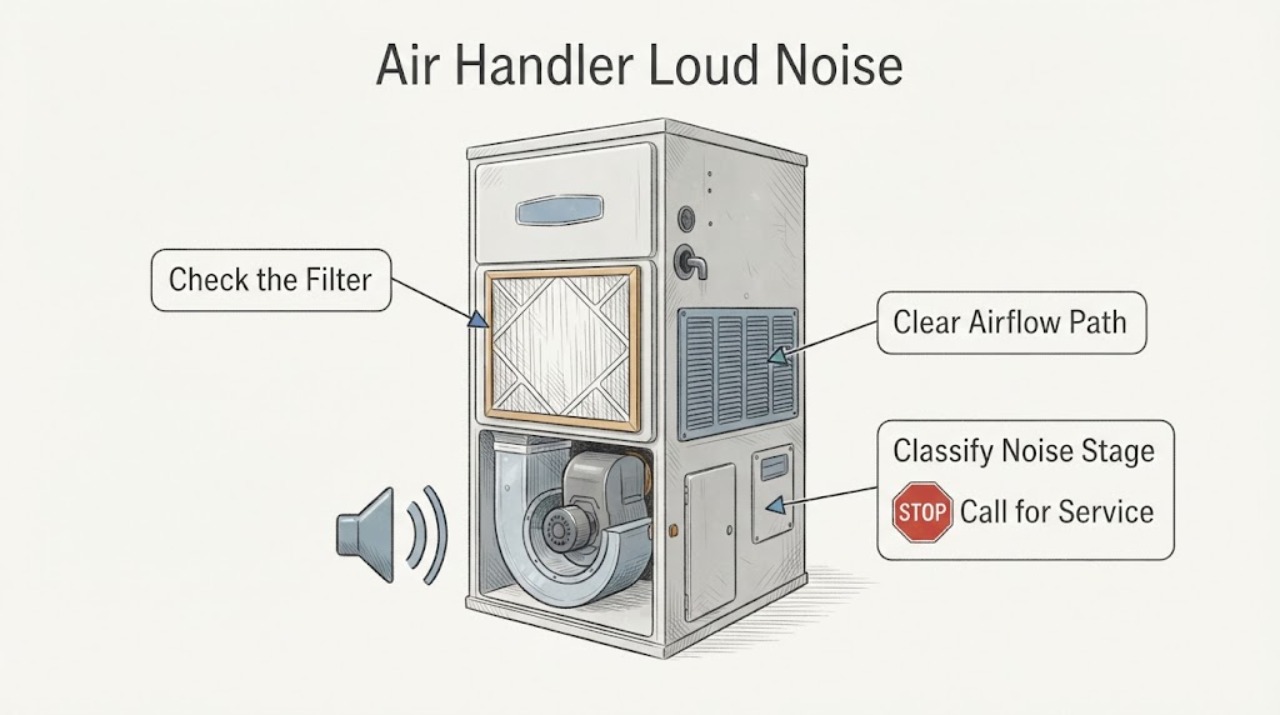
An air handler that suddenly becomes loud may have restricted airflow, a loose grille or cabinet part, a blower-wheel or fan problem, vibration, or a blower motor, capacitor, relay, or control fault. First classify the sound as a whistle, rattle, buzz, hum, grind, or vibration and note whether it occurs at startup, during airflow, or at shutdown. From ordinary safe access, inspect the filter, return and supply grilles, and visible exterior condition; do not open the air handler or reach toward the blower. Stop the system for smoke, burning odor, arcing, a hot cabinet, water, a grinding or scraping sound, or a rapidly worsening vibration, and have a qualified HVAC technician diagnose the blower motor and electrical parts.
Before you begin
Safety first
- This article supports room-side and ordinary-access observations only. A qualified HVAC professional must inspect the blower motor, wheel, capacitor, wiring, controls, internal mounting, and any energized or moving parts.
Work through in order
Diagnostic checks
Use only checks that match the exact appliance or system and its official guide.
-
Check 1
From a normal standing position, note whether the sound is a whistle, rattle, buzz, hum, grind, scrape, or vibration and whether it begins at startup, continues with airflow, changes speed, or occurs at shutdown; do not move closer to an unsafe cabinet or repeat a hazardous cycle.
Expected result: The sound is a brief expected startup or shutdown sound, a steady airflow whistle, a loose-sounding rattle, an electrical-sounding buzz or hum, or a grinding or scraping noise that changes with fan speed.
Next step: Record the sound and operating stage for the HVAC technician, then continue only with dry, non-invasive checks when there is no stop condition.
Stop if: Stop the system and leave it out of use for smoke, burning odor, arcing, hot equipment, a loud grind or scrape, or rapidly worsening vibration.
Why this matters
Why: Timing and character narrow the next safe observation. A new loud indoor hum can involve the blower motor; a rattle can involve a blower wheel, fan, loose hardware, or vibration. Sound alone cannot prove which component is defective.
-
Check 2
If the filter is designed for ordinary access and the unit area is dry, inspect the filter for heavy dust, collapse, moisture, or incorrect seating and record its size and airflow direction; do not reach through the filter opening toward the blower.
Expected result: The filter is visibly clogged or wet, the filter and return path are clear, or the filter cannot be reached without opening an air-handler cover.
Next step: Use only the exact equipment instructions to replace or clean an accessible filter. If the noise remains, the filter is wet, or access is not ordinary, keep the system off as needed and arrange HVAC service.
Stop if: Do not run without the required filter, force a filter into place, remove an access panel, or continue operation with water, smoke, burning odor, or electrical noise.
Why this matters
Why: A clogged filter can restrict airflow and increase motor wear, which can contribute to a whistle or motor strain. A clear filter does not rule out a blower-wheel, motor, capacitor, mounting, duct, or control problem.
-
Check 3
From the room side, look at return and supply grilles for furniture, drapes, debris, or a visibly loose grille and note whether airflow is weak, unusually strong, pulsing, or normal; do not remove duct covers or reach into a register.
Expected result: A grille is blocked or loose, airflow changes when a safe obstruction is removed, airflow is weak despite clear grilles, or the noise continues with normal airflow.
Next step: Move only loose furniture or fabric that can be cleared without disturbing the equipment, then record whether the sound changes. If airflow remains abnormal or the noise persists, request qualified HVAC diagnosis.
Stop if: Do not insert tools into grilles, remove ductwork, seal an opening as a test, or continue operation with a loose panel, exposed moving part, or damaged duct.
Why this matters
Why: A blocked return or supply path can create airflow noise and load the blower, while a clear path with abnormal noise moves the concern toward the fan assembly, motor, mounting, ductwork, or controls.
-
Check 4
With the system off and only from safe external access, look for a loose exterior access cover, displaced insulation, visible water, rust, or a cabinet that visibly vibrates; do not remove screws, panels, or fasteners and do not place hands on the cabinet while running.
Expected result: The exterior is secure and dry, a cover or insulation is visibly displaced, vibration transfers to the cabinet or nearby duct, or the source is inside the enclosure.
Next step: Photograph the exterior condition and keep the system off if vibration is severe or worsening. Ask an HVAC technician to inspect the blower assembly and mounting using the exact equipment procedure.
Stop if: Do not tighten or remove fasteners, touch moving parts, enter an attic or crawlspace without safe access, or operate a unit with a loose or damaged cover.
Why this matters
Why: An external loose part or transmitted vibration may explain a rattle, but internal wheel imbalance, bearing wear, motor, or mounting faults remain possible when the exterior looks normal.
-
Check 5
From a safe distance, compare the noise and airflow at the lowest normal fan setting, a normal call for heating or cooling, and fan-only mode only when the equipment is dry and free of hazards; stop immediately rather than changing modes again if the sound becomes harsh or electrical.
Expected result: Noise follows fan speed, occurs only in fan-only mode, occurs only with heating or cooling, is present while the fan fails to move air, or is accompanied by clicking, humming, smoke, or repeated cycling.
Next step: Record the mode, speed, airflow, and timing, turn the system off if the noise is abnormal, and arrange HVAC service for the blower motor, capacitor, relay, controls, and internal assembly.
Stop if: Do not remove panels, handle a capacitor, measure voltage, spin the blower by hand, bypass a safety switch, or continue a mode test with smoke, odor, arcing, heat, water, or scraping.
Why this matters
Why: A speed-related sound points toward the blower path or motor, while a mode-specific sound can involve controls or the connected heating or cooling sequence. A fan that hums without airflow or cycles abnormally needs professional diagnosis and is not safe to test by repeated starts.
-
Check 6
Record the equipment make and model from an exterior label, sound type and location, operating mode and stage, filter and grille condition, airflow change, vibration, water, and any safety symptom without opening the cabinet.
Expected result: The record identifies a likely airflow restriction, external vibration, fan-stage symptom, or an unresolved noise that requires internal diagnosis.
Next step: Keep the air handler off when the noise is new, severe, worsening, or accompanied by any stop condition, and request qualified HVAC service.
Stop if: Do not continue listening or restart the equipment after smoke, burning odor, arcing, hot equipment, water, a grind or scrape, or a protective-device trip.
Why this matters
Why: A clear record helps the technician distinguish a simple airflow observation from a blower motor, capacitor, mounting, control, duct, or other HVAC service boundary without guessing from a sound description alone.
Use your observations
Decision map
Find the observation that best matches what you see, then follow the next safe action.
-
PATH 01Safety boundary
What you see
The air handler produces smoke, burning odor, arcing, unsafe heat, water near electrical equipment, a harsh grind or scrape, or a rapidly worsening vibration.
Do this next
Turn the system off using a normal accessible control if safe, keep clear of the cabinet, and arrange qualified HVAC or electrical service. Use emergency response for fire, smoke, shock, or an immediate hazard.
Why this path and its safety boundary
Why it matters: This is a stop-use event, not a blower-motor listening exercise.
Safety stop: Do not open the cabinet, touch wet or hot equipment, reset a tripped protective device repeatedly, or restart to reproduce the sound.
-
PATH 02Safety boundary
What you see
A filter is visibly loaded or wet, a return or supply grille is blocked, and the noise changes when the safe obstruction is removed.
Do this next
Restore the exact filter arrangement and clear only safe room-side obstructions; if the noise remains or the filter is wet, arrange HVAC service.
Why this path and its safety boundary
Why it matters: Restricted airflow is a plausible contributor, but it does not establish that the blower motor is healthy.
Safety stop: Do not operate without the required filter, scrape ice, remove covers, or continue if airflow is absent or the unit overheats.
-
PATH 03Safety boundary
What you see
The sound follows fan speed, airflow is weak or absent, or a loud indoor hum or rattle continues with clear filter and grilles.
Do this next
Leave the system off as needed and request qualified HVAC diagnosis of the blower motor and associated controls.
Why this path and its safety boundary
Why it matters: A blower wheel, mounting, motor, capacitor, control, or duct issue is possible; sound and airflow alone cannot select a repair part.
Safety stop: Do not remove the access panel, handle a capacitor or motor, reach toward the wheel, or perform live electrical testing.
-
PATH 04Safety boundary
What you see
The noise occurs only during a heating or cooling sequence, while fan-only operation is normal and no immediate hazard is present.
Do this next
Record the mode, timing, thermostat call, and sound, then ask an HVAC technician to diagnose the complete sequence without repeated cycling.
Why this path and its safety boundary
Why it matters: The connected system, control sequence, duct expansion, or another stage-specific component may be involved rather than the blower alone.
Safety stop: Stop if a new odor, smoke, arcing, abnormal heat, gas symptom, water, or repeated protective trip appears.
-
PATH 05Safety boundary
What you see
The sound is unchanged from installation, limited to normal airflow or startup behavior, and there is no weak airflow, damage, or safety symptom.
Do this next
Keep the filter and room-side grilles maintained according to the equipment instructions and document any change; schedule HVAC service if the sound becomes new, louder, or mechanically abnormal.
Why this path and its safety boundary
Why it matters: Some systems have characteristic airflow or startup sounds, but a technician can still assess a noise that is unacceptable or changing over time.
Safety stop: Do not add insulation, block a grille, or alter the blower or ductwork as a noise experiment.
Helpful context
Understand the symptom
Classify the sound before naming a part
Normal airflow and startup sounds vary by system, but a new or noticeably louder sound deserves attention. A whistle often follows restricted airflow or a grille or duct opening; a rattle follows vibration or a loose external item; a buzz or hum may involve the blower motor or its controls; and a grind or scrape suggests a moving-part or foreign-object concern. These are decision branches, not remote part diagnoses.
Keep checks outside the blower compartment
A filter protects the air-handler motor, and a clogged filter can reduce airflow and increase motor wear. Filter access and grille inspection are appropriate only when the equipment is designed for ordinary user access and the area is dry and stable. The blower motor, capacitor, relay, control board, wiring, and internal wheel remain professional work.
A dangerous noise changes the answer immediately
Do not keep listening to a unit that smells like burning plastic, smokes, arcs, overheats, or scrapes loudly. Turn the system off using a normal accessible control if it is safe, keep clear of the cabinet, and arrange qualified HVAC service. Water near the air handler or a repeatedly tripping protective device also requires a safety-first stop rather than more noise testing.
Safety boundary
Stop conditions
- Stop the air handler for smoke, burning odor, arcing, unsafe heat, water near electrical equipment, a harsh grind or scrape, or rapidly worsening vibration.
- Do not open the air-handler cabinet, remove panels or fasteners, reach toward the blower wheel, handle a capacitor or motor, measure live voltage, or bypass a safety switch.
- Do not scrape ice, pour water or chemicals into the unit, operate without the required filter, or seal or alter ductwork as a noise test.
- Do not repeatedly restart a unit that hums without airflow, cycles abnormally, trips a protective device, or produces an electrical or mechanical hazard.
- Do not enter an unsafe attic or crawlspace, touch wet or exposed wiring, or continue an observation that requires moving the cabinet or disturbing the installed equipment.
Only after diagnosis
Potential parts
- air-handler filter
Consider this category only if the accessible filter is missing, wet, damaged, or loaded and the exact equipment instructions identify a compatible replacement.
Confirm the exact equipment model, filter dimensions, airflow direction, and manufacturer requirements; do not operate without the required filter. - blower motor
Consider this category only after a qualified HVAC diagnosis confirms a blower-motor fault and the exact equipment supports replacement.
Confirm motor type, controls, electrical ratings, mounting, and manufacturer fit information with the technician before ordering. - blower wheel or mounting hardware
Consider this category only when a qualified technician identifies a damaged, imbalanced, or incorrectly mounted blower assembly as the cause of the noise.
Confirm the exact air-handler model, wheel dimensions, rotation, mounting, balance, and approved installation procedure with a qualified professional.
When checks do not resolve it
Need a professional?
Arrange qualified HVAC service when an air handler's loud noise is new, worsening, mode-specific and unresolved, accompanied by weak airflow, or persists after safe filter and grille observations. Ask the technician to evaluate the blower wheel, blower motor, capacitor, mounting, controls, ductwork, and connected system as appropriate. Use electrical or emergency service for smoke, arcing, burning odor, hot equipment, water near electricity, shock, fire, or a repeated protective-device trip.
Safety scope: This article supports room-side and ordinary-access observations only. A qualified HVAC professional must inspect the blower motor, wheel, capacitor, wiring, controls, internal mounting, and any energized or moving parts.
Common questions
FAQ
What does a loud hum from an air handler usually mean?
A loud indoor hum can involve the blower motor or its controls, but a filter restriction, frozen coil, wiring, capacitor, or another fault can produce related symptoms. Record the stage and airflow, keep clear of the cabinet, and arrange HVAC service if the hum is new or the blower is not moving air.
Can a dirty filter cause an air handler to make noise?
It can restrict airflow and increase motor strain, which may contribute to airflow noise or motor problems. Replace or clean an accessible filter only as the exact equipment instructions allow; a clear filter does not rule out an internal blower or control fault.
Should I run the air handler again to identify the noise?
Do not repeatedly restart it. Stop for smoke, burning odor, arcing, heat, water, grinding, scraping, weak or absent airflow, or worsening vibration. Otherwise record the sound and operating stage from a safe distance and have an HVAC technician diagnose the internal assembly.
Read the exact guide
Official sources
- HVAC Proper Installation of FiltersU.S. Department of Energy Building Science Education · Department of Energy guidance on air-handler filter placement, airflow, motor protection, and accessible filter maintenance
- Air Handler Fan Not Working: Causes and SolutionsTrane · Trane air-handler filter, thermostat, power, blower motor, capacitor, wiring, and professional repair guidance
- Is This Normal? HVAC Smells and Sounds, ExplainedTrane · Trane residential HVAC noise distinctions, blower motor and outdoor component boundaries, and service guidance
Community feedback
Share a repair observation
Share a plain-text repair observation. Accepted observations are published automatically; this page may take a moment to update.