
On this page
Start here
Quick answer
First separate an airflow problem from a cooling problem: confirm the thermostat is set to Cool with the fan on Auto, then check the air handler's filter and supply/return airflow. With power off at the thermostat, look for ice or unusual water around the indoor coil; if you see ice, shut the system off and let a qualified HVAC professional diagnose the airflow or refrigerant cause. You may reset a tripped breaker once only if you are comfortable doing so, but stop if it trips again. Do not open the air handler, handle refrigerant, or work on high-voltage parts yourself.
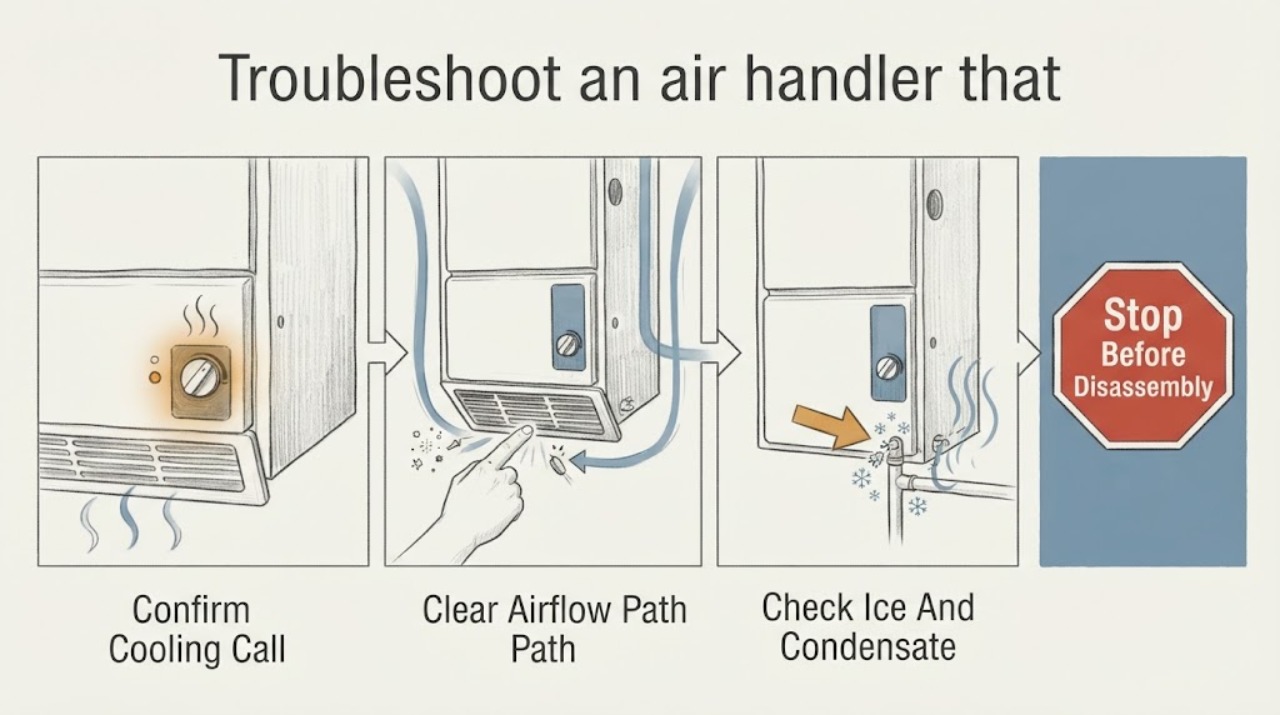
Work through in order
Diagnostic checks
Use only checks that match the exact appliance or system and its official guide.
-
Check 1
At the thermostat, confirm the mode is Cool, the target temperature is below the room temperature, and the fan is set to Auto rather than On. Cancel any schedule override that changed the mode or set point.
Expected result: The air handler starts when there is a cooling call, and the registers deliver air that becomes noticeably cooler after the system has had a short opportunity to run.
Next step: If the settings were wrong and cooling returns, monitor the system. If the settings are correct but airflow is weak or warm, continue to the filter and airflow checks.
Stop if: Do not open the thermostat or air-handler wiring compartment; stop if the thermostat is blank, wiring is damaged, or the system behaves erratically.
Why this matters
Why: A wrong mode, an unintended fan-only setting, or a changed schedule can make the air handler appear unable to cool even when the equipment is operating normally.
-
Check 2
Using the owner's guide to locate the filter, inspect it without opening the air-handler cabinet. Replace a visibly loaded filter with the correct type specified by the system. Check that supply registers and return grilles are open and not blocked by furniture or stored items.
Expected result: The filter is clogged, airflow is weak at several registers, or one return grille is obstructed; alternatively, the filter is clean and airflow is normal.
Next step: After correcting a filter or register obstruction, run one cooling cycle and reassess airflow. If airflow remains weak, the blower is noisy, or cooling is still absent, arrange HVAC service.
Stop if: Stop if the filter is wet, the cabinet has standing water, the blower is not operating, or access requires removing panels or reaching into moving/electrical components.
Why this matters
Why: A clogged filter or blocked return can restrict the air reaching the coil and registers. A clean filter with normal airflow makes a simple airflow restriction less likely and shifts attention to the coil, outdoor unit, or refrigeration circuit.
-
Check 3
With the system not actively cooling, look only at accessible surfaces around the indoor air handler and refrigerant line entry for frost or ice, unusual water, or a blocked-looking drain area. Do not scrape ice, pour water into the cabinet, or remove coil covers.
Expected result: There is ice on the coil or copper line, excessive condensate or leakage below the indoor unit, or no visible ice or water.
Next step: If ice is present, turn the thermostat to Off and arrange professional diagnosis after the system is allowed to defrost. If there is a leak or standing water, keep the cooling off and request service. If neither is present, continue to the power and outdoor-unit check.
Stop if: Stop immediately for ice, standing water, water near electrical components, mold-contaminated material, or any need to remove the air-handler access panel.
Why this matters
Why: Ice can reduce cooling and is commonly associated with restricted airflow or low refrigerant; leakage can accompany a frozen or drainage problem. Neither condition is safely solved by continuing to run the system.
-
Check 4
If the air handler is completely silent, look at the electrical panel for a breaker that is visibly in the tripped position. Reset it once only if you are comfortable doing so and can follow the panel and equipment instructions; do not remove the panel cover or touch wiring.
Expected result: The air handler starts and stays on after the reset, or the breaker trips immediately or trips again.
Next step: If the system remains on, check whether airflow and cooling return. If the breaker trips again, leave it off and call a qualified HVAC professional.
Stop if: Stop for burning odor, buzzing, smoke, a hot panel, water near electrical equipment, or a breaker that trips again; do not keep resetting it.
Why this matters
Why: A single tripped breaker can interrupt the air handler, but a repeat trip indicates an electrical or equipment fault rather than a problem to reset away.
-
Check 5
From a safe distance, observe the outdoor condenser or heat-pump unit while the thermostat calls for cooling. Do not remove its panels, wash fins while energized, or touch the fan, capacitor, disconnect, or refrigerant lines.
Expected result: The outdoor unit runs normally, does not start, has an unusual noise, or has heavy debris blocking its accessible exterior.
Next step: Clear only loose vegetation or objects that can be removed without touching the equipment. If the unit remains off, noisy, or the home stays warm, provide the observation to an HVAC technician.
Stop if: Stop for a burning smell, exposed wiring, a fan that is seized, refrigerant/oil residue, or any need to open the outdoor unit or handle the disconnect.
Why this matters
Why: The indoor air handler cannot provide a complete cooling cycle if the outdoor equipment is not operating. Noise, a dead unit, or high-voltage component symptoms require professional diagnosis; a blocked exterior can reduce performance.
Use your observations
Decision map
Find the observation that best matches what you see, then follow the next safe action.
-
PATH 01Next step
What you see
The thermostat was set to Heat, Off, or Fan On rather than an active Cool call with the fan on Auto.
Do this next
Correct the mode, target temperature, fan setting, and any schedule override.
-
PATH 02Next step
What you see
The filter is visibly clogged or multiple registers/returns are blocked, with no ice or water visible.
Do this next
Replace the filter according to the owner's guide and restore clear airflow at the registers and returns.
-
PATH 03Safety boundary
What you see
Ice or frost is visible on the indoor coil or nearby refrigerant line, especially with weak airflow or water appearing as it melts.
Do this next
Turn the cooling call Off and do not continue operating the system while it is frozen.
Why this path and its safety boundary
Safety stop: True
-
PATH 04Safety boundary
What you see
The air handler has no power and its breaker trips again after one reset, or there is an electrical odor/noise.
Do this next
Leave the breaker off and keep away from the equipment.
Why this path and its safety boundary
Safety stop: True
-
PATH 05Next step
What you see
The air handler blows air but the outdoor condenser or heat-pump unit does not run during a valid cooling call.
Do this next
Do not open the outdoor unit or adjust electrical components.
-
PATH 06Next step
What you see
Thermostat settings, filter, registers, power, ice, and outdoor operation do not explain the lack of cooling.
Do this next
Stop homeowner troubleshooting rather than opening the air handler or changing force, wiring, or refrigerant settings.
Helpful context
Understand the symptom
What “air handler not cooling” means
In a split system, the indoor air handler moves air through the evaporator coil while the outdoor equipment performs the rest of the cooling cycle. So warm air from the registers can result from a control or airflow issue at the air handler, a frozen indoor coil, or a problem outside the house. Start with checks that do not require opening the cabinet or touching refrigerant lines.
Use the symptom to choose the next check
No air from the registers points toward the blower, power, filter, or an airflow obstruction. Strong airflow that is warm points more toward thermostat mode, a frozen or dirty coil, the outdoor condenser, or refrigerant. A filter change can help restricted airflow, but it cannot repair a failed blower motor, a refrigerant leak, or an electrical fault.
When to stop testing
Turn the cooling call off if ice is visible, water is accumulating around the indoor unit, a breaker trips again, or the blower makes an unusual noise. Do not repeatedly reset power, keep running a frozen system, open the sealed refrigeration circuit, or reach into the blower cabinet. Those observations are useful to a technician, but the repair requires appropriate training and equipment.
When checks do not resolve it
Need a professional?
Ice, excessive condensate, or water is visible around the air handler., The blower does not run, is unusually noisy, or the air handler has no power., A breaker trips again, there is an electrical odor, or the outdoor unit does not run., The filter and airflow checks do not restore cooling.
Common questions
FAQ
Why is my air handler blowing air but not cooling?
Check the thermostat mode and fan setting, then inspect the filter and airflow. If airflow is normal but the air is warm, the indoor coil may be frozen or dirty, the outdoor unit may not be operating, or the system may have a refrigerant fault that needs professional diagnosis.
What should I do if I see ice on the air handler coil?
Turn the cooling call Off and do not keep running the system while it is frozen. Ice can be associated with restricted airflow or low refrigerant; let a qualified HVAC professional diagnose the cause rather than scraping the coil or adding refrigerant.
Can a dirty filter make an air handler stop cooling?
Yes. A clogged filter can restrict airflow, reduce cooling, and in more severe cases contribute to shutdown or coil icing. Replace it according to the owner's guide, then seek service if airflow or cooling does not recover.
Is it safe to reset the air-handler breaker?
Only reset a visibly tripped breaker once if you are comfortable doing so and can follow the equipment instructions. If it trips again, leave it off and call a qualified professional; do not repeatedly reset it or open the electrical compartment.
What if the air handler runs but the outdoor unit does not?
The indoor blower can circulate air without a complete cooling cycle. Observe the outdoor unit from a safe distance, but do not open it or touch electrical components; report the symptom to an HVAC technician for diagnosis.
Read the exact guide
Official sources
- Why Is My AC Not Blowing Cold Air? 7 Common CausesCarrier · Thermostat, filter, indoor air handler, outdoor unit, frozen coil, refrigerant, and service boundaries
- Air Handler Troubleshooting - Contact a Local DealerTrane · Air-handler airflow, filters, frozen coil, blower, and breaker troubleshooting
- Troubleshoot an Air Conditioner: 6 Steps to Fix an AC Not WorkingCarrier · Thermostat, airflow, breaker, frozen coil, refrigerant, electrical safety, and professional service guidance
Community feedback
Share a repair observation
Share a plain-text repair observation. Accepted observations are published automatically; this page may take a moment to update.