
On this page
Start here
Quick answer
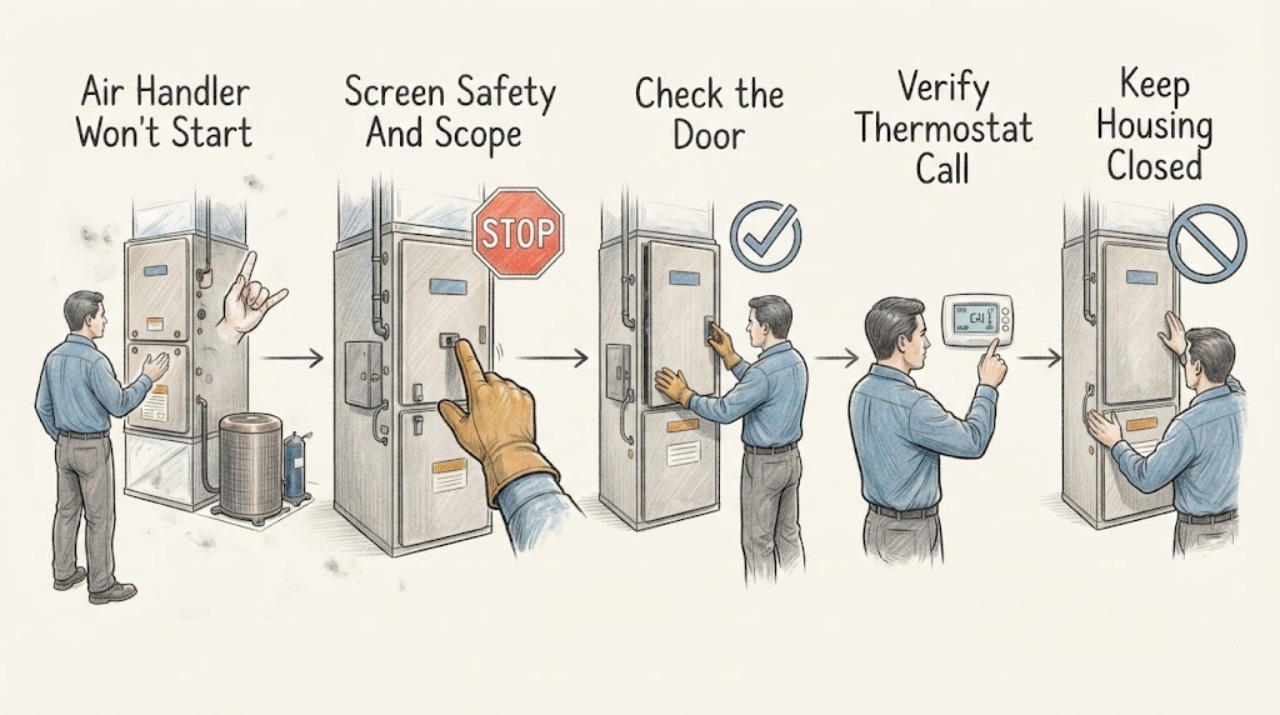
An air handler that will not start may have no indoor power, an incorrect thermostat call, a dirty filter or blocked airflow, a condensate overflow safety switch, an accessible service-door interlock, or an internal blower, control, wiring, compressor, or refrigerant problem. First determine whether the indoor fan is silent, whether the thermostat display and call are present, and whether the outdoor unit is also silent. From a dry, safe position, check the thermostat, visible power switch or breaker status, filter, return grilles, and any visible condensate water; use only one reset attempt when there is no warning sign and the equipment instructions allow it. If a breaker trips again, water reaches electrical equipment, ice or burning odor appears, or the system remains dead after these checks, stop and call a qualified HVAC technician. Do not open the air handler, touch wiring, reach into the blower, test capacitors, open refrigerant circuits, or bypass a door or condensate safety switch.
Before you begin
Safety first
- This article permits only dry, visible observation, manual or thermostat setting checks, an exact-manual filter check, visible grille inspection, and one permitted power reset when no warning sign is present. It does not authorize cabinet opening, live electrical work, capacitor testing, blower access, refrigerant/high-pressure work, ice removal, drain chemicals, or safety bypasses.
Work through in order
Diagnostic checks
Use only checks that match the exact appliance or system and its official guide.
-
Check 1
Stop normal operation and observe the indoor air handler and accessible outdoor unit from a dry, safe position. Note smoke, flame, sparks, arcing, burning odor, a hot enclosure, exposed wiring, active water, severe vibration, ice, or a breaker that has tripped.
Expected result: There is no visible hazard and only a no-start, or there is water, ice, heat, odor, smoke, arcing, exposed damage, violent vibration, or repeated protection action.
Next step: For smoke, fire, arcing, shock, or immediate danger, move away and call emergency responders. For water, ice, heat, odor, or visible damage, leave the system off and arrange urgent HVAC service once safe.
Stop if: Do not touch wet equipment, reach through a grille, open a cabinet, remove a panel, or use water on energized equipment.
Why this matters
Why: A hazard sign is not a routine thermostat or compressor check; it can indicate electrical, fire, water, mechanical, or refrigerant risk.
-
Check 2
With the thermostat calling for heating or cooling only if the area is safe, observe whether the indoor blower/airflow responds and whether the outdoor unit or compressor makes its normal start attempt. Do not approach moving fans or open either unit.
Expected result: The indoor air handler is silent while the outdoor unit runs, the outdoor compressor is silent while the indoor fan runs, both are silent, or the system starts and stops immediately.
Next step: Record the sequence and stop-start timing for the technician. Do not repeatedly call for operation to reproduce the failure; persistent outdoor or compressor silence needs HVAC diagnosis.
Stop if: Do not touch outdoor wiring, fan blades, compressor, disconnect, refrigerant tubing, or any moving or energized part.
Why this matters
Why: The symptom separates an indoor power/blower/control path from an outdoor compressor/control/refrigerant path, but it does not prove which part has failed.
-
Check 3
Check the thermostat display, mode, setpoint, fan setting, schedule, and any visible lockout or error message. For a battery thermostat, replace batteries only when the model instructions permit it and the thermostat can be handled dry and safely.
Expected result: The display is blank, the mode or setpoint does not call for operation, a schedule/lockout is active, or the display shows a normal call but the air handler remains silent.
Next step: Correct only an obvious setting or battery issue using the manual and observe one normal start attempt. If the call is correct but there is no response, continue to the visible power/filter checks and prepare HVAC service.
Stop if: Do not remove thermostat wiring, bridge terminals, bypass controls, or repeatedly cycle a system showing an error or unsafe symptom.
Why this matters
Why: A blank display can reflect batteries or lost system power; a wrong mode, setpoint, schedule, or lock can suppress the call. A normal call with no response points beyond a simple setting issue.
-
Check 4
From a dry, safe position, look for the equipment's visible service switch and the labeled breaker status. If no warning sign is present and you are comfortable doing so, follow the equipment instructions for one normal breaker reset; do not open the panel or touch wiring.
Expected result: The visible switch is off, a breaker is clearly tripped, power returns and the unit starts, or the breaker trips again/does not restore operation.
Next step: If a single safe reset restores normal operation, monitor without repeated cycling. If it trips again, will not stay on, or the unit remains dead, leave it off and call a qualified HVAC technician.
Stop if: Do not reset repeatedly, hold a breaker on, replace a fuse, change breaker size, remove a panel, or work on a live circuit.
Why this matters
Why: An off switch or one tripped breaker can interrupt operation, but a repeat trip or no response may indicate an electrical fault, motor problem, control issue, or compressor-side fault.
-
Check 5
With the system off and only if the filter access is explicitly user-accessible in the exact manual, inspect the filter for heavy dirt, collapse, wetness, damage, wrong size, or a reversed airflow arrow. Also look at return and supply grilles for obvious blockage without removing ductwork.
Expected result: The filter is clean and correctly installed, or it is loaded, wet, damaged, missing, wrong-sized, or reversed; grilles are clear or blocked.
Next step: Install only the exact manual-specified filter size/type and arrow direction, clear ordinary visible obstructions, and make one normal start attempt. If airflow remains absent, weak, or the system stays off, stop and call HVAC service.
Stop if: Do not run without a filter, force a filter into place, reach beyond the filter rack, remove coil or blower panels, scrape ice, or use chemicals in the drain.
Why this matters
Why: Restricted airflow can strain or overheat equipment and contribute to freezing or shutdown. A filter or grille issue can explain poor operation but does not prove the compressor or blower is defective.
-
Check 6
Look only at the closed exterior of the indoor unit for visible condensate water, a full pan, a wet floor, ice, or a service door that is visibly ajar or not seated. If the model manual identifies a user-accessible door position or overflow indicator, follow that manual; do not remove the panel or bypass the interlock.
Expected result: There is no visible water or ice and the accessible door appears seated, or water/ice is present or the door/interlock status is uncertain.
Next step: Leave the system off for water, ice, a full pan, or uncertain interlock status and arrange HVAC service. Do not assume every air handler has the same switch or reset method.
Stop if: Do not open the cabinet, bypass a door or float switch, chip ice, enter standing water, or restore power to wet or damaged equipment.
Why this matters
Why: A condensate overflow switch can shut down the indoor fan and outdoor compressor to prevent water damage. Water or ice also changes the risk and may hide a drain, airflow, coil, or refrigerant problem.
-
Check 7
Prepare the HVAC handoff with the model and system type, thermostat state, indoor/outdoor response, breaker or switch state as found, filter condition, grille airflow, water/ice, error display, noise, odor, and the exact time the no-start began. Do not attempt to identify or test the compressor, capacitor, contactor, wiring, or refrigerant yourself.
Expected result: The system remains silent after safe checks, only the outdoor compressor is silent, the indoor fan is silent, or the failure recurs after a temporary start.
Next step: Leave the equipment off when the symptom persists or any stop condition is present and schedule a qualified HVAC technician. Ask for a full system diagnosis rather than replacing a compressor based only on silence.
Stop if: Do not open cabinets, measure live voltage, test capacitors, bypass safeties, open refrigerant lines, or repeatedly force a start.
Why this matters
Why: A persistent no-start needs professional separation of blower, controls, electrical supply, condensate safety, compressor, refrigerant, and other model-specific causes.
Use your observations
Decision map
Find the observation that best matches what you see, then follow the next safe action.
-
PATH 01Safety boundary
What you see
There is smoke, fire, arcing, shock, burning odor, exposed wiring, hot equipment, repeated breaker action, or water at electrical equipment.
Do this next
Move away and call emergency responders for immediate danger; otherwise keep the equipment off and arrange urgent HVAC/electrical service once the area is safe.
Why this path and its safety boundary
Why it matters: The no-start is accompanied by an electrical, fire, or water hazard.
Safety stop: Do not touch, open, reset, spray, or operate the equipment.
-
PATH 02Safety boundary
What you see
The thermostat is blank, set to the wrong mode or setpoint, locked, scheduled off, or not requesting a cycle.
Do this next
Correct only an obvious setting or battery issue allowed by the manual and observe one normal call. If the display remains blank or the call still produces no response, arrange HVAC service.
Why this path and its safety boundary
Why it matters: The controls may not be sending a start request; this does not establish a compressor or air-handler failure.
Safety stop: Do not remove thermostat wiring, bridge terminals, or repeatedly cycle the controls.
-
PATH 03Safety boundary
What you see
A visible equipment switch is off or the labeled breaker is tripped, with no hazard sign.
Do this next
Follow the manual for one safe reset only. If it trips again or the system remains off, leave it off and call a qualified HVAC technician.
Why this path and its safety boundary
Why it matters: Power interruption can stop the air handler, but a repeat trip or no response points to an unresolved fault.
Safety stop: Do not hold, replace, up-rate, or repeatedly reset the breaker or switch.
-
PATH 04Safety boundary
What you see
The filter is dirty, wet, damaged, wrong-sized, reversed, or grilles are visibly blocked.
Do this next
Correct the filter only according to the exact manual, clear visible grille blockage, and make one normal start attempt. Escalate if airflow or starting does not return.
Why this path and its safety boundary
Why it matters: Airflow restriction can contribute to overheating, freezing, poor performance, or protective shutdown, but it does not prove a compressor failure.
Safety stop: Do not run without a filter, enter the cabinet, scrape ice, or clean internal components while energized.
-
PATH 05Safety boundary
What you see
Water, a full pan, a condensate warning, or a wet floor is visible around the air handler, or the system stopped while cooling.
Do this next
Keep the system off and arrange HVAC service to inspect the drain, pan, switch, coil, and water damage. Do not bypass or guess a reset procedure.
Why this path and its safety boundary
Why it matters: A condensate overflow sensor or float switch may intentionally shut down the supply fan and outdoor compressor; a drain or pan problem may be present.
Safety stop: Do not restore power to wet equipment, enter standing water, open the unit, or pour chemicals into an unknown drain.
-
PATH 06Safety boundary
What you see
The indoor fan responds but the outdoor compressor does not, both sections remain silent after safe checks, or the fault returns after one permitted reset.
Do this next
Leave the system off as appropriate and call a qualified HVAC technician for system diagnosis.
Why this path and its safety boundary
Why it matters: Compressor, contactor, capacitor, wiring, control, refrigerant, blower, or another internal fault remains possible and cannot be identified from silence alone.
Safety stop: Do not test capacitors, open refrigerant circuits, touch wiring, bypass safeties, or replace a compressor based only on the symptom.
Helpful context
Understand the symptom
First separate indoor and outdoor symptoms
An air handler is the indoor section, while the compressor is commonly in the outdoor unit. A thermostat call with no indoor airflow can mean the air handler has lost power or has a blower, control, wiring, filter, or safety-switch issue. If the indoor fan runs but the outdoor compressor does not, the fault may be on the outdoor, control, or refrigerant side. Record which section is silent without opening either cabinet or trying to force a start.
Use only visible, low-risk checks
The appropriate homeowner checks are thermostat mode and setpoint, visible power status, an accessible filter, unobstructed return and supply grilles, and visible water or ice around the indoor unit. A filter should be inspected or changed according to the exact equipment instructions; do not run the system without its filter. A condensate drain or overflow switch is model-dependent, and a high water level may intentionally stop the system to prevent damage.
Do not turn a no-start into a live repair
A breaker that trips again, a failed blower, a failed compressor, a capacitor or contactor issue, damaged wiring, low refrigerant, a frozen coil, or a failed control requires HVAC service. Electrical connections, motors, blower components, refrigerant, and high-pressure systems are professional work. If the system is wet, smoking, sparking, hot, badly vibrating, or repeatedly trips protection, leave it off and use urgent service or emergency response for immediate danger.
Safety boundary
Stop conditions
- Stop immediately and move away for smoke, fire, arcing, shock, exposed wiring, burning odor, hot equipment, violent vibration, or a breaker that trips again; use emergency responders for immediate danger.
- For water, ice, a full condensate pan, a wet floor, or water near electrical equipment, leave the system off and do not enter unsafe water or restore power to wet equipment.
- Do not open the air-handler or outdoor-unit cabinet, touch wiring, reach into a blower, test capacitors or motors, measure live voltage, open refrigerant lines, chip ice, or bypass a door or condensate safety switch.
- Do not repeatedly reset a breaker, switch, thermostat, or safety; arrange qualified HVAC service for persistent no-start, compressor silence, blower silence, recurring shutdown, poor airflow, or an unknown cause.
When checks do not resolve it
Need a professional?
Call a qualified HVAC technician when the air handler remains off after the thermostat, visible power, filter, grille, and condensate checks, when the outdoor compressor does not respond, when a breaker trips again, or when water, ice, weak airflow, unusual noise, odor, or an error returns. Use emergency responders for smoke, fire, arcing, shock, or immediate danger.
Safety scope: This article permits only dry, visible observation, manual or thermostat setting checks, an exact-manual filter check, visible grille inspection, and one permitted power reset when no warning sign is present. It does not authorize cabinet opening, live electrical work, capacitor testing, blower access, refrigerant/high-pressure work, ice removal, drain chemicals, or safety bypasses.
Common questions
FAQ
Why is my air handler not starting even though the thermostat display is on?
A thermostat display does not prove the air handler has operating power. Check the mode and call, visible breaker or switch status, filter and airflow, and visible condensate water without opening the equipment. If the call is correct but the unit remains silent, arrange HVAC service.
Can a condensate overflow switch stop both the compressor and air handler?
On systems equipped with one, yes. Trane explains that an overflow switch can shut down the outdoor compressor and the supply fan when a drain pan or line has a high-water condition. Do not bypass the switch; have the drain, pan, switch, and water damage inspected.
Should I reset the air-handler breaker if it will not start?
Only one normal reset is reasonable when there is no smoke, odor, water, heat, damage, or other warning sign and the equipment guidance allows it. If the breaker trips again or the system remains off, leave it off and call a qualified HVAC technician.
Is the compressor the problem if the air handler will not start?
Not necessarily. The indoor air handler, thermostat, breaker, filter, condensate safety, wiring, controls, blower, outdoor controls, or compressor may be involved. Record whether indoor and outdoor sections respond separately and let an HVAC technician test the system.
Read the exact guide
Official sources
- Troubleshooting the HVAC Air Handler Overflow SwitchTrane · Manufacturer explanation of model-dependent condensate protection; not every air handler has the same switch or reset.
- Maintenance ChecklistENERGY STAR · Government energy-efficiency guidance used for routine checks and professional maintenance boundaries; equipment instructions and local requirements control.
- Heat Pump Troubleshooting Guide | Common Heat Pump Problems & FixesCarrier · Manufacturer heat-pump guidance applied to the indoor air-handler symptom; exact system configuration and manual control.
- Air Handler Troubleshooting - Contact a Local DealerTrane · Manufacturer troubleshooting guidance used for general air-handler checks; exact model manual and qualified service control.
Community feedback
Share a repair observation
Share a plain-text repair observation. Accepted observations are published automatically; this page may take a moment to update.