
On this page
Start here
Quick answer
An air handler or central AC that starts and stops before completing a cooling cycle is short cycling. Record how long each run lasts, how long the off period lasts, whether the indoor blower and outdoor compressor respond together, and whether cooling or humidity changes. Check only the thermostat state, accessible filter and grilles, visible ice or condensate, and the outdoor response from a safe position. Dirty filters, thermostat signals, airflow restriction, frozen coils, low refrigerant, an oversized system, or electrical and compressor controls can all produce similar patterns. If ice, water, burning odor, smoke, unusual noise, overheating, repeated breaker operation, or a compressor that buzzes and stops appears, turn the system off and call qualified HVAC service. Do not open the air handler or condenser, touch the compressor or high-voltage parts, or handle refrigerant.
Before you begin
Safety first
- Keep the system off for ice, water, smoke, odor, heat, unusual noise, arcing, or repeated protective-device operation. Compressor, motor, capacitor, contactor, wiring, high-voltage, and refrigerant work belongs to qualified HVAC personnel.
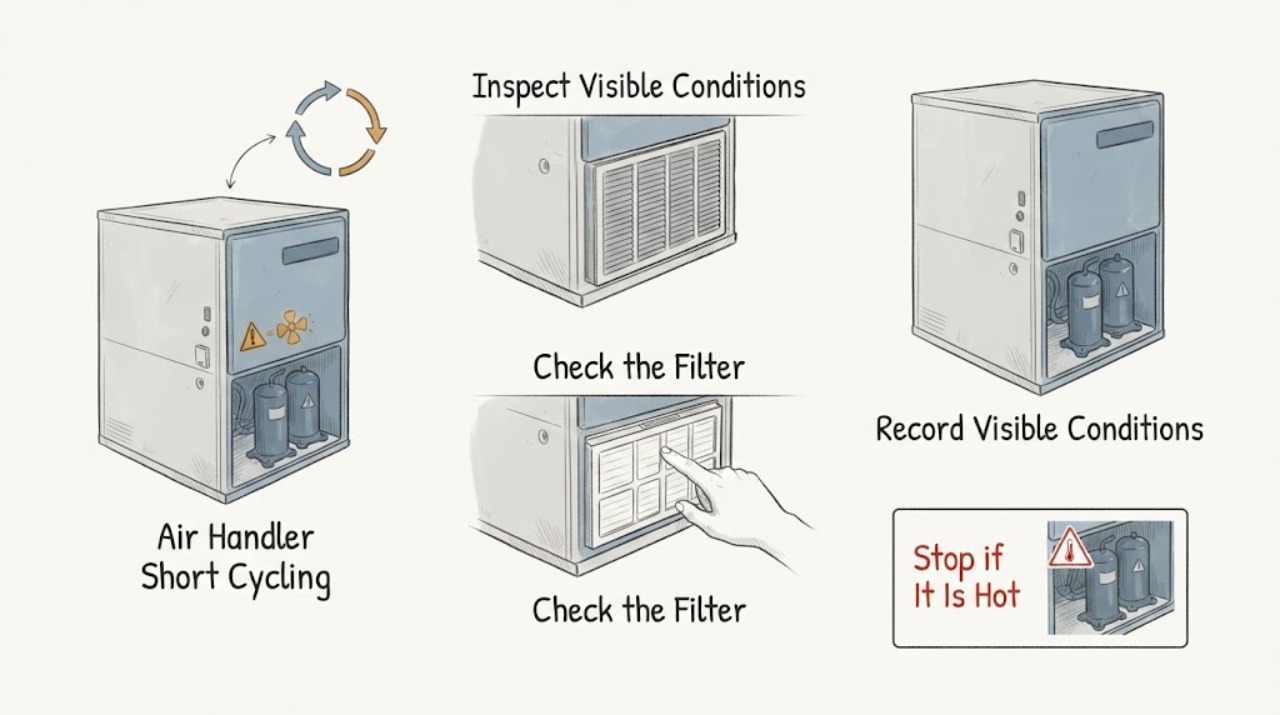
Work through in order
Diagnostic checks
Use only checks that match the exact appliance or system and its official guide.
-
Check 1
Without forcing extra starts, record the time from each cooling start to stop, the off period before the next start, the room temperature trend, and whether the pattern repeats; stop recording if the equipment becomes hot, noisy, smoky, or odorous.
Expected result: Runs are repeatedly brief, the off periods are brief, the system runs continuously, or the pattern occurs only once after a normal target is reached.
Next step: Keep the cycle note for HVAC service and avoid repeated thermostat changes or forced restarts. If the system is repeatedly cycling or cooling is deteriorating, proceed with safe external checks and prepare service.
Stop if: Stop immediately for smoke, burning odor, overheating, unusual mechanical noise, ice, water, arcing, or repeated protective-device operation.
Why this matters
Why: Repeated premature starts support short cycling. A single normal stop or a documented restart delay is not enough to diagnose a fault; repeated brief cycles can stress the compressor and point to airflow, thermostat, refrigerant, sizing, control, or safety causes.
-
Check 2
At the thermostat, observe whether Cool is selected, the target is below the room reading, the fan is set as intended, the schedule is active, and a delay or alert is displayed; use only documented user controls and do not touch wiring.
Expected result: The mode, target, fan setting, schedule, or alert is inconsistent with a normal cooling call, or the thermostat calls while the system repeatedly starts and stops.
Next step: Correct only an obvious setting through the thermostat instructions and observe one normal cycle. If the pattern returns or the alert persists, leave the settings alone and call HVAC.
Stop if: Stop for a blank or damaged control, exposed wiring, smoke, heat, odor, or a need to remove the wall control.
Why this matters
Why: A control state or temperature-sensing issue can create an apparent no-start or cycling pattern. A correct call with repeated stops shifts attention to airflow, safety, outdoor equipment, or internal service causes.
-
Check 3
With the system stopped through its normal control, inspect the accessible air filter and return and supply grilles; replace a visibly loaded filter only in the orientation and type specified by the equipment manual, and keep the air-handler compartment closed.
Expected result: The filter is heavily loaded, airflow was weak, grilles are blocked, airflow is normal, or the short cycling remains after the documented filter change.
Next step: If a filter change is appropriate and there is no ice, water, odor, or other hazard, observe one normal call only. If the cycling remains, keep the cabinet closed and arrange HVAC diagnosis.
Stop if: Stop for ice, water, burning odor, smoke, a hot cabinet, abnormal blower noise, or any need to reach the blower or coil.
Why this matters
Why: Restricted airflow can contribute to overheating, freezing, weak cooling, or premature safety shutdown. A clear filter does not rule out a coil, blower, refrigerant, control, or compressor-related cause.
-
Check 4
From outside the equipment cabinet, look for ice on visible tubing or coil surfaces, excess water around the air handler, a full accessible condensate pan, a wet-switch indication, or an unexpected drain discharge; do not scrape ice, add heat, open the cabinet, or disturb a safety control.
Expected result: Ice, water, a full pan, or a water-protection indication is present, or no visible ice or condensate symptom is present.
Next step: Turn cooling off and arrange qualified HVAC service for ice, water, overflow, or a suspected safety trip. Keep the system off until the cause is assessed; do not handle refrigerant or force a restart.
Stop if: Stop for ice, standing water near electrical equipment, an overflowing pan, ceiling or floor damage, or any need to touch a drain switch, pump, coil, or wiring.
Why this matters
Why: A frozen coil may follow restricted airflow or low refrigerant, while water or a full pan may indicate a condensate or safety shutdown. No visible symptom does not clear internal causes.
-
Check 5
During one ordinary cooling request, observe from a safe distance whether the air-handler blower starts, whether the outdoor fan and compressor response is present, whether one side stops first, and whether the system restarts soon after stopping; do not remove a service cover or reach toward either unit.
Expected result: Both sides cycle together, the blower continues while the outdoor unit stops, the outdoor unit buzzes or stops, the blower is weak or silent, or both sides stop unexpectedly.
Next step: Record the sequence and stop repeated calls. Arrange HVAC service for persistent cycling, a buzzing outdoor unit, a silent blower, or no cooling; compressor, motor, capacitor, control, high-voltage, and refrigerant diagnosis belongs to the technician.
Stop if: Stop for compressor or fan buzzing, grinding, smoke, burning odor, a hot cabinet, ice, water, exposed wiring, or repeated breaker operation.
Why this matters
Why: A matched short cycle can involve thermostat, airflow, safety, refrigerant, sizing, or controls. A split response narrows the handoff toward indoor blower or outdoor condensing-unit controls, motors, compressor, or related safety conditions without proving a part.
-
Check 6
Prepare a service note with equipment and thermostat models, run and off durations, setpoint and room trend, filter and airflow state, visible ice or water, indoor and outdoor response, sound and odor, recent power events, and whether the problem changes with outdoor conditions; leave the compressor, controls, wiring, and refrigerant circuit untouched.
Expected result: Short cycling persists after safe setting and filter observations, cooling or humidity is poor, or the outdoor unit or compressor response is abnormal.
Next step: Keep the system off when ice, water, odor, heat, noise, or electrical symptoms are present and request qualified HVAC diagnosis. Give the technician the time sequence instead of selecting a replacement part from the symptom.
Stop if: Stop all user diagnosis if it would require opening a cabinet, touching the compressor, capacitor, contactor, motor, controls, wiring, or refrigerant circuit, or bypassing a safety device.
Why this matters
Why: The remaining possibilities include a thermostat or safety signal, restricted airflow, condensate issue, low refrigerant, oversized equipment, compressor or fan starting problem, control fault, or another model-specific condition.
Use your observations
Decision map
Find the observation that best matches what you see, then follow the next safe action.
-
PATH 01Next step
What you see
The system pauses once after reaching the target or the thermostat shows a documented restart delay, then completes a stable cycle.
Do this next
Monitor without repeated calls. If the pauses become frequent, cooling weakens, or humidity rises, arrange HVAC service.
Why this path and its safety boundary
Why it matters: This may be normal control behavior rather than short cycling.
-
PATH 02Next step
What you see
The filter is loaded, airflow is weak, or grilles are blocked and the system cycles prematurely.
Do this next
Use the model manual for an accessible filter change, then observe one normal cycle. Call HVAC if the symptom persists or ice or water appears.
Why this path and its safety boundary
Why it matters: Airflow restriction can contribute to overheating, freezing, and safety shutdowns.
-
PATH 03Next step
What you see
The thermostat mode, target, schedule, location, alert, or call does not match the desired cooling state.
Do this next
Correct only documented user settings and observe one cycle. Have HVAC inspect recurring short cycling or control faults.
Why this path and its safety boundary
Why it matters: The control may be starting or stopping cooling at an unintended time, or a delay may be protecting the compressor.
-
PATH 04Next step
What you see
Ice, excess condensate, a full pan, or a water-protection indication is visible.
Do this next
Turn cooling off and arrange qualified HVAC service. Do not scrape ice, add heat, handle refrigerant, or bypass a safety control.
Why this path and its safety boundary
Why it matters: Airflow, refrigerant, drain, or safety conditions may be shutting the system down and continued operation can damage the equipment.
-
PATH 05Next step
What you see
The outdoor unit buzzes, starts and stops quickly, stays silent while the blower runs, or shows abnormal noise or heat.
Do this next
Stop repeated calls and leave the outdoor enclosure closed. Request qualified HVAC service and provide the sound timing and indoor/outdoor sequence.
Why this path and its safety boundary
Why it matters: A compressor, fan, capacitor, control, power, or refrigerant-related condition may be present; these are not safe sound-based DIY diagnoses.
-
PATH 06Next step
What you see
A breaker or other protective device opens during a cycle or opens again after a single permitted external reset.
Do this next
Do not reset again or open the panel; keep the system off and call qualified HVAC or electrical service.
Why this path and its safety boundary
Why it matters: A deeper electrical, motor, compressor, control, or installation fault may be present.
-
PATH 07Next step
What you see
The filter and visible settings are reasonable, no ice or water is seen, but short cycling continues or comfort remains poor.
Do this next
Arrange HVAC diagnosis rather than changing parts or allowing the compressor to cycle continuously.
Why this path and its safety boundary
Why it matters: Sizing, refrigerant, control, safety, compressor, or another internal condition remains possible.
Helpful context
Understand the symptom
Confirm that it is really short cycling
A normal system can pause after reaching the target or during a built-in restart delay. Short cycling is a repeated pattern in which cooling starts, stops prematurely, and starts again without settling the room. Record several observed run and off periods without repeatedly forcing a call. Also note whether the house is clammy, the temperature is not settling, or the equipment sounds strained. The duration and sequence are more useful than a guess about the compressor.
The air handler and compressor are separate clues
The air handler contains the indoor blower and filter path, while the outdoor condensing unit normally contains the compressor, outdoor coil, fan, and controls. The indoor fan may run while the outdoor unit stops, or the outdoor unit may stop while airflow continues. Each pattern changes the service handoff, but none proves a failed component. Keep both enclosures closed.
Why not to let it keep cycling
Repeated starts place extra stress on compressor and fan motors and can leave the home under-cooled or humid. A dirty filter may be a safe maintenance clue, but a frozen coil, low refrigerant, condensate problem, control fault, or compressor symptom needs qualified HVAC diagnosis. Ice should not be scraped or melted with improvised heat.
Safety boundary
Stop conditions
- Stop immediately for smoke, fire, burning or melted-plastic odor, arcing, a hot cabinet, loud mechanical noise, or repeated protective-device operation.
- Stop for visible ice, standing water near electrical equipment, an overflowing condensate pan, ceiling or floor damage, or a wet air handler.
- Do not open the air handler or outdoor condenser, touch the compressor, motor, capacitor, contactor, wiring, or controls, bypass a safety device, or handle refrigerant.
- Stop repeated cooling calls when the compressor or outdoor unit buzzes, starts and stops rapidly, or becomes hot, and arrange HVAC service.
- If smoke or fire is present, leave the area and use the local emergency route from a safe location; do not return to investigate.
Only after diagnosis
Potential parts
- compressor or outdoor fan motor
- capacitor, contactor, or control component
- thermostat or condensate safety component
When checks do not resolve it
Need a professional?
The equipment repeatedly starts and stops before completing a cycle, especially with weak cooling or rising indoor humidity., The outdoor unit buzzes, stops, stays silent while the blower runs, or becomes hot or unusually noisy., Ice, excess water, a full condensate pan, a wet-switch indication, or a suspected drain issue is present., A breaker or protective device opens again, or the symptom persists after the thermostat and accessible filter observations., Diagnosis would require opening an enclosure, touching the compressor, motor, capacitor, controls, wiring, safety device, or refrigerant circuit.
Safety scope: Keep the system off for ice, water, smoke, odor, heat, unusual noise, arcing, or repeated protective-device operation. Compressor, motor, capacitor, contactor, wiring, high-voltage, and refrigerant work belongs to qualified HVAC personnel.
Common questions
FAQ
What counts as air-handler short cycling?
It is a repeated pattern in which cooling starts and stops prematurely before completing a cycle, then starts again. Record the run and off periods and indoor and outdoor response; one normal stop or restart delay is not enough to diagnose a fault.
Can a dirty filter cause short cycling?
Yes, restricted airflow from a loaded filter can contribute to weak cooling, freezing, overheating, or premature shutdown. Check only the accessible filter using the equipment instructions, and call HVAC if cycling persists or ice appears.
Does short cycling mean the compressor is bad?
No. The compressor is one possible service concern, but thermostat, airflow, refrigerant, condensate, sizing, control, and other safety conditions can look similar. Do not open the outdoor unit or diagnose the compressor by sound.
What should I do if I see ice during short cycling?
Turn cooling off and arrange HVAC service. Ice can relate to restricted airflow, low refrigerant, or another fault, and continued operation can damage the system. Do not scrape it, add heat, or handle the refrigerant circuit.
Why does the blower run after the outdoor unit stops?
Indoor and outdoor equipment have separate responses and controls, so a split pattern can point toward airflow, thermostat, safety, outdoor-unit, or control concerns. Record which side stops first and provide that sequence to HVAC service.
Read the exact guide
Official sources
- Troubleshoot an Air Conditioner | AC TroubleshootingCarrier · Carrier central-air troubleshooting guidance; equipment type, controls, and safe access vary by installation.
- What Is AC Short Cycling: Causes, Effects, and TroubleshootingCarrier · Carrier residential air-conditioner guidance; system type, equipment sizing, controls, and service procedures vary by installation.
- Troubleshoot an Air Conditioner: 6 Steps to Fix an AC Not WorkingCarrier · Carrier residential central-air guidance; equipment type and safe access vary by installation.
- Common Thermostat Issues and How to TroubleshootCarrier · Carrier thermostat guidance; display features, delays, wiring, and control behavior vary by thermostat and HVAC installation.
Community feedback
Share a repair observation
Share a plain-text repair observation. Accepted observations are published automatically; this page may take a moment to update.