
On this page
Start here
Quick answer
Short cycling means the HVAC system starts and stops before completing a normal cooling cycle. A dirty, wet, wrong-size, collapsed, or backward filter can restrict airflow and contribute to coil freezing, motor strain, or a protective shutdown, but the filter is not the only possibility: thermostat placement or settings, condensate protection, system sizing, low refrigerant, controls, or the blower can also be involved. Record how often the air handler starts and stops, check the thermostat, inspect the accessible filter and room-side airflow, and look for visible ice or water. Keep the system off and call a qualified HVAC technician for recurring short cycles, ice, water, a silent or overheating blower, a tripped breaker, smoke, burning odor, or electrical symptoms; do not open the air handler or adjust refrigerant.
Before you begin
Safety first
- This article supports thermostat, accessible filter, room-side airflow, and visible ice or water observations only. A qualified HVAC professional must handle the blower motor, capacitor, controls, coil, energized or moving parts, compressor, refrigerant, and system sizing assessment.
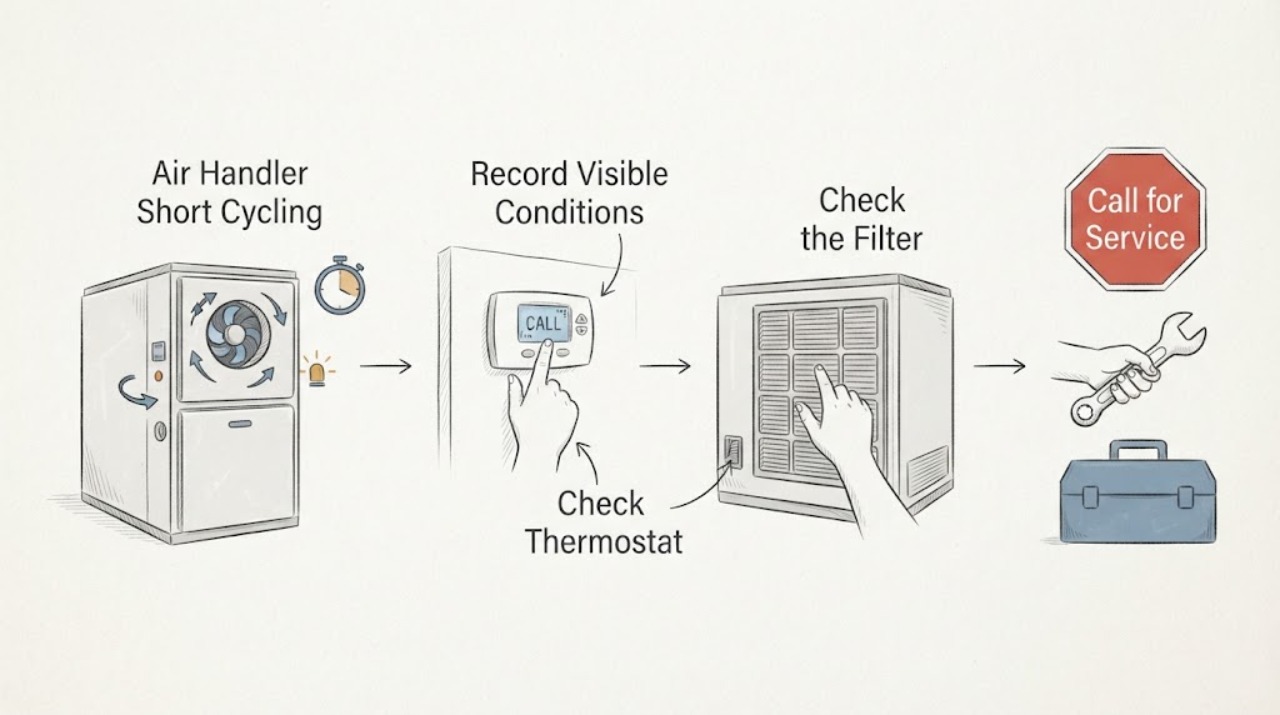
Work through in order
Diagnostic checks
Use only checks that match the exact appliance or system and its official guide.
-
Check 1
From a safe position, record the time the thermostat calls for cooling, the time the air handler and outdoor unit start, the time each stops, and whether the thermostat still calls; do not restart the system to force another cycle.
Expected result: The system stops after a brief run and restarts while the room is still warm, the thermostat ends the call normally, the blower continues after cooling stops, or the unit trips or stops with an odor, noise, or water.
Next step: Keep the timing record and continue only with ordinary thermostat, filter, airflow, ice, and water observations when there is no stop condition; arrange HVAC service for recurring or unexplained short cycles.
Stop if: Stop immediately for smoke, burning odor, arcing, abnormal heat, water near electrical equipment, a harsh sound, or a protective-device trip.
Why this matters
Why: A premature stop with an active call supports short cycling or a protection event. A normal thermostat-satisfied stop may be expected operation. A blower that continues or a mismatch between indoor and outdoor response points toward a control or equipment sequence that a technician must diagnose.
-
Check 2
Read the thermostat mode, set temperature, room temperature, fan setting, schedule, location, and any delay or fault message, then use only ordinary documented settings without removing the thermostat or touching wiring.
Expected result: The thermostat is set to cool with a valid call, fan is set to ON or AUTO, the setpoint is reached before the next start, the thermostat is near sunlight or a heat source, or the display or wiring is abnormal.
Next step: Record the settings and location and follow the exact thermostat instructions for ordinary correction. If the system still cycles rapidly, request qualified HVAC diagnosis.
Stop if: Do not move the thermostat, remove its cover, splice wires, or continue if the wall or wiring is wet, scorched, loose, or sparking.
Why this matters
Why: Incorrect mode, schedule, fan setting, or thermostat location can mimic short cycling. A valid call with premature stops suggests an airflow, coil, condensate, control, sizing, refrigerant, or electrical issue rather than a simple setting error.
-
Check 3
If the filter is designed for ordinary user access and the area is dry, inspect its printed size, airflow arrow, fit, surface loading, collapse, and moisture without reaching into the blower compartment.
Expected result: The filter is dirty, wet, collapsed, the wrong size, installed backward, clean and correctly fitted, or inaccessible without an equipment panel.
Next step: Replace or clean the filter only according to the exact equipment instructions and with the same specified size and type. If the cycling continues or the filter is wet, arrange HVAC service.
Stop if: Do not operate without the required filter, force a wrong filter, reverse the airflow direction, remove an air-handler panel, or continue with ice, water, smoke, odor, or heat.
Why this matters
Why: A restriction or incorrect fit can reduce airflow, increase blower or coil stress, and contribute to short cycling. A clean, correct filter makes a filter cause less likely but does not clear the blower motor, coil, condensate, thermostat, refrigerant, controls, or system sizing.
-
Check 4
From the room side, observe several supply registers and return grilles for blocked furniture, drapes, dust, or unusual airflow and note whether the air handler sounds strained; clear only loose room-side obstructions without opening ducts or the cabinet.
Expected result: Returns or supplies are blocked, airflow is weak throughout the home, only one zone is affected, airflow is normal but cooling ends early, or a grille or duct visibly vibrates.
Next step: Record the affected rooms and any safe change after clearing an obstruction. Request HVAC service for weak, uneven, pulsing, or unresolved airflow rather than altering dampers or ductwork as a test.
Stop if: Do not insert tools into grilles, remove ductwork, block a register, or continue if the system produces smoke, burning odor, arcing, water, or abnormal heat.
Why this matters
Why: Restricted or uneven airflow can contribute to coil or motor stress and short cycling. Normal airflow with premature stops points toward thermostat, condensate, control, sizing, refrigerant, or another cooling-side diagnosis.
-
Check 5
From safe external access, look for frost or ice on visible refrigerant tubing or near the indoor coil cabinet, standing water, excessive condensate, a full pan, or a condensate alarm; do not scrape ice, pour chemicals into a drain, or reach inside the unit.
Expected result: No ice or water is visible, ice is present, water or a full pan is present, or the condition cannot be seen without opening the equipment.
Next step: Turn cooling off and arrange HVAC service for ice, recurring water, a full pan, or an inaccessible condition; protect surfaces without touching wet electrical equipment.
Stop if: Do not scrape or chip ice, pour water or chemical cleaner into the unit or drain, remove a pan, or operate near standing water or wet wiring.
Why this matters
Why: A frozen coil can reduce airflow and cooling and can result from restricted airflow, blower problems, or refrigerant conditions. Water can indicate condensate or protection trouble. These signs require diagnosis and are not proof that the filter is the only cause.
-
Check 6
Prepare the equipment make and model, cycle timing, thermostat settings and location, filter size and direction, airflow results, ice or water signs, indoor and outdoor responses, and any breaker or odor history without opening the cabinet.
Expected result: The record points to filter or airflow restriction, thermostat behavior, ice or condensate, blower or control behavior, sizing, refrigerant, electrical protection, or an unresolved pattern.
Next step: Keep the system off when cycling is frequent, recurring, frozen, wet, electrically abnormal, or unresolved and schedule qualified HVAC service.
Stop if: Do not continue observations or restart after smoke, burning odor, arcing, abnormal heat, water near electricity, or a repeat protective-device trip.
Why this matters
Why: A detailed record helps the technician prioritize the filter and airflow, thermostat, condensate protection, blower motor, controls, coil, refrigerant, compressor, and sizing boundaries without guessing from a short run alone.
Use your observations
Decision map
Find the observation that best matches what you see, then follow the next safe action.
-
PATH 01Safety boundary
What you see
The system produces smoke, burning odor, arcing, abnormal heat, water near electrical equipment, harsh mechanical noise, or a repeated protective-device trip.
Do this next
Turn the system off using a normal accessible control if safe, keep clear, and obtain qualified HVAC or electrical service; use emergency response for fire, smoke, or shock.
Why this path and its safety boundary
Why it matters: This is a safety event, not a filter or cycle-timing experiment.
Safety stop: Do not open panels, touch wet or hot equipment, repeatedly reset protection, or restart to reproduce the event.
-
PATH 02Safety boundary
What you see
The filter is dirty, wet, collapsed, wrong-size, backward, or visibly preventing the specified airflow.
Do this next
Restore the same specified filter size and direction using the exact equipment instructions, then monitor only from safe access; arrange HVAC service if cycling remains or the filter is wet.
Why this path and its safety boundary
Why it matters: Filter restriction is a plausible contributor to airflow stress, coil freezing, and short cycling, but it does not confirm a blower or coil condition.
Safety stop: Do not run without the required filter, force a fit, scrape ice, or open the air handler.
-
PATH 03Safety boundary
What you see
The filter and room-side airflow are normal, the thermostat location or schedule is suspect, or the system has cycled this way since installation.
Do this next
Record the thermostat settings, location, installation history, room temperature, and humidity feel and request qualified HVAC assessment without moving the thermostat or changing system size by guesswork.
Why this path and its safety boundary
Why it matters: Thermostat behavior, placement, system sizing, or load may be involved, and a filter change will not resolve those causes.
Safety stop: Do not relocate wiring, alter controls, or use rapid setting changes to force longer cycles.
-
PATH 04Safety boundary
What you see
Ice, excessive condensate, a full pan, or a condensate alarm is visible near the indoor unit.
Do this next
Leave cooling off and arrange HVAC service for the coil, filter and airflow, blower, drain, pan, protection, and refrigerant boundaries.
Why this path and its safety boundary
Why it matters: A frozen coil or condensate protection condition can shorten or stop cycles and may be related to airflow, blower, drain, or refrigerant conditions.
Safety stop: Do not scrape ice, use chemical drain cleaner, remove panels, or operate near standing water or wet wiring.
-
PATH 05Safety boundary
What you see
The filter and grilles are clear, but the blower is silent, hums without airflow, cycles abnormally, or stops while the thermostat still calls.
Do this next
Keep the system off and request qualified HVAC service; provide the cycle timing and any sound or airflow record.
Why this path and its safety boundary
Why it matters: The blower motor, capacitor, relay, control, wiring, protection, or frozen coil may be involved and requires professional diagnosis.
Safety stop: Do not handle a motor or capacitor, measure live voltage, bypass protection, or repeatedly restart the blower.
-
PATH 06Safety boundary
What you see
The thermostat, filter, registers, and visible conditions are normal, but cycles remain short or the home stays warm; ice or outdoor response may be present.
Do this next
Request qualified HVAC diagnosis and do not adjust refrigerant, open a coil cabinet, or perform electrical tests.
Why this path and its safety boundary
Why it matters: Refrigerant, compressor, outdoor unit, coil, controls, or system sizing may be involved; short cycling alone cannot select a component.
Safety stop: Stop for smoke, odor, arcing, abnormal heat, water, or a protective-device trip.
Helpful context
Understand the symptom
Confirm that the pattern is short cycling
A system can run briefly in mild weather or longer during a hot day, so count starts and stops instead of assuming that every short run is a fault. Record the thermostat call, whether the blower continues, the indoor temperature and humidity feel, and whether the outdoor unit stops at the same time. Frequent premature stops, clammy air, uneven cooling, or a rising indoor temperature justify a service diagnosis.
The filter is a focused check, not a complete diagnosis
A filter protects the air-handler motor and supports airflow. Check its size, arrow direction, fit, moisture, and dust from ordinary access. A filter that is clean and correctly fitted does not rule out a thermostat, coil, condensate, blower, control, sizing, refrigerant, or electrical cause. Use the exact equipment instructions for any replacement or cleaning.
Ice, water, and electrical symptoms override troubleshooting
Visible ice, excessive condensate, a wet cabinet, repeated breaker trips, burning smell, smoke, arcing, or an overheating blower is a stop condition. Do not keep restarting the air handler to watch the cycle, scrape ice, open the cabinet, handle the blower or capacitor, or work on refrigerant.
Safety boundary
Stop conditions
- Stop the system for smoke, burning odor, arcing, abnormal heat, water near electrical equipment, harsh mechanical noise, or a repeated protective-device trip.
- Do not open the air-handler cabinet, handle a blower motor or capacitor, measure live voltage, bypass protection, or adjust refrigerant.
- Do not scrape or chip ice, pour water or chemical cleaner into the unit or condensate drain, remove a pan, or operate near standing water or wet wiring.
- Do not operate without the required filter, force a wrong size or direction, alter ductwork or dampers as a test, or repeatedly restart a short-cycling system.
- Do not relocate a thermostat, enter an unsafe attic or crawlspace, or disturb concealed wiring, coils, refrigerant lines, or equipment panels.
Only after diagnosis
Potential parts
- air-handler filter
Consider this category only when the accessible filter is dirty, wet, damaged, or missing and the exact equipment instructions identify a compatible replacement.
Confirm the exact model, filter dimensions, type, airflow direction, and manufacturer requirements; do not operate without the required filter. - thermostat
Consider this category only after a qualified diagnosis confirms thermostat failure or an incompatible control, not merely because the system short cycles.
Confirm the exact system, wiring, staging, heat-pump or air-conditioner configuration, and manufacturer compatibility with a qualified professional. - condensate protection component
Consider this category only if a qualified HVAC diagnosis confirms a condensate pan, drain, float switch, or related protection fault.
Confirm the exact equipment and protection arrangement and use an approved installation procedure; do not bypass the safety device.
When checks do not resolve it
Need a professional?
Arrange qualified HVAC service when short cycling continues after the thermostat, accessible filter, and room-side airflow checks, when the pattern began after installation, or when ice, condensate, weak airflow, a silent or overheating blower, electrical symptoms, or a warm home is present. Ask the technician to evaluate filter and airflow, thermostat, condensate protection, coil, blower motor, controls, system sizing, compressor, and refrigerant boundaries. Use electrical or emergency service for smoke, arcing, burning odor, hot equipment, shock, fire, or repeated trips.
Safety scope: This article supports thermostat, accessible filter, room-side airflow, and visible ice or water observations only. A qualified HVAC professional must handle the blower motor, capacitor, controls, coil, energized or moving parts, compressor, refrigerant, and system sizing assessment.
Common questions
FAQ
How often should an air handler cycle?
There is no single interval for every system and weather condition. A pattern of frequent premature starts and stops, clammy air, uneven cooling, or a rising indoor temperature is short cycling until a technician establishes another explanation. Record the timing rather than forcing a test cycle.
Can the filter alone cause short cycling?
A dirty, wet, collapsed, wrong-size, or backward filter can restrict airflow and contribute to stress, coil freezing, or a protective shutdown. If the correct filter is clean and the system still short cycles, the cause may be thermostat, condensate, blower, coil, refrigerant, electrical, sizing, or another condition.
Should I keep restarting a short-cycling air handler?
No. Keep it off for recurring short cycles, ice, water, absent or weak airflow, smoke, burning odor, arcing, abnormal heat, or a protective-device trip and arrange qualified HVAC service. Do not open the air handler, scrape ice, handle a capacitor, or adjust refrigerant.
Read the exact guide
Official sources
- Air Handler MaintenanceTrane · Trane air-handler filter size and direction, airflow, motor, noise, vibration, condensation, and maintenance boundaries
- Air Handler Troubleshooting - Contact a Local DealerTrane · Trane residential air-handler troubleshooting for filters, frozen coils, blower motor, power, and service boundaries
- What Is AC Short Cycling: Causes, Effects, and TroubleshootingCarrier · Carrier residential AC short-cycling definition, filter, thermostat, refrigerant, sizing, electrical, and professional-service guidance
- Air Handler Fan Not Working: Causes and SolutionsTrane · Trane air-handler filter, thermostat, power, capacitor, blower motor, wiring, and frozen-coil service guidance
- Troubleshoot an Air Conditioner | AC TroubleshootingCarrier · Carrier residential AC thermostat, filter, short-cycling, refrigerant, electrical, frozen-coil, compressor, and professional-service guidance
- AC Short CyclingTrane · Trane residential short-cycling definition, thermostat placement, system sizing, humidity, and filter-maintenance guidance
Community feedback
Share a repair observation
Share a plain-text repair observation. Accepted observations are published automatically; this page may take a moment to update.