
On this page
Start here
Quick answer
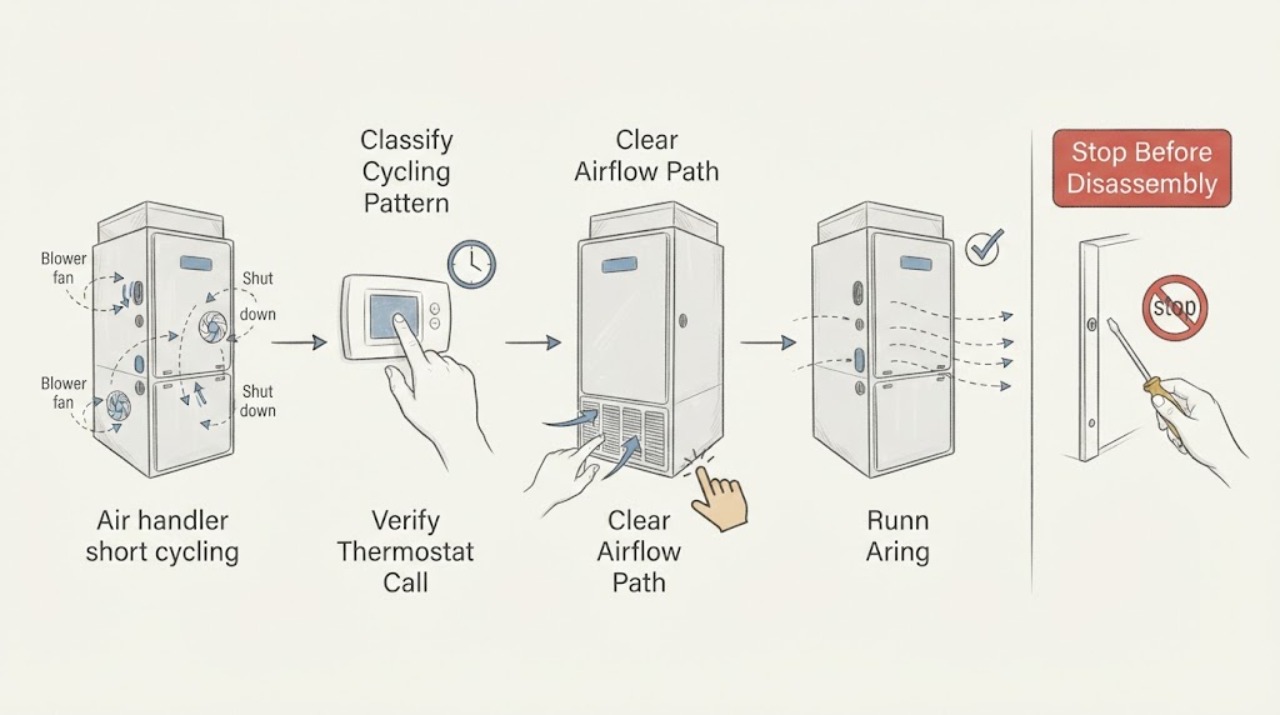
An air handler that repeatedly starts and stops may be showing a control or airflow problem, or it may be passing along short cycling from the connected air conditioner, heat pump, or heating equipment. Confirm whether only the indoor blower is cycling or the whole system is stopping, then check the thermostat mode and schedule, the accessible filter, airflow, and visible ice or condensate; stop before opening the cabinet or handling refrigerant, high-voltage wiring, heat strips, or safety controls and arrange qualified HVAC service if the pattern persists.
Work through in order
Diagnostic checks
Use only checks that match the exact appliance or system and its official guide.
-
Check 1
From a safe position, note each start and stop without removing an access panel. Compare the thermostat call, indoor blower sound, supply-air flow, and—only if it can be seen without approaching unsafe equipment—whether the outdoor unit or heating source starts at the same time. Record whether the indoor blower alone cycles or the complete heating/cooling call ends.
Expected result: The blower cycles with no active heat or cool call, the blower and outdoor unit stop together, or the system starts again after a short off period while the room is still away from the setpoint.
Next step: Use the identified pattern to choose the following checks and give the record to the technician. Do not repeatedly command the system to reproduce the symptom if it is icing, tripping a breaker, or stopping on a safety limit.
Stop if: Stop operating the system and arrange service for smoke or burning odor, a tripped breaker, exposed wiring, water near electrical equipment, unusual grinding, or rapid uncontrolled cycling.
Why this matters
Why: Blower-only cycling points toward fan settings, thermostat/control signaling, or an air-handler control path; whole-system cycling points toward airflow, coil, refrigerant, sizing, thermostat, or equipment protection causes.
-
Check 2
Check the thermostat display and settings without opening it: confirm the intended heat, cool, or off mode; confirm the fan is not set to a continuous or unusual mode; review a programmed schedule, temporary override, and any remote sensor reading. Look for a thermostat in direct sun, by a supply register, or beside a heat-producing appliance.
Expected result: The displayed mode or schedule does not match the requested operation, the fan is being commanded independently, or the thermostat is exposed to a local heat or draft source; otherwise the call appears consistent while cycling continues.
Next step: Correct only an obvious user setting and observe one normal call from a clear position. If the thermostat still calls and the system cycles, do not change installer settings, wiring, cycle limits, or control-board parameters; request service.
Stop if: Stop at the thermostat if it is loose, damaged, wet, hot, showing an error, or connected wiring is exposed; do not remove the faceplate to alter terminals.
Why this matters
Why: A wrong mode, fan command, schedule, or biased thermostat location can make the blower appear faulty or can end a system call prematurely; a correct setting with continuing cycling moves the diagnosis toward equipment or system checks.
-
Check 3
With the equipment off at the normal user control, inspect only the filter location identified by the equipment instructions. Note whether the filter is visibly loaded, collapsed, wet, or installed in the wrong direction, and compare supply airflow at several registers without blocking them or placing anything inside the cabinet.
Expected result: The filter is dirty, wet, damaged, or restrictive-looking, or airflow is much weaker than usual; alternatively, the filter is clean and airflow appears normal.
Next step: If the instructions identify a correct replacement, install only the specified type and orientation, then observe whether airflow returns to normal. If the filter is wet, airflow remains weak, or cycling continues, leave the system off as needed and arrange HVAC diagnosis.
Stop if: Stop for water on or around the air handler, a filter that cannot be removed without opening a secured cabinet, damaged insulation, exposed wiring, or a filter that is frozen to the equipment.
Why this matters
Why: A restricted filter or reduced airflow can contribute to poor cooling and short cycling and can also precede coil icing; a clean filter does not rule out a blocked coil, duct problem, blower fault, or refrigerant issue.
-
Check 4
Without opening the air-handler cabinet or touching refrigerant lines, look for visible frost or ice on accessible tubing or around the indoor unit and note unusual condensate, a wet filter, or water that is not draining as expected. Check from the floor or another stable location and do not scrape ice or use heat on the equipment.
Expected result: Ice or frost is present, cooling is weak, airflow is reduced, or condensate is excessive or collecting near the indoor unit.
Next step: Turn the cooling call off and arrange qualified service for an ice or condensate condition. Do not open the coil compartment, add refrigerant, bypass a freeze sensor, or restart repeatedly to see whether the ice returns.
Stop if: Stop immediately for ice, active water near electrical parts, a blocked drain overflowing, a refrigerant smell or hissing, or any need to access the coil or drain pan inside the cabinet.
Why this matters
Why: A frozen evaporator coil can be related to airflow restriction, coil contamination, or low refrigerant; continuing to run a frozen system can cause damage and does not identify which cause is present.
-
Check 5
Compare the symptom with the weather or heating load and with the system's history: note whether short cycling began after a thermostat change, duct or filter work, refrigerant service, equipment replacement, or a new insulation or air-sealing project. Record room temperature, humidity or comfort symptoms, and whether the issue has existed since installation without changing installer settings.
Expected result: The system reaches the setpoint very quickly with brief runs and poor humidity control, or the problem began after a change and now occurs with inadequate airflow, uneven comfort, or an unresolved service condition.
Next step: Give the timeline and observations to a qualified HVAC professional and ask for system sizing, airflow, thermostat/control sequence, coil condition, and refrigerant evaluation as applicable. Do not alter capacity settings or add/remove refrigerant yourself.
Stop if: Stop troubleshooting if the system cannot maintain safe indoor conditions, repeatedly trips protection, develops ice or water, or requires electrical, refrigerant, combustion, or sealed-cabinet access.
Why this matters
Why: Very fast temperature satisfaction can be consistent with oversizing, while a new symptom after service or an installation change needs a review of setup, airflow, controls, and charge rather than a guessed air-handler replacement.
-
Check 6
Prepare a service record with the mode, thermostat setting, fan mode, approximate sequence of starts and stops, whether the outdoor unit or heat source followed the blower, filter condition, airflow change, ice or water observations, and any recent work. Include equipment model information only as read from the exterior label; do not remove panels to obtain it.
Expected result: The record separates observed behavior from suspected causes and identifies what was not inspected because it was inside the cabinet or electrically or refrigerant connected.
Next step: Arrange qualified HVAC service if the issue persists or any stop condition is present. Ask the technician to assess the complete system rather than replacing the air handler solely because its blower is the component heard cycling.
Stop if: Do not proceed beyond external documentation when diagnosis depends on live voltage, capacitors, heat strips, refrigerant pressures, coil access, safety switches, or control wiring.
Why this matters
Why: A bounded record helps the technician reproduce and prioritize the fault without turning a homeowner check into electrical, refrigerant, or control-board work.
Use your observations
Decision map
Find the observation that best matches what you see, then follow the next safe action.
-
PATH 01Next step
What you see
Only the indoor blower starts and stops, especially when the thermostat shows no active heat or cool call.
Do this next
Check the user-visible fan mode, schedule, and thermostat location. If the settings are correct or the blower continues to cycle, arrange control and air-handler service without opening the cabinet.
-
PATH 02Next step
What you see
The indoor blower and the outdoor cooling or heat-pump equipment, or the heating call, start and stop together before comfort is reached.
Do this next
Check the thermostat settings and accessible filter, then stop repeated tests and request system-level diagnosis for airflow, coil condition, refrigerant, controls, and sizing as applicable.
-
PATH 03Next step
What you see
Visible ice, weak airflow, a wet filter, excessive condensate, or water near the indoor unit is present.
Do this next
Stop the cooling call and arrange qualified service. Do not scrape ice, open the coil cabinet, bypass a control, or add refrigerant; the underlying airflow, coil, drain, or refrigerant cause must be assessed.
-
PATH 04Next step
What you see
The fan command, mode, schedule, remote sensor, or thermostat location does not match the intended operation.
Do this next
Correct only the obvious user setting or move an obstruction from around the thermostat without changing wiring or installer parameters, then observe one normal call. If cycling remains, escalate for service.
-
PATH 05Next step
What you see
The filter is clean and correctly installed, or a permitted replacement does not restore airflow or stop short cycling.
Do this next
Do not assume the air handler motor or control is the cause. Request inspection of ducts, blower operation, coil, controls, refrigerant circuit, and equipment sizing by a qualified HVAC professional.
-
PATH 06Next step
What you see
A breaker trips, wiring is exposed, there is a burning odor, water reaches electrical parts, or the equipment makes an abnormal mechanical sound.
Do this next
Leave the equipment off if it can be done from the normal user control, keep clear, and arrange urgent qualified HVAC or electrical assessment. Do not reset repeatedly or remove panels.
Helpful context
Understand the symptom
First identify what is cycling
The air handler is the indoor section of a split system, so its blower may be reacting to a thermostat call while the outdoor compressor or heat-pump section is also cycling. A blower that runs briefly with no heating or cooling call is a different control symptom from a complete cooling or heating cycle that starts and stops quickly. Do not diagnose a failed air-handler part until those two patterns are separated.
Why short cycling matters
Frequent starts can reduce comfort and humidity control and add wear. ENERGY STAR explains that an oversized air conditioner can run for short periods without removing as much moisture, while Trane identifies thermostat placement or malfunction, incorrect system sizing, and related system issues as possible causes. Those are system-level possibilities, not proof that the air-handler motor or control board is defective.
Keep the cabinet boundary clear
A filter and thermostat check can be appropriate when they are accessible and the equipment instructions allow it. Refrigerant diagnosis, coil access, electrical testing, heat-strip work, blower-compartment work, and changes to safety or timing controls require the equipment-specific procedure and qualified service. A clean filter or a different thermostat setting does not rule out an icing, refrigerant, control, sizing, or mechanical problem.
Only after diagnosis
Potential parts
- air filter
Consider this category only when the equipment instructions identify a user-replaceable filter that is dirty, damaged, or incorrectly fitted.
Confirm the equipment instructions, dimensions, airflow direction, and filter type before replacement; a filter change does not diagnose a short-cycle control, coil, duct, or refrigerant issue. - thermostat or control component
Consider this category only after testing confirms a thermostat or control fault and a qualified professional identifies the correct repair.
Control voltage, staging, heat-pump logic, fan timing, and wiring depend on the complete HVAC system; do not select or rewire from the cycling symptom alone. - air-handler blower or airflow component
Consider this category only if a professional confirms a failed blower, motor, capacitor, wheel, or related airflow component after the filter and system checks.
Confirm the exact air-handler model, motor/control type, electrical ratings, and system airflow requirements before any part is selected or installed.
When checks do not resolve it
Need a professional?
The blower or complete HVAC system continues to short cycle after the visible thermostat and filter checks., Ice, weak airflow, a wet filter, excessive condensate, or water near the air handler is present., The breaker trips, there is a burning odor or exposed wiring, or the system makes an abnormal sound., Diagnosis would require opening the cabinet, testing voltage or capacitors, handling heat strips or safety controls, accessing the coil, or checking refrigerant., The system may be oversized or the symptom began after installation, duct, thermostat, or refrigerant work.
Common questions
FAQ
Is an air handler that turns on and off every few minutes always defective?
No. The audible blower may be responding to a thermostat or fan command, or the connected air conditioner, heat pump, or heater may be stopping for a system problem. First separate blower-only cycling from whole-system cycling and record what the thermostat is calling for.
Can a dirty filter cause the air handler to short cycle?
A restricted filter can reduce airflow and is associated with short cycling and coil-icing symptoms in cooling systems. Check only the accessible filter as the equipment instructions allow; if airflow is weak, the filter is wet, or cycling continues after a permitted replacement, arrange service.
What should I do if I see ice on the air handler?
Turn off the cooling call and arrange qualified HVAC service. Do not scrape the ice, open the coil compartment, bypass a freeze control, or add refrigerant; airflow, coil condition, drain function, and refrigerant problems require further diagnosis.
Could an oversized system cause short cycling?
Yes. ENERGY STAR and Trane describe oversized or improperly sized equipment as a possible cause of short runs and poor humidity control. A sizing conclusion needs system and building information, so do not replace the air handler based on cycling alone.
What part should I replace first?
Do not choose a blower motor, control board, thermostat, capacitor, or refrigerant component from the symptom alone. Check the visible thermostat settings and accessible filter, document the pattern, and have a qualified professional test the complete system before selecting a part.
Read the exact guide
Official sources
- Right-Sized Air Conditioners: Mechanical Equipment ImprovementsENERGY STAR, U.S. Environmental Protection Agency and U.S. Department of Energy · U.S. federal ENERGY STAR guidance on air-conditioner sizing, short cycling, humidity removal, efficiency, airflow-related maintenance issues, and wear
- Troubleshooting an AC Not WorkingCarrier · Carrier residential air-conditioning troubleshooting guidance covering indoor air-handler filters, short cycling, frozen coils, thermostat settings, and professional boundaries
- What Is HVAC Short Cycling?Trane · Trane residential HVAC explanation of short cycling, thermostat placement, system sizing, comfort effects, and service escalation
Community feedback
Share a repair observation
Share a plain-text repair observation. Accepted observations are published automatically; this page may take a moment to update.