
On this page
Start here
Quick answer
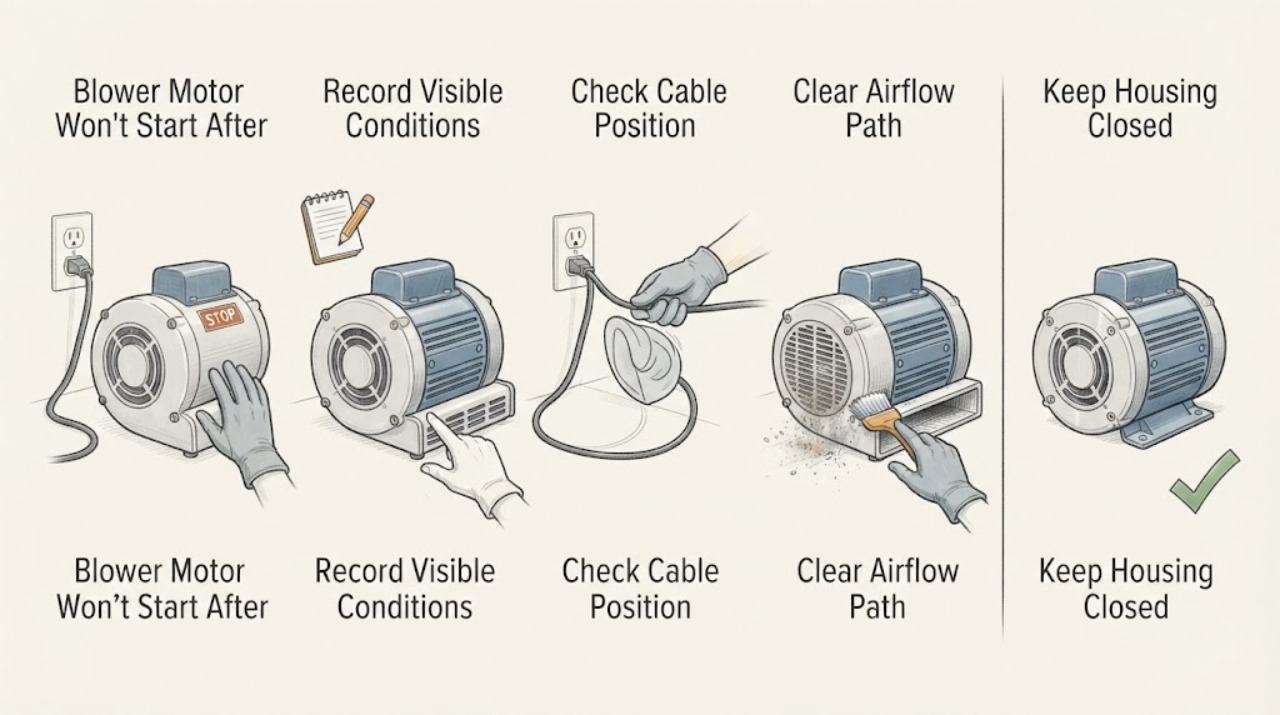
If an HVAC blower motor still will not start after someone spun the wheel manually, that hand movement does not prove the motor, capacitor, control, or power circuit is healthy. Do not repeat the hand-spin test while the equipment is connected or energized, and do not reach through a grille or access panel. First record whether the thermostat calls for heating or cooling, whether the indoor blower is silent, humming, or briefly trying, whether the outdoor unit responds, and whether the filter or return is restricted. A failed capacitor, motor, control, safety switch, or wiring can stop the blower; a frozen coil can also block airflow. Stop for burning odor, smoke, arcing, overheating, ice, repeated trips, or shock and arrange qualified HVAC service.
Before you begin
Safety first
- Keep the system off for no-start, abnormal, or severe symptoms and stay away from the blower and outdoor electrical compartments. Do not manually spin, open, touch, bypass, reset, or electrically test internal components.
Work through in order
Diagnostic checks
Use only checks that match the exact appliance or system and its official guide.
-
Check 1
Record what was spun and when: the indoor blower wheel or an outdoor fan, with the equipment disconnected or while it may have been energized. Do not repeat the hand-spin test, reach through a grille, or touch any moving or electrical part.
Expected result: The wheel was free by hand while isolated, the test conditions are unknown, the wheel felt tight or obstructed, or the outdoor fan was spun instead of the indoor blower.
Next step: Keep the equipment off and tell the HVAC technician exactly what was done. Continue only with thermostat, filter, airflow, and external response observations.
Why this matters
Why: Free movement is only a limited mechanical observation and does not test the start circuit. An unknown or energized test is unsafe. A tight or obstructed wheel can indicate a mechanical issue, but internal access is not a user repair.
-
Check 2
Read the thermostat display and visible settings. Confirm the requested mode, temperature, fan setting, schedule or hold, battery or power warning, and any delay or error. Do not remove the faceplate, handle wires, or bypass the control.
Expected result: There is no call for heating or cooling, the fan is set to a non-running mode, a schedule or delay is active, the display is blank or abnormal, or the settings appear correct.
Next step: Make only a documented user-level setting correction once and observe normally. If the blower remains stopped or the display is abnormal, call HVAC service; do not touch thermostat wiring.
Why this matters
Why: A thermostat setting, schedule, battery, sensor, or communication issue can make a blower appear not to start. Correct settings with no blower response shift attention to power, safety controls, motor, capacitor, wiring, or the equipment control.
-
Check 3
Inspect the accessible filter, return grille, and supply registers from outside the equipment. Note a loaded filter, blocked return, closed registers, weak airflow, or a clear path. Replace the filter only if the exact system instructions permit it; do not remove a blower or coil panel.
Expected result: The filter is dirty, the return is blocked, airflow was weak before the blower stopped, or the visible airflow path is clear.
Next step: Use the exact filter procedure once, then leave the system off if the blower remains stopped, the cabinet is hot, or ice is present. Call a qualified HVAC technician rather than entering the blower compartment.
Why this matters
Why: Restricted airflow can strain a blower and can contribute to overheating or coil freeze. A clear external path does not rule out a motor, capacitor, control, safety, wheel, or internal coil issue.
-
Check 4
From a safe distance, observe one normal start command only if there is no hazard. Listen for silence, a hum, a click, a brief attempt, or repeated starts, and note whether the indoor blower remains stopped and whether the outdoor unit responds. Do not cycle the system repeatedly or reset a protective device.
Expected result: The blower is silent, hums without starting, clicks, starts briefly then stops, or the outdoor unit runs while indoor airflow is absent.
Next step: Turn the system off through normal user controls and call HVAC service for any no-start, hum, repeated attempt, or absent airflow. Do not touch the motor, capacitor, control board, or wiring.
Why this matters
Why: Silence can involve a control, power, safety, or open motor circuit. A hum or brief attempt can involve a capacitor, motor, wheel, or mechanical load. Outdoor operation with no indoor airflow can freeze the coil or strain the system and needs prompt service.
-
Check 5
Look from outside the equipment for accessible ice, water, oil-like residue, an overheated-looking cabinet, damaged external grille, severe vibration, or an obstructed return or outdoor clearance. Do not scrape ice, touch refrigerant lines, remove a cover, or approach a moving fan.
Expected result: No visible abnormality is present, or there is ice, moisture, residue, overheating, damage, vibration, or blocked airflow.
Next step: Keep the system off for ice, water, residue, heat, severe vibration, or damage and request HVAC service. Clear only loose objects well away from the equipment.
Why this matters
Why: Ice can follow no indoor airflow, restricted airflow, or a refrigerant problem. Moisture or residue can signal a leak or equipment fault. Heat, damage, vibration, or blockage can worsen a no-start condition and should not be tested further.
-
Check 6
Compare heating, cooling, and fan-only response only through normal thermostat controls, without opening equipment or repeating a failed start. Record whether the blower fails in every mode, only during cooling, only during heating, or after the system has run for a while.
Expected result: The blower fails in every mode, fails only in cooling or heating, starts after a delay, or stops after warming up.
Next step: Stop repeated testing and give the mode pattern to the technician. Do not bypass a safety switch or attempt to restart a hot motor.
Why this matters
Why: Every-mode failure keeps power, motor, capacitor, control, safety, and wheel issues in scope. A mode-specific failure keeps the thermostat call, board, safety control, coil, or system sequence in scope. A delayed or heat-related stop can indicate protective operation or an overheating motor, not a successful repair.
-
Check 7
Prepare a service note with equipment model if visible without opening it, what was spun and under what safe conditions, thermostat call and mode, filter and airflow, indoor and outdoor response, start sound, delay or short-cycle pattern, ice or moisture, recent service, and any odor, heat, smoke, arcing, trip, or shock.
Expected result: The blower remains stopped, the source is uncertain, the hand-spin test was performed while energized or with unknown isolation, or an internal component would need inspection.
Next step: Request qualified HVAC service and disclose the hand-spin history. Ask for a cause diagnosis before approving a motor, capacitor, thermostat, control, compressor, or contactor replacement.
Why this matters
Why: The remaining diagnosis may require safe power isolation, motor and wheel inspection, capacitor and control testing, wiring checks, airflow evaluation, or coil and refrigerant diagnosis. These are qualified HVAC tasks.
Use your observations
Decision map
Find the observation that best matches what you see, then follow the next safe action.
-
PATH 01Next step
What you see
The blower was spun only while power was isolated, but it still remains silent when the thermostat calls for operation.
Do this next
Keep the system off and call an HVAC technician. Do not repeat the hand-spin test or open the blower compartment.
Why this path and its safety boundary
Why it matters: Free hand movement does not clear the start circuit. A control, power, safety, motor, capacitor, wiring, or command issue remains possible.
-
PATH 02Next step
What you see
The blower hums or briefly tries to start after the hand-spin observation but does not reach normal operation.
Do this next
Turn the system off and request qualified HVAC service. Do not manually assist the wheel, touch a capacitor, or keep cycling the motor.
Why this path and its safety boundary
Why it matters: A capacitor, motor, wheel load, bearing, control, or wiring fault may be involved; a hand start is not a safe repair or proof of a capacitor fault.
-
PATH 03Next step
What you see
The thermostat does not call for operation, shows a delay or error, or responds incorrectly in only one mode.
Do this next
Check only the visible settings once and call HVAC service if the call remains absent or mode-specific. Do not handle thermostat wiring or bypass controls.
Why this path and its safety boundary
Why it matters: Thermostat settings, sensor, schedule, communication, safety control, or system sequence can prevent a start without proving motor failure.
-
PATH 04Next step
What you see
The filter or return is restricted, airflow was weak, or ice appears after the blower stops.
Do this next
Replace the filter only under the exact instructions, turn the system off for ice or overheating, and call HVAC service. Do not scrape ice or open the coil compartment.
Why this path and its safety boundary
Why it matters: Airflow restriction, coil freeze, motor overheating, or refrigerant trouble may be involved and can damage the system if it continues to run.
-
PATH 05Next step
What you see
The outdoor unit runs while the indoor blower does not, or an outdoor component clicks, hums, or trips.
Do this next
Stop the cooling call and request urgent HVAC service. Do not approach the outdoor electrical compartment or reset a trip to repeat the test.
Why this path and its safety boundary
Why it matters: The thermostat call may reach part of the system while an indoor motor, control, capacitor, outdoor contactor, compressor, or protection circuit fails.
-
PATH 06Next step
What you see
There is smoke, burning odor, electrical odor, arcing, rapid heating, severe vibration, refrigerant or oil spray, a breaker trip, or shock.
Do this next
Leave the area and keep people away. Use emergency help for smoke, fire, active arcing, or injury; otherwise obtain urgent HVAC service. Do not approach or energize the equipment.
Why this path and its safety boundary
Why it matters: This is an immediate fire, electrical, pressure, or injury hazard and ordinary blower troubleshooting must stop.
Helpful context
Understand the symptom
A hand-spin result is not an electrical diagnosis
If the blower wheel was spun by hand while power was isolated, free movement may rule out only an obvious hard obstruction at that instant. It does not prove that the motor receives a start command, that the capacitor can start it, or that a safety control allows operation. Never repeat the test through an opening or while the system is energized.
Separate no airflow from a cooling failure
No air from the vents points toward the indoor blower, power, filter, control, motor, or a frozen coil. Air that moves but is warm points toward the thermostat call, outdoor unit, coil, refrigerant circuit, compressor, or contactor. The thermostat and filter are visible user checks; internal equipment is professional work.
Keep the blower and electrical compartment closed
HVAC motors and capacitors can involve high voltage and stored charge, while a compressor can involve pressurized refrigerant and oil. Do not touch the wheel, motor, capacitor, contactor, wiring, coil, or compressor, and do not keep cycling a system that will not start.
Safety boundary
Stop conditions
- Stop immediately for smoke, fire, burning or electrical odor, arcing, rapid heating, refrigerant or oil spray, shock, repeated protective-device trips, severe vibration, grinding, or a hard mechanical impact. Leave the area and obtain emergency or qualified HVAC help as appropriate.
- Do not manually spin the blower or fan while the equipment is connected or energized. Do not remove panels, reach into a grille, touch the motor, capacitor, control board, contactor, compressor, wiring, coil, or refrigerant line.
- Stop the system for weak or absent airflow with ice, overheating, water, residue, short cycling, or an outdoor unit running without indoor airflow. Do not scrape ice, bypass a safety control, or keep cycling the equipment.
- Do not infer a failed capacitor or motor from a hand-spin result. The start command, power, safety controls, motor, capacitor, wheel, airflow, and system sequence require safe professional diagnosis.
Only after diagnosis
Potential parts
- blower motor or wheel assembly
Consider only when professional diagnosis isolates the no-start condition to the indoor motor, wheel, bearing, mount, or related assembly after the control, power, capacitor, and airflow paths are evaluated.
Motor type, speed control, wheel dimensions, mounting, rotation, and system configuration must be confirmed by qualified HVAC service. - run capacitor
Consider only when qualified testing identifies a capacitor fault contributing to the blower motor's failure to start or run.
A capacitor can retain dangerous charge and its rating is system-specific; selection, discharge, and installation belong to qualified service. - thermostat or HVAC control
Consider only when the thermostat call, sensor, communication, or control sequence is shown to be absent or incorrect after safe system checks.
System type, staging, heat-pump behavior, wiring, programming, and safety controls must be confirmed by a qualified technician. - contactor or compressor service
Consider only when professional diagnosis shows the outdoor contactor or compressor prevents cooling operation or creates a symptom mistaken for an indoor blower no-start.
Electrical ratings, high-voltage isolation, refrigerant handling, compressor selection, and commissioning require qualified HVAC service.
When checks do not resolve it
Need a professional?
Call after recording the test conditions, thermostat call, filter, airflow, indoor and outdoor response, sounds, timing, and visible clues, or immediately for smoke, odor, heat, arcing, shock, trips, ice, severe vibration, or refrigerant or oil release.
Safety scope: Keep the system off for no-start, abnormal, or severe symptoms and stay away from the blower and outdoor electrical compartments. Do not manually spin, open, touch, bypass, reset, or electrically test internal components.
Common questions
FAQ
Does a blower that spins by hand have a good motor?
No. Hand movement, if it was done with power safely isolated, shows only limited mechanical freedom at that moment. It does not test the start command, capacitor, motor windings, controls, safety circuit, or wiring. Do not repeat the hand-spin test while connected or energized.
What if the blower hums after I spun it manually?
A hum or brief attempt can involve a capacitor, motor, wheel load, bearing, control, or wiring fault. Do not assist the wheel, touch a capacitor, or keep cycling the system; turn it off and call an HVAC technician.
Could the thermostat stop a blower from starting?
Yes. A wrong mode, setpoint, schedule, sensor, delay, battery, or communication fault can prevent a cooling call. Check visible settings once without handling wiring. If the call is correct but the blower stays stopped, the equipment needs professional diagnosis.
Can I test or replace the blower capacitor myself?
No. HVAC capacitors can retain dangerous charge, and the motor, wiring, and control system are model-specific. Leave testing, discharge, selection, and replacement to qualified HVAC service.
When should I stop running the HVAC system?
Stop for smoke, burning or electrical odor, arcing, shock, rapid heating, severe vibration, repeated trips, ice with absent airflow, water, refrigerant or oil spray, or a blower that will not start. Keep clear and obtain emergency or qualified HVAC help as appropriate.
Read the exact guide
Official sources
- HomeCooling101U.S. Department of Energy · DOE consumer cooling guide; exact equipment and service requirements vary.
- Can a Bad Thermostat Have Heat But Not CoolTrane · Trane thermostat guidance used for general control concepts; exact systems and wiring vary.
- AC Fan Not Spinning? Here’s Why and How to Fix ItCarrier · Carrier residential AC guidance; exact equipment behavior and service boundaries vary.
- Terminal VentingCopeland US · Compressor safety guidance for HVACR service; it is not a homeowner diagnostic procedure.
- Furnace Blower Motor Repair & Replacement GuideCarrier · Carrier furnace guidance used for general blower concepts; exact equipment manuals and service procedures vary.
- AC Unit Not Turning On? Troubleshooting Steps & SolutionsCarrier · Carrier residential AC guidance; exact equipment and service procedures vary.
Community feedback
Share a repair observation
Share a plain-text repair observation. Accepted observations are published automatically; this page may take a moment to update.