
On this page
Start here
Quick answer
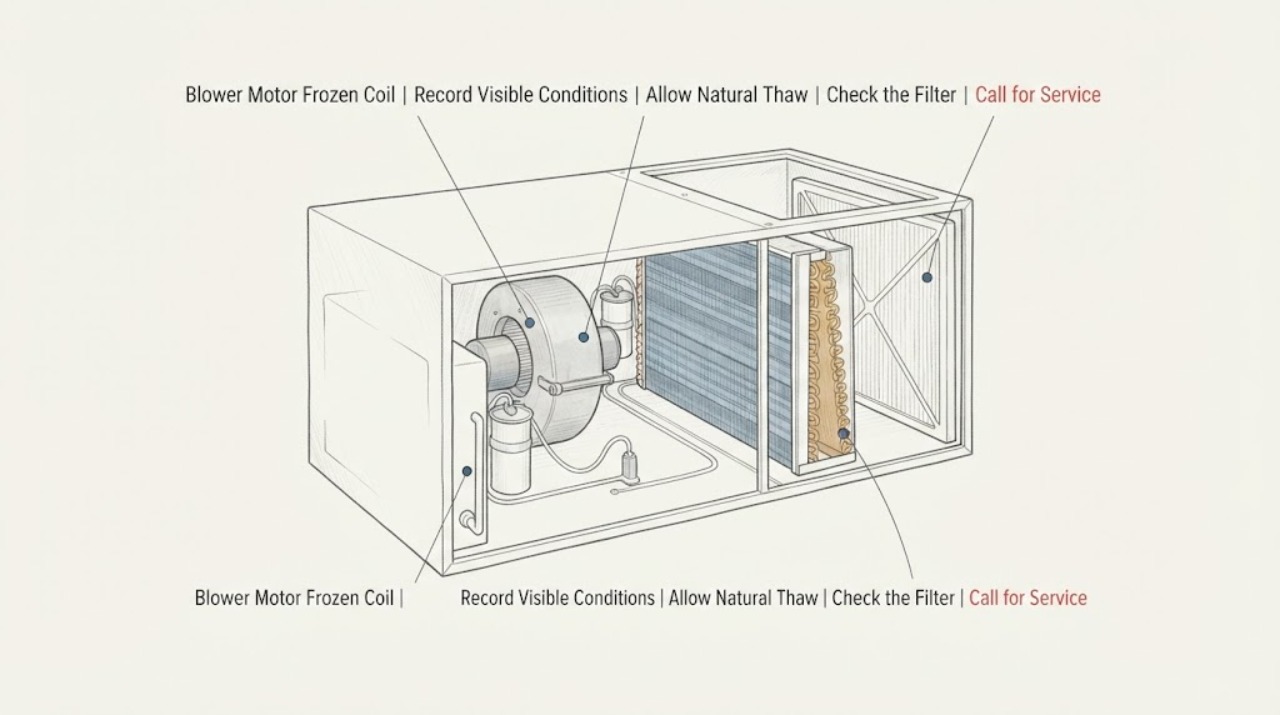
A frozen evaporator coil around an air-handler blower is usually a symptom of restricted airflow, a blower or control problem, or a cooling-side condition such as low refrigerant; a dirty filter is only one possible cause. Turn the cooling call off and let the ice thaw naturally, without chipping it or pouring hot water on it. From safe, dry access, check the accessible filter, return and supply airflow, and visible condensate or water. If water reaches electrical equipment, the system smells scorched, smokes, arcs, repeatedly trips protection, or the coil freezes again after thawing and a filter correction, leave the system off and call a qualified HVAC professional. Do not open the air handler, handle a capacitor, test live voltage, disturb the coil, or work on refrigerant or high-voltage parts.
Work through in order
Diagnostic checks
Use only checks that match the exact appliance or system and its official guide.
-
Check 1
From a safe, dry position, note whether ice or frost is visible on the indoor coil cabinet or accessible refrigerant tubing, whether the blower is moving air, and whether the thermostat is calling for cooling; then set the thermostat cooling mode to OFF using the normal control and record the time without opening the equipment.
Expected result: Ice is present with weak or absent airflow, ice is present with normal-looking airflow, the coil is already thawed, or water is pooling below the indoor unit.
Next step: Keep cooling OFF and allow natural thawing. If the area is wet near electrical equipment, stop accessing it and arrange HVAC service; do not chip ice, pour hot water, or restart to test.
Stop if: Stop immediately for smoke, burning odor, arcing, unsafe heat, exposed wiring, standing water at electrical equipment, or a protective-device trip.
Why this matters
Why: Visible ice confirms a frozen-coil symptom but not a failed blower motor. Weak airflow raises restricted-filter, return, blower, or frozen-coil possibilities; ice with apparently normal airflow keeps coil, refrigerant, thermostat, and cooling-side causes open. Water may be meltwater or a condensate problem and changes the safety decision.
-
Check 2
Leave the cooling call off until all visible ice has melted naturally; use fan-only only if the thermostat and equipment instructions support it and the area is dry, and place protection near—not inside—the unit for meltwater.
Expected result: The ice clears and the area stays dry, meltwater overflows or reaches a pan or floor, the blower is silent, or the coil does not thaw without cabinet access.
Next step: Keep the system off and call HVAC service for overflow, recurring water, a silent blower, or inaccessible ice. Do not use a heater, hair dryer, hot water, scraper, or chemical cleaner on the coil or drain.
Stop if: Do not continue near standing water, wet wiring, hot equipment, smoke, burning odor, or an electrical sound; do not remove panels or the condensate pan.
Why this matters
Why: A complete thaw is needed before airflow observations are meaningful. Meltwater or a full pan can indicate condensate or drainage trouble, while a silent blower may be a motor, capacitor, control, power, or frozen-coil issue. A coil that cannot be safely observed or thawed is not a homeowner disassembly task.
-
Check 3
After the area is dry and only if the filter has ordinary user access, inspect the filter for dense dust, moisture, collapse, incorrect seating, or an airflow arrow facing the wrong way; compare its size with the label or exact manual and do not reach past the filter opening.
Expected result: The filter is visibly restricted or wet, it is clean and correctly seated, or reaching it would require an equipment-panel removal.
Next step: Replace or clean the accessible filter only as the exact equipment instructions allow, using the same specified size and direction. If the coil froze, airflow remains weak, or the issue recurs, keep cooling off and request HVAC diagnosis.
Stop if: Do not run without the required filter, force a filter into a track, use an improvised size, remove a cabinet panel, or handle the blower, capacitor, coil, or wiring.
Why this matters
Why: A clogged or wet filter can reduce airflow and contribute to coil freezing, but a clean filter does not rule out blocked returns, a dirty evaporator coil, a blower motor or capacitor, controls, or low refrigerant. A filter that requires cabinet access is outside this check.
-
Check 4
From the room side, compare several supply registers and the return grille after thawing, noting whether airflow is absent, weak everywhere, weak in one zone, or normal; clear only furniture, curtains, or other loose room-side obstructions without inserting tools or changing internal dampers.
Expected result: All registers have little or no airflow, only one room or zone is weak, the return is blocked, or airflow is normal after thawing but cooling is still poor.
Next step: Record the locations and whether airflow changed after a safe obstruction was removed. Arrange HVAC service for absent or weak airflow, and do not assume the blower motor or capacitor from airflow alone.
Stop if: Do not remove registers or duct covers, reach into ducts, alter dampers, or continue if there is water, smoke, burning odor, arcing, abnormal heat, or a repeated trip.
Why this matters
Why: Weak airflow everywhere supports a filter, return, frozen-coil, blower, control, or protection branch. A single-zone problem can involve a grille, damper, duct, or zone path. Normal airflow with poor cooling keeps the outdoor unit, coil, refrigerant, thermostat, and other cooling-side causes open.
-
Check 5
With cooling still OFF, look only from safe external access for a full or damaged condensate pan, continuing drip, wet insulation, a condensate alarm, or visible dirt at an exposed filter-side surface; do not open the coil cabinet, touch refrigerant tubing, or pour anything into a drain.
Expected result: There is no visible water, meltwater is draining normally, water is overflowing or recurring, or the coil surface is dirty but not safely accessible.
Next step: Keep the unit off for overflow, recurring water, inaccessible dirt, or a full or damaged pan and include photos from a safe distance with the service request. Only clean loose room-side dust that the manual explicitly permits.
Stop if: Stop for water near electrical equipment, exposed wiring, mold or sewage-like contamination, a damaged cabinet, smoke, burning odor, or any need to enter the air handler.
Why this matters
Why: Meltwater after a freeze can expose a drainage or pan issue, and recurring water can damage the surrounding structure. Visible dirt may restrict airflow, but safely identifying or cleaning an internal evaporator coil, condensate protection, refrigerant circuit, or high-voltage assembly requires HVAC judgment.
-
Check 6
After a complete thaw and any allowed filter correction, document whether the coil freezes again, the cycle timing, indoor airflow, outdoor-unit response from a safe distance, thermostat display, water, noise, and any breaker or disconnect event; do not deliberately restart a system that has a hazard or repeat a protective-device reset.
Expected result: Cooling works without renewed ice, ice returns, airflow remains weak, the blower is silent or noisy, the outdoor unit is abnormal, or the system trips protection.
Next step: Keep cooling off for recurrence or any abnormal behavior and give the HVAC technician the recorded pattern. Ask for airflow, coil, condensate, blower, electrical, and refrigerant diagnosis rather than ordering a part from the symptom alone.
Stop if: Do not open panels, test live voltage, handle a capacitor, touch the blower motor or coil, recover or add refrigerant, or restart after smoke, burning odor, arcing, water near electricity, or a repeated trip.
Why this matters
Why: No recurrence after a correctly fitted accessible filter supports an airflow-maintenance cause but does not prove it. Recurring ice or abnormal blower behavior can involve the evaporator coil, blower motor, capacitor, controls, duct restrictions, condensate protection, or refrigerant. A trip or electrical symptom is a stop event.
Use your observations
Decision map
Find the observation that best matches what you see, then follow the next safe action.
-
PATH 01Safety boundary
What you see
Smoke, burning odor, arcing, unsafe heat, exposed wiring, standing water at electrical equipment, gas symptoms, or a protective device trips.
Do this next
Stop using the system. From a safe position use an accessible normal control only if doing so does not require approaching the hazard, then obtain qualified HVAC or electrical help; use emergency response for fire, smoke, shock, or an immediate danger.
Why this path and its safety boundary
Why it matters: This is a safety event, not a filter or frozen-coil diagnosis.
Safety stop: Do not touch wet or hot equipment, open panels, reset protection repeatedly, or restart to reproduce the symptom.
-
PATH 02Safety boundary
What you see
The coil is frozen and the accessible filter or room-side return path is visibly restricted.
Do this next
Leave cooling OFF, let the coil thaw naturally, correct only the accessible filter or loose room-side obstruction permitted by the manual, and arrange service if airflow does not return or ice recurs.
Why this path and its safety boundary
Why it matters: Restricted airflow is a supported possible cause, but the ice and the restriction must be addressed without damaging the coil.
Safety stop: Do not chip ice, pour hot water or chemicals, run without a filter, or enter the air handler.
-
PATH 03Safety boundary
What you see
The filter is clean and correctly fitted, or replacing it does not restore airflow and the coil later freezes again.
Do this next
Keep the cooling system off and request HVAC diagnosis. Give the technician the recurrence pattern and do not choose a blower motor, capacitor, coil, or refrigerant service from the symptom alone.
Why this path and its safety boundary
Why it matters: A clean filter does not rule out a blocked internal coil or duct, a weak blower, capacitor or control fault, condensate protection, thermostat issue, or low refrigerant.
Safety stop: Do not remove panels, test electrical components, adjust refrigerant, or continue restarting the system.
-
PATH 04Safety boundary
What you see
Meltwater overflows, a pan is full or damaged, water recurs, or water reaches the floor near electrical equipment.
Do this next
Keep cooling OFF, keep people away from wet electrical areas, protect finishes only from a dry safe position, and call HVAC service for the drain, pan, coil, and protection system.
Why this path and its safety boundary
Why it matters: Thawing ice can reveal condensate drainage or pan trouble, and water near electrical equipment creates a separate hazard.
Safety stop: Do not operate near standing water, remove a pan, pour drain chemicals, open the cabinet, or touch wet wiring.
-
PATH 05Safety boundary
What you see
The filter and room-side airflow path are clear, but the blower is silent, weak, noisy, or repeatedly stops while the thermostat calls for cooling.
Do this next
Keep the system off when airflow is absent or abnormal and request qualified HVAC service for the blower assembly and controls.
Why this path and its safety boundary
Why it matters: The blower motor, capacitor, controls, power, or a frozen coil may be involved; these cannot be distinguished safely by a homeowner sound check.
Safety stop: Do not handle a capacitor, open the air handler, measure live voltage, touch moving parts, or bypass a safety device.
-
PATH 06Safety boundary
What you see
Airflow is normal after thawing and filter checks, but cooling is poor or ice returns without an obvious accessible airflow restriction.
Do this next
Keep the system off if ice returns and arrange HVAC service for coil, refrigerant, outdoor-unit, and control diagnosis. Do not add refrigerant or open the sealed system.
Why this path and its safety boundary
Why it matters: Low refrigerant, a leak, a dirty internal coil, outdoor-unit fault, thermostat issue, or another cooling-side problem remains possible.
Safety stop: Do not troubleshoot refrigerant, high-voltage, compressor, coil, or electrical faults yourself.
Helpful context
Understand the symptom
A frozen coil is a symptom, not proof that the blower motor failed
The evaporator coil sits in or beside many residential air handlers, while the blower moves household air across it. If airflow is restricted, the coil is dirty, the blower is not moving enough air, or the refrigerant side has a problem, the coil can ice over. Ice then blocks airflow further and can produce water when it thaws. A frozen coil by itself cannot identify the blower motor, capacitor, evaporator coil, filter, or refrigerant as the failed part.
Thaw first and keep the check external
Switch the thermostat cooling call off and let the ice melt naturally. If the thermostat instructions support fan-only operation, that can move room-temperature air while cooling remains off, but do not run the system if water is reaching electrical equipment or the fan produces a dangerous symptom. Never chip, scrape, drill, or heat the ice, and do not open the cabinet to speed the process. Protect nearby finishes from meltwater without touching wet wiring or equipment.
The filter branch is useful only when the filter is accessible and dry
A heavily loaded, wet, collapsed, or incorrectly seated filter can restrict airflow. Inspect or replace a filter only through the ordinary access described by the exact equipment instructions, preserving its size and airflow arrow. A clean filter does not clear a frozen coil, weak blower, failed capacitor, dirty internal coil, blocked duct, condensate protection fault, or refrigerant issue. Those conditions belong in the HVAC service request.
Recurring ice changes the decision
If the coil freezes again after a complete thaw and an accessible filter or grille correction, stop restarting it. Recurrence can indicate a blower or control fault, an obstructed coil or duct, condensate or freeze protection, or low refrigerant. The technician should diagnose the cause rather than simply adding refrigerant or replacing a guessed part.
Safety boundary
Stop conditions
- Stop using cooling and do not restart if visible ice is accompanied by water near electrical equipment, smoke, burning odor, arcing, unsafe heat, exposed wiring, or a repeated protective-device trip.
- Do not chip, scrape, drill, heat, or pour hot water on the frozen coil; let it thaw naturally with cooling off.
- Do not remove the air-handler cabinet or coil panels, handle a capacitor or blower motor, test live voltage, touch moving parts, or work on high-voltage or sealed refrigerant components.
- Keep the system off and call qualified HVAC service if ice returns after a complete thaw and allowed filter correction, airflow stays weak, water recurs, or the cause is not clear.
Only after diagnosis
Potential parts
- air filter
Only consider an air filter after the accessible filter is visibly loaded, wet, collapsed, or otherwise due for replacement and the exact size and airflow direction are confirmed.
Confirm the equipment manual or the existing filter label for the exact size, type, and airflow direction; a filter is not a substitute for diagnosing recurring ice. - blower motor or capacitor
Only a qualified HVAC diagnosis may establish that an abnormal blower response is caused by the motor or capacitor rather than a frozen coil, control, power, or airflow condition.
Do not order or handle these electrical parts from the symptom alone; confirm exact model fit and professional installation requirements. - evaporator coil or condensate component
Only consider a coil, pan, drain, or protection component after a qualified technician confirms the corresponding leak, drainage, freeze, or coil condition.
Confirm the exact air-handler model and system design with the HVAC professional; do not open the sealed or high-voltage sections.
When checks do not resolve it
Need a professional?
Call a qualified HVAC professional immediately for visible ice that persists or returns, weak or absent blower airflow, recurring water, a full or damaged condensate pan, suspected refrigerant or coil trouble, abnormal outdoor-unit response, or any issue that cannot be checked through ordinary dry access.
Have this ready
- Provide the air-handler make and model, thermostat mode and set temperature, when the ice appeared, whether cooling was turned off, filter size and condition, room-side airflow, visible water, recurrence after thawing, outdoor-unit response, unusual sounds or odors, and any protection trip. Do not provide or request a part diagnosis from the symptom alone.
Common questions
FAQ
Should I run the air handler if its evaporator coil is frozen?
No. Turn the cooling call off and let the ice thaw naturally. If the thermostat and equipment instructions support fan-only operation, it may help thaw the coil while cooling stays off, but do not operate near standing water or an electrical hazard. If the ice returns, keep the system off and call HVAC service.
Can a dirty filter freeze the coil around the blower motor?
Yes, a dirty or clogged filter can restrict airflow and contribute to freezing, but it is not proof that the filter is the only cause. After thawing, replace an accessible filter only with the specified size and airflow direction. Recurring ice needs professional diagnosis for airflow, coil, blower, condensate, thermostat, and refrigerant causes.
Can I chip the ice or pour hot water on a frozen coil?
No. Do not chip, scrape, drill, heat, or pour hot water on the coil. Let it thaw naturally with cooling off. A damaged coil, meltwater near electrical equipment, or a coil that will not safely thaw requires HVAC service.
Does a frozen coil prove the blower motor or capacitor is bad?
No. A frozen coil can follow restricted airflow, a blower or control problem, a dirty internal coil, thermostat trouble, or a refrigerant condition. The blower motor, capacitor, coil, high-voltage controls, and refrigerant circuit require qualified HVAC diagnosis; do not open the air handler or test live parts.
Read the exact guide
Official sources
- Air Handlers MaintenanceTrane · Trane residential air-handler filter access, size and airflow direction, airflow maintenance, condensate, motor, noise, and professional-maintenance boundaries
- Air Handler Troubleshooting - Contact a Local DealerTrane · Trane residential air-handler troubleshooting for dirty filters, frozen coils, blower motors, power, and professional service
- Will Frozen AC Fix Itself? | Guide to Frozen AC CoilsCarrier · Carrier residential frozen-coil causes, safe thawing, filter and airflow checks, water observation, and recurrence escalation
- Air Handler Freezing Up: Causes and SolutionsTrane · Trane residential air-handler frozen-coil symptoms, safe thawing, airflow causes, filter maintenance, refrigerant boundary, and professional service guidance
- Why Is My AC Leaking Water | Air Conditioner LeakingCarrier · Carrier residential AC water-leak causes, frozen-coil meltwater, filter and drainage observations, and stop-use guidance
- Troubleshoot an Air Conditioner | AC TroubleshootingCarrier · Carrier residential air-handler and AC troubleshooting for filters, airflow, frozen evaporator coils, refrigerant, outdoor-unit, electrical, and service boundaries
- Air Handler Fan Not Working: Causes and SolutionsTrane · Trane residential air-handler fan troubleshooting for filter, thermostat, power, capacitor, blower motor, wiring, and frozen-coil boundaries
- Coil Troubleshooting - TraneTrane · Trane residential coil freezing, filter and airflow observations, natural defrost, water leakage, and refrigerant-service guidance
Community feedback
Share a repair observation
Share a plain-text repair observation. Accepted observations are published automatically; this page may take a moment to update.