
On this page
Start here
Quick answer
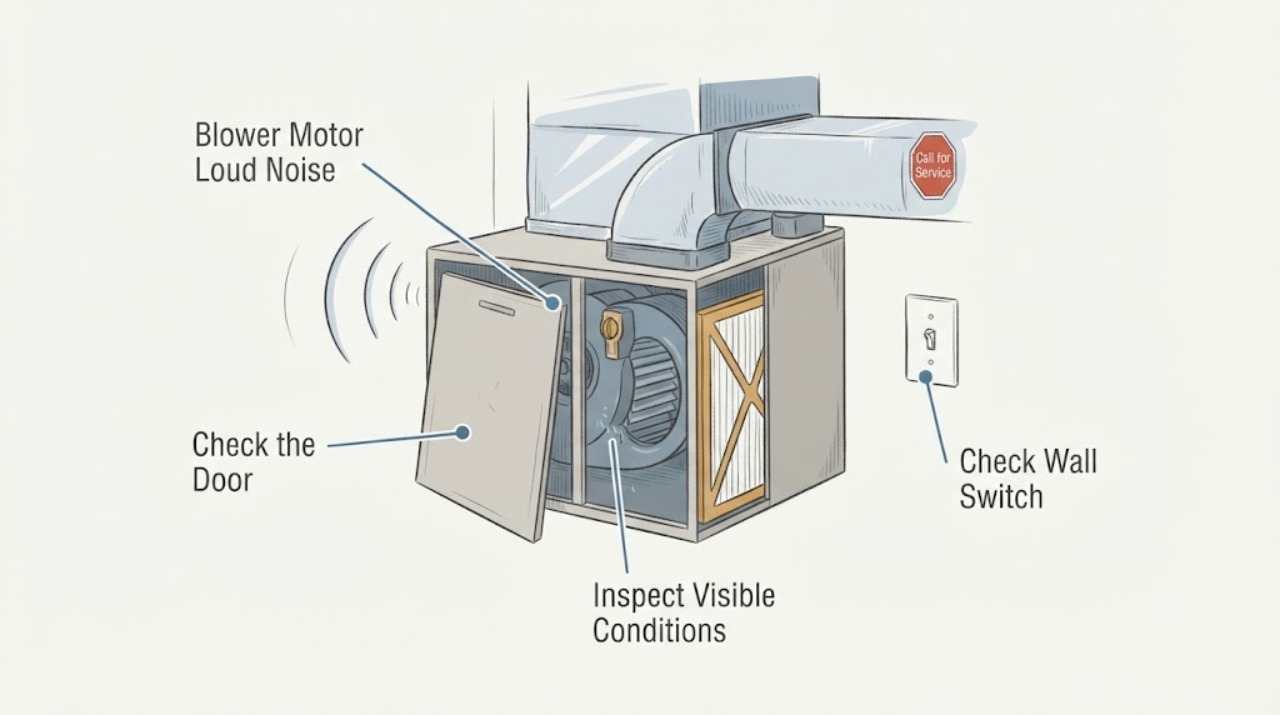
A new or unusually loud noise from the indoor blower is not something to diagnose by opening the air handler. Humming can come from a blower motor or another motor, while rattling, grinding, squealing, or banging can involve the blower wheel, worn bearings, a loose internal part, a capacitor, or airflow restriction. First note where and when the sound occurs, then check only the user-accessible filter, return grille, and supply registers with the system off or at the thermostat. If the noise is sudden, grows louder, comes with weak airflow, vibration, overheating, a burning smell, a tripped breaker, or a blower that stops, turn the HVAC system off and call a qualified technician. Do not remove panels, touch the motor or capacitor, reach into the blower, or run repeated cycles to reproduce the noise.
Work through in order
Diagnostic checks
Use only checks that match the exact appliance or system and its official guide.
-
Check 1
Identify the noise from a safe position without touching the equipment: note whether it comes from the indoor air handler or a register, whether it is a low hum, high-pitched squeal, rattle, grinding sound, or bang, and whether it starts at startup, continues while running, or occurs at shutdown.
Expected result: The noise is suddenly louder than usual, is continuous, occurs only at startup or shutdown, or is accompanied by vibration, weak airflow, or a change in heating or cooling.
Next step: If the noise is forceful, worsening, or accompanied by weak airflow, vibration, heat, odor, smoke, or a tripped breaker, switch the system off and stop testing. Otherwise record the sound and continue only with the external airflow check.
Why this matters
Why: A new or loud indoor noise should be treated as a service symptom rather than normal operation. Timing and sound type help a technician distinguish blower motor or wheel, loose component, airflow, capacitor, control, or another system path, but do not prove which part is bad.
-
Check 2
With the HVAC system not actively heating or cooling, inspect the user-accessible air filter, return grille, and supply registers. Look for a heavily loaded filter, furniture or covering over a return, or a blocked register; do not remove an air-handler panel or reach toward the blower wheel.
Expected result: The filter is visibly dirty, a return or register is blocked, or the accessible airflow path is clear.
Next step: Replace only a user-accessible filter with the type and size specified by the equipment manual and clear room-level obstructions. If the noise remains, the filter is clear, or the system has weak airflow, keep the system off as needed and arrange HVAC service.
Why this matters
Why: A dirty filter or blocked return can restrict airflow and make the blower work harder, while a blocked supply register can change system pressure and noise. A clear filter and registers do not rule out a worn motor, wheel, bearing, duct problem, loose internal part, or control fault.
-
Check 3
Read the thermostat's fan setting and note whether the noise is present only when the blower is commanded to run, continues after the heating or cooling call ends, or occurs while the thermostat is off. Do not repeatedly switch modes to provoke the sound and do not remove the thermostat or equipment cover.
Expected result: The fan is set to run continuously, the noise follows a normal heating or cooling call, the blower continues with the thermostat off, or the noise occurs only during a brief startup or shutdown.
Next step: Record the setting and timing for the technician. If the blower runs unexpectedly, the noise is new or loud, or the system does not stop normally, leave the HVAC system off and schedule qualified service rather than changing wiring or controls.
Why this matters
Why: A continuous fan setting can explain continued airflow but not a newly loud mechanical sound. Noise with the blower call, noise that persists when the thermostat is off, and startup or shutdown noise point to different control, motor, wheel, duct, or system conditions that require professional interpretation.
-
Check 4
From outside the closed equipment cabinet and without touching it, look for visible vibration, a displaced external cover, water below the unit, dust or debris at an accessible grille, or a burning odor, smoke, heat, or electrical buzzing. Do not remove the panel, place a hand on the cabinet, or look inside while the blower is running.
Expected result: The cabinet or nearby duct visibly vibrates, an external cover is displaced, water is present, or there is heat, odor, smoke, buzzing, or no visible abnormality.
Next step: Turn the system off if it is running and arrange qualified HVAC service. For smoke, flame, strong burning odor, or immediate electrical danger, leave the area and contact emergency responders; do not restore power or open the equipment.
Why this matters
Why: Vibration can be transmitted by a blower wheel, motor, duct, or loose component; water can affect equipment and nearby electrical parts. Heat, smoke, odor, or buzzing is a safety boundary. A normal exterior does not clear internal bearings, wheel balance, capacitor, wiring, or motor faults.
-
Check 5
Record related performance without disassembling anything: whether airflow is weak or uneven, the system short-cycles, a breaker trips, the blower stops, the indoor coil is iced, or the noise returns after a filter change. Do not reset a tripped breaker repeatedly or run a noisy system for an extended observation.
Expected result: The loud noise is paired with weak airflow, repeated stops, icing, a breaker trip, overheating, a burning smell, or no other performance change.
Next step: Keep the HVAC system off for persistent, paired, or safety-related symptoms and give the technician the timing and observations. Do not attempt motor, bearing, capacitor, wiring, coil, or refrigerant work.
Why this matters
Why: Noise plus weak airflow or icing can involve airflow restriction or a blower problem; repeated stops or breaker trips can indicate an electrical or control fault; overheating or a burning smell raises urgency. Noise without another symptom still warrants service when it is new, loud, or worsening.
Use your observations
Decision map
Find the observation that best matches what you see, then follow the next safe action.
-
PATH 01Next step
What you see
The noise is new, suddenly louder, or comes with rattling, grinding, squealing, or excessive vibration
Do this next
Turn the HVAC system off and arrange qualified service for the blower wheel, motor, bearings, loose components, ductwork, and controls. Do not open the cabinet or run repeated cycles.
-
PATH 02Next step
What you see
A dirty filter or blocked room-level return or register is visibly present and there is no heat, odor, smoke, water, or electrical warning sign
Do this next
Replace the accessible filter according to the equipment manual and clear only the room-level obstruction. If the loud noise or weak airflow remains, keep the system off as needed and call an HVAC technician.
-
PATH 03Next step
What you see
The blower continues with the thermostat off, starts and stops abnormally, or the noise follows a control setting
Do this next
Leave the system off and arrange professional diagnosis of the thermostat, fan control, safety switch, motor, and control board. Do not remove the thermostat or change wiring.
-
PATH 04Next step
What you see
Loud noise is accompanied by weak airflow, an iced coil, water below the unit, repeated breaker trips, or overheating
Do this next
Stop the system and arrange prompt HVAC service. The combined symptoms can involve airflow, blower, condensate, electrical, or refrigeration faults; do not keep operating it to collect more evidence.
-
PATH 05Next step
What you see
There is smoke, flame, a burning smell, active arcing, a hot enclosure, exposed wiring, or water contacting electrical equipment
Do this next
Leave the area and keep people away. Contact emergency responders for fire or immediate danger and arrange qualified HVAC or electrical service after the equipment is safe; do not touch, restore power, or open the cabinet.
Helpful context
Understand the symptom
Use the sound as a branch, not a diagnosis
A blower motor is one part of the indoor air-moving assembly. Humming, rattling, grinding, squealing, and banging can come from different parts, and a dirty or restrictive filter can change the motor's load without the motor being the failed component. The most useful homeowner evidence is the sound's location, timing, airflow effect, and whether it began suddenly.
Stop before the cabinet becomes part of the test
Keep the air handler, furnace, and blower compartment closed. Do not remove an access panel, spin a wheel by hand, touch a capacitor, tighten an internal fastener, oil a motor, or use a meter. If there is a burning smell, smoke, electrical buzzing, visible heat, or water near equipment, turn the system off from a safe control and obtain urgent professional help.
Only after diagnosis
Potential parts
- indoor blower motor assembly
Consider this only after a qualified HVAC technician confirms that the motor is the source of the loud noise and that the rest of the blower assembly and airflow path are suitable.
Confirm the equipment model, motor type, control method, wheel, mounting, and electrical requirements through the technician and manufacturer information; do not choose a motor by sound or appearance. - HVAC blower wheel
Consider this only if professional inspection finds a damaged, unbalanced, obstructed, or improperly fitted wheel after ruling out filter, duct, motor, and control causes.
Confirm wheel diameter, width, rotation, hub, mounting, and equipment model before ordering; installation requires safe access and alignment by a qualified technician.
When checks do not resolve it
Need a professional?
Use professional HVAC service for sudden or persistent noise, vibration, weak airflow, repeated stops, breaker trips, icing, water, electrical symptoms, or any diagnosis involving the blower motor, wheel, capacitor, wiring, coil, or controls.
Common questions
FAQ
Does a loud blower noise mean the motor must be replaced?
No. Humming, rattling, grinding, squealing, or banging can involve the blower motor, wheel, bearings, loose parts, filter or airflow, ductwork, capacitor, or controls. Record the sound and timing, check only the accessible filter and registers, and have a technician identify the failed component.
Can a dirty filter cause a loud blower motor?
A loaded filter can restrict airflow and make the blower work harder, and a restrictive airflow path can contribute to noise. Replace only a user-accessible filter with the manual-specified type and size; if noise or weak airflow remains, keep the system off as needed and call an HVAC professional.
Is it safe to open the air handler to find the noise?
No. Do not remove panels, reach into the blower, touch the motor or capacitor, tighten internal parts, or use a meter. HVAC blower repairs involve moving parts and electrical hazards; use a qualified technician for cabinet access and diagnosis.
What if the loud blower noise comes with weak airflow or ice?
Turn the cooling system off and do not keep running it. A frozen coil can result from restricted airflow, blower problems, thermostat issues, or low refrigerant, and the combined noise and airflow symptom needs professional HVAC diagnosis after the coil is allowed to thaw naturally.
Read the exact guide
Official sources
- Furnace Blower Motor Repair & Replacement GuideCarrier · The opened Carrier guide identifies unusual grinding, squealing, or banging, weak airflow, overheating, smoke, and electrical or capacitor concerns as reasons for professional diagnosis and repair.
- Furnace Blower Not Working: Causes and SolutionsTrane · The opened Trane page explains blower operation with cooling and heating, thermostat fan settings, filters and return vents, and professional diagnosis for motor, capacitor, controls, and safety issues.
- Why Is My Air Handler Freezing Up?Trane · The opened Trane guidance supports the branch where loud blower noise is paired with weak airflow, coil ice, or meltwater and directs system shutdown and professional service.
- Is This Normal? HVAC Smells and Sounds, ExplainedTrane · The opened Trane guidance distinguishes normal system sounds from sudden loud indoor noise and connects humming, rattling, and high-pitched sounds with blower, motor, loose-component, filter, control, or other service branches.
Community feedback
Share a repair observation
Share a plain-text repair observation. Accepted observations are published automatically; this page may take a moment to update.