
On this page
Start here
Quick answer
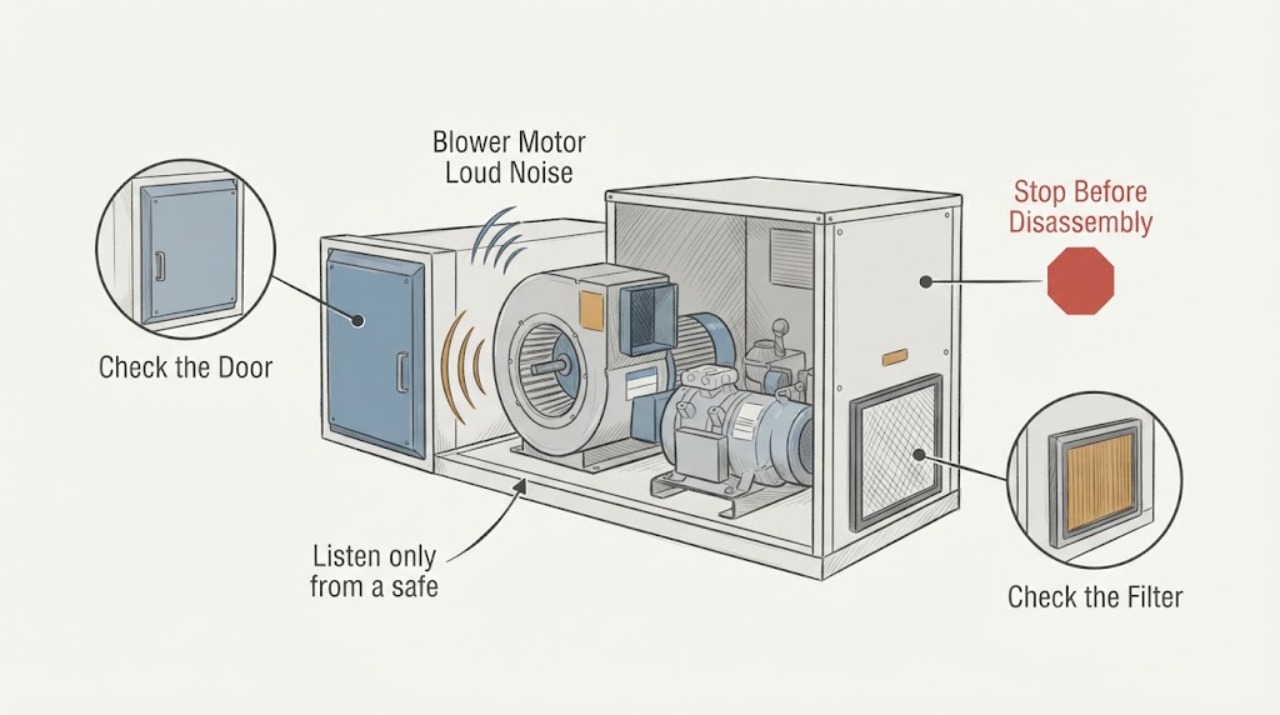
A loud noise blamed on a blower motor may actually come from the indoor blower assembly, ductwork, or the outdoor compressor and fan section. First locate the sound: the blower is normally in the indoor air handler or furnace, while a split-system compressor is outdoors. Record the sound type, whether it starts with the indoor fan or outdoor unit, airflow, cooling or heating performance, and any visible ice, debris, vibration, or water. A sudden grinding, banging, squealing, electrical buzz, hissing, burning odor, smoke, overheating, or repeated breaker trip is a reason to turn the HVAC system off and call an HVAC professional. Do not open the cabinet, touch a capacitor or contactor, enter the compressor compartment, measure voltage, or handle refrigerant.
Work through in order
Diagnostic checks
Use only checks that match the exact appliance or system and its official guide.
-
Check 1
From a safe position, identify whether the loud noise is strongest at an indoor return or air handler, a supply register, or the outdoor condensing unit. Do not remove an access panel or grille.
Expected result: Record indoor, duct/register, outdoor, or unclear location, and whether the noise changes when the system starts or stops.
Next step: If the source is unclear, do not approach either unit to investigate further. Keep the event description for HVAC service.
Why this matters
Why: An indoor location keeps the blower wheel, blower motor, filter, duct, or indoor assembly in consideration; an outdoor location keeps the condenser fan, compressor, mounting, or outdoor electrical parts in consideration.
-
Check 2
Listen only from a safe distance and classify the sound as humming, buzzing, clicking, rattling, scraping, grinding, squealing, banging, hissing, or a brief normal-looking startup or shutdown sound.
Expected result: Record whether it is continuous, occurs only at startup or shutdown, follows the indoor fan, follows the outdoor unit, or appears during a heat-pump defrost cycle.
Next step: Turn the system off and request HVAC service for a new persistent loud noise, grinding, rattling, banging, high-pitched sound, or unexplained hissing. Do not repeat cycles to reproduce it.
Why this matters
Why: Timing helps distinguish an airflow or rotating assembly symptom from a compressor, fan, control, or electrical symptom, but it cannot identify a failed part without professional testing.
-
Check 3
With the system off at the thermostat, inspect only the accessible air filter, return grille, supply registers, and surrounding furniture or curtains.
Expected result: Record a dirty, wet, collapsed, or incorrectly seated filter, blocked return or supply, or normal-looking airflow path. Do not reach through a grille toward a fan.
Next step: If the filter is visibly due for replacement, use the exact size and orientation specified for the system without opening the unit. If noise remains or airflow is weak, call HVAC service.
Why this matters
Why: Restricted airflow can strain the indoor blower and affect system performance, while a clear filter does not rule out blower bearings, wheel, motor, duct, compressor, or electrical causes.
-
Check 4
From outside the equipment enclosure and without touching it, observe the outdoor unit's visible condition and surrounding clearance while it is off.
Expected result: Record leaves or debris around the cabinet, a visibly damaged or obstructed fan blade, unusual tilt or vibration marks, ice, water, oil-like residue, or no visible abnormality. Do not remove the top grille or reach inside.
Next step: Keep the unit off for damage, ice, oil-like residue, strong vibration, or a persistent outdoor noise and arrange HVAC service. Do not clean inside or handle refrigerant lines.
Why this matters
Why: A damaged blade, obstruction, ice, or unstable mounting can create noise or vibration; no visible issue does not clear the compressor, fan motor, capacitor, or refrigerant system.
-
Check 5
Check the thermostat display and visible operating mode, then note whether the system still delivers normal airflow and heating or cooling without changing settings repeatedly.
Expected result: Record normal airflow, weak airflow, no airflow, warm air during cooling, poor heating, short cycling, or an error or safety message.
Next step: If performance is abnormal, shut the system off and call HVAC service. Do not open the unit to test a motor or capacitor.
Why this matters
Why: A noise paired with weak airflow keeps the blower or airflow path in consideration; a running indoor blower with poor cooling keeps the outdoor compressor or refrigerant cycle in consideration.
-
Check 6
Look from a safe distance for visible ice on accessible refrigerant lines or coils, water near the indoor unit, smoke, or signs of overheating; do not touch a line or wet electrical area.
Expected result: Record ice, dripping water, a hot-looking cabinet, burning or plastic odor, smoke, or no visible hazard.
Next step: Turn the system off for ice, water near electrical equipment, smoke, burning odor, or overheating and obtain professional help. Never thaw ice with a tool or heat source.
Why this matters
Why: Ice or water with unusual noise can indicate airflow, condensate, or refrigerant-related trouble. Smoke, burning odor, or overheating indicates an urgent electrical or equipment hazard.
-
Check 7
Prepare a service note with indoor or outdoor source, sound description, timing, thermostat mode, airflow, comfort result, filter state, visible ice or water, vibration, and any breaker or odor event.
Expected result: The record shows whether the noise follows the indoor blower, outdoor compressor section, startup, shutdown, defrost, or an abnormal operating condition.
Next step: Keep the system off when the noise is sudden, severe, persistent, or associated with a hazard, and provide the note to the HVAC professional.
Why this matters
Why: A precise symptom history helps the HVAC professional choose safe tests without repeated operation of a noisy or failing system.
Use your observations
Decision map
Find the observation that best matches what you see, then follow the next safe action.
-
PATH 01Safety boundary
What you see
Do this next
Check only the accessible filter and registers. If the noise persists, airflow is weak, or the sound is grinding, squealing, or banging, turn the system off and request HVAC service for the blower assembly.
Why this path and its safety boundary
Safety stop: Use the outdoor-source branch or preserve the location as unclear for professional diagnosis.
-
PATH 02Safety boundary
What you see
Do this next
Keep the system off for a new loud, grinding, rattling, high-pitched, or vibrating sound and call an HVAC professional. Do not open the outdoor enclosure or handle electrical or refrigerant components.
Why this path and its safety boundary
Safety stop: Continue only with safe timing and performance observations; do not guess a compressor diagnosis from sound alone.
-
PATH 03Safety boundary
What you see
Do this next
Record the timing and compare it with the owner's manual. If the sound is new, becoming louder, or fails to settle, stop operation and schedule HVAC service.
Why this path and its safety boundary
Safety stop: Treat persistent or changing noise as a service symptom rather than repeatedly cycling the system.
-
PATH 04Safety boundary
What you see
Do this next
Turn the system off and call HVAC service. A filter or airflow issue may coexist with blower, coil, compressor, or refrigerant trouble; do not open the equipment or handle refrigerant.
Why this path and its safety boundary
Safety stop: A sound-only symptom can still require service if it is new, loud, or persistent; keep the event record.
-
PATH 05Safety boundary
What you see
Do this next
Stop immediately, leave the system off, keep clear, and seek emergency help for active fire, gas danger, or immediate electrical danger. Do not operate switches, open panels, or restart the equipment.
Why this path and its safety boundary
Safety stop: Use only the safe observation path and arrange HVAC service for a persistent abnormal noise.
Helpful context
Understand the symptom
Do not assume the blower motor is the sound source
A blower motor is inside the furnace or air handler and moves air through the ducts. In a common split air conditioner or heat pump, the compressor and condenser fan are outdoors. A noise heard at a vent or indoor cabinet can therefore have a different cause from a noise heard at the outdoor condensing unit. Location, timing, airflow, and system performance are more useful than guessing a part from the sound alone.
Separate normal operating changes from a new loud noise
Some equipment has noticeable startup, shutdown, or heat-pump defrost sounds. A sudden change, persistent grinding or rattling, strong vibration, or a noise accompanied by poor heating or cooling should be treated as a service symptom. A homeowner can collect safe observations, but the motor, capacitor, compressor, refrigerant circuit, and internal electrical work belong to an HVAC professional.
Safety boundary
Stop conditions
- Stop immediately for smoke, burning or plastic odor, gas odor, hissing with suspected gas or refrigerant, electrical arcing, hot wiring, visible fire, severe vibration, or a repeated breaker trip.
- Do not remove an access panel, fan grille, electrical cover, or compressor enclosure; do not touch a capacitor, contactor, motor wiring, terminals, or refrigerant line.
- Do not measure voltage, discharge a capacitor, bypass a safety switch, add refrigerant, open the sealed system, or repeatedly restart equipment to reproduce the sound.
- Stop if water is near electrical equipment, ice is extensive, the unit is unstable, or the source cannot be observed without approaching a hazard.
When checks do not resolve it
Need a professional?
Call an HVAC professional for any new, loud, persistent, grinding, squealing, rattling, banging, or high-pitched noise, especially when the source is outdoors or the compressor may be involved. Turn the system off and seek urgent help for smoke, burning odor, gas odor, arcing, hot wiring, severe vibration, ice with poor performance, water near electrical equipment, or a repeated breaker trip.
Common questions
FAQ
How do I know whether the loud noise is from the blower motor or compressor?
Locate it without opening the equipment: the blower is normally indoors near the air handler or furnace, while a split-system compressor is outdoors. Record whether the noise follows indoor airflow or outdoor compressor operation. The location narrows the service path but does not prove a failed part.
Can a dirty filter make a blower motor noisy?
A dirty or restrictive filter can reduce airflow and strain the system, but it does not prove the motor is the cause. With the system off, inspect only the accessible filter and replace it only with the specified type and orientation. Call HVAC service if noise or weak airflow remains.
Should I keep running the HVAC system to identify the sound?
No. For a new or persistent loud noise, especially grinding, banging, rattling, hissing, smoke, odor, vibration, ice, or poor performance, turn it off and schedule HVAC service. Do not repeatedly cycle equipment to reproduce the sound.
Can I replace the blower motor, capacitor, or compressor myself?
No. These jobs can involve high-voltage wiring, stored electrical energy, moving parts, and refrigerant. Do not open the cabinet or outdoor unit, measure voltage, discharge a capacitor, or open the sealed system; have a qualified HVAC professional diagnose and repair it.
Read the exact guide
Official sources
- Is This Normal? HVAC Smells and Sounds, ExplainedTrane · HVAC sound types, indoor blower versus outdoor compressor clues, abnormal-noise escalation, and safety boundaries.
- Furnace Blower Motor Repair & Replacement GuideCarrier · Blower motor noise, airflow, filter restriction, high-voltage wiring, overheating, and professional blower service.
- AC Fan Not Working? Reasons Why It Stopped SpinningTrane · Indoor blower and outdoor condenser-fan locations, airflow symptoms, visible fan damage, and capacitor or electrical service boundaries.
- Troubleshoot an AC Not WorkingCarrier · Filter, airflow, ice, outdoor condensing unit, breaker, refrigerant, and high-voltage component safety boundaries.
- AC CompressorCarrier · Compressor function, unusual compressor noise, electrical or refrigerant symptoms, and qualified HVAC diagnosis.
Community feedback
Share a repair observation
Share a plain-text repair observation. Accepted observations are published automatically; this page may take a moment to update.