
On this page
Start here
Quick answer
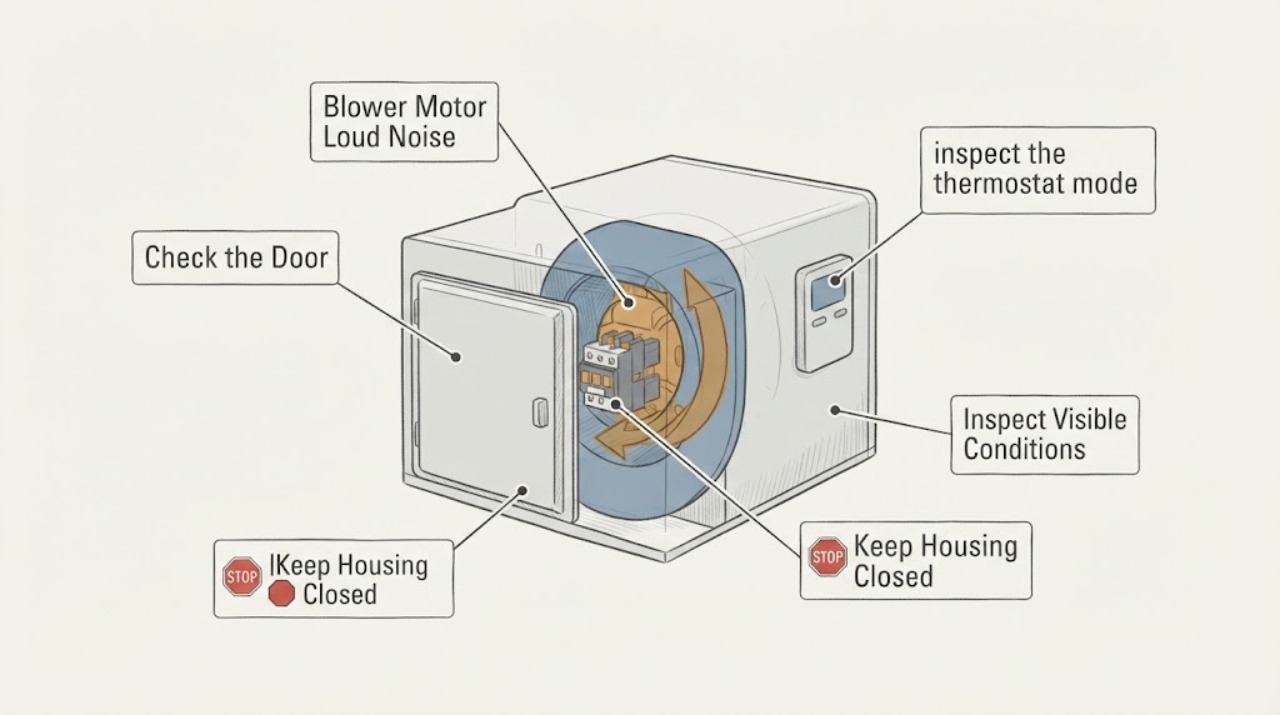
A loud noise that seems to come from the blower motor is not automatically a contactor fault. First locate the sound: an indoor blower noise that follows fan speed points toward airflow, a filter, a wheel, motor, or mounting; a click, hum, or buzz from the outdoor unit at startup or shutdown can involve the contactor, capacitor, fan motor, or compressor. From a safe position, note when the noise occurs, inspect only the accessible filter and grilles, and keep the system off if the noise is sudden, metallic, electrical, or accompanied by heat, smoke, burning odor, ice, water, or a tripped breaker. Do not open the outdoor electrical panel, touch a contactor or capacitor, spin a fan, or open the refrigerant circuit.
Work through in order
Diagnostic checks
Use only checks that match the exact appliance or system and its official guide.
-
Check 1
From a safe distance, identify whether the loud noise is at an indoor air handler or grille, at the outdoor unit, or transmitted through the ductwork. Note whether it starts with fan-only operation, cooling, heating, startup, shutdown, or a change in speed.
Expected result: The noise follows indoor airflow, occurs only outside at a switching event, occurs continuously outdoors, or is heard in both locations.
Next step: Keep the observation external and record the timing and location. Do not open either unit to confirm a component by sight or touch.
Why this matters
Why: Indoor airflow-linked noise points first toward the filter, grille, duct, blower wheel, motor, or mounting. Outdoor switching-time noise can involve the contactor or another electrical or motor component; both-location noise needs system-level assessment.
-
Check 2
With the system not calling for cooling, inspect the thermostat mode and fan setting without changing settings repeatedly. If the equipment instructions permit a brief fan-only call and there is no safety warning, listen from the room rather than approaching the blower.
Expected result: The noise appears with fan-only operation, only when cooling starts, only when cooling stops, or not until the outdoor unit starts.
Next step: Stop the call if the sound is harsh, newly worsening, or paired with weak airflow, heat, odor, or vibration. Arrange HVAC service for any outdoor switching-related noise.
Why this matters
Why: Fan-only noise makes the indoor blower path more likely. A noise only during outdoor cooling engagement or release keeps the contactor, capacitor, outdoor fan, compressor, or control path in the professional-service branch.
-
Check 3
From a dry, safe position, inspect the accessible air filter and look at return and supply grilles for dust, blockage, a loose external grille, or a visible object. Do not reach through a grille or into the blower housing.
Expected result: The filter is loaded, a grille is blocked, an external cover is visibly loose, or the airflow path looks clear.
Next step: Correct only the accessible filter or obstruction according to the manual and keep cooling off if the system is abnormal. Call HVAC service if the noise remains or any internal part would need to be reached.
Why this matters
Why: A loaded filter or blocked air path can create turbulence, whistling, or extra blower strain. A clear path means the noise may involve the blower wheel, motor, mounting, duct, or electrical controls.
-
Check 4
Look at the outdoor unit from outside the service-panel boundary. Note whether the noise is a click, hum, buzz, rattle, grinding sound, or vibration and whether the fan starts normally; do not remove a panel, place a hand near the fan, or touch any wiring.
Expected result: The sound occurs at outdoor startup or shutdown, persists while running, the fan does not start, or the unit vibrates or smells hot.
Next step: Turn the system off at the thermostat and call HVAC service. Leave a breaker or disconnect alone if it is tripped or difficult to access.
Why this matters
Why: A switching-time sound can involve the contactor, while persistent noise or a fan that does not start can involve the capacitor, motor, compressor, obstruction, or control system. The symptom cannot safely identify one part.
-
Check 5
Inspect the visible indoor-unit area and condensate location without opening the cabinet. Look for ice on accessible tubing, water below the unit, a wet filter, or a drain-pan overflow while keeping electrical equipment dry.
Expected result: There is no moisture or ice, there is controlled condensation, or water or ice is accumulating near the unit.
Next step: Keep cooling off if ice or abnormal water is present. Do not chip ice, use heat, pour water into the unit, or open the coil or drain assembly; call HVAC service.
Why this matters
Why: Ice, water, or a wet filter can accompany airflow or refrigeration faults and can change a noise complaint into a system-protection and water-damage issue. A dry area does not rule out an internal coil or drain problem.
-
Check 6
Make a safe visual note of any tripped breaker, service switch position, smoke, scorching, damaged insulation, or hot smell without opening an electrical panel or resetting protection repeatedly.
Expected result: Protection has opened, a switch or enclosure is hot, there is an electrical odor or smoke, or none of these signs are present.
Next step: Leave protection devices alone, keep clear of the equipment, and call qualified HVAC or electrical service for any abnormal sign.
Why this matters
Why: A protective trip or heat and odor signal can indicate an electrical, motor, capacitor, or contactor fault. It is not a prompt to reset the system until the noise disappears.
-
Check 7
Write down the equipment brand and model if visible without removing covers, the sound location and type, the operating mode, airflow strength, filter state, ice or water, and whether the noise is new or worsening.
Expected result: The noise is repeatable in one mode, changes with fan speed, begins after maintenance, or cannot be reproduced safely.
Next step: Provide the record to an HVAC professional and keep the system off if the sound is abnormal or accompanied by a safety warning.
Why this matters
Why: A repeatable, mode-specific pattern helps the technician separate blower, duct, outdoor switching, fan, compressor, and control clues without unsafe homeowner testing.
Use your observations
Decision map
Find the observation that best matches what you see, then follow the next safe action.
-
PATH 01Next step
What you see
The noise is inside and follows fan speed, with weak airflow or a loaded filter.
Do this next
Replace the accessible filter only as the manual directs and call HVAC service if the sound or weak airflow remains.
Why this path and its safety boundary
Why it matters: An airflow restriction or indoor blower-path issue is more likely than an outdoor contactor.
-
PATH 02Next step
What you see
The indoor noise remains after the accessible filter and grilles are clear.
Do this next
Keep the system off if the noise is harsh or worsening and have HVAC service inspect the air handler; do not open its cabinet.
Why this path and its safety boundary
Why it matters: A blower wheel, motor, mounting, duct, bearing, or internal obstruction may need inspection.
-
PATH 03Next step
What you see
A click, hum, or buzz occurs at the outdoor unit when cooling engages or releases.
Do this next
Stop listening tests and arrange HVAC service; do not remove the outdoor panel or touch the contactor or capacitor.
Why this path and its safety boundary
Why it matters: The contactor is one possible clue, but a capacitor, fan motor, compressor, control, or loose part can sound similar.
-
PATH 04Next step
What you see
The outdoor unit makes grinding, scraping, strong vibration, or a persistent abnormal hum, or its fan does not start normally.
Do this next
Turn the system off at the thermostat and call HVAC service for the outdoor unit.
Why this path and its safety boundary
Why it matters: A mechanical or electrical fault may be present and continued operation can worsen it.
-
PATH 05Next step
What you see
Ice, excess water, a wet filter, or condensate overflow is visible near the indoor unit.
Do this next
Keep cooling off, keep electrical equipment dry, and call HVAC service; do not chip ice or open the coil or drain.
Why this path and its safety boundary
Why it matters: Airflow, coil, drain, or refrigeration trouble may accompany the noise and creates a water-damage risk.
-
PATH 06Next step
What you see
A breaker trips, a switch or enclosure is hot, or smoke, scorching, arcing, or a burning odor is present.
Do this next
Stop using the system, do not reset protection repeatedly, keep clear of the equipment, and obtain qualified HVAC or electrical help.
Why this path and its safety boundary
Why it matters: Treat the event as an electrical or fire hazard rather than a noise diagnosis.
-
PATH 07Next step
What you see
The sound is a brief, familiar startup or heat-pump defrost sound with normal airflow and no new symptom.
Do this next
Monitor without opening the unit and schedule service if the sound changes, persists outside that mode, or is joined by weak airflow, odor, ice, water, or vibration.
Why this path and its safety boundary
Why it matters: Some equipment sounds are design- or mode-dependent, but a new or noticeably louder sound still deserves attention.
Helpful context
Understand the symptom
The sound location matters more than the label
A blower motor is normally in the indoor air handler, while a contactor is an electrical switching component normally associated with the outdoor unit. A noise heard at an indoor grille or cabinet is therefore not proof that the outdoor contactor is involved. Listen from a safe distance and record whether the sound begins with the indoor fan, the outdoor unit, both, or neither.
Classify the noise without opening the equipment
A new rattle, scrape, vibration, or high-pitched sound can indicate a blower wheel, fan, motor, loose external part, or airflow restriction. A click or hum at the outdoor unit can involve a contactor, capacitor, fan motor, or compressor. Normal startup or heat-pump defrost sounds vary by design, so a change from the equipment's usual sound is more important than a single word used to describe it.
Low-risk airflow checks come first
Turn the thermostat to a non-cooling state before looking at the accessible filter and visible supply and return grilles. A loaded filter or blocked air path can increase noise and reduce airflow. Replace a filter only according to the equipment instructions; do not remove an air-handler cover to reach the blower, coil, wiring, contactor, or capacitor.
When the contactor becomes a service clue
If the noise is outdoors and occurs at startup, shutdown, or continuously while the unit runs, the contactor is only one possible service clue. A technician must distinguish it from a capacitor, fan motor, compressor, loose panel, electrical connection, or refrigerant issue. Do not remove the service-panel cover or attempt to identify a contactor by touching parts.
Safety boundary
Stop conditions
- Stop immediately for smoke, arcing, a burning electrical odor, scorching, a hot enclosure or wire, repeated breaker trips, or a fan that will not start; do not reset protection or open the panel.
- Stop if the noise is grinding, scraping, violently vibrating, or rapidly worsening; turn cooling off and keep clear of moving equipment.
- Keep the system off if ice or water is accumulating near the air handler, wiring, outlet, or control; do not chip ice, pour water, or use electrical equipment in a wet area.
- Do not touch a contactor, capacitor, motor, fan wheel, refrigerant line, wiring, or internal control, and do not open a refrigerant circuit or use a meter.
Only after diagnosis
Potential parts
- blower motor
Consider this only after professional testing confirms the indoor blower motor is the source of the loud noise and is not merely responding to an airflow restriction.
Confirm the air-handler model, motor type, electrical rating, mounting, and manufacturer fit information with the technician. - contactor
Consider this only when a qualified technician confirms that the outdoor switching noise or electrical symptom comes from a failed contactor.
The correct contactor depends on the equipment model and electrical design; it is a high-voltage component and not a homeowner replacement. - blower motor capacitor
Consider this only when the system design includes one and professional testing identifies it as the cause of noisy, weak, or failed blower operation.
Confirm the exact rating and fit with the equipment documentation and technician; stored electrical energy makes this a professional part.
When checks do not resolve it
Need a professional?
Call HVAC service for any new or persistent indoor blower noise, weak airflow, an outdoor click or hum associated with startup, or a noise that returns after the accessible filter and grilles are clear., Arrange prompt service for a suspected contactor, capacitor, motor, compressor, duct, coil, drain, or refrigerant issue; these components require model-specific and electrical or refrigeration expertise., Use qualified electrical help for smoke, arcing, hot wiring, repeated protection trips, or an electrical odor, and keep away from wet equipment.
Have this ready
- Give the equipment brand and model if visible, indoor or outdoor sound location, noise type and timing, fan-only versus cooling behavior, filter and grille state, airflow strength, ice or water observations, recent service, and any breaker or odor event.
Common questions
FAQ
Does a loud blower motor always mean the contactor is bad?
No. The blower motor is indoors, while a contactor is normally part of the outdoor unit's switching circuit. A filter, airflow restriction, wheel, mounting, motor, capacitor, or outdoor component can produce similar descriptions, so location and timing matter.
What can I check before calling HVAC service?
Turn the system off if the noise is abnormal, then inspect only the accessible filter and visible return or supply grilles. Record the sound location, operating mode, timing, airflow, ice, water, odor, and breaker behavior. Do not open the unit.
Can I open the outdoor panel to listen for the contactor?
No. The outdoor panel can contain high-voltage components including a contactor and capacitor. Use external observations only and have a qualified HVAC technician diagnose the switching, motor, compressor, and wiring system.
What if the loud noise is a rattle or grinding sound?
Turn the system off if the sound is new, harsh, persistent, or paired with vibration or weak airflow. A blower wheel, fan motor, compressor, loose part, or other mechanical issue may need service; do not reach into the equipment.
Should I keep running the HVAC while waiting for service?
Do not keep running it when the noise is worsening or accompanied by burning odor, smoke, ice, water, weak or absent airflow, overheating, or a protective trip. Leave it off and provide the recorded symptoms to HVAC service.
Read the exact guide
Official sources
- LG Air Conditioner - Troubleshooting Loud Noise From My Air conditionerLG USA Support · Manufacturer example of accessible filter and airflow-obstruction checks for air-conditioner noise
- Air Handler TroubleshootingTrane · Air-handler filter, evaporator coil, blower motor, water leakage, and professional troubleshooting guidance
- Is This Normal? HVAC Smells and Sounds, ExplainedTrane · HVAC noise classification, blower motor, contactor, capacitor, compressor, electrical odor, and service boundaries
Community feedback
Share a repair observation
Share a plain-text repair observation. Accepted observations are published automatically; this page may take a moment to update.