
On this page
Start here
Quick answer
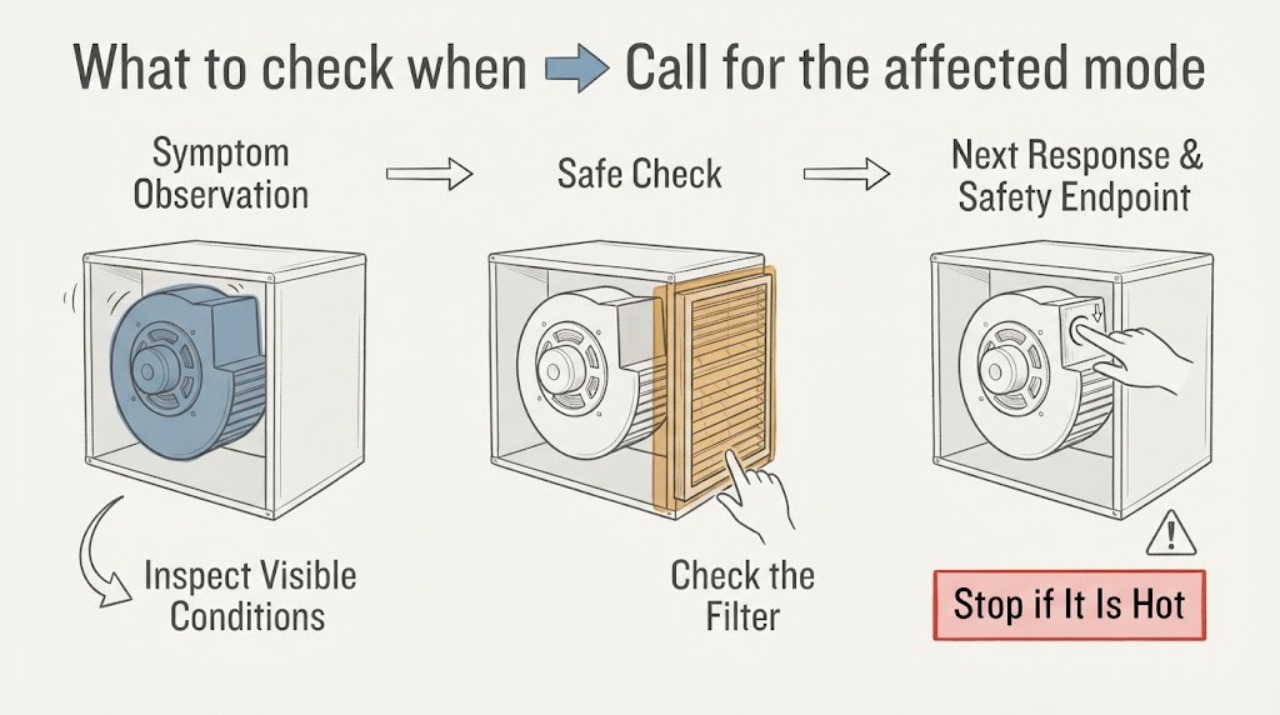
A blower motor that will not start can be blocked from receiving a call or power, or it can have an airflow, capacitor, control, wiring, or motor fault. Start with low-risk observations: confirm the thermostat is calling for heating or cooling, make sure the fan setting is not accidentally off, check the accessible air filter and return grilles, and note whether the indoor unit is silent, hums, starts and stops, or trips a breaker. Do not remove the blower panel, touch wiring or a capacitor, or test energized terminals. If a breaker trips, there is a burning smell, smoke, a frozen coil, repeated stopping, or the motor remains silent after the basic checks, turn the system off and arrange qualified HVAC service.
Work through in order
Diagnostic checks
Use only checks that match the exact appliance or system and its official guide.
-
Check 1
Call for the affected mode at the thermostat: select heating or cooling as appropriate, set the target beyond the current room condition, and place the fan in Auto for a normal demand or On for a brief fan-only observation. Do not remove the thermostat faceplate or touch its wiring.
Expected result: If the blower starts in fan-only mode, the motor can run and the original problem may be a heating or cooling control sequence. If the thermostat display is blank, the indoor unit never responds, or the blower stays silent in both modes, the issue may involve the thermostat, low-voltage control, or equipment power.
Next step: Record which thermostat mode was tested and whether you heard a click, hum, or no response. If the display is blank or the system does not respond, stop repeated calls and request HVAC service; do not bridge terminals.
Why this matters
Why: This separates a missing operating request from a blower that is being requested but cannot start.
-
Check 2
Inspect only the accessible air filter and return grilles. If the filter is visibly loaded and your equipment manual identifies it as user-replaceable, replace it with the specified type without opening the blower compartment; make sure furniture or stored items are not blocking return openings.
Expected result: A clogged filter or blocked return can restrict airflow and make the motor work harder, contribute to overheating, or cause a safety control to stop the system. If the filter is clean and the blower still will not start, restriction alone is less likely, but it does not rule out an internal fault.
Next step: After the filter change, make only one normal thermostat call. If the motor remains silent, cycles off, or the breaker trips, turn the system off and call an HVAC professional.
Why this matters
Why: Airflow is a useful external cause to remove, but changing a filter cannot repair a capacitor, control, wiring, or motor failure.
-
Check 3
Look at the nearby external service switch and electrical panel without removing any cover. Note whether the unit’s service switch is clearly off, whether an access door appears ajar, and whether the HVAC breaker is tripped. Do not reset a breaker that has tripped and do not open the equipment panel.
Expected result: An off service switch or an unlatched access door can prevent normal operation; a tripped breaker indicates a power or equipment fault that should be checked rather than repeatedly reset. A switch and breaker that appear normal do not prove that internal power reaches the motor.
Next step: If the switch is unexpectedly off, follow the equipment label or manual and arrange service if its position is unclear. If the breaker is tripped, leave it alone and call for service; do not continue operating the system.
Why this matters
Why: This checks the accessible supply and safety-interlock clues while keeping the high-voltage section closed.
-
Check 4
Listen from outside the cabinet during one normal call and note whether the blower is silent, hums or buzzes without turning, starts briefly and stops, or runs with weak airflow. If you see ice on an accessible coil or notice a burning smell, smoke, or unusual grinding, end the test immediately.
Expected result: A hum without rotation can be consistent with a starting or mechanical problem; repeated starts and stops can reflect restricted airflow, overheating, a safety control, or another fault; weak airflow can occur when the blower or air path is compromised. Ice, smoke, or burning odor is a stop condition.
Next step: Turn the system off for a non-starting, noisy, overheated, or frozen condition and request HVAC service. Do not reach through a grille, spin the wheel, or test the motor while energized.
Why this matters
Why: The sound and timing help the technician choose a safe diagnostic path but cannot identify a capacitor or motor replacement on their own.
-
Check 5
Record the equipment type if known, the thermostat mode, whether the outdoor unit or furnace responds, the filter condition, any status light or fault message visible without opening the unit, and whether the problem affects heating, cooling, fan-only operation, or all three.
Expected result: A blower that runs while a furnace does not ignite points toward a heat-generation or ignition path rather than the blower motor; a blower that fails in every mode points more broadly to power, controls, capacitor, motor, or safety shutdown. Repeated breaker trips or a motor that stays silent after basic checks require professional diagnosis.
Next step: Give the record to the HVAC professional and leave the system off if it is unsafe, repeatedly trips, smells hot, or has a frozen coil. Do not guess at a part from the status light alone.
Why this matters
Why: A precise symptom history prevents the technician from treating every no-airflow complaint as a failed motor.
Use your observations
Decision map
Find the observation that best matches what you see, then follow the next safe action.
-
PATH 01Next step
What you see
The blower runs in fan-only mode but not during heating or cooling.
Do this next
Stop treating this as a confirmed motor failure and arrange HVAC diagnosis of the affected heating or cooling sequence. Do not alter thermostat wiring or internal controls.
Why this path and its safety boundary
Why it matters: The motor can run, so the missing start signal may be in the thermostat demand, furnace or heat-pump sequence, control board, or another safety condition.
-
PATH 02Next step
What you see
The thermostat calls for operation, but the blower is silent in every mode and the accessible filter and controls appear normal.
Do this next
Turn the system off and request qualified HVAC service. Leave the cabinet closed and do not perform electrical measurements or touch the capacitor.
Why this path and its safety boundary
Why it matters: A power, control, capacitor, wiring, motor, or safety-shutdown fault is possible; the outside observation cannot identify which one.
-
PATH 03Next step
What you see
The blower hums, buzzes, starts and stops, or produces weak airflow.
Do this next
Stop repeated calls and arrange HVAC service, especially if the symptom is new or worsening. Do not try to spin the wheel or replace a capacitor without diagnosis.
Why this path and its safety boundary
Why it matters: The motor may have a starting, mechanical, airflow, overheating, or control problem rather than a simple thermostat setting issue.
-
PATH 04Next step
What you see
The filter is heavily blocked or return air is obstructed, but there is no smoke, burning odor, leak, or electrical trip.
Do this next
Correct the accessible filter or return obstruction according to the equipment manual, then make one normal call. If the blower does not start or stops again, turn the system off and call an HVAC professional.
Why this path and its safety boundary
Why it matters: Restricted airflow could be contributing to motor strain or a safety shutdown, but it does not prove that the blower assembly is healthy.
-
PATH 05Next step
What you see
A breaker trips again, there is smoke or a burning smell, a coil is frozen, or the blower compartment or wiring appears damaged.
Do this next
Stop using the HVAC system. Leave a tripped breaker off, disconnect power only if it is clearly safe to do so without contact with wet or damaged equipment, and arrange urgent qualified HVAC service; if there is a gas odor or a carbon-monoxide alarm, leave the building and contact emergency services.
Why this path and its safety boundary
Why it matters: This is a safety or equipment-damage boundary, not a routine homeowner adjustment.
Helpful context
Understand the symptom
First identify what the blower is doing
The indoor blower distributes heated or cooled air through the ductwork. A completely silent motor is different from a motor that hums, starts and stops, or runs while the furnace does not ignite. The thermostat, service switch, breaker, filter, safety controls, capacitor, relay, control board, and motor can all change the symptom, so the sound and timing are useful evidence rather than a diagnosis by themselves.
Keep homeowner checks outside the cabinet
A clean filter and clear return grille are reasonable external checks. A panel, capacitor, wiring harness, relay, or motor is not a homeowner test point: HVAC equipment contains electrical, mechanical, and sometimes combustion hazards. Never reach into the blower compartment or try to make the wheel turn. A breaker that trips is a reason to leave it off and arrange service, not to keep resetting it.
What a technician will distinguish
A technician can determine whether the thermostat is sending a demand, whether the unit has safe power, whether airflow restriction or a frozen coil has caused an overload, and whether the capacitor, relay, control board, wiring, or blower motor is responsible. The same motor symptom can come from different equipment designs, so do not order a generic motor or capacitor from the symptom alone.
Only after diagnosis
Potential parts
- blower motor run capacitor
Consider this only when a qualified technician confirms a capacitor-related starting fault; a silent motor can also result from power, controls, wiring, mechanical seizure, or a safety shutdown.
Confirm the equipment model, motor design, electrical ratings, and manufacturer fit information with the technician before selecting a capacitor. - HVAC blower motor assembly
Consider a motor only after professional testing shows that the motor itself has failed or cannot start after the control, capacitor, airflow, and safety paths are checked.
Blower motors vary by equipment, speed control, mounting, airflow requirements, and electrical characteristics; verify the exact model and fit before replacement.
When checks do not resolve it
Need a professional?
Book service when the motor will not start after the safe external checks, starts and stops, hums, trips a breaker, or is accompanied by smoke, a burning odor, ice, or damaged equipment.
Common questions
FAQ
Why is my HVAC blower motor completely silent?
The system may not be sending a start request, may not have safe power, or may have a control, capacitor, wiring, motor, or safety-shutdown problem. Check only the thermostat, accessible filter, return air, and external status; internal diagnosis needs HVAC service.
Can a dirty filter stop the blower motor from starting?
A severely restricted filter can reduce airflow, strain the motor, contribute to overheating, and cause a safety control to stop the system. Replace an accessible filter only as the equipment manual specifies, then call for service if the blower remains off or stops again.
What does it mean if the blower hums but does not turn?
A hum can be consistent with a starting, capacitor, mechanical, or control problem, but it does not identify a part. Turn the system off and have a technician diagnose it; do not touch the capacitor or try to spin the blower wheel.
Should I keep resetting the HVAC breaker when the blower will not start?
No. A repeated trip points to an electrical or equipment fault. Leave the breaker off and arrange professional service, especially if there is smoke, a burning smell, damaged wiring, or unusual noise.
Read the exact guide
Official sources
- Furnace Not Turning On? Troubleshooting & Repair GuideCarrier · Used for thermostat, service switch, breaker, filter, airflow, unusual odor, gas, carbon-monoxide, and blower-versus-ignition distinctions.
- Air Handler Fan Not Working: Causes and SolutionsTrane · Used for thermostat, filter, external power, breaker, relay, wiring, capacitor, blower motor, overheating, and frozen-coil distinctions.
- Furnace Blower Motor Repair & Replacement GuideCarrier · Used for silent or non-starting motor clues, breaker trips, overheating or smoke warnings, capacitor and wiring boundaries, and professional motor diagnosis.
- Furnace Blower Not WorkingTrane · Used for thermostat mode, filter and return-air clues, access-door and power observations, blower start versus ignition distinctions, and service escalation.
Community feedback
Share a repair observation
Share a plain-text repair observation. Accepted observations are published automatically; this page may take a moment to update.