
On this page
Start here
Quick answer
If a mini split will not start, first determine whether the indoor unit has no lamp, has a flashing lamp, responds to the remote but does not run, or runs the indoor fan while the outdoor unit or compressor stays off. Check the remote batteries, operating mode and timer, then inspect the breaker or outdoor disconnect only from the normal user position. Clean or replace the user-accessible indoor filter and clear visible airflow obstructions as the manual allows. A short delay after a stop, mode change or defrost can be normal, but a tripped breaker, recurring flashing indicator, ice, water, burning smell, unusual noise or a compressor that will not start needs qualified HVAC service. Do not open the cabinet, reset a tripped breaker repeatedly, handle refrigerant, test live wiring or replace a capacitor or compressor yourself.
Before you begin
Safety first
- The reader should not open indoor or outdoor cabinets, reset a tripped breaker repeatedly, test live wiring or capacitors, handle refrigerant, bridge a pressure switch, scrape ice, rewire the remote or keep operating after smoke, burning odor, water or sparking.
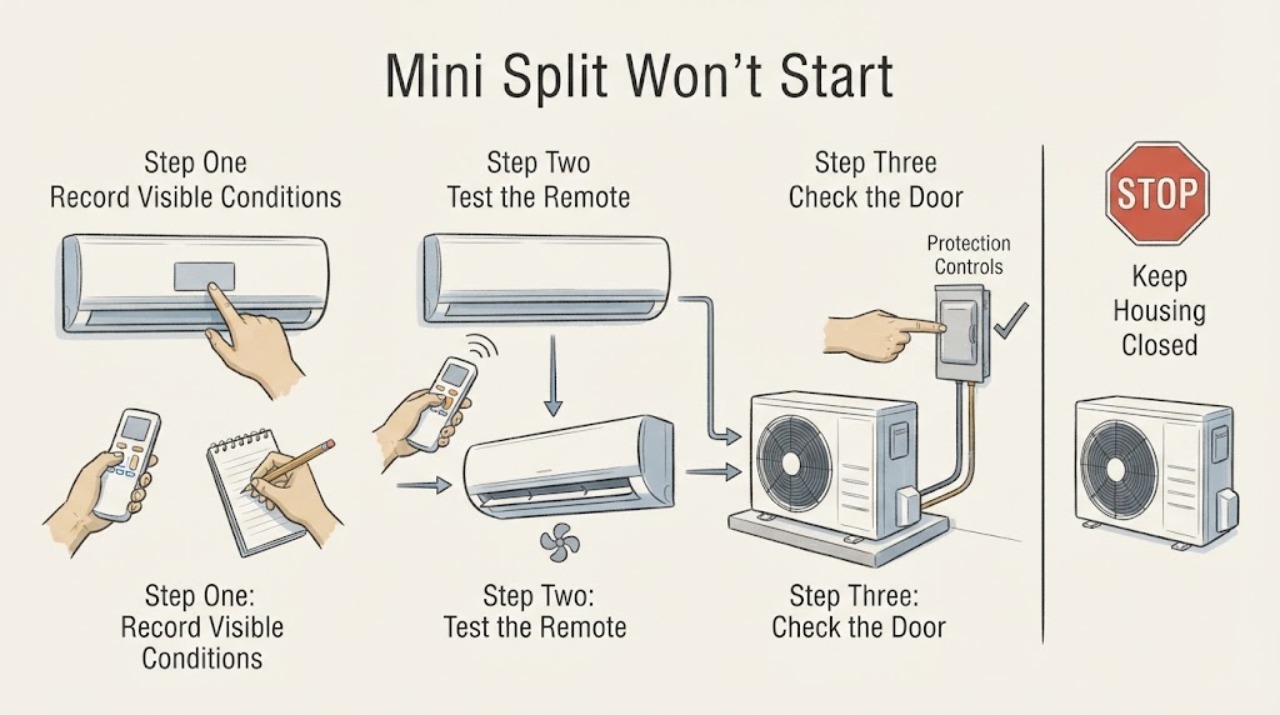
Work through in order
Diagnostic checks
Use only checks that match the exact appliance or system and its official guide.
-
Check 1
Press the remote power button once and record whether the indoor lamp is dark, steady, or flashing, whether the louver or fan moves, and whether the outdoor unit responds. Note the selected mode and any timer or code.
Expected result: Nothing responds, the operation lamp flashes, the indoor unit responds but the outdoor unit remains silent, or the unit starts after a delay.
Next step: Follow the remote and power checks, filter and airflow check, or delayed-start branch that matches the observation. Keep a record of the exact indicator behavior for service.
Stop if: Stop immediately for smoke, burning smell, sparking, a hot or damaged cord, water near electrical equipment, ice that is growing, severe vibration or repeated breaker operation.
Why this matters
Why: No lamp or no response makes power, remote and communication relevant; a flashing lamp points toward a stored fault or protection state; an indoor-only response narrows the symptom toward the outdoor unit or system controls. A short restart delay can be normal on some models.
-
Check 2
Check the remote controller batteries, selected operating mode, setpoint, timer and any sleep or schedule setting. Aim the remote at the indoor unit and use the unit's normal control only if the manual provides one.
Expected result: The remote display is blank or inconsistent, a timer is active, the mode is not calling for heating or cooling, or the indoor unit still does not acknowledge a valid command.
Next step: Correct only the user setting or replace the remote batteries with the type specified by the manual, then make one start attempt. If the indoor unit remains unresponsive, do not remove its cover; arrange service.
Stop if: Do not rewire the indoor unit, bypass a control, open the remote receiver or repeatedly issue start commands to a unit with a safety symptom.
Why this matters
Why: Daikin lists remote batteries and timer settings among the first no-operation checks. A wrong mode or schedule can look like a failed unit, while no response after a valid command shifts suspicion to power, receiver, control or communication problems.
-
Check 3
From the normal user-accessible position, check whether the mini split has power and whether its dedicated breaker or outdoor disconnect is visibly off or tripped. Do not remove electrical covers.
Expected result: The indoor lamp is dark and the supply is off or uncertain, the breaker is tripped, or power appears normal but the unit remains dead.
Next step: If supply is off or a breaker has tripped, leave it off and contact qualified HVAC or electrical service as appropriate. If power is normal, continue only with the filter and airflow check; do not open the unit.
Stop if: Do not repeatedly reset a breaker, replace an unknown fuse, use an extension cord, inspect live terminals or touch a wet disconnect.
Why this matters
Why: Trane warns that a tripped heat-pump breaker can indicate a unit problem and that resetting it and restarting may cause further damage. Daikin directs a no-operation or recurring flashing-lamp condition to service after the basic supply check.
-
Check 4
Clean or replace each indoor unit's user-accessible air filter as the model manual allows, let washable filters dry fully, and clear visible objects from indoor and outdoor air inlets and outlets without reaching into a fan.
Expected result: The filter is clogged or airflow is obstructed, or the airflow path is clear and the system still will not start.
Next step: Restore the filter and airflow path, then make one supervised start attempt. If the unit still does not start or the indicator flashes again, stop and arrange HVAC service.
Stop if: Do not remove the blower or coil, insert tools through a grille, wash an energized unit, scrape ice or run the system with missing panels or filters.
Why this matters
Why: Trane links inadequate airflow and dirty filters with compressor struggle and shutdown, while Daikin asks the user to check filters and blocked inlets or outlets when an operation lamp flashes. A clear airflow path does not prove the compressor or controls are healthy.
-
Check 5
If the unit was stopped or a mode was changed just before the failure, wait for the model's normal protection or defrost period while observing from a safe distance. Do not force a restart by cycling power repeatedly.
Expected result: The system resumes after a short model-typical delay or defrost event, or it remains off, flashes a fault, or the outdoor unit never starts.
Next step: If it resumes normally, monitor one complete call. If it remains off or the fault returns, leave the system off and provide the technician with the timing, mode, indicator state and filter or power findings.
Stop if: Do not open the outdoor unit, handle refrigerant, test capacitors, bridge a pressure switch, or keep waiting and restarting when there is ice, unusual noise, odor, water or a power trip.
Why this matters
Why: Daikin and Fujitsu describe restart protection and heating defrost as normal on some systems. A persistent no-start, recurring flashing indicator or silent outdoor unit is not explained by a normal delay alone and may involve a breaker, pressure protection, capacitor, compressor or control fault.
Use your observations
Decision map
Find the observation that best matches what you see, then follow the next safe action.
-
PATH 01Next step
What you see
The remote display, mode, batteries or timer does not request normal operation.
Do this next
Correct the user setting or batteries according to the manual and make one start attempt; persistent no response needs service.
-
PATH 02Next step
What you see
The operation lamp is off and the breaker, disconnect or power supply is off, tripped or uncertain.
Do this next
Leave the supply off and arrange qualified HVAC or electrical service; do not keep resetting the breaker or open covers.
-
PATH 03Next step
What you see
The operation lamp flashes or the filter and airflow path are visibly restricted.
Do this next
Clean or restore only the user-accessible airflow items as the manual permits and try once; a returning flash requires service.
-
PATH 04Next step
What you see
The unit was just stopped, changed modes, lost power or is heating while the outdoor unit defrosts.
Do this next
Allow the model's normal delay or defrost event to complete without repeated restarts. If it does not recover, use the service branch.
-
PATH 05Next step
What you see
The indoor unit receives a valid call but the outdoor unit stays silent after power, remote and filter checks.
Do this next
Stop at the user-accessible boundary and arrange qualified HVAC diagnosis for controls, pressure protection, capacitor, compressor or refrigerant concerns.
Helpful context
Understand the symptom
Start with the indicator and the unit that is silent
A dark indoor lamp, a flashing lamp, a remote that does nothing, and an indoor fan that runs without the outdoor unit are different observations. Record them before changing settings. The distinction tells a technician whether to begin with power and communication, the indoor unit, or the outdoor compressor and its protection controls.
Rule out a normal restart or defrost delay
Some mini splits intentionally delay a compressor restart after a stop or power interruption. In heating mode, an outdoor defrost event can pause normal heating and may create water-flow or sizzling sounds. If the unit does not recover, the indicator flashes, or the delay is accompanied by another fault, use the service branch.
Keep electrical, refrigerant and compressor work professional
A dirty filter can be checked by the homeowner, but a tripped breaker may reflect a fault rather than a reset opportunity. Refrigerant pressure, capacitors, compressors, wiring, control boards and safety switches require qualified HVAC diagnosis. Keep equipment panels closed.
Only after diagnosis
Potential parts
- mini-split remote batteries or remote controller
Consider this category only when the remote display or command response is abnormal and the model manual confirms the battery type or controller; a silent indoor unit can have another cause.
Confirm the exact remote and indoor-unit model before ordering; do not open or rewire the receiver. - mini-split air filter
Consider this category only when the user-accessible filter is damaged or cannot be cleaned and the manual specifies replacement; a dirty filter should be cleaned or replaced as directed before deeper diagnosis.
Confirm the exact indoor-unit model and manufacturer filtration requirements before ordering. - mini-split capacitor, compressor or control component
This is a professional-diagnosis category only when power, command, filter and airflow checks are normal but the outdoor compressor still does not start; the symptom does not identify a particular component.
Do not test, replace or wire internal electrical or sealed-system parts yourself; qualified service must confirm the fault and exact model fit.
When checks do not resolve it
Need a professional?
Call a qualified HVAC technician when the mini split remains off after the manual-approved remote, power, filter and airflow checks, the operation lamp flashes again, the outdoor unit or compressor stays off, or a breaker trips. Stop immediately for smoke, burning smell, sparking, water near electrical equipment, growing ice, severe vibration or unusual noise; disconnect power only if safe and do not open the cabinets or handle refrigerant.
Safety scope: The reader should not open indoor or outdoor cabinets, reset a tripped breaker repeatedly, test live wiring or capacitors, handle refrigerant, bridge a pressure switch, scrape ice, rewire the remote or keep operating after smoke, burning odor, water or sparking.
Common questions
FAQ
Why will my mini split not turn on at all?
Check the remote batteries and timer, then look at the breaker or disconnect from the normal user position and check the indoor lamp. A tripped supply, dark unit or persistent no response needs qualified service; do not repeatedly reset the breaker.
Why does my mini split have power but not start?
Confirm the mode and timer, clean the user-accessible filter and clear visible airflow obstructions. If the indoor unit responds but the outdoor unit or compressor remains off, a control, protection, capacitor, compressor or refrigerant issue needs HVAC diagnosis.
Is a delay before a mini split starts normal?
It can be. Daikin and Fujitsu describe protection delays after stopping, power interruption or mode changes, and defrost can pause heating. If the unit does not recover, flashes a fault or repeatedly fails to start, arrange service.
Should I keep resetting a mini split that will not start?
No. Trane warns that resetting a tripped breaker and restarting can cause further damage. Leave the system off when a breaker trips, a lamp keeps flashing, or there is ice, water, unusual noise, burning smell or sparking, and seek qualified help.
Read the exact guide
Official sources
- Mini-Split Compressor Not Turning On: Causes and SolutionsTrane · Manufacturer guidance for a mini-split compressor that will not turn on, including breaker, filter, airflow, refrigerant and professional service boundaries.
- TroubleshootingDaikin · Official split-system troubleshooting for no operation, flashing lamps, remote or timer checks, filters, airflow obstructions, restart protection and defrost behavior.
- AIRSTAGE MINI-SPLITS TroubleshootingFujitsu General · Official mini-split FAQ describing compressor restart protection after a stop or power interruption and normal water-flow, casing-expansion and automatic-defrost sounds.
Community feedback
Share a repair observation
Share a plain-text repair observation. Accepted observations are published automatically; this page may take a moment to update.