
On this page
Start here
Quick answer
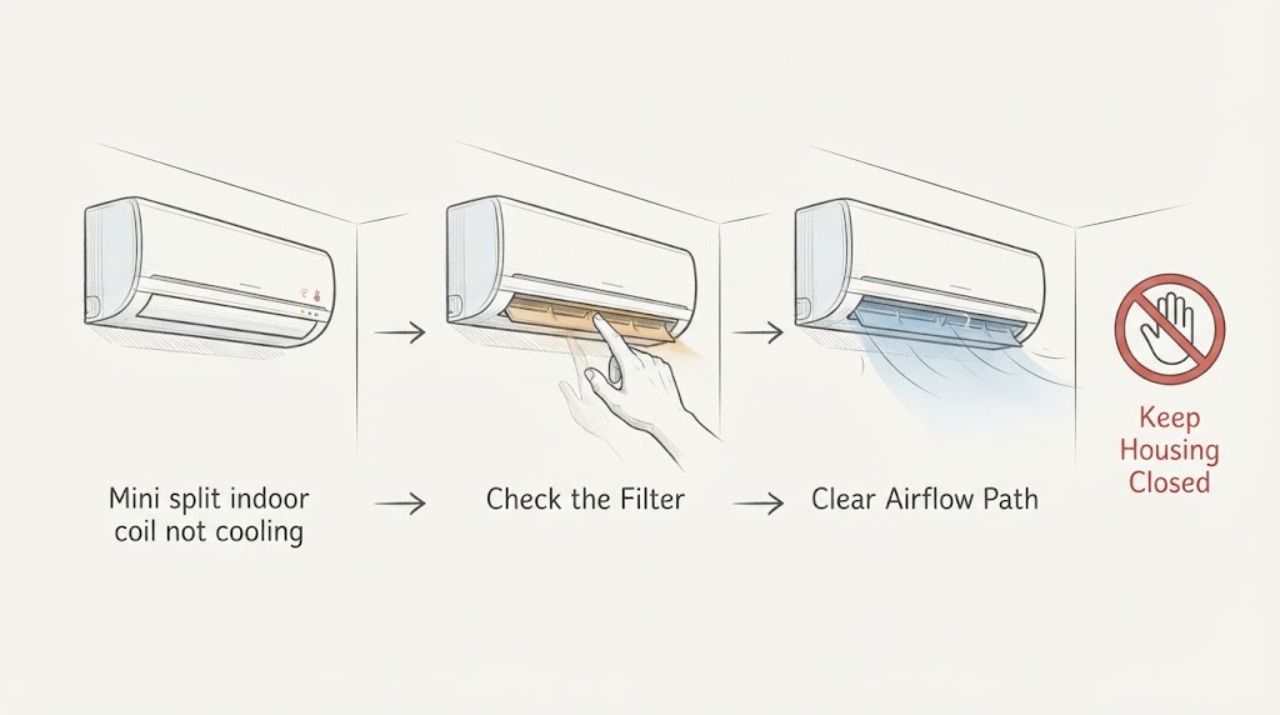
If a Carrier mini split indoor coil is not cooling the room, first verify the remote is in Cool mode, the setpoint is appropriate, and the outdoor unit has power and is operating. Then turn the system off before opening the indoor front panel, clean the accessible air filter, and clear dust or furniture from indoor and outdoor airflow paths. Carrier says weak airflow can come from a dirty filter, indoor coil, or blower wheel, while reduced cooling with adequate airflow can point to low refrigerant, an obstructed outdoor coil, or another fault. Ice on the indoor or outdoor coil, water from the indoor unit, hissing, persistent weak airflow, or a system that will not start is a service boundary. Do not open the refrigerant circuit, remove the indoor coil cabinet, pressure-wash fins, or keep running a frozen or leaking system; arrange qualified HVAC diagnosis.
Before you begin
Safety first
- This article covers controller settings, ordinary power observation, accessible filter care, external airflow clearance, and safe water containment only. Do not open the indoor unit or electrical cabinet, touch live parts, handle refrigerant, apply direct heat, pressure-wash coils, or restart through a frozen, leaking, or hazardous condition.
Work through in order
Diagnostic checks
Use only checks that match the exact appliance or system and its official guide.
-
Check 1
Use the remote or controller to verify the Carrier mini split is powered, set to Cool rather than Fan or Heat, and calling for cooling; check the home's breaker and the outdoor disconnect without touching wiring.
Expected result: Record whether the display responds, the setpoint is below room temperature, the indoor head starts, the outdoor unit runs or discharges heat, and any breaker, remote, or error indication appears.
Next step: Correct only the mode, setpoint, battery, or ordinary breaker condition described by the manual. If the outdoor unit remains off, an error returns, or power hardware looks damaged, arrange professional service.
Stop if: Do not remove electrical covers, touch disconnect terminals, repeatedly reset a breaker, or operate through smoke, burning odor, sparks, or a damaged cord.
Why this matters
Why: Carrier says incorrect mode, power, a tripped breaker, or a non-running outdoor unit can make a mini split fail to cool even when the indoor coil itself is not the root cause.
-
Check 2
Turn the mini split off and, with power isolated as the model instructions require, open only the normal front-panel access and remove the accessible mesh filter; vacuum or wash it with mild soap and water as Carrier directs, then dry it completely.
Expected result: Note whether the filter is coated with dust, airflow improves after cleaning, the indoor coil or blower wheel is visibly dirty behind the filter, or ice is present.
Next step: Reinstall the completely dry filter, keep the intake and discharge clear, and reassess airflow only after visible ice has thawed. Arrange service for persistent weak airflow, visible heavy contamination, or recurring ice.
Stop if: Do not run the unit without its filter, spray chemicals into the coil, reach into the blower wheel, or use a wet filter.
Why this matters
Why: Carrier says a clogged filter restricts airflow, strains the blower, and can contribute to an indoor coil freezing or reduced cooling. A dirty coil or blower wheel may need deep professional cleaning.
-
Check 3
With power off for cleaning, clear curtains, furniture, and dust from the indoor intake and discharge, then remove leaves or debris around the outdoor unit without opening the cabinet or bending coil fins.
Expected result: Record whether indoor airflow is weak at all speeds, the blower wheel or indoor coil is visibly coated, the outdoor coil is blocked, or the outdoor fan and compressor do not run when cooling is requested.
Next step: Restore ordinary clearance and clean only accessible external surfaces using the model guidance; request HVAC diagnosis if airflow or outdoor operation remains abnormal.
Stop if: Do not pressure-wash fins, open electrical panels, touch the fan, remove the indoor coil cabinet, or work near live conductors.
Why this matters
Why: Carrier says weak airflow can result from a dirty filter, indoor coil, or blower wheel, while outdoor debris can hinder performance. A non-running outdoor unit suggests a more significant electrical or equipment issue.
-
Check 4
Look for frost or ice on the indoor coil cover or refrigerant line, warm air with reduced airflow, water under the indoor head, a full or damaged drain pan, and a condensate drain that is not carrying water away; do not open the refrigerant circuit.
Expected result: Record whether ice is visible, water appears only while ice thaws, water drips continuously, a musty odor accompanies a drain issue, or hissing or oily residue suggests refrigerant trouble.
Next step: Turn cooling off when ice is visible, contain water, allow safe thawing without direct heat, and arrange service for recurring ice, persistent water, suspected refrigerant, or an inaccessible drain.
Stop if: Do not chip ice, use a hair dryer or space heater, pour chemicals into an unknown drain, add refrigerant, or continue cooling with a frozen coil or active leak.
Why this matters
Why: Carrier links restricted airflow and low refrigerant to ice, and says a dirty filter can freeze the coil and overwhelm the drain pan as it melts. A clogged drain line or damaged pan can also leak, while hissing or oily residue requires professional refrigerant diagnosis.
-
Check 5
After the filter and ordinary airflow checks, document the model, operating mode, setpoint, indoor airflow, outdoor operation, ice or water location, noise, and whether cooling improves without restarting through visible ice.
Expected result: Classify the result as normal cooling with restored airflow, normal airflow but warm air, weak or absent airflow, recurring ice, ongoing water, hissing or oily residue, abnormal noise, or an error or power fault.
Next step: Arrange qualified Carrier mini split service and provide the observations, photos from outside the cabinet, and all steps already taken. The technician can test coil temperature, airflow, drain, electrical controls, and refrigerant safely.
Stop if: Do not restart repeatedly to reproduce ice, bypass safeties, open sealed-system tubing, or continue if there is an electrical, water, refrigerant, or indoor-comfort hazard.
Why this matters
Why: Normal airflow with poor cooling shifts attention toward refrigerant, outdoor heat exchange, control, or compressor diagnosis; weak airflow shifts attention toward filter, coil, blower, or ductless head restrictions. Recurrence after a filter clean is not a complete repair.
Use your observations
Decision map
Find the observation that best matches what you see, then follow the next safe action.
-
PATH 01Safety boundary
What you see
The indoor head responds but is in Fan or Heat, the setpoint is not calling for cooling, a breaker or disconnect is off, or the outdoor unit does not run.
Do this next
Correct ordinary mode, remote, or power settings only as the manual permits; arrange professional service if the outdoor unit remains off or an error or electrical issue returns.
Why this path and its safety boundary
Why it matters: The apparent indoor-coil cooling problem may be a control, power, communication, or outdoor-unit problem rather than an indoor-coil failure.
Safety stop: Do not touch wiring, remove disconnect covers, or repeatedly reset a breaker.
-
PATH 02Safety boundary
What you see
The indoor airflow is weak, the accessible filter is visibly dirty, and there is no burning smell, active leak, or electrical warning.
Do this next
Power off, clean or replace the filter as the model directs, dry it fully, clear indoor airflow paths, and reassess only after any ice has thawed.
Why this path and its safety boundary
Why it matters: Carrier identifies dirty filters as a leading airflow issue; restriction can reduce cooling and contribute to coil freezing.
Safety stop: Do not run without a filter, reach into the blower, or keep cooling with visible ice.
-
PATH 03Safety boundary
What you see
The filter is clean but airflow remains weak, the indoor coil or blower wheel is visibly coated, or outdoor debris blocks heat exchange.
Do this next
Keep ordinary grilles and the outdoor area clear, leave the system off if it is iced, and arrange qualified mini split service for internal cleaning and performance testing.
Why this path and its safety boundary
Why it matters: A dirty coil, blower wheel, or obstructed outdoor coil remains possible; deep cleaning and internal access are professional boundaries.
Safety stop: Do not remove indoor covers, pressure-wash coils, bend fins, or touch fans or electrical parts.
-
PATH 04Safety boundary
What you see
Ice appears on the indoor coil or refrigerant line, airflow is reduced, the unit blows warm air, or the coil refreezes after a clean filter and safe thaw.
Do this next
Turn cooling off, allow safe thawing with water contained, and arrange licensed HVAC diagnosis of airflow, coil, leak, and refrigerant conditions.
Why this path and its safety boundary
Why it matters: Restricted airflow, low refrigerant, a dirty coil, or a mechanical fault can all produce this pattern; ice does not identify which one is present.
Safety stop: Do not chip ice, apply direct heat, add refrigerant, loosen fittings, or run the compressor while frozen.
-
PATH 05Safety boundary
What you see
Water drips from the indoor head or pools below it, especially when ice melts, while the filter may be dirty or the drain line and pan may be blocked or damaged.
Do this next
Turn cooling off if ice is present, protect the wall and floor, contain water, and arrange service for a persistent leak, damaged pan, or inaccessible drain.
Why this path and its safety boundary
Why it matters: Carrier links frozen coils and thaw water to drain-pan overflow and identifies clogged drain lines or damaged pans as separate leak causes.
Safety stop: Do not pour unapproved chemicals into the drain, remove the indoor unit from the wall, or leave water near electrical parts.
-
PATH 06Safety boundary
What you see
There is a burning smell, smoke, sparks, repeated breaker trip, damaged wiring, hissing, oily residue, severe vibration, or the system cannot cool and the indoor area is becoming unsafe.
Do this next
If safe, disconnect power at the normal breaker or disconnect without touching wet or damaged parts, keep the system off, and arrange qualified HVAC or electrical service; use local emergency procedures for smoke or fire.
Why this path and its safety boundary
Why it matters: This is an electrical, refrigerant, equipment, or immediate comfort-safety boundary rather than a filter or setting check.
Safety stop: Do not restart, handle refrigerant lines, open panels, reset a tripping breaker repeatedly, or use improvised heating or cooling unsafely.
Helpful context
Understand the symptom
Start by separating a control problem from an indoor-coil problem
A Carrier ductless system can feel warm when it is in Fan, Heat, or the wrong operating mode, when the outdoor section has no power, or when the setpoint does not call for cooling. Once the system is actually calling for Cool, compare airflow at the indoor head with cooling at the room. Weak airflow makes a filter, blower wheel, indoor coil, or obstruction more likely; normal airflow with lukewarm air makes refrigerant, outdoor coil, or control diagnosis more important.
Check the washable filter and clear both air paths
Carrier identifies a dirty mini split filter as a leading airflow problem and allows basic filter cleaning with the system powered off. A clogged filter can strain the blower and coat the evaporator coil or blower wheel. Keep the indoor discharge and intake clear and remove leaves or debris from around the outdoor unit without bending fins or opening panels. Deep indoor-coil or blower-wheel cleaning belongs to a technician.
Treat ice and water as clues, not as a reason to keep cooling
Ice on a coil or line, warm air, and reduced airflow can occur when the indoor coil is too cold because airflow is restricted or refrigerant is low. A dirty filter can also freeze the coil and create water when the ice thaws; a clogged condensate drain or damaged pan can leak independently. Turn cooling off if ice is visible, contain water, and do not use a heat source or attempt refrigerant work.
Use the result to choose the next safe step
If cleaning the accessible filter and clearing obstructions restores strong airflow and cool operation, keep the maintenance interval in the model manual. If the indoor coil remains warm, the system refreezes, airflow stays weak, the outdoor unit does not run, water continues to leak, or an electrical or refrigerant warning appears, stop relying on a filter fix. Carrier's maintenance guidance directs professional inspection for ice, water, reduced airflow, strange noises, coils, refrigerant lines, and electrical connections.
Safety boundary
Stop conditions
- Turn cooling off when the indoor coil or refrigerant line is frozen, and do not run the compressor against visible ice.
- Do not use a hair dryer, space heater, open flame, or other direct heat to thaw a mini split coil; do not chip ice or pressure-wash fins.
- Do not open the refrigerant circuit, add refrigerant, remove the indoor coil or electrical cabinet, touch capacitors or live wiring, or bypass safety controls.
- Stop for water near electrical parts, smoke, sparks, burning odor, a damaged cord, repeated breaker trips, hissing or oily residue, or severe vibration.
- Do not keep restarting the system when airflow is absent, cooling is weak after a clean filter, ice returns, water leaks, or the outdoor unit will not operate.
Only after diagnosis
Potential parts
- washable air filter or filter frame
Consider this category only when the installed model's accessible filter is damaged, missing, or no longer serviceable after confirming the correct filter design.
Match the complete Carrier indoor-unit model and filter size or frame; never run the system without its filter. - indoor blower wheel or fan motor
Consider this category only when qualified testing confirms weak, intermittent, noisy, or inoperative indoor airflow after filter and obstruction checks.
Fan assemblies, motors, connectors, and controls are model-specific; do not infer a failed motor from poor cooling alone. - evaporator coil, drain pan, or condensate drain component
Consider this category only when a technician confirms a damaged, contaminated, leaking coil, cracked pan, or blocked or failed drain after the system is safely thawed.
Match the complete Carrier model, refrigerant system, cabinet, and drain arrangement; coil and refrigerant work require qualified service. - refrigerant, expansion, sensor, or control component
Consider this category only after qualified diagnosis confirms a leak, metering, sensor, or control fault associated with reduced cooling or recurring ice.
Do not order or add refrigerant from symptoms alone; compatibility, charge, and sealed-system work are model-specific and regulated.
When checks do not resolve it
Need a professional?
Arrange qualified Carrier mini split service when the indoor coil remains warm after mode, power, filter, and airflow checks; airflow is weak or absent; ice or water appears; the coil refreezes; the outdoor unit does not run; hissing, oily residue, abnormal noise, an error, or an electrical warning occurs; or the drain, coil, fan, refrigerant, or control needs access. Turn off power if safe for smoke, sparks, damaged wiring, or water at electrical parts and follow local emergency procedures for fire.
Safety scope: This article covers controller settings, ordinary power observation, accessible filter care, external airflow clearance, and safe water containment only. Do not open the indoor unit or electrical cabinet, touch live parts, handle refrigerant, apply direct heat, pressure-wash coils, or restart through a frozen, leaking, or hazardous condition.
Common questions
FAQ
Why is my Carrier mini split indoor coil not cooling?
Check mode, setpoint, power, filter, indoor airflow, and outdoor-unit operation first. Carrier identifies dirty filters, indoor coil or blower restrictions, outdoor obstructions, refrigerant issues, drainage problems, and electrical faults as possible causes.
Can a dirty mini split filter stop the indoor coil from cooling?
A dirty filter restricts airflow across the indoor coil, reducing cooling and potentially causing the coil to freeze. Power off, clean the accessible filter as Carrier directs, dry it completely, and arrange service if airflow remains weak or ice returns.
What should I do if my Carrier mini split indoor coil is frozen?
Turn cooling off and allow a safe thaw, containing water as the ice melts. Do not use a hair dryer, space heater, open flame, or sharp tool. Check the accessible filter after power is off, then arrange service if the coil refreezes or cooling remains abnormal.
Why is my Carrier mini split blowing air but not cooling?
With normal airflow, incorrect mode, outdoor-unit operation, refrigerant, outdoor-coil, control, or compressor conditions become more likely than a filter-only issue. Carrier recommends professional diagnosis when basic mode, power, filter, and obstruction checks do not restore cooling.
When should a Carrier mini split not cooling problem be serviced?
Arrange service for visible ice, recurring freeze, persistent water, weak or absent airflow, a non-running outdoor unit, hissing or oily residue, strange noise, an error, or any need to open the coil, electrical cabinet, drain, or refrigerant system.
Read the exact guide
Official sources
- What is a Mini Split Air Filter? Complete Guide & MaintenanceCarrier · Carrier guidance for common ductless washable filters; filter construction and access vary by model.
- Mini Split Leaking Water? Diagnosis & DIY Repair TipsCarrier · Carrier consumer guidance for ductless condensate and leak symptoms; drainage layout and service access vary by model.
- Ductless Mini Split Repair | Mini Split Troubleshooting GuideCarrier Canada · Carrier Canada consumer guidance that applies broadly to ductless systems; exact model instructions remain controlling.
- Mini Split Repair Guide | Troubleshooting & ServiceCarrier · Carrier US consumer guidance for ductless mini split systems; exact model procedures and component access vary.
- Ductless Mini Split Maintenance | Service & Cleaning TipsCarrier · Carrier US maintenance guidance for ductless mini split systems; model instructions control access and intervals.
- Will Frozen AC Fix Itself? Guide to Frozen AC CoilsCarrier · Carrier guidance for frozen AC coils, applicable to the underlying coil and airflow mechanics of ductless cooling; exact mini split controls vary.
Community feedback
Share a repair observation
Share a plain-text repair observation. Accepted observations are published automatically; this page may take a moment to update.