
On this page
Start here
Quick answer
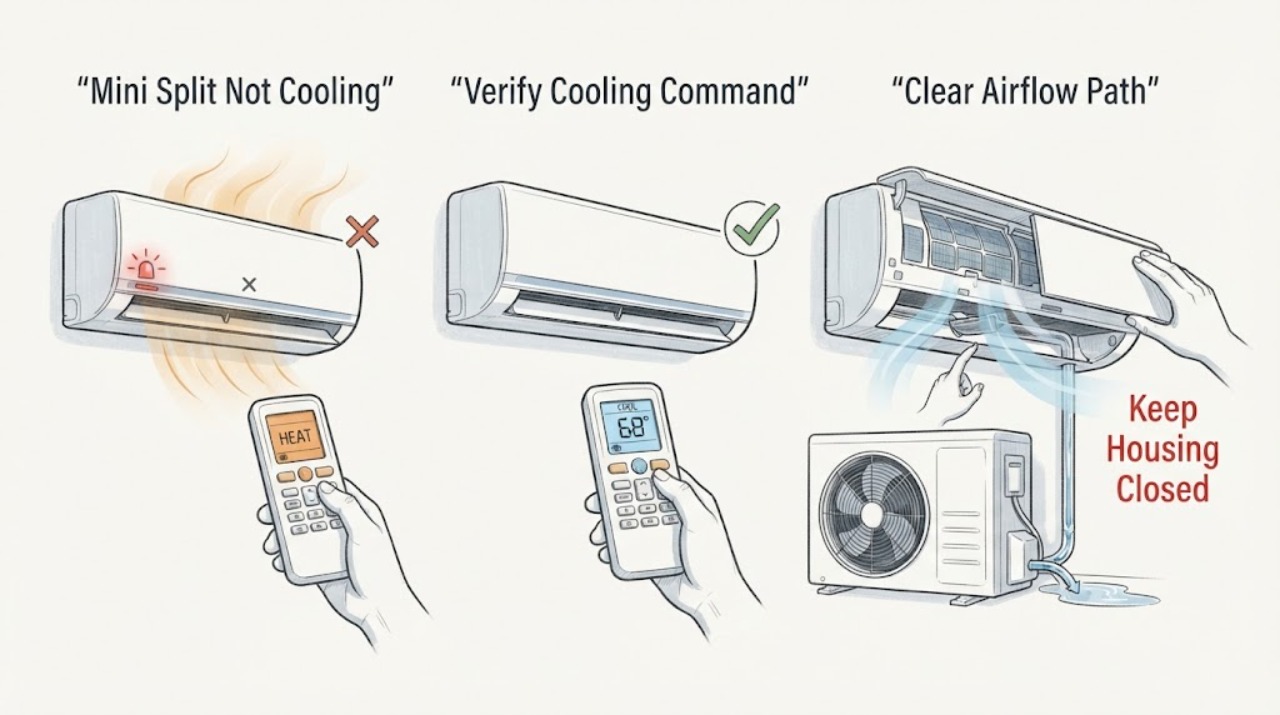
When a Daikin mini split runs but does not cool, first confirm that the remote is in cooling mode with a set temperature below the room temperature, then check the indoor filter and both indoor and outdoor air paths for visible blockage. Daikin's troubleshooting guidance lists incorrect mode or temperature, airflow direction or quantity, dirty filters, blocked indoor or outdoor inlets and outlets, open windows or doors, and ventilation as initial checks. If the unit has weak or no airflow, ice, water leaking indoors, an error indication, unusual noise, a repeatedly tripping breaker, or a clean filter and clear air path do not restore cooling, stop experimenting and arrange qualified HVAC service. Do not open sealed refrigerant lines, remove electrical covers, or assume that a low-charge, compressor, board, or sensor part is the cause from warm air alone.
Before you begin
Safety first
- This article supports ordinary remote checks, safe visual inspection, user-accessible filter care, and documentation. It does not authorize electrical or refrigerant work, panel removal, climbing, coil repair, or safety-control bypass.
Work through in order
Diagnostic checks
Use only checks that match the exact appliance or system and its official guide.
-
Check 1
Using the Daikin remote from a normal standing position, confirm that the unit is commanded to cool, the target temperature is below the room temperature, fan quantity is not unintentionally minimized, and the air direction is aimed into the room; do not change service settings.
Expected result: Record the selected mode, target setting, fan setting, vane direction, timer or schedule state, operation lamp state, and whether the indoor unit responds to a normal command.
Next step: Correct only the ordinary remote setting described in the owner's manual, allow the unit to operate normally, and note whether the delivered air becomes cooler; do not repeatedly switch modes to force a response.
Stop if: Stop if the unit shows an error indication, emits a burning odor or unusual noise, or the controls behave unpredictably; arrange qualified service.
Why this matters
Why: A fan, dry, auto, timer, or unsuitable target setting can explain warm air without a failed refrigeration circuit. If the unit ignores the remote, the lamp flashes, or the mode is correct but cooling remains absent, continue to airflow and service checks rather than changing hidden settings.
-
Check 2
With the mini split stopped and only the user-accessible cover or filter described in the manual, inspect the indoor filter and visible air inlet and outlet for dust, lint, furniture, curtains, or other blockage; clean or reinstall the filter only by the model instructions.
Expected result: Classify the filter and indoor path as clean and clear, visibly dirty, wet or damaged, incorrectly seated, or inaccessible without removing panels; record whether airflow is weak, uneven, or normal.
Next step: Restore only the filter and cover positions allowed by the manual, then retest once; if airflow remains weak or cooling is still absent, request service with the filter condition and result.
Stop if: Do not spray cleaner into the indoor unit, reach into the fan or coil, remove electrical covers, or operate the system with a loose or damaged filter.
Why this matters
Why: A dirty or badly seated filter or blocked grille can reduce airflow and cooling delivery. A wet or damaged filter, normal airflow with warm air, or anything requiring panel removal points beyond ordinary maintenance and does not identify a refrigerant or electrical part.
-
Check 3
From ground level and without opening the outdoor unit, inspect the visible outdoor air inlet and outlet for leaves, stored items, snow, fencing, or an enclosure that restricts airflow; also note whether the outdoor fan starts when cooling is commanded.
Expected result: Record the outdoor path as clear, visibly blocked, enclosed, heavily soiled, inaccessible, or associated with no outdoor-unit response; note any unusual sound, ice, smoke, or water without touching the unit.
Next step: Remove only loose objects that are safely reachable without moving the unit or entering a restricted area, then retest once; request service for inaccessible blockage, no outdoor response, abnormal operation, or continuing warm air.
Stop if: Do not climb, move the condenser, bend coil fins, open a service panel, touch wiring, or handle refrigerant piping or valves.
Why this matters
Why: A blocked outdoor path can reduce heat rejection and cooling performance, while no fan response, abnormal sound, ice, or a damaged enclosure requires professional diagnosis. A clear path does not rule out a refrigerant, fan, sensor, control, or compressor issue.
-
Check 4
Observe the system and room pattern during one normal cooling call: compare the airflow from the indoor head, the outdoor-unit response, room doors and windows, and whether other indoor heads in a multi-split system respond normally; do not add refrigerant or change wiring.
Expected result: Record whether one zone is warm while another cools, all zones are warm, airflow is weak or normal, doors or windows are open, the operation lamp flashes, the system stops and restarts, or the outdoor unit remains silent.
Next step: Close doors and windows and restore ordinary settings only if safe, then document the pattern; if cooling remains absent, arrange service with the zone pattern and indicator behavior.
Stop if: Stop if the system trips a breaker, leaks water indoors, develops ice, smells burnt, makes abnormal noise, or cycles in an uncontrolled way.
Why this matters
Why: A single-zone problem can focus attention on that indoor unit, filter, sensor, fan, or zone connection. All zones warm or a silent outdoor unit points toward a shared power, control, outdoor, or refrigeration issue; open windows or a large heat load can reduce comfort but do not explain a fault indication or repeated shutdown.
-
Check 5
Read any visible error code or flashing-lamp pattern from the remote or indoor unit without opening the equipment, and collect the model number, recent outage or installation history, filter result, airflow result, and outdoor response for the service request.
Expected result: Record the exact code or lamp pattern, whether it clears or returns, which zones are affected, whether cooling stopped suddenly or gradually, and whether water, ice, noise, or a breaker event occurred.
Next step: Keep the system off when the manufacturer directs it and provide the complete record to a qualified Daikin-capable HVAC professional; do not continue resets while the fault returns.
Stop if: Do not connect gauges, open refrigerant lines, remove covers, probe energized parts, bypass a safety control, or select a replacement part from a code alone.
Why this matters
Why: A model-specific code or recurring lamp pattern can narrow diagnosis, but the code alone does not authorize replacing a board, sensor, fan, compressor, or refrigerant component. A returning fault or a system that cannot cool after the safe checks is a service condition.
Use your observations
Decision map
Find the observation that best matches what you see, then follow the next safe action.
-
PATH 01Safety boundary
What you see
The remote was not in cooling or had an unsuitable target, or the filter or visible indoor/outdoor air path was dirty or blocked, and the unit responds normally after the ordinary correction.
Do this next
Use the manual's normal settings and maintenance procedure, then monitor one ordinary cooling call. If cooling remains poor, move to service rather than repeating adjustments.
Why this path and its safety boundary
Why it matters: The symptom is plausibly caused by a command or airflow restriction rather than a confirmed refrigeration failure.
Safety stop: Do not remove panels, spray inside the unit, or force a fan, vane, filter, or grille.
-
PATH 02Safety boundary
What you see
The correct cooling command is confirmed, the filters and visible air paths are clear, airflow is normal, but the air remains warm or the room does not cool.
Do this next
Stop homeowner troubleshooting and arrange qualified HVAC diagnosis with the model, zone pattern, outdoor response, and any code or lamp information.
Why this path and its safety boundary
Why it matters: The cause is no longer a simple user setting or visible blockage. Refrigerant circuit, outdoor heat rejection, fan, sensor, control, or capacity/installation issues remain possible and cannot be distinguished safely from the symptom alone.
Safety stop: Do not add refrigerant, open sealed piping, bypass controls, or replace a compressor, board, sensor, or fan without model-specific professional diagnosis.
-
PATH 03Safety boundary
What you see
Airflow is weak, the filter is wet or heavily dirty, ice is visible, or water is leaking from the indoor unit.
Do this next
Stop cooling, protect the floor from water, follow only the model's safe shutdown guidance, and request qualified service; do not scrape ice or reach into the unit.
Why this path and its safety boundary
Why it matters: The system may have restricted airflow, condensate or drain trouble, coil freeze protection, or another fault. Continuing to run it can damage the home or equipment.
Safety stop: Do not keep restarting, use a heat source to thaw the coil, remove panels, or spray the coil or drain with an unapproved product.
-
PATH 04Safety boundary
What you see
A code or flashing lamp returns, the outdoor unit does not respond, the system makes an abnormal sound, smells burnt, cycles unpredictably, or trips a breaker.
Do this next
Leave the system off as directed by Daikin, keep clear of exposed equipment, and arrange qualified service with the exact indication and event history.
Why this path and its safety boundary
Why it matters: This is an unresolved equipment or electrical-control symptom, not a filter-only problem. A safety device may be stopping operation or a component may be failing.
Safety stop: Do not reset repeatedly, open the electrical compartment, touch wiring, bypass a safety device, or keep operating after a breaker trips.
Helpful context
Understand the symptom
Start with the command the mini split is receiving
A mini split can blow room-temperature air when it is in fan, dry, auto, or a heating-related mode, when the target is already met, or when the set temperature and airflow direction do not call for the cooling you expect. Daikin's homeowner troubleshooting list starts with the remote setting, air quantity and direction, clean filters, blocked indoor or outdoor air paths, and the condition of doors and windows. These checks are useful because they change the next decision without opening the equipment.
Separate weak airflow from air that flows but is not cold
A visibly dirty filter or blocked grille can reduce the air delivered into the room. The U.S. Department of Energy explains that a clogged filter restricts airflow and reduces cooling effectiveness, and Daikin says to clean the indoor filter when indicated and keep indoor and outdoor inlets and outlets clear. If airflow is normal but the air remains warm after the settings and air paths are correct, the problem moves away from a simple filter check and toward system diagnosis.
Ice, water, errors, and breaker behavior change the safety boundary
Ice on the indoor coil or piping, water from the indoor unit, a flashing indicator or error display, unusual noise, and a breaker that trips are not invitations to keep restarting the system. Daikin advises refraining from use when indoor-unit water leakage could damage the home and contacting service for persistent trouble or abnormal operation. Refrigerant, electrical, sensor, fan, and control work requires the appropriate trained professional and model information.
Safety boundary
Stop conditions
- Stop using the mini split for indoor water leakage, visible ice, a burning odor, smoke, abnormal noise, uncontrolled operation, or a breaker that trips again.
- Do not open electrical covers, touch wiring, connect refrigerant gauges, open sealed refrigerant lines, add refrigerant, or bypass a safety control.
- Do not climb or move the outdoor unit, bend coil fins, scrape ice, spray cleaner into the indoor unit, or keep restarting a returning fault.
- If the correct cooling command, clean filter, and clear visible air paths do not restore cooling, arrange qualified HVAC service and provide the model, zone pattern, lamp or code indication, and observations.
Only after diagnosis
Potential parts
- mini-split air filter
Consider this category only if the exact model's maintenance instructions identify a missing, damaged, or non-cleanable filter after the airflow check.
Confirm the exact Daikin indoor-unit model and filter dimensions or manufacturer fit information before ordering; a dirty filter should be cleaned only as directed. - indoor-unit temperature sensor
Consider this category only if qualified diagnosis and the model service information identify a sensor fault after settings and airflow are confirmed.
Sensor type, connector, and placement are model-specific; do not select or replace one from warm air alone. - indoor-unit fan motor or control assembly
Consider this category only when the indoor fan or control is professionally diagnosed as the cause of weak or absent airflow with a clean filter and clear grille.
Verify the exact indoor-unit model, revision, electrical specification, and approved replacement information before any service.
When checks do not resolve it
Need a professional?
Arrange qualified HVAC service when the mini split remains warm after the correct cooling setting and safe filter or airflow checks, when airflow is weak, the outdoor unit does not respond, an error indication returns, or ice, water, abnormal noise, burnt odor, or breaker operation appears. Keep the unit off for unsafe symptoms and provide the model number, affected zone, settings, filter condition, outdoor response, and event history.
Safety scope: This article supports ordinary remote checks, safe visual inspection, user-accessible filter care, and documentation. It does not authorize electrical or refrigerant work, panel removal, climbing, coil repair, or safety-control bypass.
Common questions
FAQ
Why is my Daikin mini split running but not cooling?
Start by confirming cooling mode, target setting, fan and vane settings, then check the indoor filter and visible indoor and outdoor air paths. If those are correct and air remains warm, service may be needed for a fan, sensor, control, outdoor, drain, installation, or refrigeration issue.
Can a dirty filter make a Daikin mini split stop cooling?
A dirty filter can restrict airflow and reduce cooling delivery. Clean or reinstall only the user-accessible filter and only as the exact model manual directs; weak airflow after that check needs qualified diagnosis.
Should the outdoor unit run when a Daikin mini split is cooling?
The outdoor unit's response is useful information, but do not open it or touch its wiring. A silent outdoor unit, abnormal sound, or no cooling with clear air paths should be reported to a qualified HVAC professional with the model and indicator details.
Can I add refrigerant if my Daikin mini split blows warm air?
No. Warm air does not prove a low charge, leak, or compressor fault. Refrigerant diagnosis and sealed-system work require qualified service and model-specific information; do not open the circuit or add refrigerant by guesswork.
When should I stop using the mini split and call for service?
Stop for indoor water leakage, visible ice, a burnt odor, abnormal noise, a returning error or flashing lamp, uncontrolled operation, or a breaker that trips. Arrange service for persistent warm air after the correct setting and safe filter or airflow checks.
Read the exact guide
Official sources
- HVAC Proper Installation of FiltersU.S. Department of Energy Building Science Education · DOE guidance primarily describes ducted air handlers; it supports the general airflow effect of a dirty filter, while the Daikin manual controls mini-split filter care.
- Following Symptoms are not Air Conditioner TroublesDaikin Comfort · Opened Daikin Comfort operating manual; the exact unit's operation manual and regional configuration control.
- HomeCooling101U.S. Department of Energy · U.S. Department of Energy consumer cooling guidance; it is general information and does not replace Daikin model instructions.
- TroubleshootingDaikin Global · Daikin manufacturer guidance for residential split and multi-split systems; controls and procedures vary by model and region.
Community feedback
Share a repair observation
Share a plain-text repair observation. Accepted observations are published automatically; this page may take a moment to update.