
On this page
Start here
Quick answer
An air conditioner that will not start may have a thermostat or power problem, restricted airflow, a frozen evaporator coil, a condensate safety shutdown, or a professional-level electrical or refrigerant fault. Check the thermostat call, accessible filter, clear registers and return, visible breaker or service-switch state, and any ice or water you can see without opening the equipment. If ice is present, switch the system off at the thermostat and do not chip it or keep restarting the AC. Do not open the coil cabinet, touch wiring, test voltage, handle refrigerant, or replace a high-voltage part; arrange HVAC service if the system remains off or any safety warning appears.
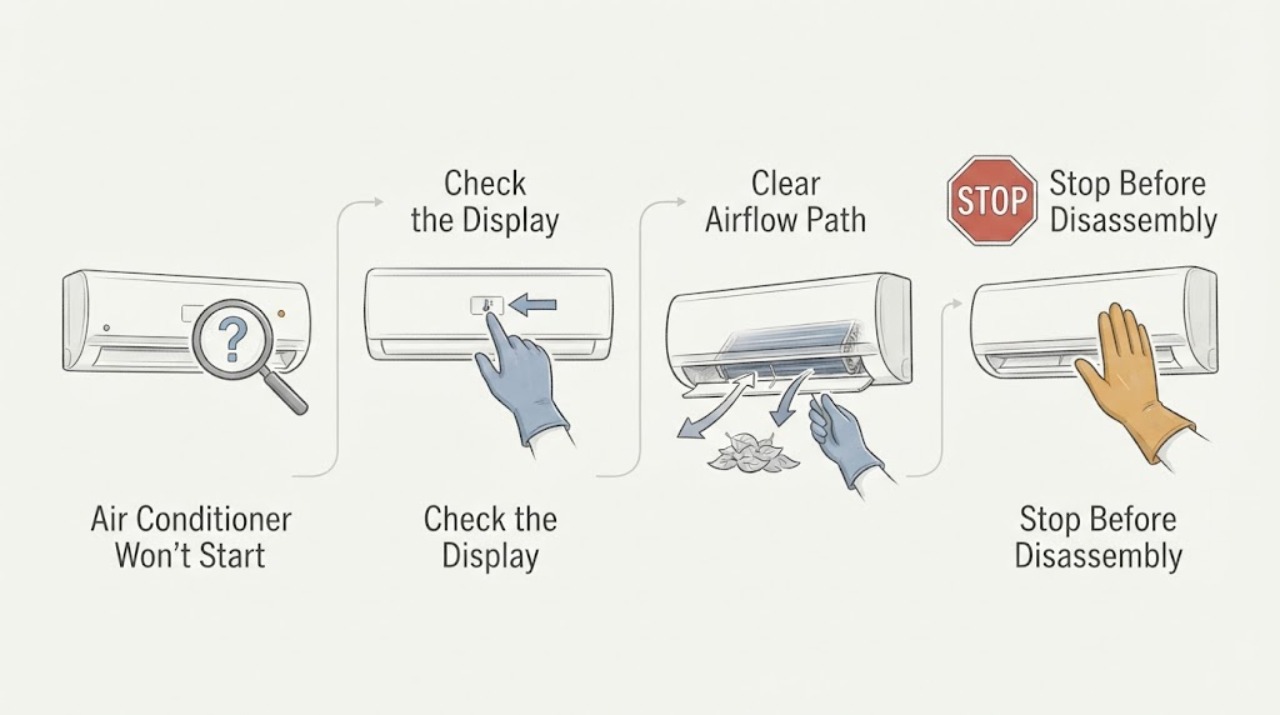
Work through in order
Diagnostic checks
Use only checks that match the exact appliance or system and its official guide.
-
Check 1
Check the thermostat display and normal settings without removing it. Confirm whether the system is set to Cool or Auto, whether the setpoint calls for cooling, and whether the display shows an alert, delay, or no response.
Expected result: Record a valid cooling call, no cooling call, a blank display, or an alert/delay. Do not change installer settings or attempt a wiring check.
Next step: Correct only an obvious user setting. If a valid call still produces no start, continue with the external airflow and power observations.
Why this matters
Why: A missing cooling call or thermostat power issue can mimic a no-start AC. A valid call with no airflow or no outdoor response makes the equipment path more relevant.
-
Check 2
Inspect the user-accessible air filter and the supply registers and return grille. Replace the filter only if the equipment instructions provide a safe access point and specify the correct type and airflow direction; do not open the air handler.
Expected result: Record a loaded or collapsed filter, blocked return, closed registers, or normal accessible airflow paths. A clean filter does not prove that the evaporator coil is clean or that the blower works.
Next step: Remove only an obvious external obstruction or change an accessible filter as instructed. If airflow remains absent or ice is visible, stop and arrange HVAC service.
Why this matters
Why: Restricted airflow can contribute to coil icing, overheating, weak airflow, and protective shutdown. A single blocked register is different from no airflow at every register.
-
Check 3
From a safe position outside the electrical panel, read the visible breaker or indicator labeled for the air conditioner, air handler, furnace, or heat pump. Look for a clearly labeled indoor service switch without opening the equipment cabinet.
Expected result: Record on, off, or tripped-looking status. Note heat, discoloration, buzzing, burning odor, smoke, water, exposed parts, or a breaker that has already tripped again without touching the installation.
Next step: Only when dry and free of warning signs, follow the model instructions for no more than one normal user reset. If it trips again or the AC remains off, leave it alone and call HVAC service.
Why this matters
Why: An external power interruption can stop the AC and prevent a coil-related cooling cycle. A normal-looking breaker does not prove that the coil, blower, transformer, control, or refrigerant circuit is healthy.
-
Check 4
Look through safe, already-open viewing areas or at accessible refrigerant lines and the floor below the air handler for visible frost, ice, dripping water, or a puddle. Do not remove a coil cover, reach inside, scrape ice, or touch an unfamiliar pipe.
Expected result: Record no ice/water, localized frost, extensive icing, or water below the indoor unit. Note whether the system was blowing weak or warm air before it stopped.
Next step: If ice is present, switch the thermostat to Off and arrange HVAC service; do not run the AC to speed testing or chip the ice. If water is near electrical equipment, keep clear and stop.
Why this matters
Why: Visible icing supports a frozen-coil path that can be related to airflow, blower operation, coil condition, thermostat behavior, or refrigerant. Water may follow thawing or a condensate problem. Neither observation proves a refrigerant leak.
-
Check 5
During one normal cooling call, observe airflow at several registers and the outdoor condenser from a safe distance. Do not remove grilles, touch a fan, or deliberately cycle the system to reproduce the failure.
Expected result: Record indoor airflow with no outdoor response, outdoor response with no indoor airflow, weak airflow everywhere, or no response at either unit.
Next step: Give the comparison to the technician and leave high-voltage, motor, control, coil, and refrigerant checks to HVAC service.
Why this matters
Why: Outdoor operation with no indoor airflow points toward the air-handler/blower path, airflow restriction, frozen coil, or indoor control. No response at both units suggests a broader thermostat, power, safety, or control issue. This comparison does not diagnose the coil.
-
Check 6
Listen from a safe distance for normal startup, silence, humming, repeated attempts, or unusual noise, and note any service-light or app message. Do not approach a hot, wet, smoking, or arcing unit.
Expected result: Record whether the indoor or outdoor unit is silent, hums without airflow, starts and stops, or makes grinding or other abnormal sounds. Record any burning smell, heat, smoke, or electrical odor.
Next step: For abnormal noise, heat, odor, smoke, or repeated starting, turn the system off at the normal control if safe and arrange HVAC service. Do not open the unit or repeat the start attempt.
Why this matters
Why: The sound and response pattern can help separate power/control symptoms from blower, motor, capacitor, frozen-coil, or compressor symptoms. Humming or heat is not a safe invitation to test a capacitor or motor.
-
Check 7
Prepare a service note with thermostat state, filter and register observations, visible breaker/switch state, airflow pattern, indoor/outdoor response, ice or water location, timing, and any sound or odor.
Expected result: A precise record shows whether the complaint is a true no-start, an indoor airflow failure, a frozen-coil symptom, or a broader power/control event.
Next step: Request HVAC service and keep the system off when ice, water near electrical equipment, smoke, heat, odor, or a repeated breaker trip is present.
Why this matters
Why: If the AC remains off after the safe checks, the next useful step is professional diagnosis of the evaporator coil, drain, blower, controls, electrical supply, and refrigerant circuit.
Use your observations
Decision map
Find the observation that best matches what you see, then follow the next safe action.
-
PATH 01Safety boundary
What you see
Do this next
Correct only an obvious user setting or documented battery issue. If the display or call does not return, report a thermostat/power/control symptom before assuming an evaporator-coil fault.
Why this path and its safety boundary
Safety stop: Continue with airflow, ice, water, and visible power observations.
-
PATH 02Safety boundary
What you see
Do this next
Change only an accessible, model-approved filter and remove only an external obstruction. If airflow remains weak or absent, arrange HVAC service for the blower, coil, controls, or airflow path.
Why this path and its safety boundary
Safety stop: Continue with the visible ice/water and indoor/outdoor response checks.
-
PATH 03Safety boundary
What you see
Do this next
Switch the thermostat to Off and arrange HVAC service. Do not chip ice, use direct heat, open the coil cabinet, or keep starting the system; airflow and refrigerant causes require professional diagnosis.
Why this path and its safety boundary
Safety stop: A no-start condition can still be electrical, control, blower, or outdoor-unit related; continue only with safe external observations.
-
PATH 04Safety boundary
What you see
Do this next
Stop using the system and keep clear of wet electrical areas. Arrange HVAC service for the condensate and coil path; do not open the cabinet or touch wet equipment.
Why this path and its safety boundary
Safety stop: Continue with the airflow and power comparison and include the dry result in the service note.
-
PATH 05Safety boundary
What you see
Do this next
Stop immediately. Turn the system off using a normal control only if safe, keep people away, and obtain qualified HVAC/electrical service. Do not reset repeatedly or open the equipment.
Why this path and its safety boundary
Safety stop: If the AC still will not start after safe checks, schedule professional diagnosis rather than replacing a coil, motor, capacitor, or refrigerant component by guesswork.
Helpful context
Understand the symptom
A no-start symptom does not prove the evaporator coil failed
The evaporator coil is inside the indoor air handler and works with the rest of the refrigeration cycle. A thermostat that is off, a tripped breaker, a blocked filter, a stopped blower, a condensate safety event, a frozen coil, or an outdoor-unit fault can all prevent normal cooling. The most useful safe distinction is whether the thermostat is calling, whether air moves at the registers, whether ice or water is visible, and whether the outdoor unit responds. Those observations narrow the service path but do not identify the coil or refrigerant charge by themselves.
Treat ice and water as stop signals
Ice on the refrigerant lines, coil cabinet, or visible indoor tubing can indicate restricted airflow, a dirty coil, a blower problem, or low refrigerant. Water below the air handler can follow thawing or a condensate problem. Turn the system off at the thermostat when ice is visible, do not chip or scrape it, and do not open the cabinet to inspect the coil. A technician must evaluate the coil, airflow, drain and refrigerant circuit.
Safety boundary
Stop conditions
- Stop immediately for smoke, sparks, arcing, burning smell, hot or discolored equipment, shock, exposed wiring, or a breaker that trips again.
- Stop for ice, frost, dripping water, or a puddle near electrical equipment; turn the thermostat off and do not chip ice, use direct heat, or continue running the system.
- Do not open the evaporator-coil cabinet, air handler, electrical panel, or disconnect; do not touch wiring, motors, capacitors, refrigerant lines, or coil fins, and do not measure live voltage or refrigerant pressure.
- Do not bypass a condensate safety, repeatedly reset a breaker, deliberately recreate a no-start, or use a guessed replacement part.
When checks do not resolve it
Need a professional?
Call a qualified HVAC technician when the air conditioner remains off after safe thermostat, filter, airflow, and visible power checks; when ice or water is present; when indoor and outdoor responses disagree; or when a blower, coil, control, electrical, or refrigerant fault is suspected.
Common questions
FAQ
Can a frozen evaporator coil make an air conditioner seem unable to start?
Yes. A frozen coil can accompany restricted airflow, a blower problem, thermostat issues, or low refrigerant and can lead to a protective or no-cooling symptom. If you see ice, switch the thermostat off, do not chip it, and arrange HVAC service.
What can I check before calling HVAC service?
Check the thermostat call and mode, an accessible filter, clear registers and return, the visible breaker or service-switch state, and any ice or water from a safe distance. Do not open the coil cabinet, touch wiring, measure voltage, or handle refrigerant.
Should I run the AC to melt an iced evaporator coil?
No. Switch the system off at the thermostat and let a qualified HVAC technician diagnose it. Do not chip the ice or use direct heat; the cause may be airflow, blower, coil, thermostat, or refrigerant related.
Does a clean filter prove the evaporator coil is good?
No. A clean filter removes one possible airflow restriction but does not prove the coil, blower, drain, control, electrical supply, or refrigerant circuit is healthy. Persistent no-start, no-airflow, ice, or water needs professional diagnosis.
Read the exact guide
Official sources
- AC Unit Not Turning On: Reasons Why And What To DoCarrier · Carrier residential AC no-start causes, blower-motor symptoms, filter/power checks, and professional escalation.
- Why Is My Air Handler Freezing Up?Trane · Trane residential air-handler frozen-coil symptoms, safe shutdown, airflow causes, water, and refrigerant-service boundaries.
- Troubleshoot an AC Not WorkingCarrier · Carrier residential AC no-start troubleshooting for thermostat, filter, breaker, airflow, frozen evaporator coil, and high-voltage service boundaries.
- Coils Troubleshooting GuideTrane · Trane residential HVAC coil troubleshooting, including no cooling, frozen evaporator coil, airflow, water, and professional service boundaries.
Community feedback
Share a repair observation
Share a plain-text repair observation. Accepted observations are published automatically; this page may take a moment to update.