
On this page
Start here
Quick answer
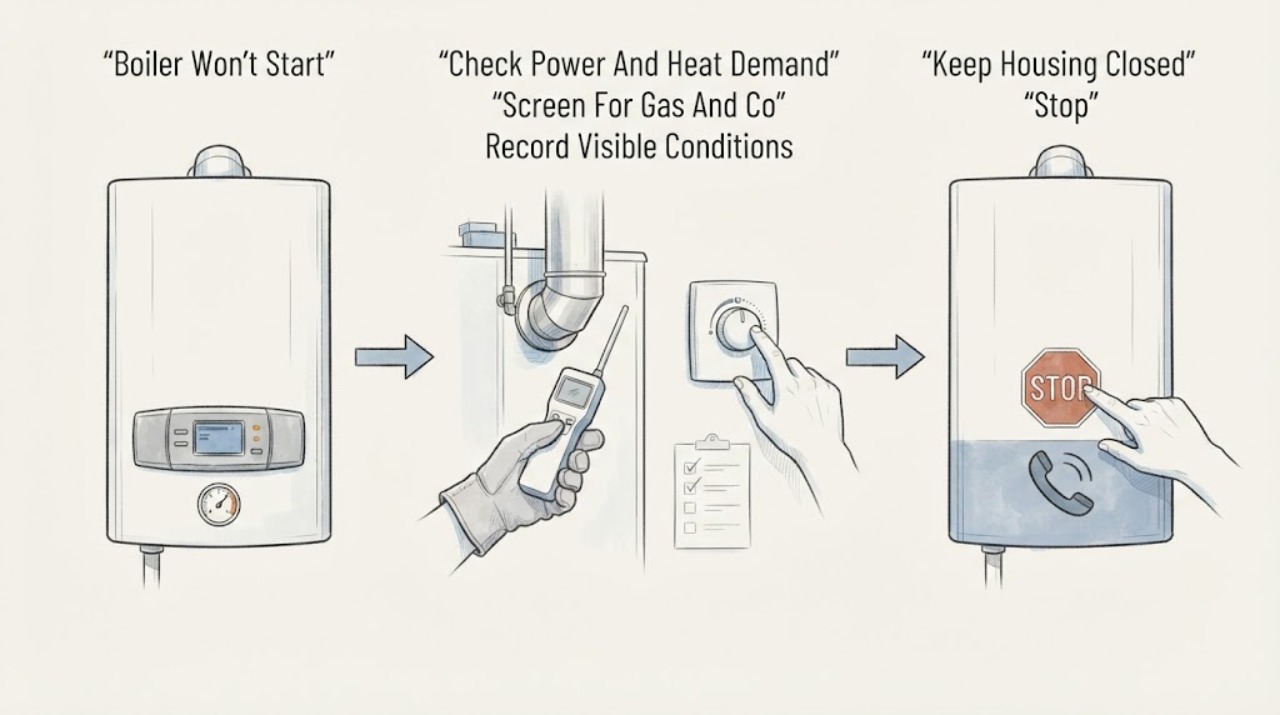
If a boiler will not start, first check for a gas odor, carbon-monoxide alarm, smoke, unusual combustion noise, or illness; leave immediately and contact emergency help for a gas or CO warning. If the area is safe, record whether the boiler display has power, whether the programmer or thermostat is asking for heat, whether the fuel supply is available without operating a suspected leak, and what error code or lockout is shown. A pressure gauge that is outside the range stated in the exact manual, rapid pressure loss, a frozen or blocked condensate path, or a repeated lockout needs qualified boiler service. You may perform only the user-level reset or other minor check specified by the exact model manual, once. Worcester Bosch and Vaillant both warn that recurring lockouts or unresolved faults need an appropriately qualified engineer; do not remove the boiler cover, test gas pressure, adjust a gas valve, relight repeatedly, or work on the burner, ignition, flue, or safety controls yourself.
Before you begin
Safety first
- This article supports external observation, reading user-accessible controls and gauges, correcting an obvious schedule or thermostat setting, and one exact-manual reset. Boiler-cover, wiring, gas supply, burner, ignition, pressure, combustion, flue, condensate, pump, and safety-control work require qualified professionals.
Work through in order
Diagnostic checks
Use only checks that match the exact appliance or system and its official guide.
-
Check 1
Before touching controls, check from outside the boiler area for a gas odor, CO alarm, smoke, unusual combustion noise, visible flame abnormality, or anyone with headache, dizziness, nausea, weakness, or breathing difficulty; do not enter or operate controls to confirm a suspected hazard.
Expected result: Record no warning signs, a gas odor or suspected leak, a CO alarm or symptoms, smoke or fire, or an abnormal sound without approaching the appliance.
Next step: For a gas or CO warning, leave immediately, keep others out, and contact emergency or gas-safety services from a safe location; for smoke or fire, contact emergency responders. Resume boiler checks only after clearance.
Stop if: Do not switch lights, use flames, operate the boiler, silence an alarm, open the boiler cover, or re-enter to locate a leak or source.
Why this matters
Why: A gas or combustion warning changes the task from troubleshooting to emergency response. A boiler that will not start may be in a safety lockout, and an odor or CO warning must not be treated as a simple reset issue.
-
Check 2
If the area is safe, check the boiler display or power indicator, the normal operating switch, programmer or timer schedule, and room thermostat or hot-water demand from user-accessible controls; do not remove a cover or touch wiring.
Expected result: Classify the boiler as powered with a heat demand, powered with no demand, completely dark, or showing a lockout or error indication.
Next step: Restore only an obviously incorrect user setting if the manual allows it; if power is absent, a protective device has tripped, or a fault is displayed, stop and arrange qualified electrical or boiler service.
Stop if: Do not repeatedly reset a breaker or fuse, alter thermostat wiring, open the electrical enclosure, or operate the boiler with smoke, odor, a damaged cord, or water near electrics.
Why this matters
Why: A powered boiler with no demand may simply be waiting for a programmer or thermostat request. A dark display may indicate supply loss or a boiler fault, while a lockout or error requires the exact code and manual rather than a guessed component.
-
Check 3
Read the complete display or lockout code and the external pressure gauge from the normal viewing position, then compare them with the exact boiler manual; do not remove the boiler cover or manipulate a filling loop merely to make the boiler start.
Expected result: Record a normal pressure indication, pressure outside the manual's range, rapid pressure loss, a lockout or ignition code, a fan or flue-related code, or an unlisted display.
Next step: Follow only the manual's low-risk user instruction for the exact code; arrange a qualified engineer for abnormal or changing pressure, an unlisted or recurring code, or any need to adjust gas, water, combustion, or flue components.
Stop if: Do not test gas pressure, open the boiler cover, adjust a valve, remove a flue, repeatedly repressurize, or continue using the system when pressure is rapidly falling or water is leaking.
Why this matters
Why: Low or high pressure, pressure loss, ignition failure, blocked condensate or flue conditions, and electronics faults can each prevent a boiler from starting. The same symptom can have different causes by model, so the code and trend are more useful than a guessed part.
-
Check 4
Without opening the boiler, note whether other gas appliances work only when there is no gas odor, whether the property has water, whether an external condensate pipe is visibly frozen or obstructed in cold weather, and whether the boiler has recently lost pressure or made an unusual sound.
Expected result: Classify the context as whole-property gas or water issue, boiler-only lockout, possible visible condensate blockage, pressure loss or leak, or no clear external cause.
Next step: Contact the relevant utility or qualified boiler engineer for a supply issue, pressure loss, condensate or flue concern, or any uncertain condition; do not dismantle or force the external pipe or appliance.
Stop if: Do not thaw with a flame or heat tool, cut or disconnect a condensate pipe, touch gas fittings, remove a flue terminal, or continue operating when an odor, leak, or combustion concern appears.
Why this matters
Why: Vaillant says other gas appliances can help distinguish a supply issue, while water pressure, condensate, fan, and flue conditions can stop ignition. These observations narrow the professional assessment but do not prove that a valve, burner, sensor, or pipe is defective.
-
Check 5
Only after the safety screen is clear and the exact manual identifies a user reset for the displayed fault, press the normal reset control for the manual's stated duration once; do not hold it longer or repeat it to force ignition.
Expected result: Record whether the lockout clears and the boiler fires, the code disappears but heating remains unavailable, or the code returns or the boiler locks out again.
Next step: If the boiler does not start or the fault returns, keep it out of service and arrange a qualified boiler or gas engineer; provide the code, pressure reading, demand setting, and reset result.
Stop if: Do not reset repeatedly, relight a pilot outside the exact manual, bypass a lockout, open the boiler cover, or work on ignition, burner, gas valve, flue, fan, pump, or safety controls.
Why this matters
Why: A one-time successful reset may clear a temporary fault, but a returning lockout indicates an unresolved issue. Vaillant warns that regular resets are not expected, and Worcester Bosch directs unresolved no-start conditions to an engineer.
Use your observations
Decision map
Find the observation that best matches what you see, then follow the next safe action.
-
PATH 01Safety boundary
What you see
There is a gas odor, CO alarm, smoke, abnormal combustion, or concerning symptoms.
Do this next
Leave immediately, keep people out, and contact emergency or gas-safety services from a safe location; do not return until cleared.
Why this path and its safety boundary
Why it matters: This is an immediate gas or combustion safety event, not a normal no-start diagnosis.
Safety stop: Do not operate switches, use flames, silence an alarm, open the boiler, or search for the leak or flue problem.
-
PATH 02Safety boundary
What you see
The boiler display is dark, or it has power but the programmer or thermostat is not requesting heat.
Do this next
Correct only an obvious user setting if safe and model-directed; use qualified electrical or boiler service for absent power, repeated protective-device trips, or a persistent no-demand response.
Why this path and its safety boundary
Why it matters: The no-start may be an external supply, schedule, thermostat, or control-state issue rather than an ignition failure.
Safety stop: Do not alter wiring, repeatedly reset a breaker, or open the boiler or electrical panel.
-
PATH 03Safety boundary
What you see
The gauge is outside the exact manual's normal range, pressure is falling, or water is visible around the boiler or heating system.
Do this next
Keep the boiler out of service and arrange qualified heating or boiler assessment; follow a pressure-top-up instruction only when the exact manual permits it and no leak is present.
Why this path and its safety boundary
Why it matters: Low or high pressure, a leak, expansion issue, or circulation fault may be preventing safe operation.
Safety stop: Do not repeatedly repressurize, open the boiler cover, remove safety components, or use the boiler while water is leaking or pressure is rapidly changing.
-
PATH 04Safety boundary
What you see
A visible external condensate pipe may be frozen or obstructed, or the display or sound suggests a fan or flue issue without a gas odor.
Do this next
Use only the exact model's external, low-risk guidance and arrange a qualified engineer if the boiler does not recover or the issue is uncertain.
Why this path and its safety boundary
Why it matters: Condensate drainage, combustion-air, or flue safety can prevent ignition and may require professional assessment.
Safety stop: Do not use a flame or heat tool, remove a flue, open the boiler cover, or continue operation with combustion odor, smoke, or a recurring lockout.
-
PATH 05Safety boundary
What you see
The boiler starts after one exact-manual reset and no gas, CO, pressure, leak, or abnormal-sound warning returns.
Do this next
Supervise one normal heating or hot-water demand and record the result; arrange service if the boiler locks out again or needs another reset.
Why this path and its safety boundary
Why it matters: A temporary lockout is possible, but a reset has not proven the underlying safety or combustion system healthy.
Safety stop: Do not treat repeated resetting, flame instability, pressure loss, or an unusual smell as normal operation.
-
PATH 06Safety boundary
What you see
The code is unlisted, the boiler remains off after the manual reset, the lockout returns, or the cause is not clear.
Do this next
Keep the boiler out of service and arrange qualified boiler or gas service with the model, code, pressure reading, demand state, and observations.
Why this path and its safety boundary
Why it matters: The fault may involve ignition, gas supply, fan or flue, controls, pressure, pump, sensor, or another model-specific safety system.
Safety stop: Do not guess a part, repeatedly reset, relight, adjust gas or pressure, or open the boiler cover.
Helpful context
Understand the symptom
Safety comes before the no-start diagnosis
A boiler can lock out to prevent unsafe operation, so a dark display or failed ignition is not permission to open the appliance. Worcester Bosch says a broken boiler should not be repaired by the homeowner and directs gas-leak concerns to emergency gas services. If there is a gas odor, CO alarm, smoke, or concerning symptoms, leave and obtain emergency guidance before any other check.
Separate missing demand from a boiler fault
If the boiler has power but no demand, the programmer, timer, room thermostat, or hot-water control may not be requesting heat. If other gas appliances also fail, the gas supply may be involved; if the boiler alone locks out, its displayed fault and model instructions matter. These observations can narrow the service call without touching the boiler cover or combustion parts.
Pressure, condensate, and flue observations have a professional boundary
A pressure gauge outside the model's normal range, repeated pressure loss, condensate blockage, fan or flue concerns, or repeated lockouts can all prevent ignition. Vaillant identifies several of these as reasons for an engineer, and Worcester Bosch says not to repair a broken boiler yourself. Read displays and visible gauges only; do not test combustion, gas pressure, flue draft, or internal safety devices.
Safety boundary
Stop conditions
- Leave immediately for a gas odor, CO alarm, smoke, abnormal combustion, or concerning symptoms; contact emergency or gas-safety services from a safe location.
- Do not remove the boiler cover, test gas pressure or combustion, adjust a gas valve, alter wiring, open a flue, or bypass ignition or safety controls.
- Do not relight repeatedly, repeatedly reset a lockout, use a flame or heat tool on condensate pipework, or continue operation with a leak, rapid pressure loss, or abnormal sound.
- Do not repeatedly repressurize or change a pressure setting; follow a top-up instruction only when the exact manual permits it and no leak is present.
- Arrange qualified boiler, gas, heating, or electrical service for an unlisted or returning fault, no power, failed demand, abnormal pressure, suspected condensate or flue issue, or any unresolved no-start condition.
When checks do not resolve it
Need a professional?
Contact emergency or gas-safety services immediately for a gas odor, CO alarm, smoke, abnormal combustion, or concerning symptoms. Arrange a qualified boiler or gas engineer for any recurring or unlisted lockout, failed reset, abnormal pressure or leak, condensate or flue concern, ignition issue, repeated need to reset, or no-start cause that remains uncertain. Use qualified electrical service for absent power or repeated protective-device trips.
Safety scope: This article supports external observation, reading user-accessible controls and gauges, correcting an obvious schedule or thermostat setting, and one exact-manual reset. Boiler-cover, wiring, gas supply, burner, ignition, pressure, combustion, flue, condensate, pump, and safety-control work require qualified professionals.
Common questions
FAQ
What should I check first when my boiler will not start?
First check for gas odor, a CO alarm, smoke, abnormal combustion, or symptoms and leave for emergency help if present. If safe, check the display, power, programmer or thermostat demand, and the complete error code. Use the exact manual for one reset and call a qualified engineer if the fault returns.
Can low boiler pressure stop it from starting?
Yes, pressure outside the exact model's normal range or pressure that keeps falling can prevent safe operation. Read the gauge without opening the boiler, check the manual, and arrange qualified service for a leak, rapid loss, high pressure, or a condition that does not resolve through an explicitly permitted user procedure.
How many times can I reset a boiler that will not start?
Use the exact manual's reset procedure once, then stop if the boiler does not start or the lockout returns. Vaillant says regular resets are not expected and persistent faults need a qualified engineer. Do not use repeated resets to bypass a safety lockout.
Can a frozen condensate pipe stop a boiler from igniting?
A blocked or frozen condensate path can be one model-dependent cause of an ignition lockout. Note only a visible external condition and follow the exact manual's low-risk guidance. Do not use a flame or heat tool, cut the pipe, open the boiler cover, or continue operating if the issue returns.
When does a boiler that will not start need an engineer?
Arrange qualified service for a recurring or unlisted code, failed reset, abnormal pressure, pressure loss or leak, ignition or gas-supply issue, fan or flue concern, repeated lockout, or any repair requiring the boiler cover, wiring, burner, gas valve, combustion system, or safety control. Leave immediately for a gas odor or CO warning.
Read the exact guide
Official sources
- Broken Boiler? What to do nextWorcester Bosch · Worcester Bosch homeowner guidance used for general boiler safety and external triage; the exact boiler model manual and local qualification rules control.
- How to reset a boilerVaillant · Vaillant homeowner guidance used for general boiler lockout logic; reset controls, pressure ranges, and minor fixes are model-specific.
- Boiler not igniting?Vaillant · Vaillant guidance for boiler ignition problems; it illustrates possible diagnostic branches without establishing a cause for an unidentified boiler.
Community feedback
Share a repair observation
Share a plain-text repair observation. Accepted observations are published automatically; this page may take a moment to update.